















Walk into almost any business today and you’ll notice something interesting: everything runs on software. Sales teams live inside CRMs. Operations rely on ERPs. HR uses separate systems for onboarding and payroll. Finance manages billing through another tool. Marketing jumps between analytics dashboards, email automation, and ad managers. Even smaller teams use ten or more tools without realizing it.
Individually, these systems work fine. The real trouble starts when they don’t talk to each other. That’s when data gets stuck in different places. Teams repeat the same work because one platform doesn’t know what the other has just updated. Reports take forever. Customer experiences become inconsistent. Somewhere, someone wrestles with a spreadsheet trying to make sense of numbers that should have aligned.
If this sounds familiar, you're not alone. Most modern businesses feel the strain of scattered systems. And this is exactly where Enterprise Application Integration—also known as Enterprise Application Integration (EAI)—becomes a game changer. This guide breaks down what enterprise application integration really is, why companies are embracing it now more than ever, how Enterprise Application Integration architecture works behind the scenes, which Enterprise Application Integration tools matter, and how to choose the right Enterprise Application Integration solution for your own organization.
When you're done reading, you'll know why companies that integrate maintain their competitiveness and why those that don't quickly lose ground.
What Is Enterprise Application Integration (EAI)?
It connects all your business tools and makes them communicate better. Instead of working in isolation, they sync up. With proper Enterprise Application Integration, information moves between systems without needing people to input data or export files all the time.
Picture it is happening without any extra effort:
- Your CRM updates flow instantly into your ERP
- Your mobile app displays real-time inventory from the backend
- Your HRMS sends payroll changes straight to your finance system
- Your analytics dashboard always shows the latest numbers
When these connections exist, the business feels synchronized. Without them, everything feels slightly out of tune.
A Simpler Way to Think About It:
Picture your business like the human body. Every department is an organ with a specific job. Even if each organ works perfectly, you only survive when there’s constant communication through the bloodstream.
EAI is that bloodstream. When data can’t move freely, the entire operation becomes sluggish. Decisions slow down. Errors appear out of nowhere. Departments become frustrated. And leadership has no real visibility into what’s happening. Enterprise Application Integration keeps your business alive, responsive, and coordinated.
Why EAI Matters More Now?
Digital tools exploded in the last decade. Companies adopted software faster than they could connect it. So instead of improving efficiency, technology created pockets of data scattered everywhere.
EAI fixes that by:
- Connecting systems that were never designed to communicate
- Standardizing data formats
- Automating workflows end-to-end
- Removing manual data entry
- Strengthening customer experience
- Giving leaders real-time insight
Once the ecosystem works as one, the entire business feels lighter, faster, and more predictable.
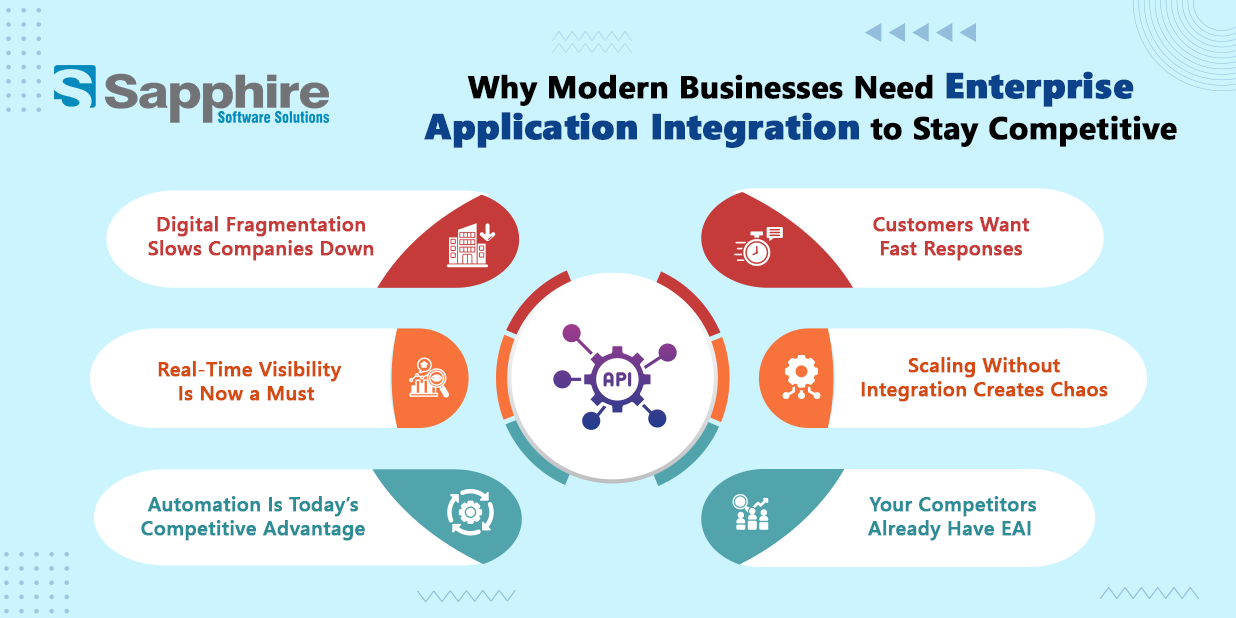
Why Modern Businesses Need Enterprise Application Integration to Stay Competitive?
In today’s landscape, having tools isn’t enough. Your competitive edge depends on how well these tools work together. Enterprise Application Integration is at the center of that.
Here’s why companies can’t ignore it:
1. Digital Fragmentation Slows Companies Down:
Most businesses use dozens—sometimes hundreds—of applications. When none of them sync properly:
- Data becomes unreliable
- Reports become painful to create
- Teams operate with partial information
- Customer service cracks under pressure
- Costs start rising quietly
Everything might look “fine” from a distance, but fragmentation slowly drains efficiency.
2. Real-Time Visibility Is Now a Must:
Leaders should not depend on old reports. They need to make decisions based on current events.
EAI enables:
- Live dashboards
- Up-to-date customer information
- Real-time inventory levels
- Instant syncing across workflows
Without integration, real-time visibility is impossible.
3. Automation Is Today’s Competitive Advantage:
Automation becomes powerful only when systems communicate reliably. With EAI:
- Approvals move faster
- Orders process automatically
- Notifications trigger on their own
- Billing updates without manual work
Companies that automate grow faster—and spend less doing it.
4. Customers Want Fast Responses:
Customers look for quick, accurate help on mobile apps, websites, and support platforms. You can deliver this if your backend systems work together.
If your inventory system doesn’t sync with your mobile app or your CRM doesn’t match your ERP, customers feel it immediately.
5. Scaling Without Integration Creates Chaos:
The larger a business becomes, the more complicated its tech environment gets. Without integration:
- New tools create more problems
- IT overhead increases
- Teams struggle to keep up
- Workflows break easily
Enterprise Application Integration lays a stable foundation for long-term growth.
6. Your Competitors Already Have EAI:
Across industries, market leaders—retail, logistics, eCommerce, banking, healthcare, SaaS—have already connected their systems. Integration is no longer a luxury. It’s the baseline.
If you want to compete, you can’t afford to fall behind.
How Enterprise Application Integration Architecture Works?
To understand integration properly, it helps to know what’s happening underneath the hood. Enterprise Application Integration architecture is the framework that makes everything run smoothly.
Components of EAI Architecture:
- Applications: Everything from your ERP and CRM to custom mobile apps and backend databases.
- Middleware: Acts like a translator. It makes systems built on different technologies understand one another.
- Data Models: Ensure all systems consistently interpret information.
- Integration Flows: Define what moves, when it moves, and why it moves.
- APIs: This is how modern systems communicate—fast, flexible, and efficient.
Types of Integration Approaches:
- Point-to-point: Direct but not scalable
- Hub-and-spoke: Centralized and easier to manage
- Enterprise Service Bus (ESB): Ideal for complex enterprise environments
- API-led integration: Lightweight and perfect for cloud ecosystems
How Data Flows?
A typical EAI flow looks like this:
- Data is generated in one application
- Middleware captures and transforms it
- Rules determine where it should go
- The destination system receives and processes it
- Automated actions trigger downstream
This creates the real-time experience businesses depend on.
Top Enterprise Application Integration Tools You Should Know
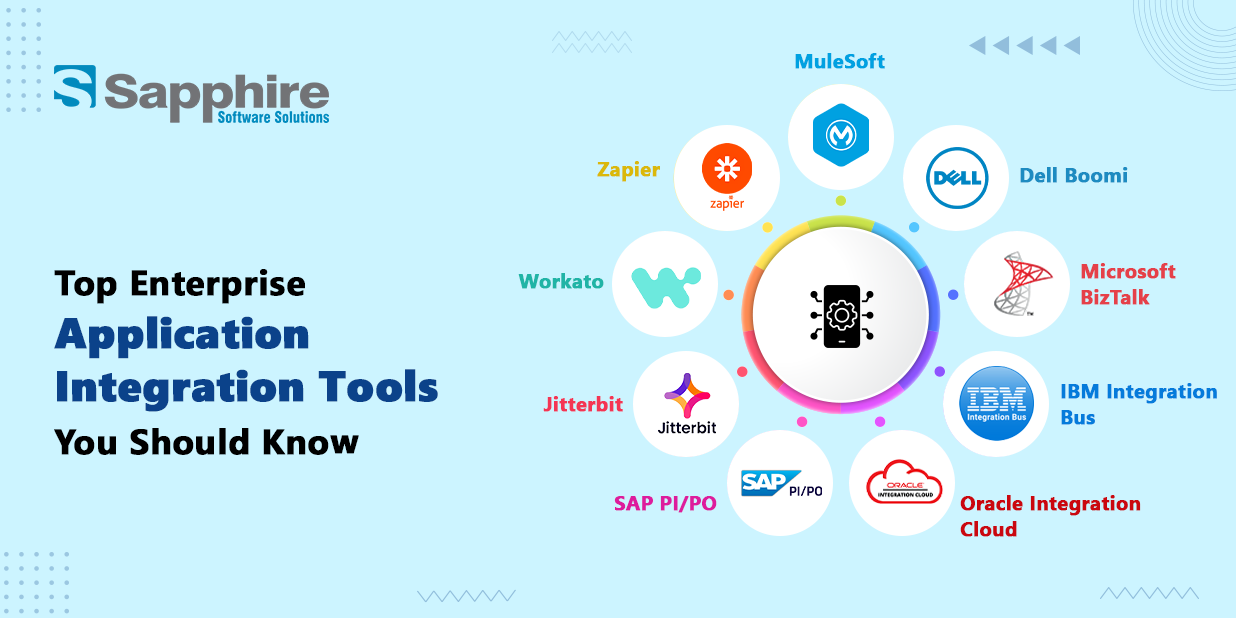
Choosing the right Enterprise Application Integration tools can make or break an integration project. Some widely adopted options include:
- MuleSoft
- Dell Boomi
- Microsoft BizTalk
- IBM Integration Bus
- Oracle Integration Cloud
- SAP PI/PO
- Jitterbit
- Workato
- Zapier (for lighter integrations)
The ideal tool depends on your scale, security needs, cloud environment, and budget.
Key Benefits of Implementing Enterprise Application Integration Services:
When EAI is done right, the Enterprise Application Integration benefits echo through the entire organization.
- Clean, Reliable Data: No more duplicates or outdated records.
- Higher Operational Efficiency: Automation handles repetitive tasks so teams can focus on meaningful work.
- Stronger Customer Experience: Agents have complete and current information—leading to faster, more accurate support.
- Simplified IT Management: One integrated ecosystem is easier to maintain and secure.
- Lower Costs: Reduced manual work and fewer redundant tools mean significant savings.
- Smooth Scalability: Growth becomes predictable instead of chaotic.
- Better Analytics: Real-time data leads to smarter, faster decisions.
Choosing the Right Enterprise Application Integration Solution for Your Business:
Choosing an Enterprise Application Integration solution takes time. Every business operates uniquely, faces specific challenges, and has goals to achieve in the future. This means businesses need to plan. The aim is to find a strategy—and the right Enterprise Application Integration Software or Enterprise Application Integration System - that supports your teams rather than complicating their work.
Here are some points you should think about before deciding:
- Your Current systems: List all tools, workflows, and pain points.
- Your Goals: Are you trying to improve reporting? Reduce errors? Automate workflows?
- The Right Architecture: API-led? ESB? Cloud-first?
- Security Requirements: Encryption, access control, compliance—this matters.
- Tool Capabilities: Evaluate scalability, usability, and cost.
- Expertise: EAI isn’t something you want to DIY. Partnering with experienced professionals leads to smoother outcomes.
Why Sapphire’s Enterprise Application Integration Services Are Essential for Competitive Advantage?
Sapphire Software Solutions delivers integration systems built for real-world business needs.
Why so many organizations trust Sapphire:
- Deep Integration Expertise: API-driven integration, ESB architectures, middleware development, and cloud-native strategies.
- Industry Experience: Healthcare, finance, retail, manufacturing, logistics, SaaS—you name it.
- Custom Integration Roadmaps: No generic solutions. Every roadmap is tailored to the business.
- Proven Results: Our integrations reduce error rates, speed up workflows, and create cleaner, more connected systems.
- Cross-Platform Integration: ERPs, CRMs, billing systems, mobile apps, payment gateways—everything can sync.
As a Mobile App Development Company in USA, we also make sure your mobile experience connects perfectly with backend systems and enterprise platforms.
Conclusion:
Companies today struggle not because they lack tools but because their tools fail to work together. This is why Enterprise Application Integration Services is now an essential requirement for any company aiming to expand and automate operations or deliver excellent customer service.
EAI helps companies get ready for the next ten years of digital expansion by removing silos, optimising workflows, and enhancing reporting.
With its extensive knowledge of mobile development and integration, Sapphire Software Solutions assists businesses in creating interconnected ecosystems that operate reliably and sensibly. Get your free Enterprise Application Integration quote now if you're prepared to remove obstacles and build a seamless, scalable digital environment.