

















Behind every fast, reliable digital product is a data engine quietly doing the heavy lifting. Users rarely think about databases when they stream videos, place online orders, track deliveries, or analyze financial dashboards. Yet, the quality of that hidden system often determines whether a business scales smoothly or crashes at the worst possible moment.
In recent years, businesses have moved far beyond static websites and simple applications. They now operate in real-time ecosystems driven by personalization, automation, and predictive intelligence. This shift has made data infrastructure a strategic business decision rather than a backend technical choice.
That is why more organizations are turning to dedicated database specialists instead of relying on generalist developers. The expertise required today goes far beyond basic query writing. It involves architecture planning, performance engineering, security hardening, compliance alignment, disaster recovery, and long-term scalability design.
This blog uncovers the often-overlooked business advantages of hiring dedicated professionals for modern database ecosystems benefits which directly impact revenue stability, customer experience, and operational confidence.
Why MongoDB Is Becoming Essential for Modern Businesses?
The way businesses store and process data has changed dramatically. Traditional relational systems were built for rigid structures, predictable growth patterns, and limited real-time activity. Today’s digital companies operate in environments defined by speed, volatility, and massive data diversity.
MongoDB has emerged as a preferred choice because it aligns naturally with how modern applications are built and scaled. Instead of forcing data into predefined tables, it allows information to flow in flexible document-based structures. This means companies can adapt quickly when product features evolve, customer behavior shifts, or new digital channels are introduced.
From e-commerce platforms managing millions of dynamic product variations to healthcare systems handling sensitive patient records, performance under unpredictable loads has become a baseline expectation. Businesses can no longer afford downtime during peak usage, whether it’s seasonal sales, global launches, or viral campaigns.
What makes this technology particularly attractive to decision-makers is not just performance; it is business agility. When marketing teams pivot strategies, when product teams launch experiments, when leadership explores new monetization models, the data layer does not become a bottleneck. It adapts quietly in the background.
In industries such as fintech, logistics, media streaming, SaaS, and edtech, this adaptability directly translates into competitive speed. The organizations that react faster to market signals consistently outperform slower-moving competitors even when both start with similar budgets.
How MongoDB Developers Optimize MongoDB Cloud (Atlas) for Performance?
While many companies understand the value of cloud infrastructure, performance optimization remains a deeply specialized discipline. Simply migrating to MongoDB Cloud does not automatically guarantee speed, stability, or cost efficiency. Without expert configuration, cloud resources can become unpredictable expense centers instead of growth enablers.
Dedicated developers focus on designing performance at the architectural level before a single user interacts with the system. This includes:
- Designing optimal cluster configurations based on workload patterns
- Segmenting traffic across geographic regions to minimize user latency
- Implementing intelligent indexing strategies that prevent query bottlenecks
- Structuring data models to avoid excessive joins and nested lookups
- Setting automatic scaling rules that match real usage patterns
Beyond raw speed, professional optimization also ensures consistent behavior during stress. Traffic spikes from marketing campaigns, product launches, or sudden global demand no longer create system instability. Instead of reacting to outages, teams operate proactively with built-in resilience.
Another overlooked advantage is cost predictability. Without optimization, businesses often overspend on over-provisioned cloud infrastructure “just to be safe.” Skilled engineers align capacity strictly with real demand, preventing waste while preserving performance.
For leadership teams, this delivers predictable budgets, stable uptime, and confident scaling, all without constant firefighting.
Role of MongoDB Database Tools in Faster Development & Better Security:
Speed without security is a liability. Security without speed is a bottleneck. Sustainable growth requires both to evolve together. This is where MongoDB Database Tools play a crucial role in modern development environments.
These tools streamline critical processes such as:
- Automated data migration between environments
- Consistent backup and restore across distributed clusters
- Secure access control for development, staging, and production
- Continuous monitoring for anomalies and threat patterns
- Intelligent debugging for performance diagnostics
Many development teams also use a MongoDB Online Compiler during early-stage testing and debugging to validate queries instantly without impacting live environments. This allows faster prototyping, safer experimentation, and reduced development of friction—especially during rapid feature rollouts. Security, meanwhile, shifts from a reactive posture to a built-in system layer. Rather than patching vulnerabilities after leaks occur, proper tooling enforces encryption, access segmentation, and audit trails at every operational stage.
Hidden Benefits of Hiring Dedicated MongoDB Developers:-
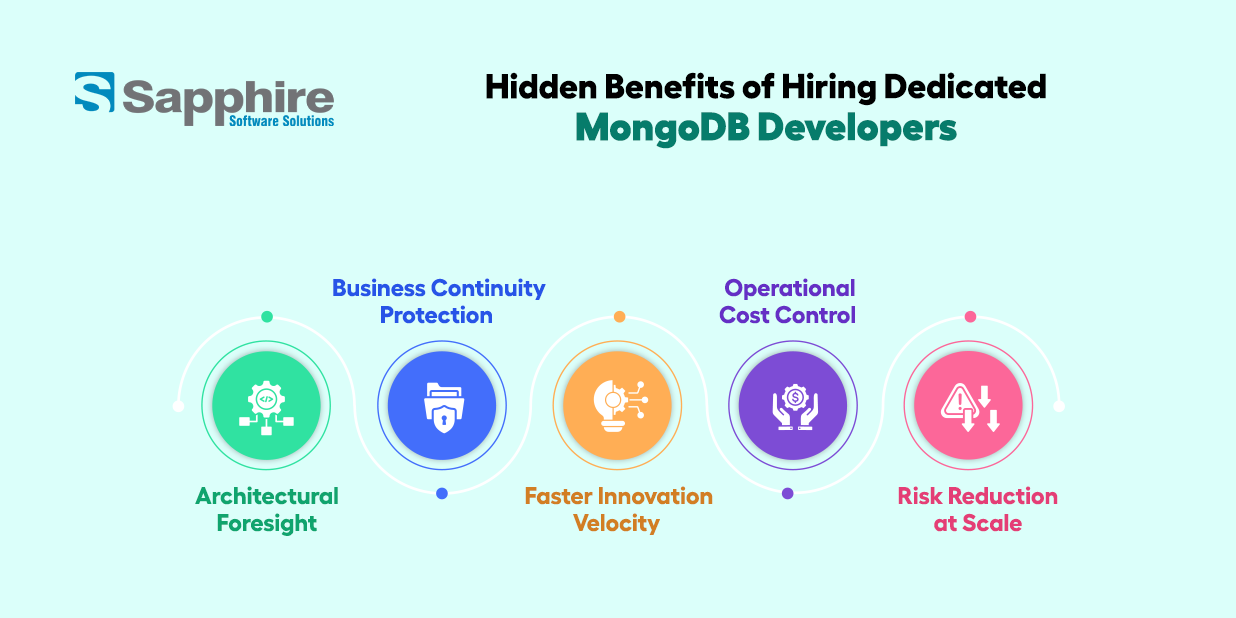 Most companies hire developers to “build features.” But dedicated specialists quietly deliver deeper advantages that extend far beyond visible functionality.
1. Architectural Foresight:
Generalist teams are often built for immediate requirements. Dedicated specialists will build for the next five years of growth. Their decisions anticipate future traffic patterns, integration expansion, regional scaling, and analytics workloads long before those demands appear.
This avoids painful platform migrations in later projects that often cost more than the original system itself.
2. Business Continuity Protection:
Downtime today does not just impact revenue; it damages trust. Specialists design fault-tolerant architectures that automatically reroute traffic during system failures, protecting customer experience even under infrastructure stress.
3. Faster Innovation Velocity:
When the underlying data layer is stable, product teams innovate faster. Developers can experiment with new features, analytics tools, and automation pipelines without worrying about destabilizing core infrastructure.
This dramatically shortens product iteration cycles.
4. Operational Cost Control:
Optimized architectures prevent runaway cloud costs. Instead of scaling blindly, specialists fine-tune computers, storage, and bandwidth usage to match actual business demand.
Over time, this alone can save organizations hundreds of thousands in unmanaged cloud expenses.
5. Risk Reduction at Scale:
As user bases grow, so do compliance, security, and performance risks. Dedicated professionals detect vulnerabilities early before they evolve into brand-damaging incidents.
The most valuable benefit of all? Leadership confidence. When executives trust the stability of their data backbone, they make bolder, faster strategic decisions without fear of system collapse.
Understanding MongoDB Data Types & Why Expert Handling Matters
Behind every dashboard, transaction, or analytical model lives an intricate layer of structured and semi-structured information. The correct handling of MongoDB data Types determines whether a system performs effortlessly or degrades under stress.
Each data format strings, numbers, arrays, embedded objects, timestamps, and geospatial coordinates, comes with unique performance and storage implications. In the hands of inexperienced engineers, misused data types quickly lead to:
- Bloated storage consumption
- Slow queries under scale
- Indexing inefficiencies
- Reporting inaccuracies
- Analytics performance decay
Experts, however, align each data structure precisely with its access pattern. High-frequency transactional fields receive optimized indexing. Archived historical data is stored in cost-efficient formats. Sensitive attributes are encrypted and isolated. Time-series data flows into analytics-ready pipelines.
What appears to be a small technical decision at the schema level ultimately decides long-term system performance, compliance, safety, and infrastructure cost efficiency.
Why Choose a MongoDB Development Company Over Individual Freelancers?
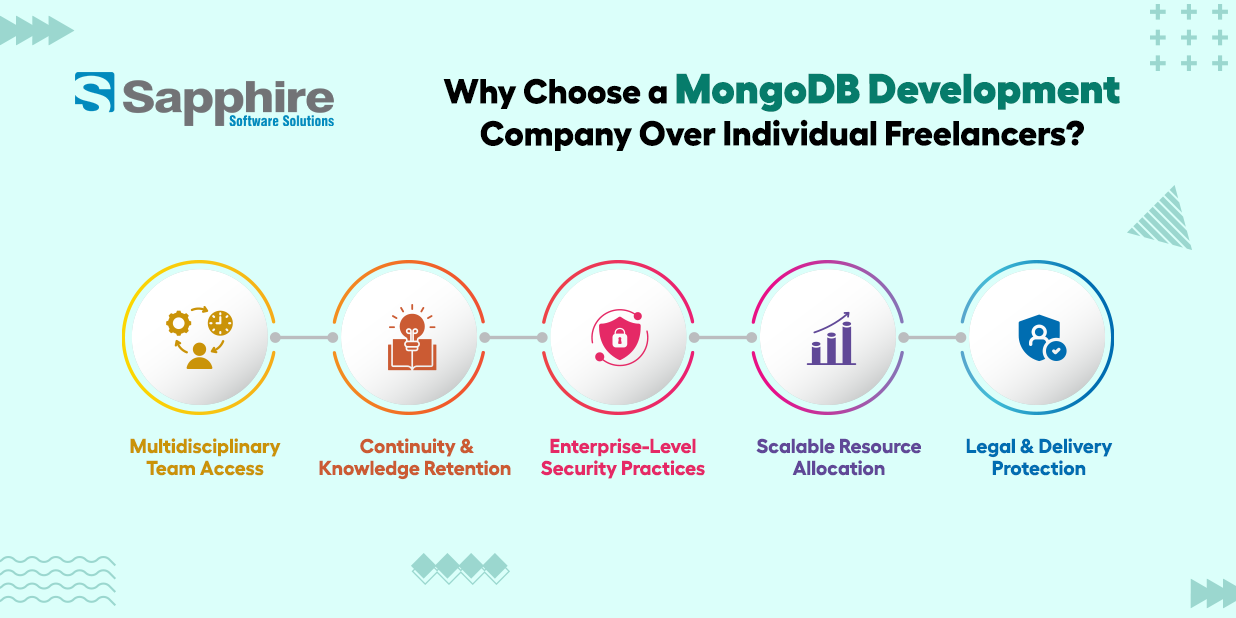
Hiring freelancers may seem flexible in the short term, but long-term systems demand long-term accountability. A professional MongoDB Development Company offers structural advantages that individuals simply cannot replicate on a scale.
- Multidisciplinary Team Access: Instead of relying on one person’s skill set, businesses gain access to architects, performance engineers, security specialists, QA analysts, and DevOps professionals.
- Continuity & Knowledge Retention: Freelancers change frequently. Development companies ensure architectural knowledge remains inside the organization rather than walking away mid-project.
- Enterprise-Level Security Practices: Professional teams operate under strict security frameworks, documented testing methodologies, and compliance procedures.
- Scalable Resource Allocation: When workloads spike, companies can instantly scale resources without restarting the hiring process.
- Legal & Delivery Protection: Service contracts, SLAs, and structured delivery models reduce project risk and provide recourse when timelines or performance metrics are not met.
In mission-critical systems where downtime equals lost revenue, reliability always beats improvisation.
Why Sapphire Is the Best Choice to Hire MongoDB Developers for Your Project?
Hiring engineers is not only a technical choice; it is a strategic partnership decision. Sapphire Software Solutions approaches every engagement through the lens of long-term business impact rather than task-driven execution.
Our MongoDB Development Services focus on delivering:
- Performance-driven architecture design
- Enterprise-grade security implementation
- Cloud-native scalability frameworks
- High-availability data systems
- Regulatory-compliant infrastructure workflows
The professionals at Sapphire are not assigned as disconnected resources. They embed directly into your product ecosystem, learning your business workflows, growth objectives, and operational constraints.
This alignment enables them to function as long-term system stewards—proactively suggesting optimizations, anticipating risks, and supporting business expansion long after initial deployment.
Whether you are building a new platform from scratch, stabilizing legacy infrastructure, or preparing for rapid market expansion, Sapphire Software Solutions structures its delivery model to support sustained success, not one-time development.
Conclusion:
As businesses scale, data complexity, performance demands, and security requirements grow exponentially. Dedicated MongoDB developers ensure that your systems remain resilient, compliant, and optimized for fluctuating market needs. Sapphire Software Solutions brings enterprise-grade expertise, architectural foresight, and continuous improvement to every database environment we manage.
Partner with us to eliminate risk, strengthen your infrastructure, and support rapid business expansion. Contact us to discover how our MongoDB specialists can transform your data into a long-term competitive advantage.