
















Tech is changing quicker than ever, pushing companies to make choices based on hard numbers and data they can measure and grow. At the heart of this change are Machine Learning Statistics - the math that backs up every smart system. Machine learning runs on real patterns in data, chances of how right it is, and ways to guess what's next. These facts help businesses get to know their customers better, make things work as they happen, make smarter choices, do boring jobs without people, and find new ways to make money.
Every clever setup - from cars that drive themselves to spotting when someone's cheating - uses stats, machine learning tricks to check if it's working right and get better at what it does. Machine learning uses the huge amount of data that people produce in everyday life. Fields like healthcare, banking, finance, retail, online shopping, transportation, and logistics now depend on machine learning to solve issues that used to be seen as impossible or too expensive to fix.
In this blog, we explore:
- The most impactful statistics driving ML innovation
- How various Machine Learning Data Types influence model behaviour
- Real-world Machine Learning Data Analysis practices behind high-performing systems
- Industry-level impacts in automation, security, and cloud computing
- Why are companies aggressively trying to hire Machine Learning Engineer talent to stay competitive
- And how Sapphire, a leading Machine Learning Development Company, helps organizations unlock ML-powered business growth
Let’s explore the real numbers that are reshaping tech - one intelligent insight at a time.
Key Stats in Machine Learning Driving Tech Industry Growth:
Industry Growth Statistics:
- The global ML market size is projected to surpass USD 225 billion by 2030, growing at over 40% CAGR.
- 85% of companies already have ML-based solutions in production or in active development.
- By 2025, experts estimate the world will generate more than 97 zettabytes of data. This data growth will create new momentum for machine learning like never before.
Businesses continue to focus on fresh ideas. They are increasing their investments in innovation to remain competitive.
Accuracy and Performance Statistics:
- Advanced ML algorithms are improving prediction accuracy by 30–60% across industries.
- Recommendation systems (like those in streaming and e-commerce) are responsible for 35–40% of total revenue.
- Real-time ML enables businesses to reduce operational delays by up to 90%.
These numbers show why ML is not just a tool — it is becoming the foundation of competitive business strategy.
Automation Statistics:
- ML-powered automation is expected to reduce operational costs by up to 50% in many industries.
- In logistics, automated demand forecasting can reduce inventory waste by 35%.
- Manufacturing using ML-driven predictive maintenance reports 70% less downtime.
Customer Experience & Engagement Stats:
- Personalized ML recommendations boost conversions by 10–30%.
- Intelligent chatbots now handle 70% of customer interactions without human support.
- Businesses using customer-centric ML platforms report 25%+ improvement in retention.
These stats illustrate how Machine Learning Statistics translate into real business advantages.
Understanding Machine Learning Data Types and Their Impact on Models:-
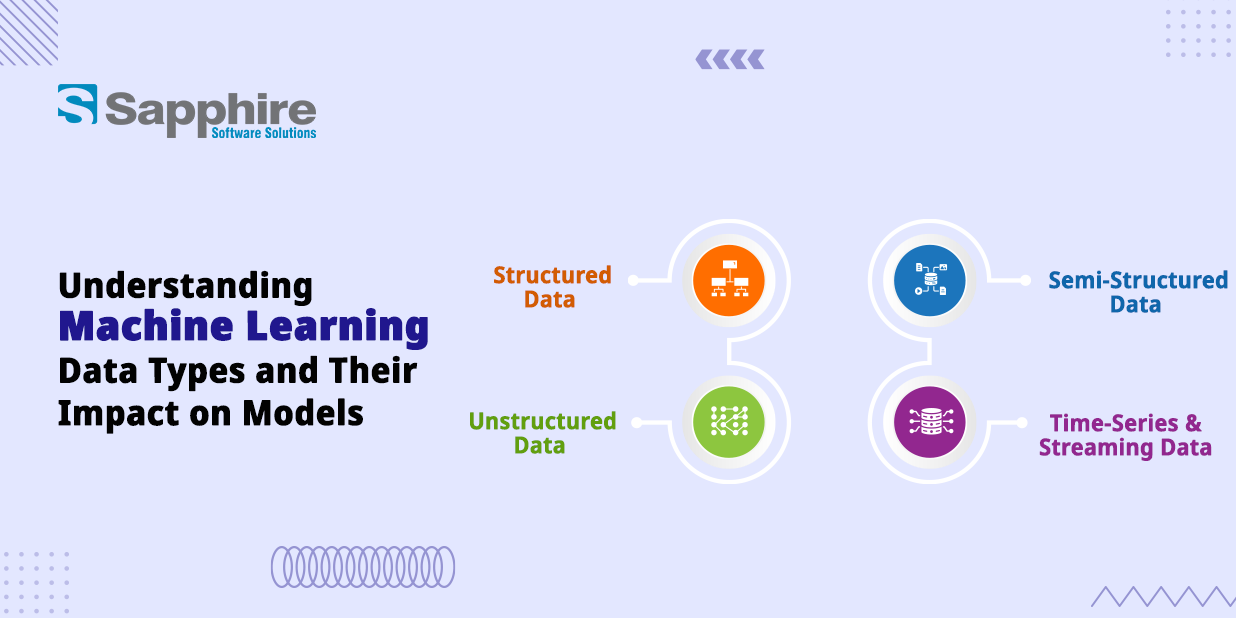
Machine learning depends on data. The way data is organized, labelled, and prepared has a major impact on how a model learns and makes predictions.
There are four primary categories:
1. Structured Data:
- Organized and stored in tabular form (rows/columns)
- Highly machine-readable
- Examples: Customer profiles, transaction logs, product catalog data
Structured data is the backbone of financial risk scoring, flight pricing engines, and most enterprise operational systems.
2. Unstructured Data:
- No defined format or schema
- Requires advanced processing
- Examples: Social media text, documents, audio, videos, medical imaging
Up to 80–90% of generated data today is unstructured, making it a huge catalyst for deep learning innovations.
3. Semi-Structured Data:
- Mix of structured & unstructured formats
- Examples: JSON, XML, sensor metadata
Used widely in IoT and logistics environments for smart automation and fleet tracking.
4. Time-Series & Streaming Data:
- Continuously updated data
- Examples: Stock market feeds, wearable health data, security system logs
Time-series data is critical for anomaly detection, supply chain forecasting, and preventive maintenance.
Power of Machine Learning Data Visualization:
A model’s success depends on how well engineers understand the data behind it. Machine Learning Data Visualization is used to:
- Identify trends, clusters, and anomalies
- Remove meaningless or noisy data
- Validate assumptions before model training
- Improve stakeholder clarity with business-friendly insights
In industries like finance and healthcare, clear visualization can literally save lives by surfacing risks faster than spreadsheets ever could.
Machine Learning Data Analysis: Extracting Insights from Data
Data goes through multiple stages before it becomes useful for prediction.
Core Steps in ML Data Analysis:
- Data Collection: Gathering data from databases, sensors, APIs, apps, cameras, and user interactions.
- Data Cleaning: Removing incorrect, duplicated, or incomplete data points.
- Feature Selection & Engineering: Choosing only the variables that truly influence results. Example: In healthcare diagnosis, symptoms matter more than the date of admission.
- Data Normalization: Ensuring numeric values are on similar scales, so no feature dominates unfairly.
- Model Training & Testing: Using mathematical methods to teach a system how to recognize patterns.
- Evaluation & Tuning: Analyzing metrics like accuracy, precision, recall, and F1-scores to refine model outputs.
Statistical Techniques in Data Analysis:
- Regression modelling
- Probability theory
- Hypothesis testing
- Bayesian inference
- Chi-square analysis
- Dimensionality reduction
These techniques help extract meaning from raw datasets and reduce bias.
Business Outcomes from ML Data Analysis: Benefits and Impact
- Predictive intelligence - Smarter decisions and lower risk
- Real-time optimization - Better operational efficiency
- Customer personalization - Higher revenue and loyalty
- Risk & fraud detection - Stronger security foundations
- Process automation - Faster workflows and lower costs
Use Cases Across Industries:
Healthcare:
- Early disease prediction using patient records and imaging analytics
- Personalized treatment analysis to reduce side effects and risks
Finance:
- Credit scoring and loan eligibility risk assessments
- High-frequency trading and fraud detection
Retail & E-commerce:
- Purchase recommendation engines, dynamic pricing, and virtual customer assistants.
Logistics & Transportation:
- Route optimization and predictive maintenance of fleets
In each use case, the statistical foundation is the hero behind the success story.
How Machine Learning Statistics Are Reshaping Automation, Security, and Cloud Technologies?
Technology leaders are aggressively investing in ML because the numbers prove one thing: automation, cybersecurity, and cloud scalability depend on Machine Learning Statistics.
Automation Acceleration:
- Repetitive human tasks automated through ML-trained workflows
- Significant cost reduction and productivity improvement
- Robotic Process Automation (RPA) blends with ML to make automation “self-improving.”
Example: Warehouse robots that constantly learn to move faster and avoid collisions.
Cybersecurity Reinvention:
- ML-driven systems detect anomalies in real time
- Behavioural analysis spots threats that traditional tools miss
- Fraud risk is reduced by 60–80% with predictive security models
Example: Banking apps that lock suspicious accounts instantly based on anomalous transaction patterns.
Cloud-Powered Intelligence:
Modern ML pipelines rely heavily on cloud computing for:
- Scalability
- High-performance GPU processing
- Centralized data governance and faster model deployment
Cloud + ML = instant access to smart capabilities across global operations.
Edge Machine Learning Statistics:
A new movement is happening, pushing ML closer to the source of data.
- In smart cars, decisions must occur in milliseconds
- Logistics networks react instantly to traffic issues
- Healthcare wearables continuously monitor vitals
Edge ML reduces latency, bandwidth, and dependency on central systems, saving millions in infrastructure costs.
Why Companies Are Hiring Machine Learning Engineers?
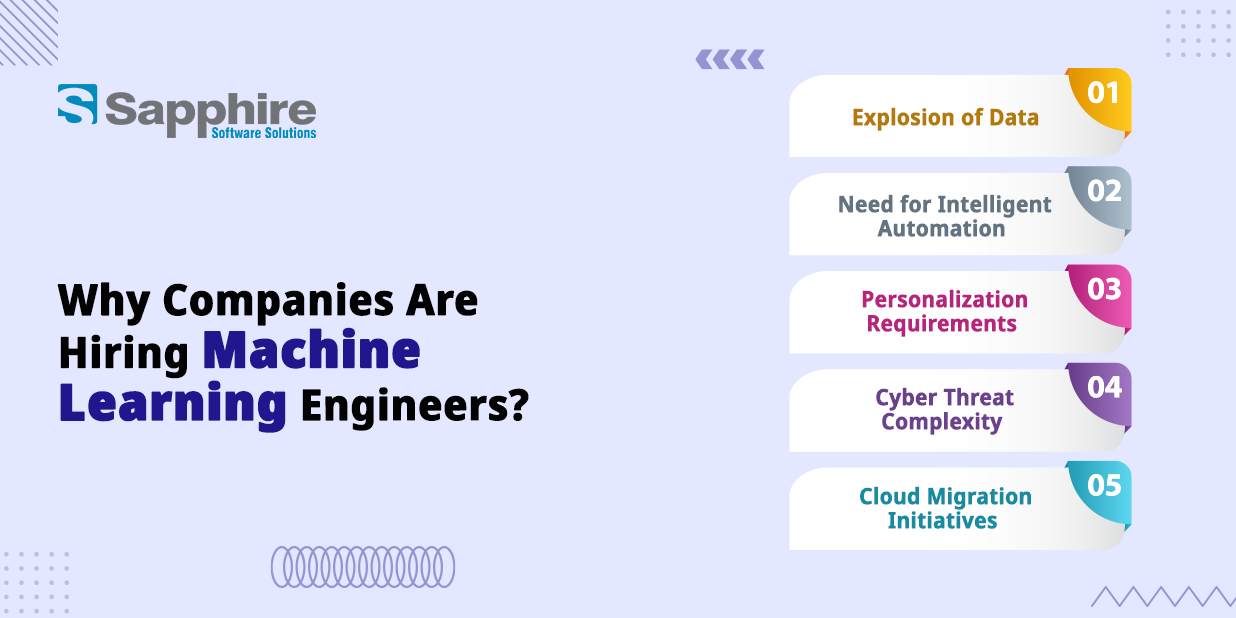
ML adoption is scaling faster than talent availability. As a result, businesses are competing to Hire Machine Learning Engineer experts to stay ahead.
Key Drivers of Hiring Demand:
- Explosion of Data: Organizations are generating volumes they cannot manually process.
- Need for Intelligent Automation: Human-based operations are too slow for hypercompetitive markets.
- Personalization Requirements: Customers expect experiences tailor-made just for them.
- Cyber Threat Complexity: Attack patterns evolve faster than human monitoring can handle.
- Cloud Migration Initiatives: Cloud-native ML development is a priority for cost savings and resilience.
ML engineers bridge the vision–execution gap, transforming raw data into business value.
Roles ML Engineers Fulfill:
- Model Developer - Builds intelligent apps and automation
- Data Analyst - Extracts growth-driving insights
- Research Engineer - Drives innovation
- ML Ops Specialist - Scales ML reliably in production
- Systems Optimizer - Improves speed, accuracy & cost efficiency
Shortage of Skilled Professionals:
- The demand for ML talent is growing 5x faster than supply.
- Over 60% of companies struggle to recruit ML experts internally.
- Outsourcing through a Machine Learning Development Company fills this gap quickly and cost-effectively.
Businesses understand that the real differentiator today is not software — it is smart software built on statistical precision.
How Sapphire, a Leading Machine Learning Development Company, Transforms Businesses with ML Statistics?
Sapphire Software Solutions helps businesses make changes using smart automation, predictions based on data, and safe cloud-based machine learning systems. We use machine learning, advanced tech, and industry knowledge to provide clear and impactful business outcomes.
Our ML Capabilities:
We offer:
- ML Model Development & Deployment
- Predictive Analytics & Demand Forecasting
- Computer Vision & Image Recognition
- Natural Language Processing Solutions
- Risk Detection & Cybersecurity ML Systems
- ML-powered Automation Workflows
- Cloud-native ML Engineering & MLOps
Industries We Serve:
- Healthcare: Disease prediction, digital diagnostics
- Finance: Fraud detection, risk scoring
- Retail & E-commerce: Recommendation engines, personalization
- Logistics & Transportation: Smart routing, fleet monitoring
How Our Approach Delivers Impact with Value Pillar and Outcome?
- Statistical Precision - Models with measurable accuracy
- Data-centric Design - Stronger insights, fewer assumptions
- Production-ready Engineering - Faster go-live, scalable systems
- Business-aligned Innovation - ROI-focused transformation
We transform machine learning ideas into practical results like boosting revenue, cutting costs, and making better choices.
Conclusion:
Machine learning is transforming technology through measurable breakthroughs, not hype. Every digital convenience - recommendations, fraud alerts, predictive healthcare, optimized deliveries - runs on Machine Learning Statistics that validate decisions at a massive scale. From leveraging Machine Learning Data Types to executing Machine Learning Data Analysis, organizations now understand that competitive advantage comes from how intelligently data is used — not how much is collected.
Automation is becoming self-learning, security is becoming adaptive, and cloud platforms are scaling automatically - all enabled by stats machine learning.
The future will be owned by companies that adopt ML early and scale it smartly. Sapphire Software Solutions, as a trusted Machine Learning Development Company, ensures every insight turns into a business outcome - secure and strategic. Let intelligence drive your next move.