

















In today’s competitive digital landscape, businesses are under constant pressure to build and scale mobile applications quickly while maintaining performance, consistency, and cost efficiency. However, many companies still rely on separate native development teams for iOS and Android, which often leads to miscommunication, inconsistent user experiences, and higher long-term maintenance costs. As a result, product development slows down, and businesses struggle to achieve faster time-to-market.
A real-world example highlights this challenge clearly. A logistics business owner approached us after months of frustration managing two separate development teams for a single mobile application. Despite continuous investment, both platforms behaved differently, issues were duplicated, and coordination gaps between developers caused unnecessary delays. The core problem was not a lack of effort, but an inefficient development approach that increased complexity instead of reducing it.
This is where Flutter has become a preferred solution for modern businesses. By allowing developers to build a single codebase for both iOS and Android, Flutter helps ensure consistency, reduces development time, and lowers operational overhead. This is why more companies now choose to hire Flutter Developers—not just for technical advantages, but to achieve faster digital growth, improved scalability, and a more streamlined product development lifecycle.
What is Flutter and Why Businesses Are Adopting It?
Flutter is an open-source UI development framework created by Google that enables developers to build applications for mobile, web, and desktop from a single codebase using the Dart programming language. On paper, this explains what Flutter is. But the reason it gained widespread adoption is tied to years of frustration in cross-platform development.
Before Flutter, most cross-platform tools followed a predictable pattern—strong marketing, promising demos, and disappointing production performance. Developers often faced issues like inconsistent UI behavior across devices, hidden performance lags, and applications that behaved differently on real user devices compared to testing environments. Flutter changed this perception by delivering stable, production-ready performance and consistent UI rendering. Over time, even sceptical developers began recommending it based on real project success rather than hype.
Why Flutter Stands Out?
1. Single Codebase Advantage:
One of Flutter’s biggest strengths is the ability to maintain a single codebase for both iOS and Android. In traditional development models, businesses often end up hiring separate teams, which leads to duplicated effort, higher costs, and communication gaps. Flutter removes this fragmentation by unifying development, significantly reducing both time and operational complexity.
2. Faster Development with Hot Reload:
Flutter’s Hot Reload feature allows developers to instantly see changes without restarting the entire application. This improves development speed, reduces downtime, and creates a smoother workflow. For businesses, it translates into faster iterations, quicker bug fixes, and shorter release cycles.
3. Consistent UI Across Platforms:
Unlike traditional frameworks that rely on native components, Flutter uses its own rendering engine. This ensures that the user interface remains consistent across different devices and operating systems. It eliminates platform-specific UI issues and reduces the need for extensive cross-device testing.
4. Strong Community & Google Support:
Flutter is backed by Google and supported by a rapidly growing global developer community. Regular updates, strong documentation, and a rich ecosystem of plugins make it a reliable choice for long-term product development. Businesses gain confidence knowing the framework is actively maintained and widely adopted.
These advantages are the reason many companies now prefer to hire Flutter developers—not just as a technical upgrade, but as a strategic decision to improve speed, reduce costs, and build scalable digital products with fewer operational risks.
Key Benefits of Hiring Flutter Developers for Business Growth:-
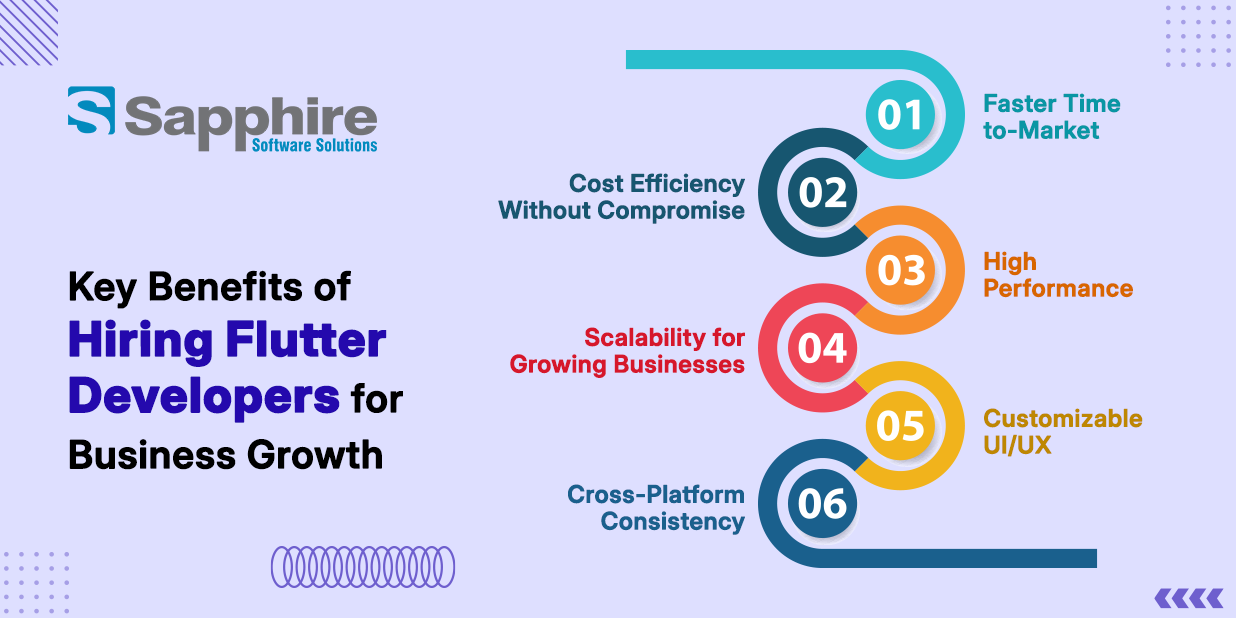
When you hire a Flutter Mobile App Developer, the downstream effects reach further than most people expect at the outset.
1. Faster Time-to-Market:
There's a SaaS company I know whose founder spent eighteen months in development, convinced they were "almost ready." They launched to discover their primary competitor had captured the exact customer segment they'd been targeting, six months earlier, with a product that was objectively less polished. The market didn't wait for polish. It responded to the presence. Flutter doesn't manufacture urgency, but it removes enough structural friction that teams who understand their window can hit it.
2. Cost Efficiency Without Compromise:
Hidden tax of dual native development - two QA cycles, two deployment pipelines, two sets of platform-specific issues, two developers pointing at each other across a support ticket. Flutter collapses all of that. The savings aren't theoretical line items in a proposal. They show up in monthly burn rates, in maintenance cycles that stay manageable, in updates that ship to both platforms in one go rather than two.
3. High Performance:
Flutter compiles directly to native ARM code. In actual daily use, most people cannot tell the difference between a well-built Flutter app and a native one. For a fintech platform where a hesitation on the transaction screen makes users second-guess their trust, or an e-commerce app where checkout friction abandons carts, near-native is functionally equivalent to native in the ways that matter.
4. Scalability for Growing Businesses:
Scaling a product reveals every shortcut taken during the build. Deepak's architecture problems would have compounded badly at ten times his current user load. Flutter's structure absorbs growth pressure rather than fracturing under it, which means engineering capacity goes toward new problems rather than structural repairs.
5. Customizable UI/UX:
Flutter offers genuine design control - not a theme selector dressed up as flexibility. Pixel-level customization means your visual identity arrives in the product accurately, not approximately.
6. Cross-Platform Consistency:
Whether You Hire Flutter App Developers in USA or work with a team distributed across time zones, users on every device get the same experience. This is invisible when done right, which is precisely the point.
Flutter vs Native Development: What Businesses Should Know:-
Feature |
Flutter Development |
Native Development |
| Codebase |
Single |
Separate for iOS & Android |
| Development Time |
Faster |
Slower |
| Cost |
Lower |
Higher |
| Performance |
Near-native |
Native |
| UI Consistency |
High |
Platform-dependent |
| Maintenance |
Easy |
Complex |
Key Takeaways:
Native development has a legitimate home - apps requiring deep hardware access or platform-exclusive functionality that Flutter genuinely can't replicate cleanly. That's a real category of product. It's also a small one. For everything outside it, maintaining two parallel native codebases is expensive coordination overhead that Flutter makes unnecessary. That's why companies hire Flutter App Developers rather than staffing two separate platform teams.
Hiring Models for Flutter Developers:-
1. Dedicated Hiring Model:
A developer who's spent six months inside your product carries knowledge that can't be written down - the reasoning behind decisions, the approaches that were tried and abandoned, the parts of the codebase that need careful handling. That knowledge accumulates and pays off on every decision that comes after it. For sustained work, Hire Dedicated Flutter Developers through a dedicated structure. The compounding is real.
2. Fixed Price Model:
Clean when the scope is genuinely defined. The failure mode -requirements shift mid-project, the fixed scope becomes a source of conflict, budget certainty evaporates - is predictable and common enough to factor into any decision to use this model.
3. Hourly Model:
Early-stage builds almost always surface discoveries that change what's being built. Hourly arrangements let you follow that learning rather than fight it within a fixed scope agreed on before you knew what you know now.
4. Offshore Development Model:
Some Companies Hire Flutter App Developers in USA because communication overhead across time zones isn't worth the cost difference. Others work offshore with enough process structure that time zone gaps stop mattering much. Team quality and process clarity decide outcomes more than geography does.
A Trustworthy Flutter App Development Company helps you figure out which structure fits rather than steering you toward whichever model benefits them most.
Common Hiring Mistakes Businesses Should Avoid:
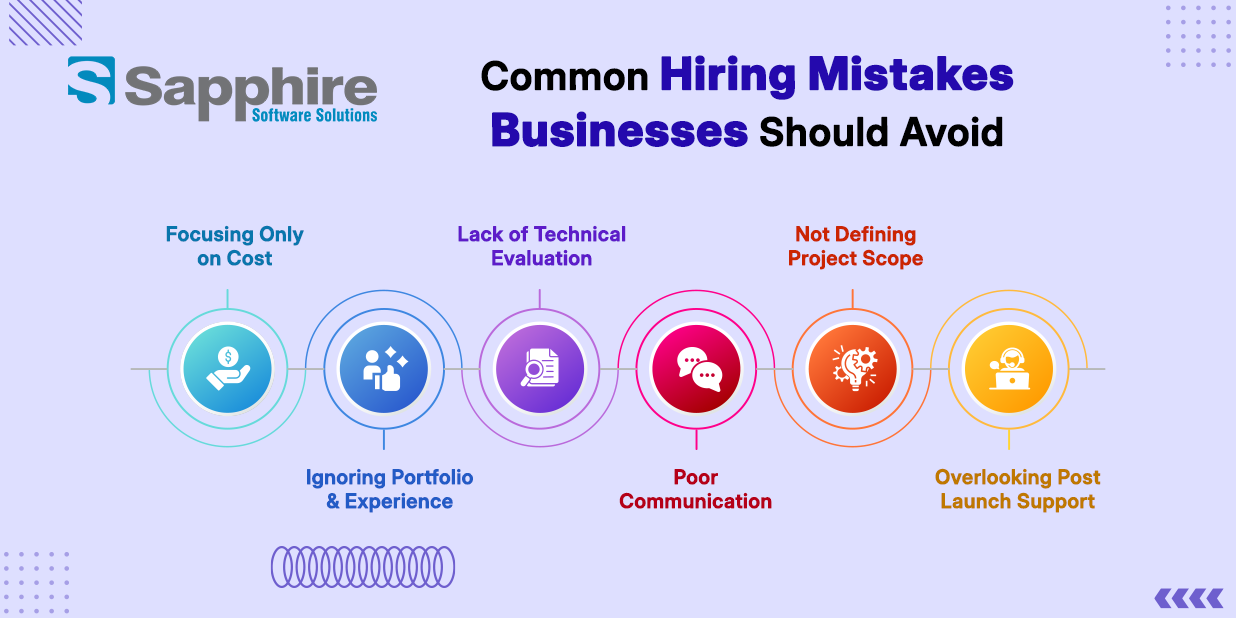
- Focusing Only on Cost: The original developers were cheap. By month seven, they had cost him more than a senior team would have from the start. Poor code doesn't announce itself - it accumulates and then presents the bill at the worst possible time.
- Ignoring Portfolio & Experience: What someone has shipped is different from what they claim they can build. Look at real products before committing to any Flutter developer for hire.
- Lack of Technical Evaluation: Test Dart knowledge, UI work, and API integration directly. Interview confidence and actual code quality are different measurements entirely.
- Poor Communication: A developer who surfaces every three days with vague updates costs you time and trust regardless of their technical ability. It's a legitimate filter.
- Not Defining Project Scope: The ambiguity cost him months of misaligned work. Specificity before development starts is not optional.
- Overlooking Post-Launch Support: When you hire Flutter App Developers, post-launch support should be explicit and agreed upon before any contract is signed.
Why Choosing the Right Development Partner Matters for Business Success?
Technical execution alone is not enough to ensure a successful digital product. In many cases, the real difference comes from the quality of questions a development team asks before and during the build process. New Flutter development partner shifted the conversation from short-term fixes to long-term thinking—focusing on scalability, customer experience, and how the product should evolve as the business grows. This approach helps uncover underlying problems that are often missed when teams only focus on task-based development.
A reliable Flutter app development company acts as a strategic partner rather than just a service provider. Instead of simply delivering features, they evaluate business goals, anticipate future challenges, and align technology decisions accordingly. This is why choosing the right partner matters—because when you hire Flutter developers through an experienced team, you gain not just coding expertise, but a structured approach that improves product stability, performance, and long-term business success.
Conclusion:
Businesses today are no longer competing only on ideas—they are competing on execution speed, product experience, and the ability to improve digital products without disruption continuously. Mobile applications have become the core touchpoint for customer engagement, and companies that fail to deliver smooth, scalable, and consistent app experiences often lose users to more agile competitors. This is why modern organizations are rethinking how they approach mobile development, especially when building for multiple platforms at once.
Flutter has emerged as a practical solution to this challenge by enabling a single codebase that works seamlessly across iOS, Android, web, and desktop. Instead of managing separate development efforts, businesses can streamline engineering, reduce operational complexity, and accelerate release cycles. However, real impact comes not just from the framework itself, but from choosing the right Flutter development team that understands both technology and business goals. If you are planning to build or scale your product, Request a Free Quote to explore how a tailored Flutter solution can support your growth strategy.