
















I've been watching Laravel projects grow in scope for years, and the pattern is always the same. You start with something manageable - a few models, some controllers, a handful of API calls. Then the requirements shift. Someone wants AI-powered recommendations. Another team wants real-time automation. Suddenly, your clean MVC structure is held together with duct tape and good intentions.
This isn't a Laravel problem. It's an architecture problem. Laravel itself has kept up remarkably well with where development has gone. The ecosystem is strong, the developer experience is genuinely good, and the community hasn't abandoned it for the framework of the month. That loyalty is earned. If teams want to scale these systems properly, it often becomes important to hire Laravel Developers who can handle both legacy structure and modern architectural complexity.
But there's a category of application - AI-native, context-dependent, multi-system - where MVC starts to crack at the seams. Not dramatically, not all at once, but gradually, in ways that become expensive to fix later. Laravel MCP (Model Context Protocol) exists specifically for that category. It doesn't replace what worked. It handles what couldn't work before.
Evolution from Laravel MVC to MCP Architecture:
The Rise of Laravel MVC:
MVC gave an entire generation of developers a shared mental model, and that mattered more than people gave it credit for. You didn't have to explain to a new team member where the business logic lived. You didn't have to debate folder structure every time a project started. The pattern handled those decisions by default.
Where MVC Falls Short:
The cracks appear when your application needs to remember things across a workflow. The right action in step four depends on what happened in step one. When an AI model needs to make an informed decision, it is informed by a hundred different signals that don't all live in the same database. Controllers get fat. Services multiply. Developers start duplicating context-fetching logic across the codebase because there's no clean home for it. It works, technically, but it starts feeling like a compromise you're managing rather than an architecture you trust.
Enter MCP Architecture:
MCP Architecture doesn't reorganize your code. It changes what the system is fundamentally doing.
Instead of handling a request and returning a response, the system maintains context - a running understanding of what's happened, what it means, and what should come next. That context becomes the connective tissue between AI agents, services, APIs, and user interactions.
| Aspect | Laravel MVC | MCP Architecture |
| Structure |
|
|
| Scalability |
|
|
| AI Integration |
|
|
| Data Flow |
|
|
| Flexibility |
|
|
MVC tells your application how to handle what arrives. MCP gives it the ability to understand what's going on.
How Laravel MCP Server work?
The name "server" is a bit misleading, honestly. The Laravel MCP Server isn't just receiving traffic - it's running the show. Think of it like a conductor rather than a switchboard. A switchboard connects the caller to the receiver and gets out of the way. A conductor hears every instrument, understands how they relate to each other, and shapes what the whole thing produces.
Core Working Principle:
When something triggers the system - a user action, an API event, an AI signal - the MCP Server doesn't treat it as an isolated event. It reads accumulated context, interprets the trigger in that light, decides what combination of services or agents needs to respond, and coordinates the result.
The system has memory. That's the core of it.
Key Components:
1. Context Manager:
This is the piece that makes everything else possible. Without it, you're back to stateless request handling - every interaction starting from zero. The Context Manager means the system carries a genuine understanding from one moment to the next. Previous decisions inform current ones. Patterns get recognized. Workflows feel coherent rather than disjointed.
2. Protocol Layer:
Your AI models, your databases, your third-party APIs - they weren't built to talk to each other. The protocol layer handles that translation work quietly, so the rest of your system doesn't have to care about the differences.
3. Execution Engine:
Rules-based systems are brittle because reality doesn't follow rules consistently. The execution engine processes tasks based on live context rather than predetermined paths, which means the same input can produce a different, more appropriate output depending on what the system knows.
4. Integration Layer:
This is where external things - ML models, third-party services, microservices - connect cleanly. Built to extend without forcing you to redesign what already works.
Role of Laravel MCP in AI Agent Workflow:
Most teams underestimate how hard AI integration is until they're six months in and maintaining three separate systems that were never designed to coordinate.
Understanding AI Agent Workflow:
A functional AI Agent Workflow isn't one thing - it's a chain. Input gets interpreted. Context shapes the interpretation. A decision gets made. Something happens. The outcome feeds back into the system. Each step depends on the one before it, and the whole thing only works if the chain stays intact.
Breaking that chain - even partially - produces AI behaviour that feels erratic to users and unpredictable to developers.
MCP Enables AI Workflows:
Laravel MCP (Model Context Protocol) treats that chain as a first-class concern.
Context Awareness:
An AI agent deciding without history is essentially guessing. MCP makes sure that relevant history travels with the workflow, so each decision draws on what the system genuinely knows rather than what it can infer from a single request.
Dynamic Orchestration:
Real workflows don't follow scripts. Conditions change, edge cases appear, users do unexpected things. MCP routes and adapts in real time rather than forcing behaviour through a predetermined path.
Seamless Communication - The protocol layer handles coordination between AI models, databases, and APIs without each connection requiring its own bespoke integration.
Real-World Example:
A customer contacts support. The AI reads the message, surfaces the user's full interaction history, notices a pattern matching a known issue type, and generates a response calibrated to that specific situation - not a generic answer pulled from a template.
Without Laravel MCP (Model Context Protocol), which requires stitching together multiple disconnected systems and hoping the handoffs don't drop anything. With it, the whole sequence is one coordinated workflow.
Benefits of Laravel MCP for Scalable Web Development:
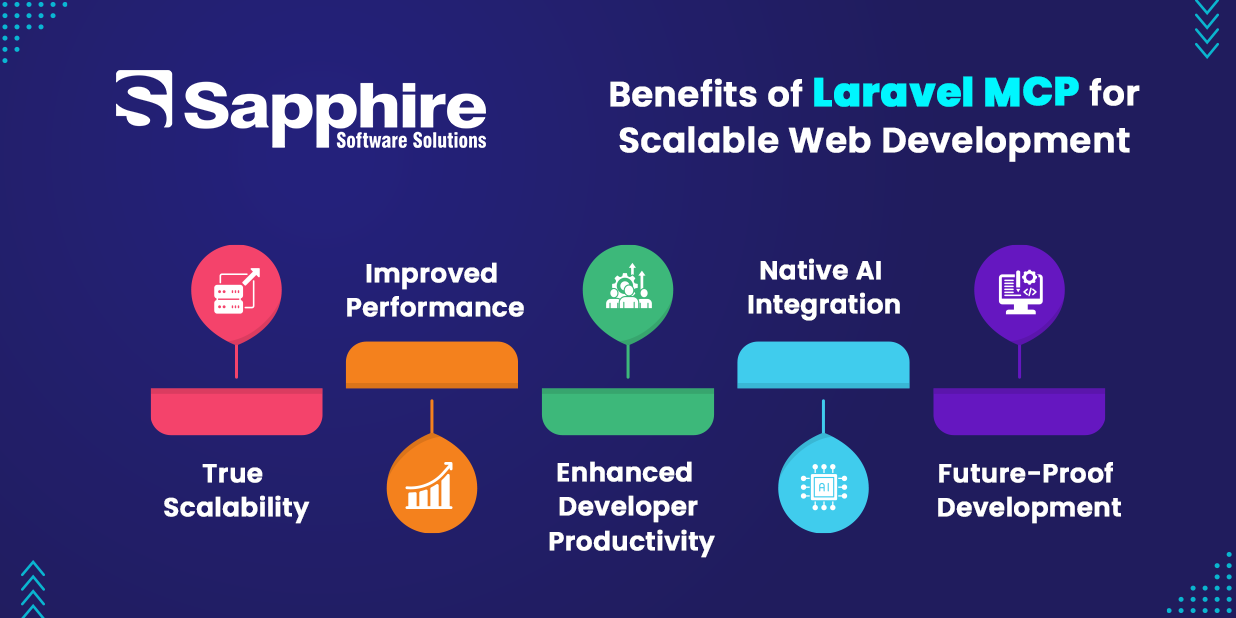
1. True Scalability:
Traffic scalability is a solved problem - throw more servers at it. Architectural scalability is harder. MCP handles the kind of complexity growth that breaks systems from the inside: more integrations, more context, smarter behaviour expected from more users.
2. Improved Performance:
When the system already holds context, it stops re-deriving it on every request. That's real computational savings, and it shows up in response times that users notice.
3. Enhanced Developer Productivity:
A Laravel Developer working in an MCP system spends less time writing coordination logic that shouldn't need to exist and more time on decisions that require human judgment. The architecture handles the orchestration; the developer handles the thinking.
4. Native AI Integration:
Bolted-on AI is a maintenance problem disguised as a feature. MCP treats AI as a structural participant, which means integrations are stable, testable, and don't require heroic effort to keep running.
5. Future-Proof Development:
Specific tools come and go. Context-driven, AI-native, service-coordinated architecture is where development is heading, regardless of which tools win. Building on MCP means your foundation stays relevant as the details change.
Why Laravel Developers Should Adopt MCP?
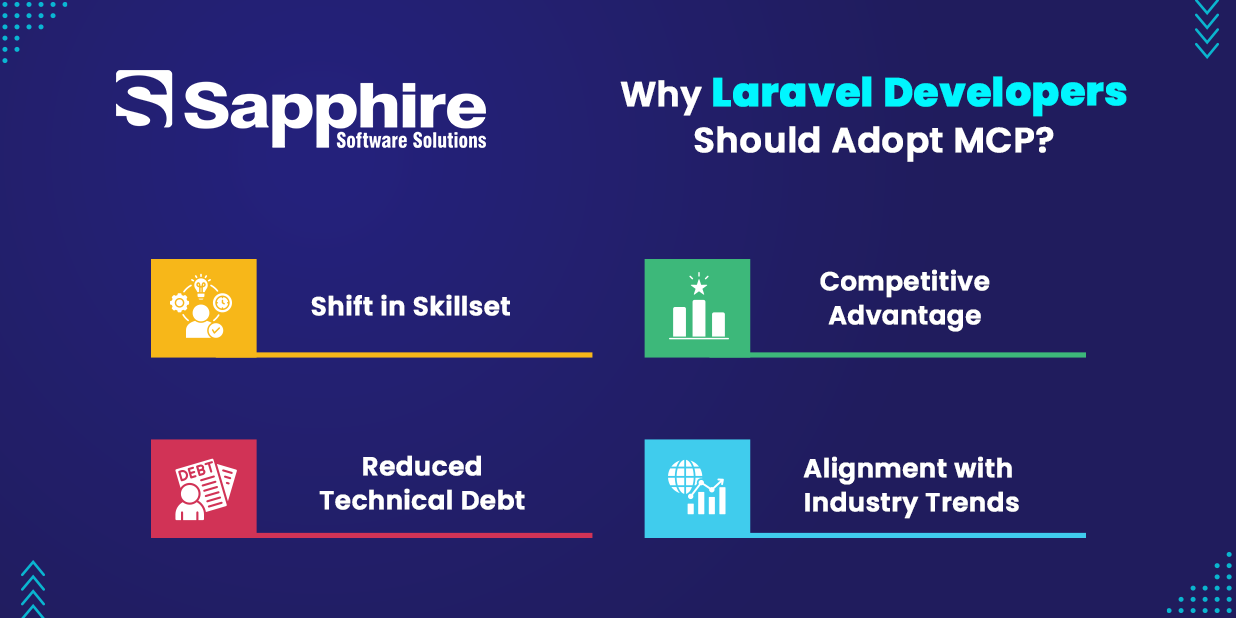
A. Shift in Skillset:
The honest version: MCP requires thinking about systems differently. Not just "how does this request get handled" but "what does the system understand, and how does that understanding evolve." That's a harder mental model to build, and it takes time.
B. Competitive Advantage:
Developers who genuinely understand MCP Architecture are rare right now. That gap will close, but the people who close it first get the interesting work projects where architecture matters and getting it wrong is expensive.
C. Reduced Technical Debt:
The shortcuts that feel harmless in MVC compound badly in complex systems. MCP's structure discourages them early, which means less time later untangling decisions that made sense in week two.
D. Alignment with Industry Trends:
AI integration, event-driven systems, microservice coordination - these aren't trends so much as directions. Laravel MCP (Model Context Protocol) is built around patterns that are becoming standard, not ones that are fading out.
Why Sapphire is a Leading Laravel Development Company for MCP-Based Solutions?
Sapphire Software Solutions, as a trusted Laravel Development Company, has been building with Laravel long enough to have navigated several of these architectural shifts firsthand. We've seen what happens when MVC gets stretched past its limits, and we've built MCP-driven systems for clients where the complexity made that transition genuinely necessary.
We handle architecture, development, integration, and ongoing maintenance - and we're honest about what a project needs rather than defaulting to whatever's most impressive to demo.
If you're deciding whether MCP is the right direction, that's exactly the kind of conversation we have.
Conclusion:
Laravel MVC built a generation of applications, and it did it well. The pattern is sound, the developer experience is good, and for a wide range of projects, it's still the right call. Laravel MCP (Model Context Protocol) is for the projects where it isn't - where AI is structural, where context must persist, and where multiple systems need to behave as a unified whole. These are the kinds of systems that are becoming more common, not less.
Teams that invest in this capability early will adapt faster as software becomes more AI-driven, while others will spend time retrofitting systems under pressure. If you're exploring whether this approach fits your roadmap, Sapphire Software Solutions can help you evaluate and build the right path forward — Get a Free Quote Today.