
















In many automotive businesses, the real challenge isn’t lack of effort—it’s the silent buildup of operational gaps that appear when speed, data, and customer expectations start moving faster than the systems meant to support them. A workshop may be fully booked, a fleet may be expanding, and a dealership may be selling well, yet decisions are still being made on delayed updates, incomplete visibility, or disconnected tools. Over time, this creates a hidden cost: teams work harder just to maintain stability instead of building momentum.
This is where automotive software development shifts from being a technical upgrade to a business necessity. For companies like Sapphire Software Solutions, it represents an opportunity to redesign how automotive operations function—connecting data, automating repetitive coordination, and turning scattered processes into structured intelligence. The value is not in adding software for the sake of digitization, but in enabling businesses to see clearly, respond faster, and scale without operational friction holding them back.
What is Automotive Software Development?
There's a service manager at a mid-sized dealership in Ohio - been there twenty-two years - who still prints out his daily schedule every morning and highlights jobs with a yellow marker. He's good at his job. His customers love him. And he's absolutely drowning.
Not because he's behind the times. Because the volume of decisions, updates, customer calls, and parts coordination that used to be manageable has quietly doubled, then tripled, the tools around him haven't kept up. That story isn't unusual. It's the automotive industry in miniature.
Automotive Software has become the connective tissue holding modern operations together - not in a vague, futuristic sense, but in very immediate ways. Which bay is free? Whether that part has shipped. Why has a customer not returned in eight months? These aren't big-picture questions. They're daily ones, and most businesses are still answering them manually.
Why the Automotive Industry Needs Software Transformation?
Nobody in automotive woke up one morning and decided to fall behind. It happened the way most institutional lag does - gradually, then all at once. For a long time, the old ways worked. Inventory on clipboards. Customer follow-up by memory or a sticky note on the monitor. Fleet scheduling done by someone who'd been doing it long enough to know the routes in their sleep. These systems weren't elegant, but they functioned.
Then the environment changed. Not in one direction - in five directions simultaneously. Electrification rewrote service requirements. Connected vehicles started generating data that nobody had the infrastructure to process. Customer expectations, already shaped by frictionless digital experiences in every other part of their lives, got harder to meet. Supply chains that seemed reliable proved they weren't.
You can't manage that kind of complexity with the same tools that worked when the problems were simpler.
The companies working with a serious Automotive Software Development Company aren't chasing innovation for its own sake. They're trying to stay functional in conditions that have genuinely gotten harder.
Key Problems in the Automotive Industry Today:
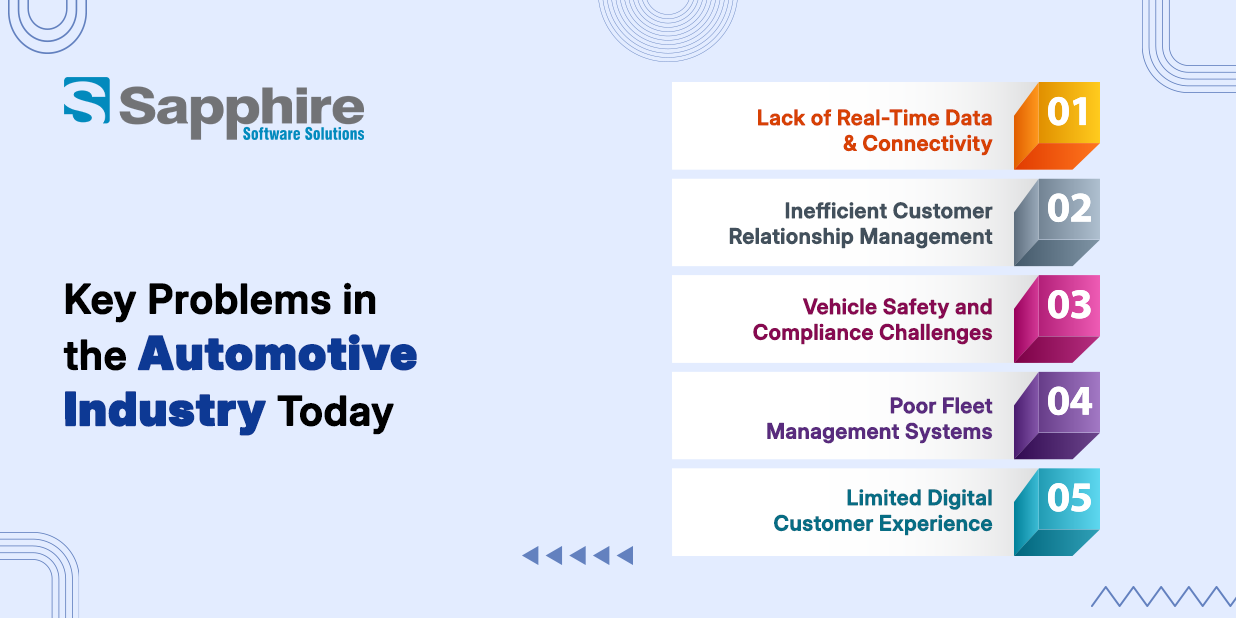
These aren't theoretical pain points. They come up in almost every honest conversation with someone running an automotive business.
1. Lack of Real-Time Data & Connectivity:
Ask a service advisor what's happening in the parts department right now and watch the hesitation. They might know. They might not. They'll probably call someone, wait, and report back. That gap - between what's happening and what the people who need to know exist at every level of most automotive operations.
2. Inefficient Customer Relationship Management:
The automotive customer relationship is genuinely complicated. Someone buys a vehicle, comes in for service a few times, goes quiet, then shows up three years later ready to trade in. Or they don't show up, and you never quite know why.
3. Vehicle Safety and Compliance Challenges:
Compliance failures rarely announce themselves in advance. They show up as penalties, recalls, or - worst case - incidents. The underlying cause is almost always the same: too much to track, not enough system to track it with.
4. Poor Fleet Management Systems:
Fleet inefficiency is genuinely hard to see clearly without the right tools. Costs creep. Routes that made sense in January don't make sense in July. A vehicle develops a pattern of small issues that individually seem minor but collectively signal something about to fail.
5. Limited Digital Customer Experience:
Here's a blunt way to think about this: if a customer can schedule a restaurant reservation, book a flight, and manage their bank account from their phone, but they have to call your service department during business hours to find out if their car is ready - that's a problem.
How do Automotive Software Development Services solve these problems?
A capable Automotive Software Developer doesn't arrive with a product to sell. They arrive with questions - about what's breaking, where decisions slow down, and what your team spends time on that they shouldn't. The solutions come from that conversation, not before it.
|
Industry Problem |
Software Solution |
Business Impact |
| Lack of real-time data |
|
|
| Poor CRM |
|
|
| Compliance issues |
|
|
| Fleet inefficiencies |
|
|
| Weak digital experience |
|
|
Real-time connectivity through IoT integration means your operation stops running on yesterday's information. Departments that used to work in isolation start sharing a live picture of what's happening - something a modern Automotive software company is uniquely positioned to design and implement effectively.
Compliance tools run in the background, monitoring requirements and flagging gaps before they become violations. Fleet platforms use AI to surface the patterns and predictions that no dispatcher, however experienced, can hold in their head simultaneously. And customer-facing digital tools - apps, portals, real-time updates - stop being a differentiator and become the baseline your customers expect.
Benefits of Automotive Software Solutions for Businesses:
- The returns from Automotive Software Development tend to show up in places businesses didn't fully expect.
- Yes, operational efficiency improves - tasks that consumed hours get automated, and accuracy goes up when human error is removed from repetitive processes. Yes, decision-making gets faster when the data behind it is current and trustworthy.
- People who spent their days chasing information and managing workarounds start spending that time on work that needs them. That changes morale, retention, and the quality of customer interactions in ways that don't always show up on a dashboard but absolutely show up in whether customers come back.
- Cost reduction follows. Fuel, labour, inventory waste, missed revenue from dropped follow-ups - the leaks close at different speeds, but they close. And modern Automotive Software Solutions are architected to scale, so growth stops being something your systems resist.
Future of Automotive Software Development:
Predicting where this goes is easier in some ways than others. Predictive maintenance moving from early adoption to industry standard - that's already happening. AI and machine learning are working their way into demand forecasting and customer behaviour analysis - also already underway. The uncertainty is about timing and scale, not direction.
Autonomous driving will keep increasing what's at stake in software quality. When code makes real-time safety decisions, "mostly works" isn't good enough. Vehicle-to-Everything (V2X) communication - cars exchanging live data with infrastructure, signals, and each other - is moving from research projects toward actual deployment in real cities. Cloud-based automotive platforms will make the flexibility that currently requires significant investment available at much lower overhead. And cybersecurity will stop being a technical concern that lives in the IT department and start being a customer trust issue that lives in the boardroom.
Why Choosing Sapphire as Your Automotive Software Development Company Is Critical for Automotive Innovation?
The difference between a development partner who understands automotive and one who doesn't show up fast - usually when the first complicated integration hits, or when a requirement that seems simple turns out to reflect twenty years of operational nuance.
Sapphire Software Solutions has worked through that complexity with real automotive businesses. Our Automotive Software Developer teams don't just bring technical skill - they bring the kind of contextual understanding that only comes from having solved these specific problems before, for businesses with real stakes riding on the outcome.
We don't build software and hand it off. We build toward outcomes - measurable, operational, tied to what your business needs to perform better. Scalable architectures, realistic timelines, honest conversations about what's achievable and what isn't.
Conclusion:
In automotive businesses today, the real competitive gap is no longer between companies that “use software” and those that don’t—it exists between those who operate with fragmented systems and those who have built connected, intelligent workflows across their entire value chain. From service bays and parts inventory to customer engagement and fleet tracking, every disconnected process quietly erodes efficiency, margins, and customer trust. The businesses that recognize this early are not just improving operations—they are reshaping how value is delivered in a highly competitive industry.
For enterprises aiming to scale sustainably, automotive software development is no longer an optional investment but a strategic enabler of growth and resilience. At Sapphire, we help automotive businesses convert operational complexity into structured digital ecosystems that support faster decisions, stronger customer relationships, and measurable cost efficiency. If your organization is ready to move beyond manual limitations and build a future-ready automotive operation, Get a Free Quote from us and start your transformation journey today.