
















Picture yourself installing a new shopping or financial services app, only to be informed some days later that your personal information has been hacked. Do you think that you will use that particular app anymore? Definitely not! It is now expected by all app users that every single mobile app should safeguard personal information, payment information, and digital identity.
Mobile Application Security is a business investment that needs to be made. Regardless of whether your business is based on an ecommerce app, a healthcare app, a fintech app, or any other services-based business, security impacts your company's profitability by helping retain customers. Those businesses that don't give importance to security end up making losses and getting into legal trouble.
What is App Security?
Mobile App Security can be defined as the measures taken, technology employed and security techniques adopted to ensure mobile apps' safety against cyber-attacks, security breaches, data thefts, virus infection and any form of vulnerability.
It covers every stage of application development, including:
- Secure coding practices
- User authentication and authorization
- Data encryption
- API security
- Secure cloud communication
- Regular security updates
- Continuous monitoring
- Vulnerability assessments
In simple terms, app security ensures that customer data stays protected while maintaining the reliability and integrity of the application.
Why Does Mobile App Security Matter?
Businesses collect valuable customer information every day, including:
- Personal details
- Payment information
- Login credentials
- Business documents
- Health records
- Purchase history
If attackers gain access to this information, the consequences extend far beyond technical damage. Businesses may face customer churn, financial penalties, lawsuits, and long-term reputation loss.
How Mobile App Security Impacts Customer Trust and Revenue?
Mobile app security plays a major role in shaping how customers view a brand. When users feel that their personal details, payment information, and online activity are protected, they are more confident about using the app and completing transactions.
Secure Apps Encourage Customer Confidence
A well-protected mobile application makes users feel safer while interacting with your business. This confidence can motivate them to create accounts, save payment details, make purchases, return frequently, and recommend the app to others.
For instance, an ecommerce app that uses secure login, encrypted payment processing, and trusted checkout systems can reduce user hesitation and improve conversion rates. Customers are more likely to complete purchases when they believe their data is handled safely.
On the other hand, poor security can quickly damage customer trust. A data breach, payment issue, or privacy concern may lead users to uninstall the app, leave negative reviews, and choose a competitor. This directly affects revenue through lost sales, lower retention, and higher recovery costs.
By investing in strong mobile app security, businesses can protect users, build long-term loyalty, improve brand reputation, and create more opportunities for revenue growth.
Revenue Depends on Customer Confidence:
Security directly affects revenue in multiple ways.
|
Strong Mobile App Security |
Weak Mobile App Security |
|
|
|
|
|
|
|
|
|
|
Businesses that invest in security often experience improved customer engagement because users feel safe interacting with the platform.
Common Mobile Application Security Risks That Affect Businesses:-
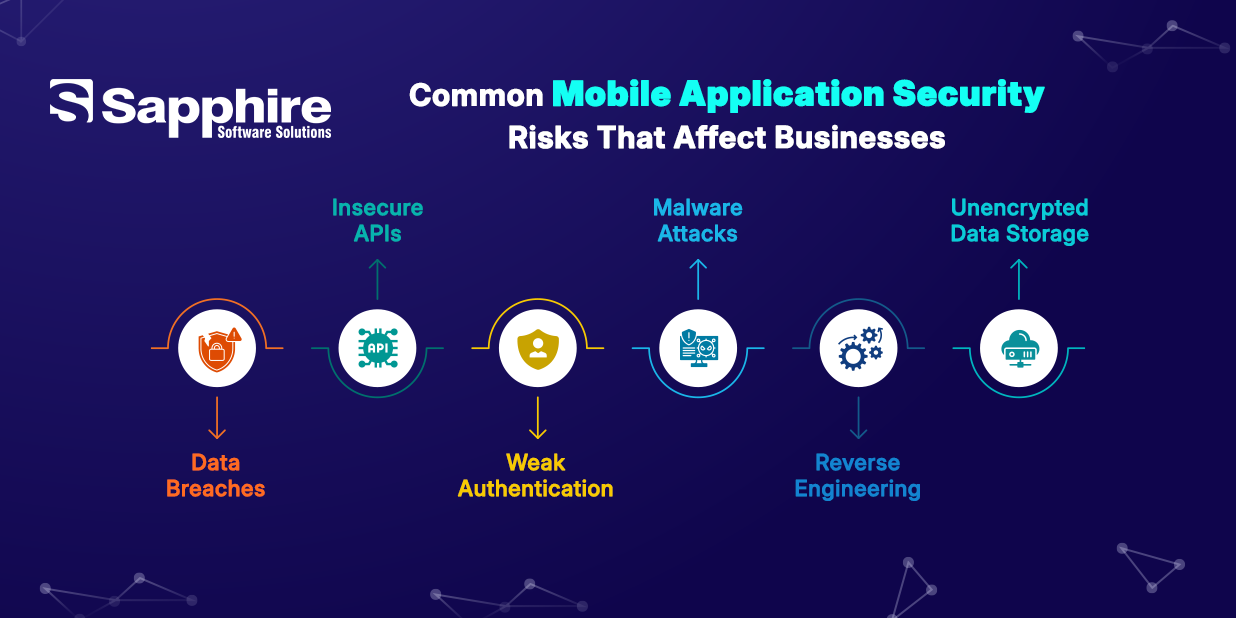
Understanding potential threats helps businesses prepare effective defense strategies.
1. Data Breaches:
Sensitive customer information can be exposed due to weak security controls.
Business Impact:
- Financial losses
- Legal penalties
- Customer distrust
2. Insecure APIs:
Most modern mobile apps rely on APIs to exchange information.
Poorly protected APIs can become easy entry points for hackers.
3. Weak Authentication:
Simple passwords and outdated login systems make unauthorized access much easier.
Adding Multi-Factor Authentication (MFA) significantly improves security.
4. Malware Attacks:
Malicious software can steal confidential business and customer information.
5. Reverse Engineering:
Attackers often analyze application code to discover vulnerabilities and exploit them.
6. Unencrypted Data Storage:
Storing customer information without encryption increases the risk of data theft if a device is compromised.
Mobile Application Security Best Practices for Business Apps:
Businesses should build security into every stage of development rather than treating it as an afterthought.
Implement Secure Authentication:
Use:
- Multi-Factor Authentication
- Biometric login
- Strong password policies
- Session management
Encrypt Sensitive Data:
Protect customer information during storage and transmission using industry-standard encryption.
Perform Regular Security Updates:
Cyber threats evolve continuously.
Regular updates help eliminate newly discovered vulnerabilities before attackers exploit them.
Secure APIs:
Implement:
- Authentication tokens
- Rate limiting
- API gateways
- Access controls
Follow Secure Coding Standards:
Developers should eliminate common vulnerabilities during development rather than fixing them after deployment.
Educate Employees:
Many cyberattacks begin with human errors.
Regular cybersecurity awareness training reduces organizational risk.
Mobile App Security Testing and Assessment for Risk Identification:
Even well-developed applications require continuous evaluation.
That's where Mobile App Security Testing becomes essential.
What is Mobile Application Security Testing?
It is the process of identifying vulnerabilities before attackers find them.
Testing evaluates:
- Authentication
- Authorization
- API security
- Code vulnerabilities
- Data storage
- Network communication
Types of Mobile Application Security Testing:
Static Application Security Testing (SAST):
Analyze source code before deployment.
Dynamic Application Security Testing (DAST):
Tests the running application for vulnerabilities.
Penetration Testing:
Security professionals simulate real cyberattacks to discover weaknesses.
Mobile Application Security Assessment:
A comprehensive Mobile Application Security Assessment evaluates the entire application ecosystem, identifying security gaps and recommending improvements before deployment.
Businesses seeking Leading Mobile App Security Testing Services often combine automated scanning with expert-led penetration testing to achieve stronger protection.
Mobile App Security Solutions for Enterprises and Growing Businesses:
Every organization has different security requirements.
Fortunately, modern Mobile App Security Solutions can be customized based on business size, industry, and compliance requirements.
Common security solutions include:
- End-to-end encryption
- Identity and access management
- Secure cloud integration
- API security monitoring
- Threat detection
- Device security management
- Continuous vulnerability scanning
- Compliance monitoring
For enterprises managing thousands of users, automated monitoring helps detect suspicious activities before they become serious incidents.
Growing businesses benefit from scalable security solutions that expand alongside their applications without disrupting user experience.
Choosing the Right Mobile App Security Partner for Long-Term Protection:
Technology alone cannot guarantee application security.
Businesses need experienced security professionals who understand modern attack methods, regulatory requirements, and secure development practices.
When selecting a security partner, consider:
- Proven experience in Mobile App Security
- Expertise across Android and iOS platforms
- Regular vulnerability assessments
- Compliance support
- Continuous monitoring and maintenance
- Transparent reporting and recommendations
A reliable security partner works proactively, helping businesses identify risks before they impact customers.
Expert Tips:
- Integrate security from the planning stage instead of after development.
- Schedule regular penetration testing for every major release.
- Encrypt all sensitive customer data, both at rest and in transit.
- Keep third-party libraries updated to reduce vulnerabilities.
- Monitor application activity continuously for suspicious behavior.
Common Mistakes to Avoid:
- Ignoring security until after launch.
- Using outdated software components.
- Weak password and authentication policies.
- Skipping regular security testing.
- Storing sensitive data without encryption.
- Neglecting API security.
- Failing to educate employees about cybersecurity risks.
Future Trends:
The future of Mobile App Security is evolving rapidly as cyber threats become more advanced. Businesses are increasingly adopting AI-powered threat detection, Zero Trust security models, behavioral analytics, biometric authentication, and automated vulnerability management. DevSecOps practices are also becoming standard, allowing security to be integrated throughout the software development lifecycle rather than added at the end. Organizations that embrace these innovations will be better equipped to protect customer data, maintain regulatory compliance, and build lasting trust.
How Sapphire’s Enterprise Application Security Services Strengthen Mobile App Security and Business Growth?
Strong security requires more than implementing a few protective features—it demands a comprehensive strategy that evolves alongside your business. Sapphire Software Solutions helps organizations build secure mobile applications by combining secure development practices, advanced threat detection, continuous monitoring, and comprehensive security assessments.
Our Enterprise Application Security Services focus on identifying vulnerabilities early, protecting sensitive business and customer data, securing APIs, implementing industry-standard encryption, and conducting thorough Mobile Application Security Testing. This proactive approach helps businesses minimize security risks, improve compliance, strengthen customer confidence, and reduce the likelihood of costly cyber incidents.
Whether you're launching a new mobile application or improving the security of an existing one, our team delivers scalable security solutions designed to support long-term business growth while ensuring a seamless user experience.
Conclusion:
Customer trust isn't won through innovative features alone—it's earned through uncompromising mobile app security. Every secure login, transaction, and interaction reinforces user confidence, helping businesses protect sensitive data, strengthen their brand reputation, and build lasting customer relationships that fuel sustainable revenue growth.
At Sapphire Software Solutions, we deliver comprehensive Enterprise Application Security Services to help businesses develop secure, high-performing mobile applications. From advanced security testing and vulnerability assessments to API protection and continuous monitoring, our experts ensure your app remains resilient against evolving cyber threats. Looking to secure your mobile application and build greater customer trust? Get a Free Quote today and discover how our tailored security solutions can support your long-term business success.