















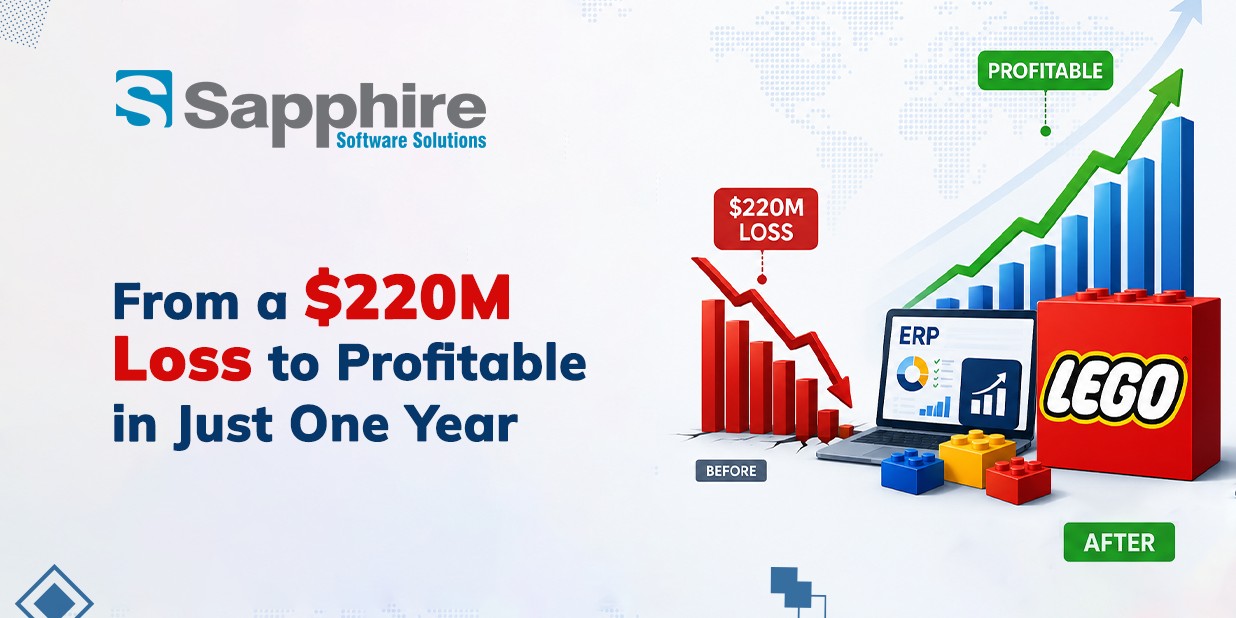
Sales numbers look fine on a dashboard. Warehouses look full. Everything seems to be moving. Then someone finally pulls the real numbers together, and it turns out the company lost hundreds of millions of dollars that year — and nobody saw it coming because nobody had the visibility to see it at all.
That's not hypothetical. It's exactly what happened to LEGO in 2003, and it's the reason this article exists. But the real subject here isn't LEGO. It's the thing that pulled LEGO back from the edge: enterprise resource planning and supply chain software — the unglamorous systems that quietly decide whether a growing business stays in control of itself or slowly loses track of where its money is going.
The Problem Every Growing Business Eventually Hits:
Growth creates complexity. More products, more warehouses, more suppliers, more regions — every one of those adds another moving part that has to be tracked, planned, and reconciled. Most companies handle this with a patchwork of spreadsheets, disconnected software, and institutional memory held together by a few key employees.
For a while, that worked. Then it doesn't.
This is precisely the trap LEGO fell into. Through the late 1990s and early 2000s, the company expanded into theme parks, clothing, video games, and dozens of new product lines. The growth looked strong from outside. Internally, almost nobody could say with confidence which products were profitable, how much inventory sat where, or which parts of the business were quietly bleeding cash.
The numbers tell the story:
- LEGO was managing close to 13,000 unique components; many needing their own dedicated manufacturing tooling for every size and color.
- The company's supply chain systems were, by its own later admission, roughly a decade behind where they needed to be.
- Inefficiency was estimated to cost the company around $337,000 in lost value every single day.
- By 2004, profit margins had collapsed to roughly -30%.
None of this was a product problem. It was a visibility problem — the exact gap that enterprise resource planning software and supply chain management systems exist to close. Without that infrastructure, a business is essentially flying blind while assuming it has a clear view.
What ERP and Supply Chain Software Actually Do?
This is the part that rarely gets the credit it deserves, because it isn't flashy. A modern ERP system doesn't sell a single product or win a single customer on its own. What it does is give a business something more valuable: an accurate, current, connected picture of itself.
In practice, that means:
- Real-time inventory tracking, so leadership knows what's in stock, what's moving, and what's dead weight — not what a report said three weeks ago.
- Centralized data across procurement, production, and sales, replacing five disconnected spreadsheets with one source of truth.
- Demand forecasting and supply chain optimization, so purchasing and production decisions are based on actual patterns instead of guesswork.
- Early warning signals, flagging when a product line, region, or supplier relationship starts underperforming before it shows up as a loss on the balance sheet.
This is exactly the kind of system a serious ERP Development Company solves— not a generic off-the-shelf dashboard, but a platform shaped around how a specific business operates. Without it, a company can be growing in revenue and losing money at the same time, for months, without anyone noticing until the damage is already done.
Proof It Works: What Happened When LEGO Got Its Systems in Order?
LEGO didn't recover because of a new toy line or a marketing campaign. It recovered because, starting in 2004 under new CEO Jørgen Vig Knudstorp, the company rebuilt its operational backbone. Unique parts were cut from roughly 13,000 down to about 7,000 — a decision that only makes sense once software can show which parts earn their keep. Inventory and production data moved much closer to real time. Non-core ventures were sold off, freeing up both cash and management attention. Growth was no longer funded by default; it had to be justified with data.
The results speak for themselves:
- 2004: LEGO reports a loss of roughly $320 million — the worst in company history.
- 2005: LEGO returns to profit, posting a net profit of about $81 million, with revenue up 12%.
- 2006: Profit climbs a further 240% over the previous year, and operating margin reaches 15.6%.
- 2007–2015: LEGO sustains around 21% average annual sales growth and 36% average annual profit growth — eight consecutive years.
- Today: LEGO reports annual revenue north of $10 billion and stands as the most profitable toy company in the world.
One year. That's the distance between LEGO's worst financial year on record and its return to profit — not because the market shifted, but because the business finally had the operational visibility; it had been missing for years.
Why This Matters for Businesses That Aren't LEGO?
It's tempting to read this and assume it only applies to companies operating at LEGO's scale. That's the wrong takeaway. The gap LEGO fell into — growth outpacing the systems meant to manage it — happens just as easily to a regional distributor, a mid-sized manufacturer, or a multi-location retailer. Revenue climbs, product lines multiply, warehouses fill up, and the systems tracking all of it quietly fall behind. Nobody notices until margins start shrinking for reasons that are hard to pin down.
Closing that gap is exactly what a Supply Chain Software Development Company is built to do — not by selling a generic tool, but by building the specific tracking, forecasting, and integration of a business needs as it scales. A properly built system delivers:
- One connected view across inventory, procurement, and fulfillment
- Warehouse management that scales with volume instead of breaking under it
- Faster, more accurate decisions because the data is current, not weeks old
- The operational foundation that lets a business grow without its internal chaos growing right alongside it
LEGO had to learn this lesson under real financial pressure, with the company's survival genuinely on the line. Most businesses get the chance to invest in ERP and supply chain software before it becomes a crisis — which is the entire case for doing it now, rather than waiting for a bad year to force the decision.
The Real Takeaway:
LEGO's comeback usually gets told as a brand story — a company that rediscovered what made it special. That's true, but it's not the whole story. The simplification, the focus, the discipline — none of it would have been possible without the underlying systems that finally let LEGO's leadership see their own business clearly. The software came first. Everything else followed by it.
If you can say, with confidence, exactly where every dollar in your supply chain is right now, you're in a small minority of businesses. If you can't, LEGO was in that same position back in 2003 — and the fix wasn't a bigger team or a better product. It was a better system.
This is the exact gap Sapphire Software Solutions works with growing businesses to close. As an IT company focused on ERP and supply chain software development, we builds systems designed around how a business actually operates, not a generic template it has to bend around — giving leadership the same kind of real-time visibility that turned LEGO's turnaround around in a single year.
Stay updated for more real-world case studies on how the right technology decisions quietly reshape entire businesses — because the next turnaround story could be yours.