
















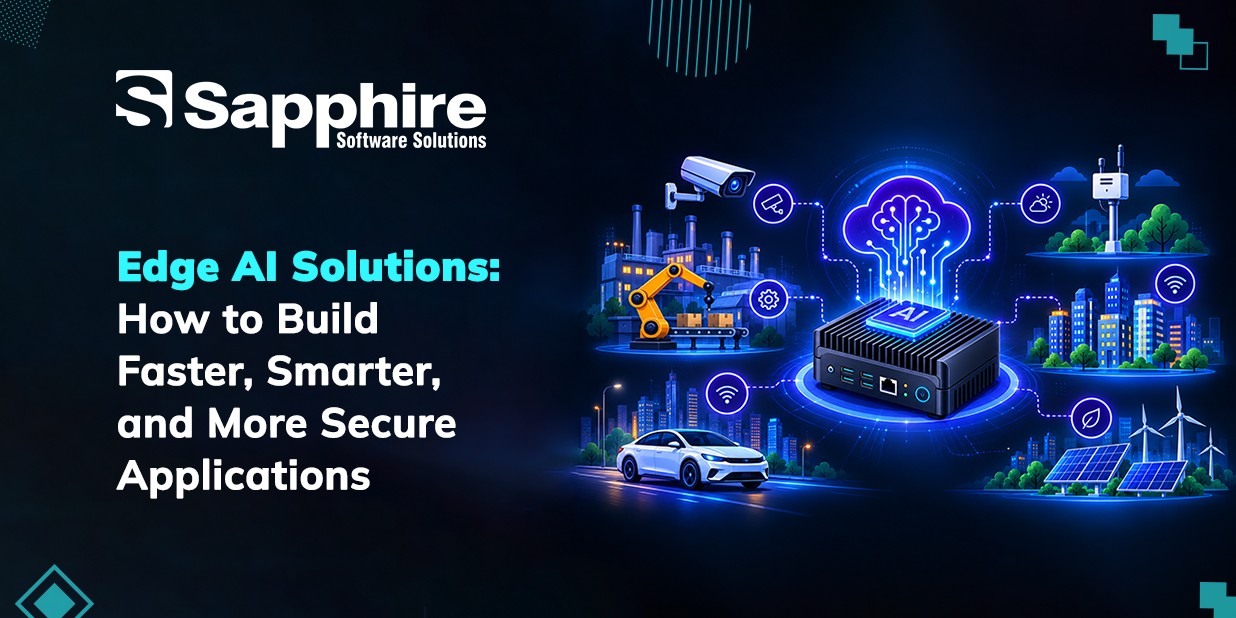
Businesses developing intelligent applications need faster data processing, real-time insights, and greater control over sensitive information. Edge AI Solutions in App Development enable organizations to process data closer to its source, reduce latency, minimize reliance on cloud infrastructure, and make faster, data-driven decisions. However, building effective edge AI applications requires more than selecting the right AI model; it also involves hardware optimization, efficient application architecture, robust security measures, and continuous performance monitoring to ensure reliability and scalability.
Working with an experienced Edge AI Company helps businesses transform these capabilities into practical, industry-specific applications that support operational efficiency and long-term growth. From healthcare systems that analyze connected-device data locally to manufacturing solutions that identify equipment anomalies and retail applications that deliver personalized customer experiences, edge AI enables smarter business operations. Sapphire helps businesses explore technology-driven solutions that align with their objectives, improve application performance, and support digital transformation through secure and efficient development.
What Is Edge AI and How Does It Work?
Edge AI integrates artificial intelligence and edge computing capabilities to ensure that AI models can work with the data collected right on-site or on nearby devices. Unlike the cloud-based AI, an application can process only required AI tasks locally to provide instant results without the need to transfer all pieces of information to a central server. This feature is important for applications that require low latency, less dependency on the network, or greater control over data transmission.
Typically, it consists of the following steps:
1. Data Gathering
An application gathers information from sensors, cameras, mobile devices, connected devices, or other information sources. A smart camera, for instance, can gather images, while a smart watch can collect data about your movements and activities.
2. Information Processing
The collected data is analyzed on-site or within a nearby computing device depending on the specific application. In some cases, the device filters unnecessary information, prepares inputs, or directly runs an AI model.
3. Inference of an AI Model
The trained model analyzes the information and generates prediction, classification, detection, or recommendation. A manufacturing device, for instance, may identify unusual vibration patterns that indicate a possible equipment problem.
4. Immediate Action
The application uses the model's output to trigger an appropriate response. This might involve generating an alert, adjusting a device setting, or displaying information to the user.
5. Optional Cloud Synchronization
When necessary, the application can send selected results to cloud infrastructure for long-term storage, centralized reporting, model updates, or deeper analysis.
Why Are Businesses Looking into Edge AI Solutions?
Businesses are considering Edge AI Solutions due to the fact that many digital applications now need more than just simple data processing. They should be able to analyze data fast, work reliably, and adapt to changes in conditions without relying fully on distant infrastructure.
For companies that develop connected products or intelligent applications, such features can prove valuable in terms of operational benefits.
1. Improved Application Performance
Cloud-based AI requires sending data to distant infrastructure and waiting for the reply. The quality of networks, distances to servers, and traffic can affect speed. Local processing of data allows minimizing these lags, which makes Edge AI a good choice for applications related to industrial monitoring, object detection, interactive devices, and time-sensitive notifications.
2. Lower Dependency on Networks
Every company does not work in conditions of constant internet connection. Warehouses, factories, distant locations, and field operations may have unstable network connections. The applications enabled by Edge technology can continue doing their functions when cloud connection is lost temporarily.
3. More Control over Sensitive Data
Organizations handling confidential information may prefer to process certain data locally instead of transmitting it to external servers. For example, a device may analyze an image locally and transmit only the resulting classification. This can reduce unnecessary data exposure, although local processing still requires appropriate security controls.
4. Lower Data Transmission Requirements
Applications that continuously process video, sensor readings, or other high-volume information can generate substantial network traffic. Edge AI can filter information and transmit only relevant events or summaries, potentially reducing bandwidth consumption and associated infrastructure costs.
5. Improved Operational Reliability
When designed appropriately, edge applications can perform essential functions without requiring a continuous connection to centralized services. This can be particularly valuable for businesses where operational interruptions affect productivity, customer experience, or equipment safety.
Key Responsibilities of an Edge AI Engineer
1. Choosing Right Models
Here, the engineer determines whether there is a right existing model that satisfies the accuracy, speed, and other constraints of the application. It means that there may be no use of large models as they can be too expensive and take too much time for the computing resources available.
2. Optimizing Models
The engineer applies such methods as quantization, pruning, and hardware-aware optimization to either shrink the model or make inference faster. The thing about such approaches is that they need validation as they might influence accuracy.
3. Integrating Models with Applications
Here, the engineer cooperates with application developers to implement inference in mobile applications, embedded systems, and local computing platforms.
4. Testing the Performance on Actual Devices
It is necessary to test the performance of models on the actual device rather than a fast development computer.
5. Applying Security Measures
Engineers cooperate with security and platform teams to secure models and their updates on the devices.
6. Monitoring the Deployment
Deployed models need maintenance and even update due to various reasons.
Challenges Business Should Consider Before Using Edge AI
Despite obvious advantages offered by Edge AI Solutions, successful deployment calls for careful preparation. The business should be aware of possible limitations of technology beforehand.
1. Hardware Limits
Edge computing devices tend to have lower processing power, memory, and storage compared to cloud servers. In some cases, they might even have to be compressed, optimized, or replaced with smaller devices.
2. Model Optimization Challenges
Optimization of the model through its downsizing improves performance. But it may lead to a decrease in accuracy as well. It is important to compare an optimized model with a real-life dataset.
3. Device Management on Distributed Level
It is rather simple to manage just a few devices. But it is much more complicated to handle thousands of devices spread over different branches, factories, vehicles, customers etc.
4. Security of Multiple Endpoints
Each new device becomes another piece of equipment to be secured. It becomes vulnerable due to loss, lack of updates, insecure updates, weak authentication, etc.
5. Implementation Costs
Edge AI may require specialized hardware, model optimization, device integration, and additional testing. These expenses should be evaluated against expected savings in cloud processing, bandwidth, downtime, or operational effort.
How to Reduce These Risks: -
- Begin with a clearly defined business use case.
- Test a small pilot on representative hardware.
- Define performance and accuracy of targets before deployment.
- Establish security, monitoring, and update procedures.
- Compare total lifecycle costs rather than only initial development costs.
- Plan for human oversight when AI outputs affect important decisions.
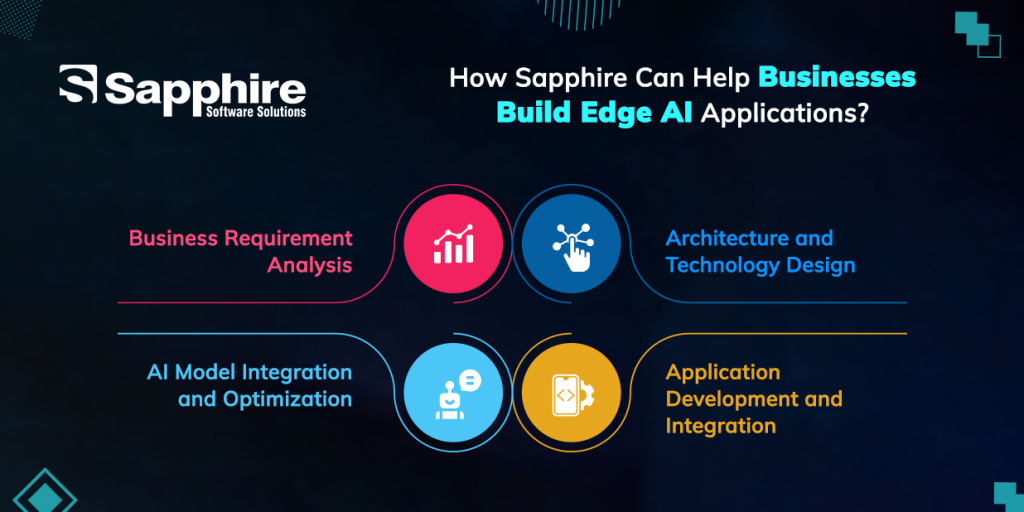
How Sapphire Can Help Businesses Build Edge AI Applications?
1. Business Requirement Analysis
Before development, it is important to understand who the users are, in what conditions the application will operate, the required reaction time, sources of data, and evaluation criteria. It will help to determine if edge computing is needed and what tasks should be left in the cloud.
2. Architecture and Technology Design
The architecture of the application can be built considering features of the target devices and the systems available within the company. Depending on the task, it can include on-device inference, local gateways, cloud synchronization, or hybrid approach, where processing is distributed between multiple environments.
3. AI Model Integration and Optimization
Available models of artificial intelligence can be analyzed for their precision, speed, memory consumption, and compatibility with hardware. If necessary, optimization can be performed for the specific target environment. The goal is to reach a balance between the performance of the model and the resources it consumes.
4. Application Development and Integration
Edge artificial intelligence functionality can be added to mobile apps, web-based solutions, enterprise systems, and device software. Integration planning must guarantee smooth communication between local inference, cloud infrastructure, and company processes.
Conclusion
Implementing Edge AI Solutions requires the right combination of AI expertise, application architecture, hardware optimization, and security planning to deliver measurable business value. From reducing application latency and improving operational reliability to strengthening data privacy and optimizing infrastructure costs, edge AI enables businesses to build intelligent, scalable, and future-ready applications. Partnering with an experienced Edge AI Developer can help organizations overcome technical challenges, streamline operations, and align AI capabilities with their long-term business objectives.
At Sapphire Software Solutions, we help businesses explore and develop AI-powered applications tailored to their operational requirements and growth goals. Whether you want to build a new edge AI application or integrate intelligent capabilities into your existing software, our team can help you identify the right technology approach for your needs. Get a Free Demo to explore how our IT services and AI development expertise can help your business improve application performance, enhance operational efficiency, and unlock new opportunities for growth.