
















Artificial Intelligence is revolutionizing the way organizations operate in today’s digital economy, enabling businesses to work smarter, faster, and more efficiently. From automating routine tasks to delivering predictive insights, AI empowers companies to enhance productivity, improve customer experiences, and uncover new growth opportunities. Globally, organizations are investing heavily in intelligent technologies, recognizing that successful AI adoption is a strategic priority rather than just a technological upgrade. Implementing AI effectively requires more than installing software—it demands strategic planning, robust data infrastructure, and a clear understanding of business goals to ensure initiatives can scale and deliver meaningful results.
Businesses that integrate AI thoughtfully can significantly improve decision-making, reduce operational costs, and gain a competitive edge in their industries. However, organizations often face challenges such as data quality issues, a lack of skilled talent, and unclear objectives, which can hinder AI success. Following best practices—such as defining clear goals, building strong data foundations, and fostering a culture of continuous learning—can help companies navigate these challenges and realize the full potential of AI, turning it into a transformative force for sustainable growth and innovation.
What is AI Adoption?
Artificial intelligence adoption refers to the process of integrating AI technologies into business operations, products, and services to improve efficiency, innovation, and decision-making. It involves identifying use cases where AI can deliver value and then implementing intelligent solutions to solve real-world business problems.
Today, AI adoption in business can be seen in many forms. Companies use AI-powered chatbots to improve customer support, predictive analytics to forecast demand, and machine learning algorithms to detect fraud or optimize supply chains.
The process of adopting AI usually involves several stages:
- Identifying business challenges that AI can solve
- Collecting and preparing high-quality data
- Developing machine learning models
- Integrating AI tools into existing systems
- Continuously monitoring and improving performance
Successful adoption requires both technological readiness and cultural transformation. Businesses must ensure that teams understand the value of AI and are willing to embrace data-driven decision-making.
Benefits of AI Adoption for Businesses:
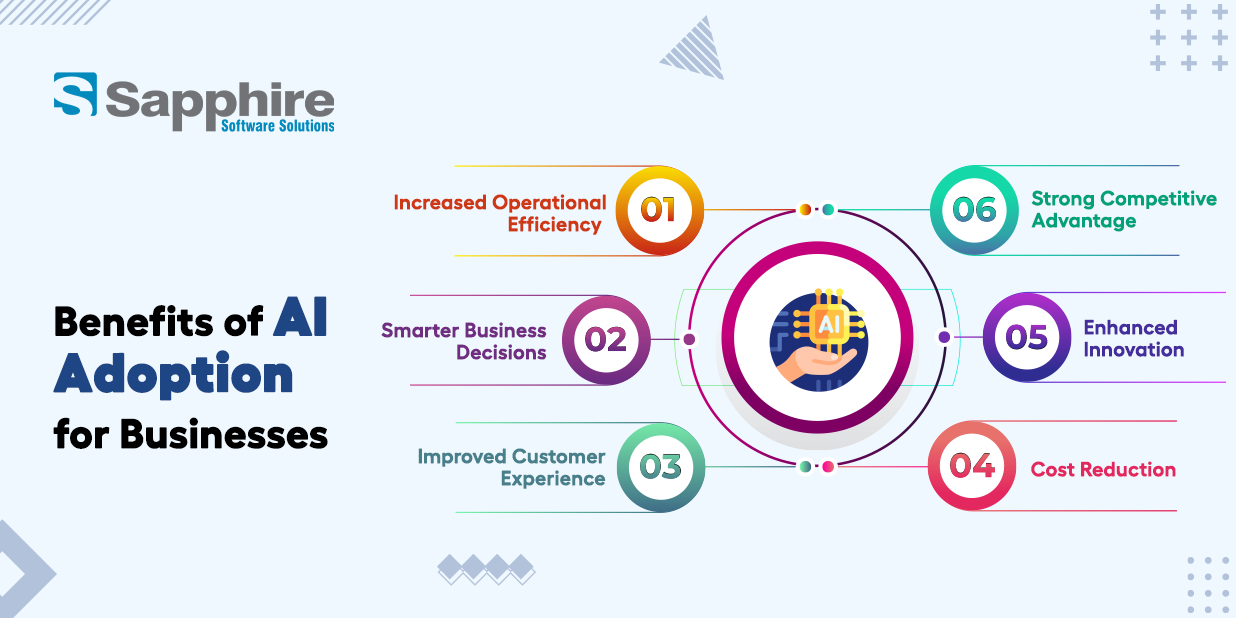
Organizations that successfully implement AI technologies can unlock significant benefits across multiple business functions.
- Increased Operational Efficiency: AI enables businesses to automate repetitive and time-consuming tasks. This reduces manual workload and allows employees to focus on strategic activities that require human creativity and critical thinking,
- Smarter Business Decisions: AI systems analyze massive datasets in seconds, helping leaders identify trends and insights that would otherwise remain hidden. This allows businesses to make faster and more informed decisions.
- Improved Customer Experience: AI-driven solutions enable businesses to personalize customer interactions. Recommendation engines, chatbots, and predictive support tools help companies deliver faster and more accurate services.
- Cost Reduction: Automation and predictive analytics help organizations reduce operational costs by optimizing resource usage and preventing unnecessary expenses.
- Enhanced Innovation: AI technologies enable businesses to experiment with new products, services, and solutions more quickly. This accelerates innovation and opens the door to new revenue streams.
- Strong Competitive Advantage: Companies that adopt AI early often outperform competitors because they can respond faster to market changes and customer demands.
Top Challenges Companies Face During AI Adoption:
While the benefits of AI are significant, many organizations encounter obstacles during implementation. Understanding these AI adoption challenges can help businesses prepare more effectively.
- Lack of High-Quality Data: AI models depend heavily on clean and well-structured data. Poor data quality can significantly reduce the accuracy and effectiveness of AI systems.
- Integration with Legacy Systems: Many organizations still rely on outdated IT infrastructure. AI integration in business with legacy systems can be complex and time-consuming.
- Shortage of Skilled Talent: The demand for AI professionals such as data scientists and machine learning engineers is growing rapidly, making it difficult for companies to find experienced specialists.
- High Implementation Costs: Building AI solutions requires investment in infrastructure, tools, and skilled professionals, which can be challenging for smaller organizations.
- Organizational Resistance to Change: Employees may worry that AI will replace their roles. Without proper communication and training, resistance can slow down adoption efforts.
Creating a Winning AI Adoption Strategy:
A well-defined AI adoption strategy helps organizations implement AI technologies efficiently while minimizing risks.
- Start with Clear Business Goals: Companies should identify specific problems they want AI to solve. Clear objectives ensure that AI initiatives remain aligned with business priorities.
- Identify High-Impact Use Cases: Instead of implementing AI across all departments at once, organizations should begin with projects that deliver quick and measurable results.
- Build a Strong Data Foundation: Reliable data infrastructure is essential for successful AI projects. Businesses must invest in data collection, storage, and governance systems.
- Encourage a Data-Driven Culture: Leadership should promote a culture where employees rely on data insights when making business decisions.
- Monitor and Improve AI Systems: AI models require continuous monitoring and updates to maintain accuracy and performance.
AI Adoption Frameworks That Work:
Implementing AI effectively often requires a structured AI adoption framework that guides organizations through each stage of the process.
- Identify Opportunities: Businesses evaluate processes and identify areas where AI can create the most value.
- Prepare Infrastructure: This stage focuses on data preparation, infrastructure development, and compliance planning.
- Develop AI Models: Data scientists and engineers build and train machine learning models using available datasets.
- Deploy AI Solutions: Once validated, AI systems are integrated into existing business operations.
- Scale Across the Organization: Successful projects are expanded across departments to maximize business impact.
Following a structured framework helps companies move from experimentation to large-scale implementation.
AI Adoption Across Industries:
Artificial intelligence for business
is transforming nearly every industry, and AI adoption by industry continues to accelerate.
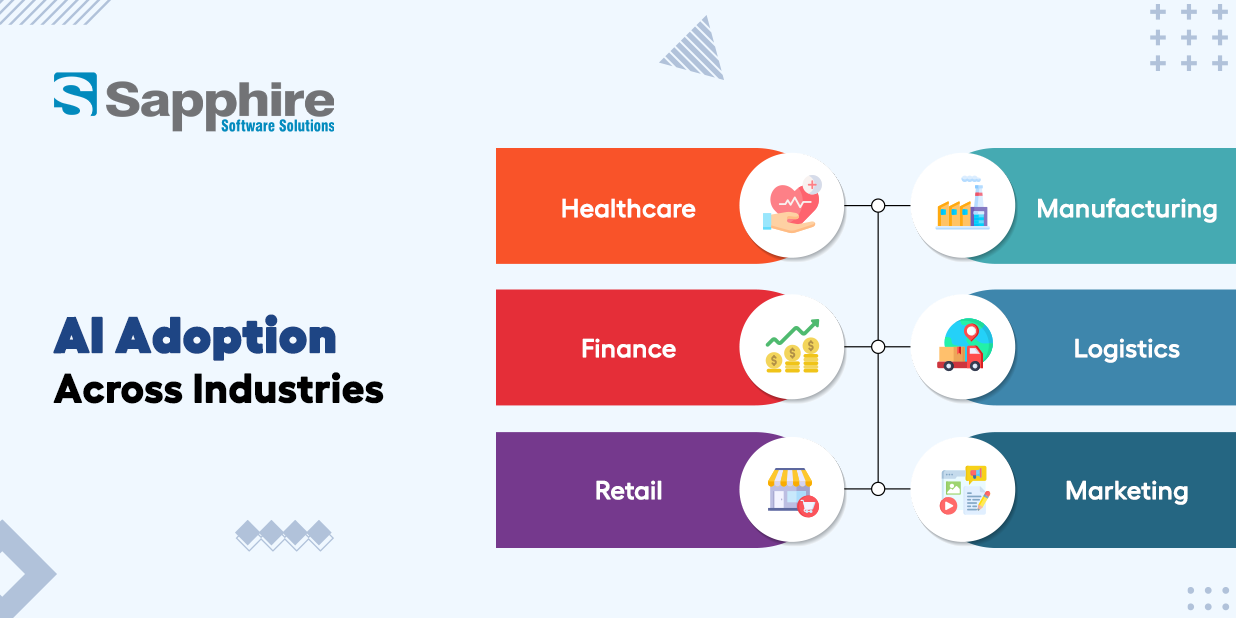
- Healthcare: AI is used for medical image analysis, disease prediction, and personalized treatment planning.
- Finance: Financial institutions use AI to detect fraud, automate trading, and improve risk assessment.
- Retail: Companies use AI for customer behavior analysis, demand forecasting, and personalized marketing.
- Manufacturing: AI-powered robotics and predictive maintenance systems improve production efficiency and reduce downtime.
- Logistics: AI optimizes supply chains by predicting demand, improving route planning, and reducing delivery delays.
- Marketing: AI tools analyze customer data and automate campaigns, enabling highly personalized marketing strategies.
Hiring the Right Talent for AI Success:
Technology alone cannot guarantee successful AI implementationAI implementation for businesses. Skilled professionals are required to design, develop, and manage AI systems effectively. Many businesses choose to hire AI Developer teams with specialized expertise in machine learning, data science, and AI engineering.
Key roles in AI development include:
- Data Scientists
- Machine Learning Engineers
- AI Architects
- Data Engineers
- AI Product Managers
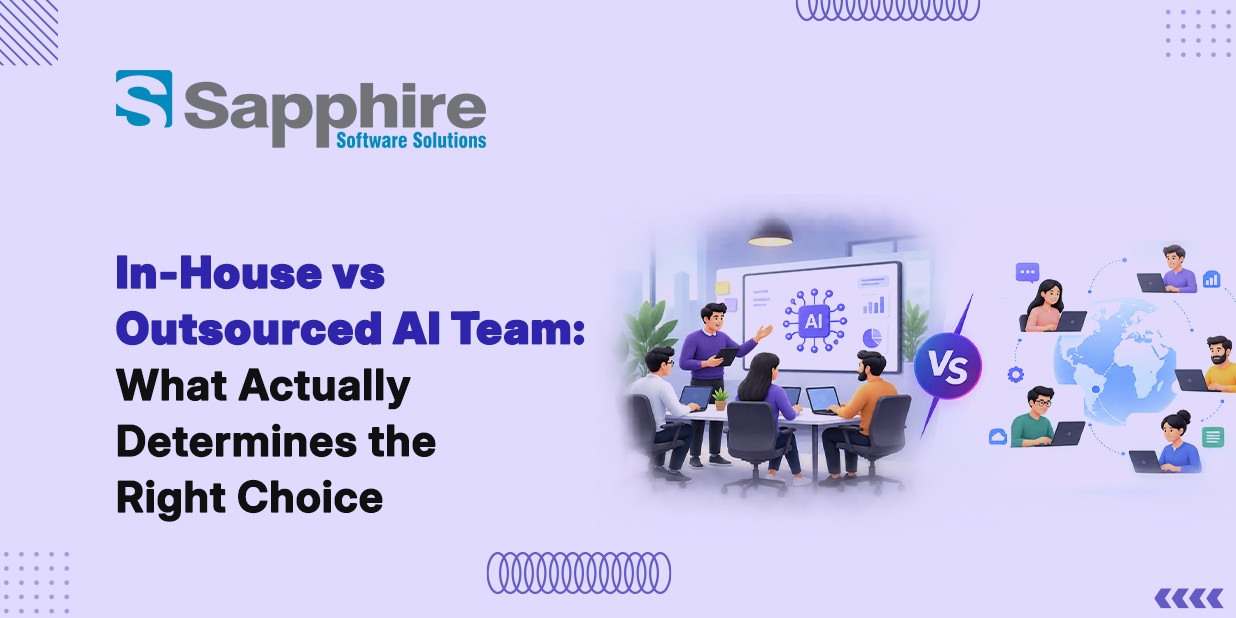
Organizations can build in-house teams or collaborate with external experts to accelerate AI innovation.
Future Trends in AI Adoption:
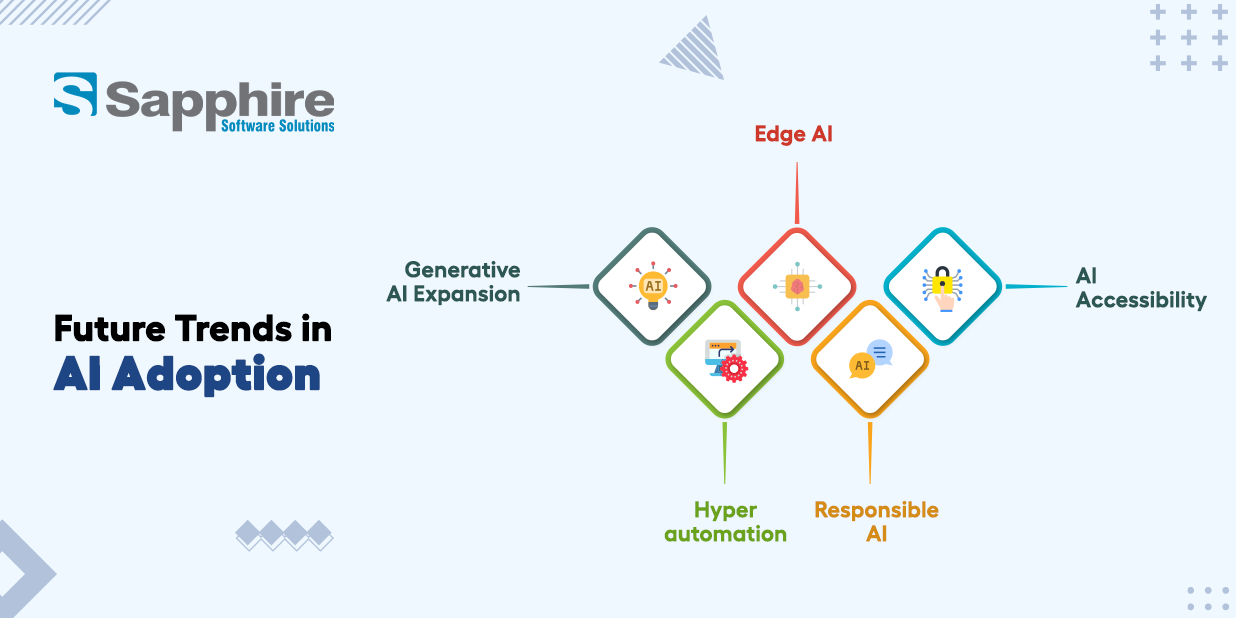
The future of artificial intelligence is evolving rapidly. Businesses should keep an eye on emerging trends that will shape the next phase of digital transformation.
- Generative AI Expansion: Generative AI technologies transform content creation, design, and software development.
- Hyper automation: Businesses combine AI with robotic process automation to automate complex workflows.
- Edge AI: AI processing is moving closer to devices, enabling real-time decision-making in industries like healthcare and manufacturing.
- Responsible AI: Organizations are focusing on transparency, fairness, and ethical AI practices.
- AI Accessibility: Low-code AI platforms make artificial intelligence accessible even to companies with limited technical expertise.
Why Sapphire is the Top Enterprise AI Development Company for Your Business?
Choosing the right development partner is critical for successful AI implementation, and Sapphire Software Solutions has earned a strong reputation as a Top Enterprise AI Development Company by delivering advanced, tailored AI solutions that drive digital transformation. With extensive experience in enterprise technologyEnterprise AI adoption, Sapphire offers customized AI services, including machine learning development, predictive analytics, AI-powered automation, and intelligent application development, catering to the unique needs of businesses across industries. Their focus on scalable, secure, and high-performance AI solutions ensures seamless integration with existing systems, while their combination of technical expertise and strategic insights helps organizations accelerate innovation, improve operational efficiency, and achieve measurable business results.
Conclusion:
Artificial intelligence is reshaping the future of business by enabling smarter operations, improved customer experiences, and faster innovation. Organizations that successfully integrate AI technologies can unlock powerful opportunities for growth and efficiency. However, implementing AI requires careful planning, strong data infrastructure, and skilled professionals. Businesses must address technical challenges, develop strategic roadmaps, and adopt structured frameworks to maximize the value of AI investments.
As digital transformation continues to accelerate, AI will become an essential tool for organizations seeking long-term success. Companies that embrace AI today will be better prepared to adapt to changing market conditions, drive innovation, and maintain a competitive edge in the global marketplace.