















All successful startups today—from leading SaaS platforms to innovative mobile apps—share one key trait: they started with a focused, simple concept. Rather than launching a fully featured, polished product, they began with a smaller, faster solution known as a Minimum Viable Product (MVP). This approach allows startups to test ideas, validate market demand, and iterate quickly, making MVP development for startups a critical step in turning concepts into successful products.
Startups face unique challenges, including tight budgets, uncertain markets, aggressive timelines, and pressure from investors and early users. Launching a full-scale product too early can result in wasted time, high costs, and solutions that miss the mark with users. An MVP enables entrepreneurs to validate assumptions, gather real user feedback, and refine their product without the high costs of full-scale development.
With the adoption of Lean methodologies, Agile frameworks, and rapid prototyping tools, MVP development has evolved from a trial-and-error experiment into a structured, strategic process. Today, specialized MVP development services for startups help businesses minimize risks, accelerate time-to-market, and achieve their goals efficiently, making it easier for startups to transform ideas into validated, market-ready products.
What Is an MVP and Why Startups Can’t Afford to Skip It?
An MVP is an acronym for Minimum Viable Product (MVP), and it refers to the most minimal version of a product that provides users with its core value while also allowing for maximum output in terms of time, effort, and cost expended in creating it. To be clear, the focus of Startups MVP is not about creating a “cheap” product; rather, it is about gaining a competitive edge by gaining access to information that will allow them to make better decisions about their products.
For new entrepreneurs, building the wrong product is a much bigger risk than building slowly. The MVP provides Startups with an opportunity to get a physical product into the hands of users as soon as possible. Rather than relying on their best guess as to what customers want, they will be able to collect actual user feedback, usage statistics, and preferences to help refine the next round of product development.
Given the current financial situation in the economy, Startups cannot afford to forgo developing their MVPs. Developing an MVP first allows companies to minimize their investment of cash (i.e., applying capital toward product development) while maximizing the amount of information gained from trial and error. Investors are also more likely to invest in Startups that show varying degrees of traction, user activity, and validation than they are in Startups that do not. All of which are provided through an MVP.
MVP Development for Startups: Common Mistakes Founders Make
One of the most common mistakes is building an MVP that is too complex. Entrepreneurs tend to create an MVP that is a scaled-down version of the final product, packing it with features that are not necessary for MVP development. This not only increases the time and cost of development but also makes it unnecessarily complex, thus negating the point of an MVP. The right MVP for Startups should concentrate on one problem and one user's flow.
Another mistake is not paying heed to user feedback. Some startups develop an MVP but do not pay attention to user behavior or adjust accordingly. An MVP that is not developed upon is simply an unfinished product. The right approach to Startup MVP Development is to have constant feedback loops and make decisions based on data.
Another common mistake that entrepreneurs make is that they choose the wrong technology stack. Using a technology stack that is too complex or not scalable can hinder the development process. An MVP should focus on being fast and agile, not perfect.
Choosing the Right MVP Type for Your Startup Ideas:
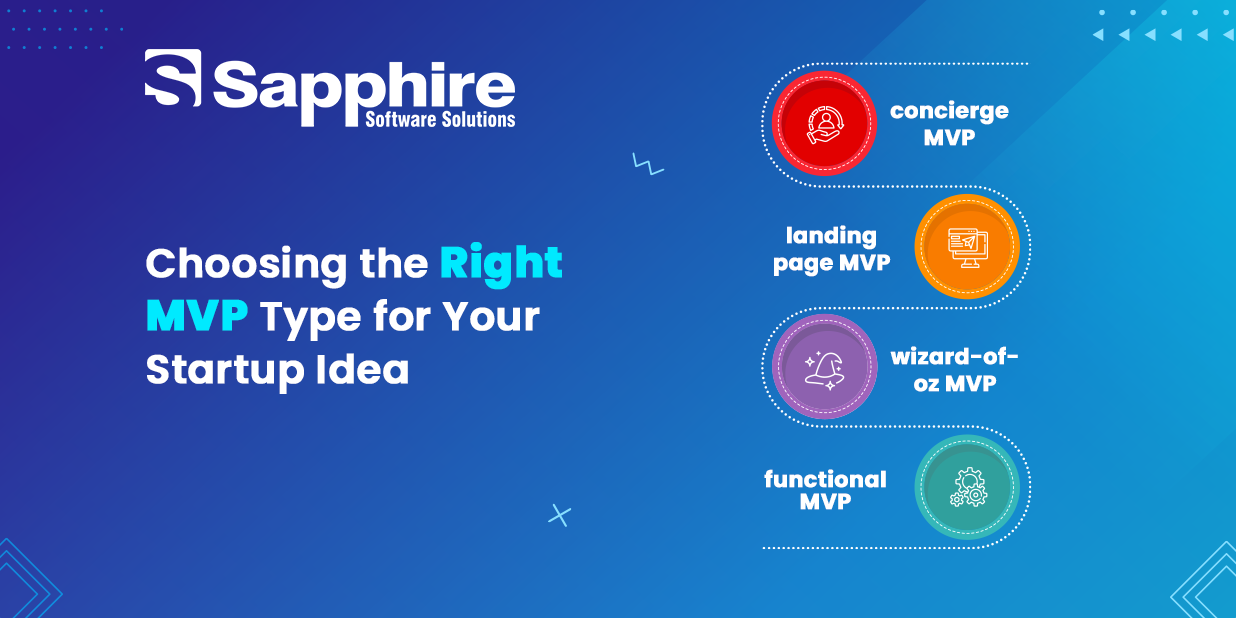
Not all MVPs are created equal, and it is important to select the correct type of MVP to develop your startup effectively. The best MVP is the one that helps you validate your riskiest assumption with the least amount of effort.
- Concierge MVP is where the service is delivered by hand before automating it. This type of MVP is best suited for service startups that want to validate demand and workflows without writing code.
- Landing page MVP is where the focus is on validating interest rather than functionality. Startups use marketing pages, waitlists, or sign-up forms to validate demand before developing.
- Wizard-of-oz MVP is where the system seems fully automated to the user, but is driven by manual processes in the background. This type of MVP is best suited for startups that want to validate user behavior without building complex systems upfront.
- Functional MVP, also used in MVP App Development, includes key functionality that is required for actual usage. This type of MVP is best suited for scenarios where user interaction and data collection are required for validation.
Feature Prioritization: What to Build First and What to Ignore
Prioritizing features is one of the most difficult aspects of Startup MVP Development. Entrepreneurs find it difficult to choose what to implement and what to defer, especially when ideas continue to change.
- The first rule of MVP feature prioritization is this: implement only what validates your hypothesis. Each feature must validate your key value proposition. If it doesn’t, it shouldn’t be in your MVP.
- One of the best ways to prioritize features in your MVP is through Moscow analysis—Must-have, Should-have, Could-have, Won’t-have. Your MVP should only have must-haves that allow users to access the key value of your product.
- Another great way to prioritize features is through user journey mapping. Find the most important user journey—from start to realization of value—and implement only what helps users on that journey. Everything else can wait.
- Entrepreneurs should also focus on features that help with learning. Analytics, feedback tools, and usage data are often more important in an MVP than other features.
Not focusing on non-essential features doesn’t mean they’re never going to be implemented. It means they’re going to be implemented later, after data has validated their importance. Many successful startups have found that features they thought were “critical” were never actually used.
MVP Development Services for Startups: When to Build vs Outsource
One of the most important decisions that startup founders must make is whether to develop their MVP in-house or outsource it. Both options have their advantages, and the best option depends on the startup's resources, timelines, and expertise.
Developing in-house gives founders complete control and in-depth product knowledge, but it also means that founders must hire talented developers, designers, and product managers, which can be costly and time-consuming for early-stage startups.
Outsourcing MVP Development Services for Startups enables founders to tap into the expertise of seasoned professionals who have experience developing MVPs for various industries. These professionals possess well-developed processes, reusable assets, and collective knowledge gained from previous product launches.
Outsourcing is also beneficial when speed is a priority. Seasoned professionals can help founders accelerate MVP App Development for Startups, enabling founders to launch their product quickly and iterate faster. But founders need to communicate effectively, have clear goals, and choose the right outsourcing partner. A good MVP Software Development Company is a product partner, not just a code supplier.
Many start-ups adopt a hybrid approach—outsourcing MVP development while gradually building an internal team as traction grows. This balances speed, cost, and long-term ownership.
Why Sapphire Is the Right MVP Software Development Company for Startups?
Sapphire Software Solutions is regarded as a reputable MVP Software Development Company that helps new companies quickly create high-quality, validated products from their ideas. Unlike other companies, we consider MVP software development for startup companies to be strategic and driven by learning, iteration, and scalability, instead of strictly just development.
The MVP Development Process used at Sapphire is one of our key strengths. All elements of the process, from validating an idea through feature prioritizing to designing the user experience and using an agile approach to develop it, will align with the business goals of the startup.
Another unique aspect of Sapphire’s approach to MVP development is our focus on collaboration. Founders will work collaboratively with Product Strategists, Designers, and Engineers who will provide a fresh perspective to the founder’s assumptions about the application being built; refine that assumption into an idea; and, through an iterative process, prioritize learning over creating a “perfect” application. This collaborative approach allows new companies to make better and faster decisions.
Conclusion:
Building a Minimum Viable Product is not just a development step—it’s a strategic approach that can make or break your startup's success. By focusing on validated learning, rapid iteration, and user feedback, startups can minimize risk, save valuable resources, and create products that truly meet market demand.
At Sapphire Software Solutions, we specialize in helping startups transform their ideas into high-quality, market-ready MVPs quickly and efficiently. Our collaborative approach ensures that every decision is data-driven, every feature is purposeful, and every product is designed for growth. If you’re ready to take your startup from concept to launch with confidence, contact us today to discuss how Sapphire Software Solutions can accelerate your journey.