

















Rapid iteration, fast UI rendering, and cross-platform compatibility are particularly favorable for modern startups, thus making Dart App Development popular among them. Rather than focusing on investing in several teams of developers, companies may rely on Dart to enhance their development processes and speed up the release of products.
One of the main reasons for the popularity of Dart Development is its high performance. When comparing Dart vs Java performance, most companies realize that Dart provides faster UI responsiveness and more efficient application rendering in the current cross-platform landscape.
Modern enterprises need scalable and maintainable solutions. With Dart, businesses can create apps that adapt and grow with their business processes thanks to its powerful architecture, hot reload capabilities, and execution models.
There is an increased interest in professional Dart Development Services, with businesses looking for skilled partners capable of delivering Dart-based solutions. Companies need experienced partners in both technical and business aspects of developing products.
How Dart Works: Architecture, Compilation, and Execution Explained
To appreciate the importance of Dart Development, it is essential to consider first how Dart works. It should be mentioned that Dart is a client-optimized programming language designed particularly for creating fast and scalable applications.
One of the major advantages of the Dart language is its versatile compilation system. There are two major types of dart compilations:
1. Just-in-Time (JIT) Compilation:
In the course of the app development process, Dart utilizes JIT compilation in order to allow for real-time modifications of the code without the need to restart the whole application. Thus, Dart provides a basis for such popular features as Flutter Hot Reload and speeds up the process of coding dramatically.
2. Ahead-of-Time (AOT) Compilation:
However, for productive use, Dart uses AOT compilation, which generates native machine code and provides several important benefits, including:
- faster startups
- better application performance
- smooth animations
- low memory consumption
Moreover, another important feature worth mentioning is reactive programming. Using Dart, developers can create apps with highly reactive user interfaces that will respond to user interaction and data changes immediately.
Businesses benefit greatly from this architecture because it allows developers to:
- Build apps faster
- Reduce debugging complexity
- Improve performance consistency
- Maintain scalable codebases
Dart vs Java Performance: Which One Is Better for Modern Startup Needs?
Performance is an important aspect when it comes to evaluating development technologies. Nowadays, startups tend to compare the performance of Dart vs Java to choose a faster, more scalable, and less expensive solution.
The Java programming language is known for reliability and high levels of performance, as well as the ecosystem of frameworks that work perfectly with it. But at the same time, modern startups usually need something faster and more flexible.
What's the Difference between Dart and Java?
- Improved User Interface Rendering: The Dart compiler is known for compiling code into native machine languages, which enables fast rendering and smooth animations. Such a feature is especially useful for mobile apps that should be rendered quickly.
- More Efficient Cross-Platform Development: While Java is mostly used for developing Android apps, Dart can be used not only for mobile devices but also for desktop apps and websites.
- Fast Iterations in Code Development: Dart features hot reloading, thus allowing developers to test their changes instantly during code editing.
- Enhanced Frontend Development: Dart is perfect for applications that have complicated user interfaces due to its optimization features.
Why Startups Choose Dart Over Traditional Languages for App Development?
In today's business environment, startups must act fast and be flexible enough. This is one of the main reasons that make Dart Development preferable to other technologies.
Why Startups Choose Dart:
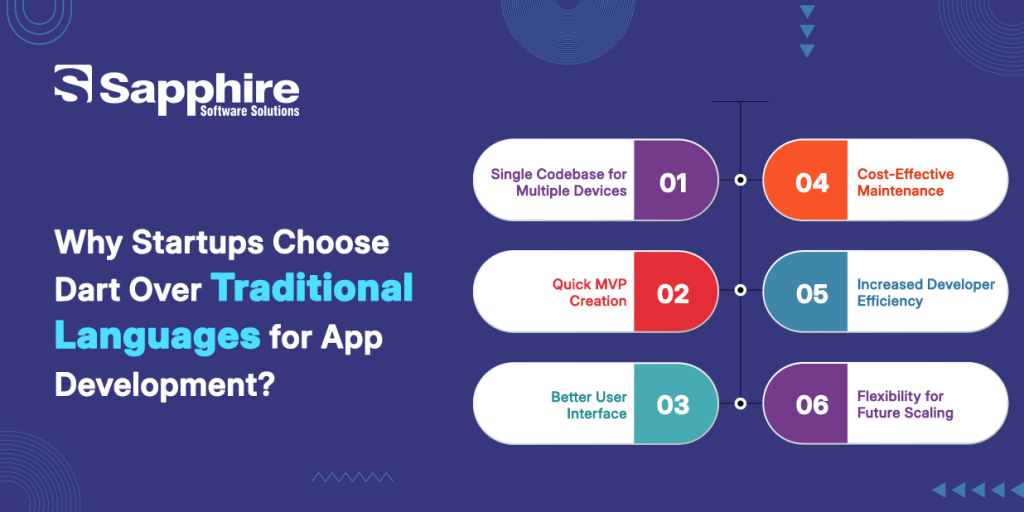
- Single Codebase for Multiple Devices: With Dart, startups can create apps for Android, iOS, the web, and desktop devices from a single codebase, saving time and money.
- Quick MVP Creation: Dart makes it easy for startups to bring MVPs to market faster.
- Better User Interface: Dart enables fast and responsive animations, which are helpful when creating aesthetically pleasing applications.
- Cost-Effective Maintenance: Using a single codebase makes application maintenance more manageable.
- Increased Developer Efficiency: Such features as hot reload make it easier for developers to test and develop apps.
- Flexibility for Future Scaling: The applications developed with Dart can grow along with your startup's needs.
For startups looking to test their concepts and get ahead of their competitors, Dart is an ideal choice.
Benefits of Dart Development for Scalable Mobile and Web Applications:
- Cross-Platform Compatibility: Another major benefit associated with using Dart Development involves building mobile, web, and desktop apps with a single codebase. This makes development more convenient and helps to ensure consistency on all platforms.
- Improved App Speed and Animation: Dart Development involves the use of the ahead-of-time compilation technology, which turns source code into native machine code and provides faster app speed and better animation performance.
- Shortened Development Process: Thanks to hot reload functionality, developers can instantly notice the changes made to their codebase while developing an app, thus saving a lot of time and effort.
- Consistent User Interface Across All Platforms: Due to the use of the Flutter Framework, companies can develop applications with identical interfaces on various platforms such as Android, iOS, and web, enhancing their brand identity and ensuring better user experience.
- Scalability: Scalable Dart-based solutions allow companies to easily accommodate their growing number of users, features, and other factors.
Cost Efficiency of Dart App Development for Early-Stage Businesses:
For startups and young businesses, minimizing development costs is critical.
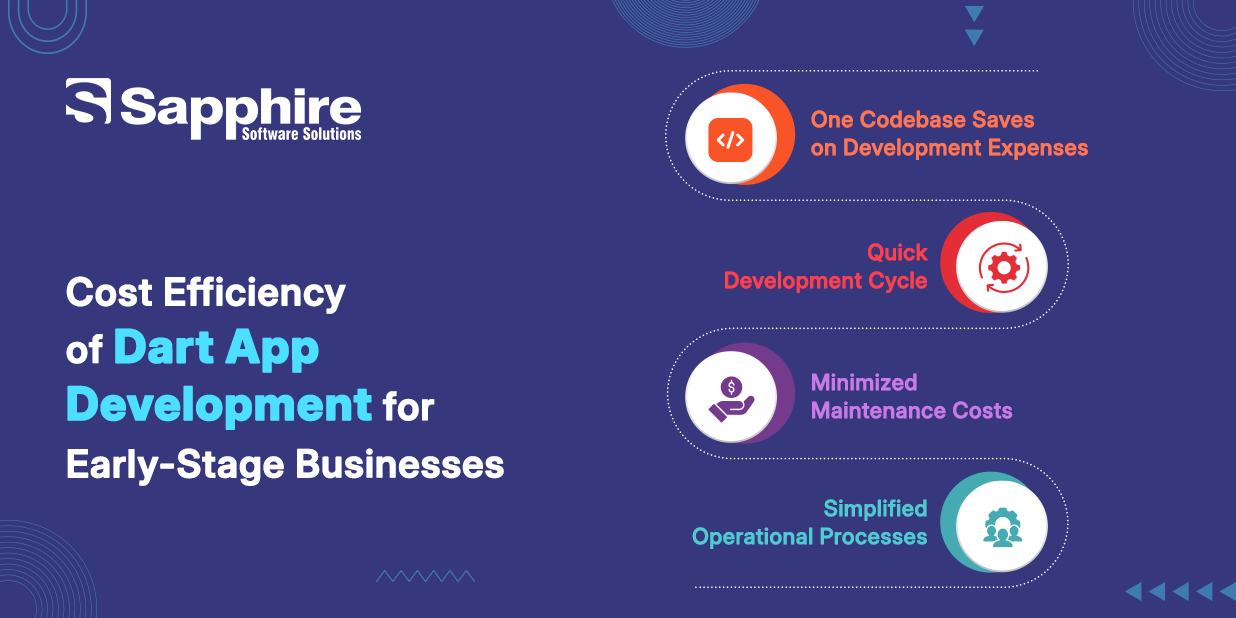
A. One Codebase Saves on Development Expenses:
One of the key strengths of Dart App Development is that it provides an opportunity to develop software for several platforms with one codebase. Companies don't require additional Android, iOS, and web development teams to complete their projects, saving money on development.
B. Quick Development Cycle:
Thanks to Dart's hot reload feature, programmers are able to make changes instantly and test them. This results in accelerated development cycles and less time spent debugging.
C. Minimized Maintenance Costs:
As all platforms use the same codebase, updating, fixing bugs, and adding new features become easier and less costly. Early-stage businesses may save on maintenance thanks to Dart.
D. Simplified Operational Processes:
With only one development process required, coordination among team members becomes simpler. Moreover, businesses save on operating expenses.
How Dart Development Services Help Startups Launch Faster?
As a Leading Dart Development Company allow startups to speed up the process of delivering their products without sacrificing quality and scalability.
Development Services Assistance
- MVP development speedup
- Agile development approaches
- UI/UX improvements
- Multiplatform solutions
- Scalability and support
Development professionals already know all the necessary things, helping startups avoid typical problems that may slow down their project.
Moreover, when working with professional developers, startups can concentrate on growing their business rather than on solving technical issues.
Why Startups Choose Sapphire as a Leading Dart Development Company for Scalable Apps?
One of the most important advantages of Sapphire Software Solutions lies in its proficiency in Dart Development and cross-platform development. Using Dart and Flutter, Sapphire enables its clients to create mobile and web applications with one codebase to save time and money spent on development. With this technology, new companies can enter markets faster without compromising the quality and experience of their applications.
In addition to this, Sapphire specialists are well-versed in the way Dart operates both in terms of architecture and performance. They will make sure that all aspects of the application are optimized for high performance from day one of its development.
Another benefit of working with Sapphire Software Solutions is the fact that Sapphire focuses on client-based software development. Prior to creating an application, specialists will analyze clients' business models and customer preferences to develop solutions that will help you grow your business in the long run.
Conclusion:
The emergence of Dart development has transformed the way businesses build modern web and mobile applications. With the increasing demand for faster development cycles, reduced operational costs, and scalable digital solutions, many organizations are adopting Dart as a powerful option for cross-platform app development. Its core features, like hot reload, AOT compilation, and a single codebase architecture, make it highly efficient and well-suited for today’s dynamic development needs.
Additionally, comparisons between Dart and Java highlight Dart’s strong advantage in building high-performance, UI-focused cross-platform applications. For startups, the ability to launch products quickly while maintaining scalability is crucial for long-term success. Professional Dart development services help businesses streamline development, reduce complexity, and ensure smooth, timely product delivery. Get a Free Quote Today to turn your app idea into a scalable and high-performing solution.