
















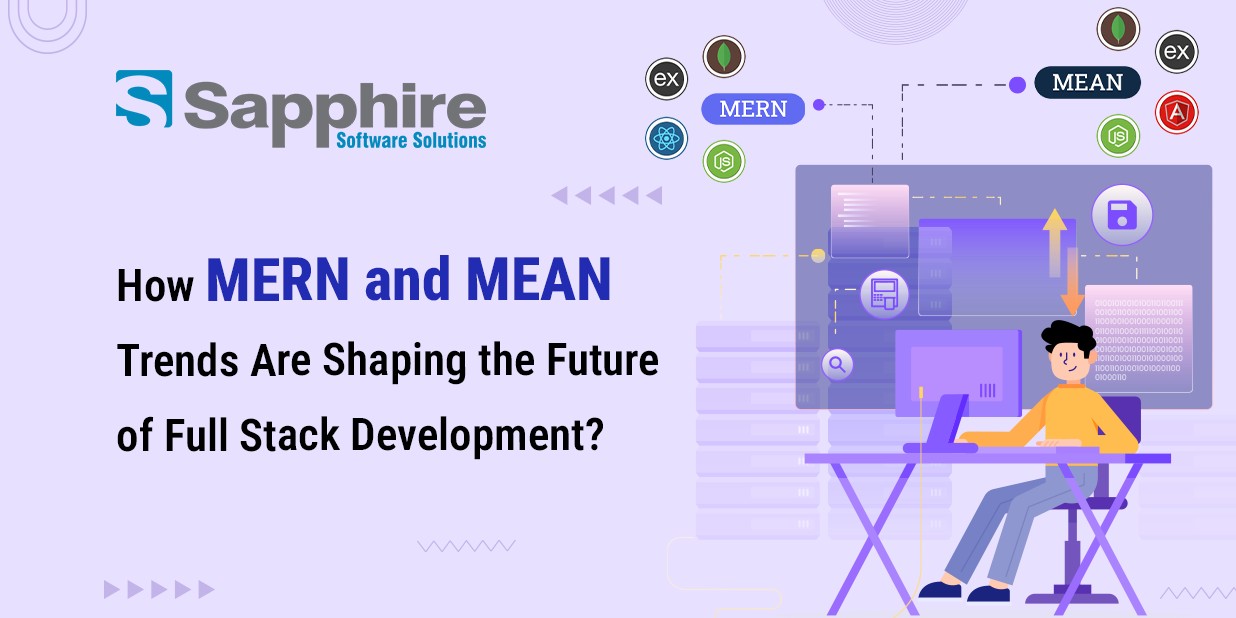
With the fast-changing tech landscape, Full Stack Development Trends are becoming further influenced by the influential abilities of the MERN Stack and MEAN Stack. These JavaScript frameworks have revolutionized the way developers design contemporary web and mobile apps due to their end-to-end versatility and the ease with which they integrate front-end and back-end technologies.
The MERN Stack — MongoDB, Express.js, React, and Node.js — revolutionized the way developers provide rich, interactive user interfaces. The component-based structure of React, paired with effective handling of data through MongoDB and Node, makes it possible to have very responsive and scalable applications. Modern MERN Stack Trends indicate increasing usage of serverless architecture, microservices, and real-time capabilities such as collaborative tools, making MERN a future-proof framework for startups and rapidly scaling companies.
At the same time, the MEAN Stack - constructed on MongoDB, Express.js, Angular, and Node.js - is enjoying renewed popularity due to the maturity and enterprise-ready capabilities of Angular. MEAN Stack Trends 2025 reports a solid emphasis on micro-frontend architectures and deeper security practices, so MEAN is well-suited for big-scale, mission-critical applications where consistency, maintainability, and compliance are required.
Both stacks are moving towards the wider Full Stack Developer Trends of composable architecture, AI-driven coding, and cross-platform harmony. As more organizations put money into digital transformation, they anticipate applications that are scalable, secure, and simple to evolve. MERN and MEAN do just that, providing developers with the machinery to rapidly create robust, data-intensive applications that look stunning across devices.
Understanding Full Stack Development:
These days, companies want their apps and websites to work perfectly and look great while doing it. That's basically what Full Stack Development is all about - handling both the stuff users see on their screens and all the behind-the-scenes work that makes everything actually function. Think of it as being responsible for the entire digital experience from start to finish.
Instead of having one team work on how something looks, and another team handle the technical stuff in the background, Full Stack Development lets developers work on everything. They can build the interface that users interact with, set up servers that process information, and manage databases that store all the data. Having one person or team handle the whole thing means fewer communication problems and projects get done faster.
What's popular right now are these technology combinations called MERN Stack and MEAN Stack. Both use JavaScript for everything, which is pretty convenient since developers don't have to switch between different programming languages. MERN uses MongoDB for databases, Express.js for server work, React for user interfaces, and Node.js for running everything. MEAN is similar but uses Angular instead of React. When everything speaks the same language, it's much easier to build and maintain.
Full-stack development works perfectly with how most companies operate today. Teams need to make changes quickly based on what customers want, and having developers who understand the whole system means they can adapt faster. The reality is that Full Stack Development isn't just some trendy approach - it's become essential for businesses that want to stay competitive. When you can build and maintain both the front and back parts of your digital products efficiently, you can respond to market changes faster and create better experiences for your users.
Overview of MERN and MEAN Stacks:
With the world today being technology-oriented, companies anticipate quick innovation and smooth digital interactions, and that is where Full Stack Development steps in. Full-stack describes the act of developing and maintaining both the front-end (the user-visible and user-interacting part) and the back end (how data is processed and stored) of an application. It combines user interface design, server-side scripting, and database management into a single development process.
This single solution allows developers to work end-to-end on the app stack, from designing usable interfaces to secure data handling and silky server rendering. Rather than splitting the task between different front-end and back-end teams, Full Stack Development allows a single cross-functional team or even an individual developer to take responsibility for the end-to-end process.
New Full Stack Development Trends are about stacks like the MERN Stack (MongoDB, Express.js, React, Node.js) and MEAN Stack (MongoDB, Express.js, Angular, Node.js), where JavaScript is executed across the stack. Such a one-language environment facilitates collaboration, minimizes context switching, and accelerates development. As business requires more adaptability, these stacks make applications scalable, modular, and easy to develop in the long term.
In short, Full Stack Development is not a trend; it is an ethos that speaks of agility, speed, and sustainable growth. Given the ever-evolving nature of technology, the skill of creating and sustaining front-end and back-end together will be vital to companies that aim to provide substantial and future-proof digital solutions.
What is the MERN Stack?
The MERN Stack is one of the most powerful and popular tech stacks to build current web applications today. It is a combination of MongoDB, Express.js, React.js, and Node.js, four open-source technologies that are essential. They create a flawless, end-to-end JavaScript ecosystem enabling developers to create feature-rich, scalable, and responsive applications.
Here's the breakdown:
- MongoDB is a NoSQL database that manages a very large amount of flexible, unstructured data. It stores information in JSON-like documents, which is very natural for native data structures of JavaScript, offering seamless data communication between front-end and back-end.
- Express.js is a light web application server-side framework powered by Node.js. It makes backend logic, routing, and handling HTTP requests easy, providing a solid base for API and server development.
- React.js is used for the front end. Renowned for its virtual DOM and component-driven architecture, React enables the creation of highly interactive, fast, and reusable UIs that maximize performance as well as user experience.
- Node.js is the runtime that runs JavaScript on the server, allowing for the use of JavaScript on the server-side across the entire stack. Node.js's event-driven, non-blocking architecture makes it possible to create high-performance, scalable software.
All three tools allow developers to write in a single language (JavaScript) throughout the entire process of software development. Consequently, all businesses, big and small, from start-ups to large corporate houses, are hiring MERN Stack Development Company partners for creating cutting-edge, user-friendly, and scalable applications that can be modified to meet their developing requirements.
What is the MEAN Stack?
So, you've probably heard about the MEAN Stack - it's this combination of four different technologies that work together to build websites and apps. The name comes from the first letters: MongoDB, Express.js, Angular, and Node.js. What makes it interesting is that everything runs on JavaScript, so developers don't have to juggle multiple programming languages.
Here's how each piece fits together:
- MongoDB handles all the data storage, but it's not like traditional databases that force you into rigid structures. Instead, it stores information in flexible formats that look similar to JSON. This means if you need to change how your data works later, you're not stuck rebuilding everything from scratch.
- Express.js runs on the server and handles all the communication between your website and the database. When someone clicks a button or submits a form, Express.js figures out what needs to happen and makes sure the right information gets passed around. It takes care of a lot of the tedious server management stuff so developers can focus on building features.
- Angular is what users see and interact with. Google built it to be restructured and organized, which is great for big companies that need their code to be maintainable over time. It has features like automatic updates between the interface and data, plus built-in testing tools that help catch problems early.
- Node.js is what makes JavaScript work on servers instead of just in web browsers. It's designed to handle lots of users at the same time without slowing down, which is crucial for popular websites or apps that get heavy traffic.
The biggest advantage of MEAN Stack Development is that your entire team can work with the same programming language. Many businesses hire MEAN Stack Developers instead of trying to build everything in-house, especially for important applications that need to be reliable and supported long-term. Since everything works together smoothly, you can add new features. Or handle more users without having to rebuild everything from the ground up.
MERN Stack Development Trends in 2025:-
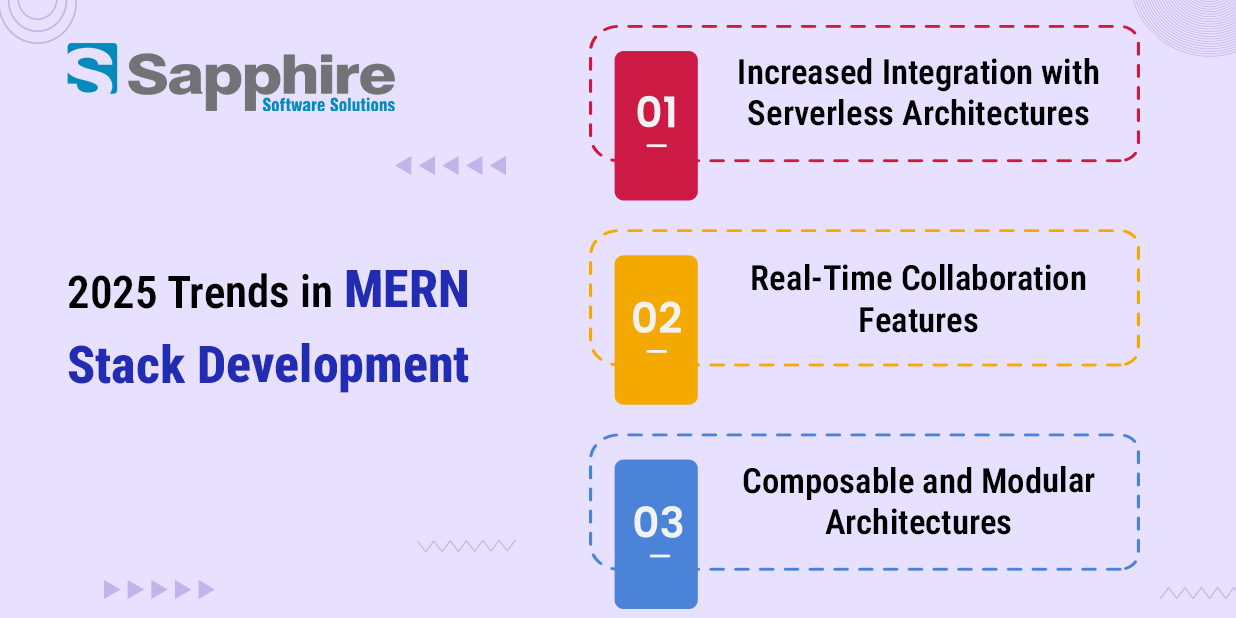
As we approach 2025, MERN Stack Development is one of the best innovations. But what will this trendsetting framework look like in the next couple of years?
1. Increased Integration with Serverless Architectures:
One of the largest MERN Stack Trends is its transition to serverless computing. Offloading the management of infrastructure to cloud providers frees developers to write cleaner, easier-to-maintain code and get faster deployments. Serverless technologies like AWS Lambda, backed by React front ends, will make it easy for MERN applications to scale without worrying about operating costs, a boon for startups and expanding businesses alike.
2. Real-Time Collaboration Features:
With a world that is more dependent on remote work and live collaboration, 2025 will witness MERN apps with more real-time aspects. From live chat, collaborative whiteboards, or even shared documents, the event-driven architecture of the stack. And React's effective state managementmakese it perfect for developing such interactive, always-synced apps. Look for MERN Stack Development Company teams to redouble efforts in incorporating WebSocket-based real-time frameworks into their offerings.
3. Composable and Modular Architectures:
Today's product teams desire flexibility to change and shift directions rapidly. In 2025, Full Stack Development Trends will prioritize composable, microservices-based architecture instead of inflexible monolithic systems. The MERN stack is well-suited to this by virtue of Node's support for microservices and React's reusable component paradigm. Programmers will decompose applications into separate, reusable modules that can be deployed or updated with no effect on the overall system.
MEAN Stack Development Trends in 2025:-
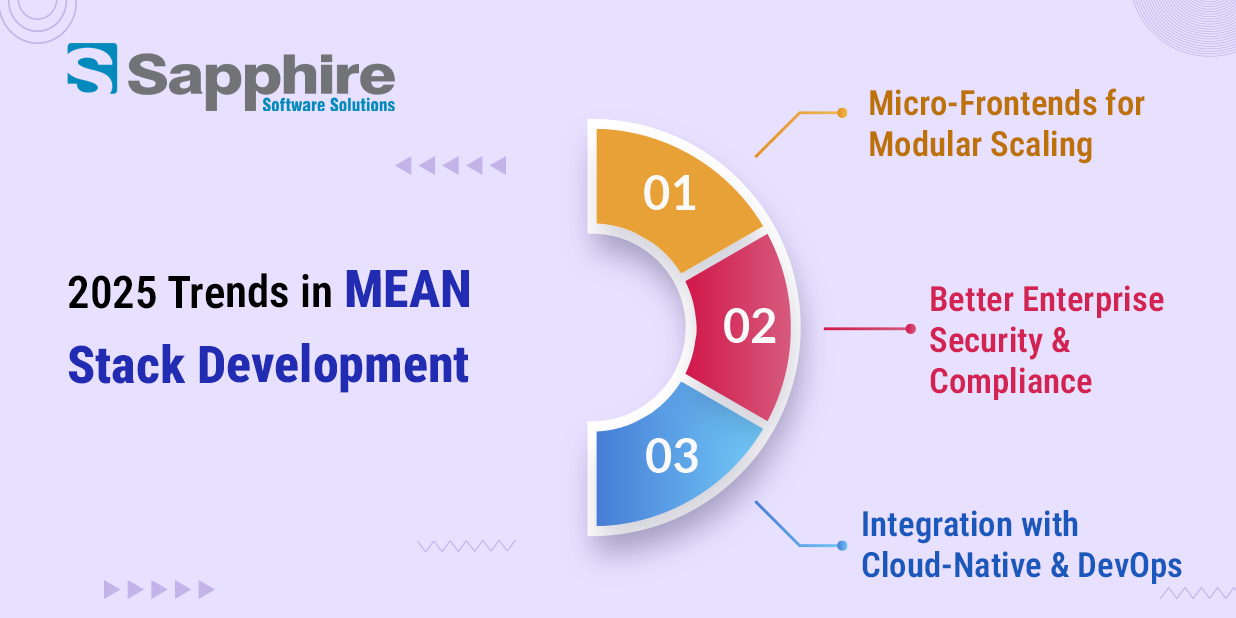 As we near the year 2025, MEAN Stack Development keeps catching on, particularly with enterprises that appreciate structure, scalability, and maintainability over the long term. What particular MEAN Stack Trends will characterize the years ahead?
1. Micro-Frontends for Modular Scaling:
One of the most significant trends is the use of micro-frontend architecture. Rather than developing massive, monolithic Angular applications, teams will fragment them into individually deployable, smaller pieces. The modularity enables parallel development, simpler maintenance, and quicker release cycles — all essential as enterprise applications become larger and more complex. MEAN's uniform JavaScript base makes it an ideal choice for these composable systems.
2. Better Enterprise Security and Compliance:
As data privacy laws become increasingly stringent across the Globe. MEAN Stack Development will put even greater emphasis on security best practices and compliance models in 2025. Capabilities such as stricter authentication and granular user permissions. And encryption right out of the box will take top priority to safeguard sensitive business information. Angular's robust endorsement of security patterns and best practices will continue to make it the front-runner front-end framework for enterprise-class applications.
3. Integration with Cloud-Native and DevOps:
One more defining trend is deeper integration with cloud-native platforms and DevOps practices. As continuous deployment and scalable cloud infrastructure become standard, MEAN Stack Development Company teams will utilize containerization (e.g., Docker, Kubernetes) and CI/CD pipelines to speed delivery and guarantee consistent quality. This DevOps synergy will enable teams to deliver features more regularly without compromising stability.
Comparing MERN and MEAN: Which is the Better Choice?
Deciding between MERN Stack and MEAN Stack may seem daunting, particularly given that both stacks rely on MongoDB, Express.js, and Node.js. The actual difference lies in the front-end tech: React for the MERN Stack and Angular for the MEAN Stack. Knowing their strengths will enable you to make a better choice.
When you value flexibility and fast UI innovation, MERN Stack Development could be your best bet. React's component-based structure is very flexible and less opinionated than Angular. With room for programmers to organize applications in a manner that best supports the project requirements. MERN is especially strong for projects that require a rich, interactive front end and regular updates to the user experience, like social media websites or collaborative software.
MEAN Stack Development, on the other hand, is based on Angular's heavy, opinionated framework. Angular has a more rigid structure, with heavy features such as two-way data binding, built-in testing, and a uniform coding standard. For enterprise-level, large-scale applications where security, maintainability, and standardization are essential, MEAN is a good choice.
There isn't a one-size-fits-all champion. It's better for your project, team expertise, and future goals. If you desire flexibility, quicker iterations, and deep user interactions, the MERN Stack is tough to top. But for a stable, heavily structured framework for enterprise solutions, the MEAN Stack is probably the wiser choice.
Future of Full Stack Development: How MERN and MEAN Will Evolve in 2025?
The future of Full Stack Development is very bright, and both MEAN Stack and MERN Stack will lead the way to creating a new future by 2025. As businesses promote speedier innovation, new stacks will be more scalable, modular, and robust to enable architecture.
One of the key trends will be composable architecture. Instead of crafting behemoth, monolithic applications, teams will increasingly split their systems into microservices and micro-frontends. So they can deploy faster and maintain more easily. The MERN Stack, with its flexible React front end, is well-suited to this transformation, permitting reusable components and highly customizable user interfaces. Concurrently, Angular's structured framework in the MEAN Stack is best designed for enterprise-grade micro-frontend designs, providing reliable, predictable front-end modules.
Another evolution is greater convergence of automation and AI. From AI-powered code assistants to test automation and CI/CD pipelines. These stacks will evolve to fit workflows that need fewer manual processes and more intelligent tooling. MERN and MEAN developers will rely on more intelligent, AI-driven solutions by 2025 to automate coding, catch bugs earlier, and accelerate product releases.
Finally, cloud-native development will be the norm. Both stacks will get even more closely coupled with container technologies like Docker and orchestration tools like Kubernetes, so that they can scale automatically and make infrastructure management more convenient. This shift will make Full Stack Development teams capable of providing applications that are fault-tolerant and globally distributed. And capable of handling unpredictable traffic patterns.
Why Sapphire’s MERN & MEAN Expertise is the Key to Unlocking Your Digital Transformation?
In a global economy where speed, innovation, and scalability equal digital success, collaboration with the right technology experts can be a difference maker. One of Sapphire Software Solutions' biggest strengths is how well it understands both MERN stack tech. And Angular frameworks make them able to offer the most suitable solution for your project, not merely a one-size-fits-all situation.
What really makes Sapphire stand out is its end-to-end approach. This transparency fosters clearer communication, fewer surprises, and quicker turnaround times, all key factors in a successful digital transformation process.
With Sapphire Software Solutions, you're not only employing coders. But you're also engaging with a Stack Development Company that sees the risks of digital disruption. Their profound knowledge of MERN Stack Framework and MEAN Stack Trends allows them to future-proof your applications while keeping you one step ahead of market pressures. For any business seeking to turn ideas into powerful, durable, and elastic digital products. Sapphire's full-stack expertise is the secret to achieving real digital transformation.