

















In today’s subscription-driven digital economy, sustainable growth is no longer driven by one-time sales alone. Businesses are increasingly focused on building predictable, recurring revenue models that ensure long-term profitability and scalability. This shift has accelerated the adoption of white-label app solutions, which enable companies to monetize digital products continuously rather than relying on a single product launch. For startups, agencies, SaaS providers, and enterprises alike, white-label apps offer a proven pathway to recurring income in a highly competitive digital landscape.
White-label apps allow businesses to enter the market quickly with ready-made, customizable solutions, eliminating the high cost, risk, and development time associated with building applications from scratch. By rebranding and reselling these platforms under their own identity, companies can focus on customer acquisition, marketing, and growth. More importantly, white-label apps are designed to generate ongoing revenue through subscriptions, licensing fees, commissions, and premium feature upgrades, making them an ideal strategy for businesses looking to scale efficiently while maintaining consistent cash flow.
What is a white-label app?
To grasp the full potential of revenues, it is necessary to define a white-label app clearly. What is a White Label App? The White Label App is a ready-to-use software solution that is created by a technology company. It can be resold by a company to customers as their own solution. However, the solution is customized in terms of logo, color scheme, domain, and even functionalities to match the business of the customer.
In contrast to the time, cost, and complexity involved in custom applications, the time, cost, and complexity involved in developing white-label applications are greatly reduced. The organization is not required to deal with the product architecture, backend, and feature sets, particularly when choosing white label mobile app development solutions.
White-label apps are particularly desirable for agencies, startups, and entrepreneurial ventures looking to provide digital solutions without having to employ massive IT teams. Through the application of White label App development, businesses get instantaneous access to well-tested and perfected technology solutions through white label mobile app development.
Another important aspect of white-label apps has to do with ownership from a customer's perspective. Customers utilizing the application are using it in a way that suggests it is completely their property and has been developed by their company. This enhances brand loyalty and ensures that the other company, which provides technology, remains in the background.
How White Label Apps Generate Recurring Revenue?
A white-label app builder simplifies the entire process that pertains to launching and scaling a digital product. Instead of having to manage complex development cycles, businesses make use of a structured platform that can enable fast customization and deployment through a white label app builder for businesses.
One of the most popular ways of generating revenue for mobile app development is subscription pricing. Here, businesses charge clients or consumers a certain subscription charge every month or yearly for accessing the app. Subscription pricing is most suitable for a service-based app, for example, a restaurant management app, a taxi services app, and even a dating app.
Licensing is another great monetization strategy by itself. Companies can license the application to various clients, such as restaurant owners, fleet owners, or local entrepreneurs, and charge them a steady fee to use and maintain it. This means that an application can earn profits from dozens or even hundreds of different clients simultaneously.
Revenue models that are commission-based are also quite prevalent. For instance, for the White Label restaurant app, restaurants earn money from each and every order that has been processed through the app. Likewise, for the White Label Taxi app, revenue may be earned through the completion of trips.
Popular White Label App Categories for Maximum Profit:
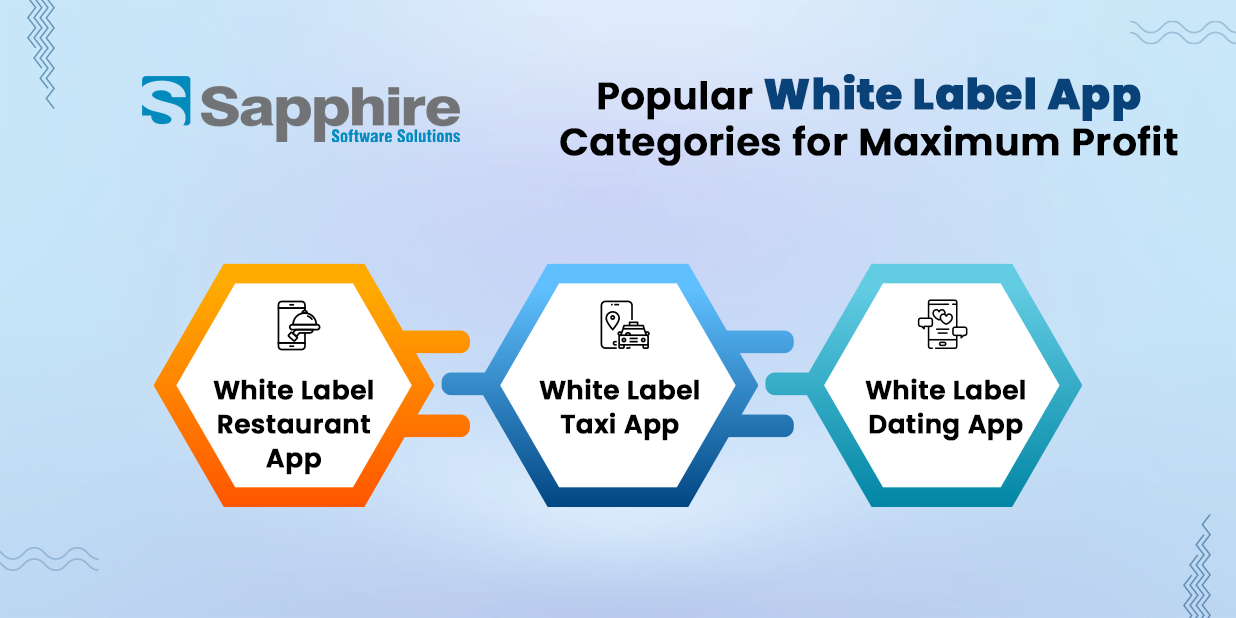
Not all white-label applications are created equal when it comes to revenue. Some categories consistently perform better than others due to high demand, repeat usage, and strong monetization potential.
White Label Restaurant App:
The white label restaurant app enables restaurants to accept online orders, manage menus, handle deliveries, and engage directly with customers through a branded digital platform. Offered as part of Restaurant App Development Services, these solutions allow businesses to onboard multiple restaurants under a single system while providing a seamless ordering experience for end users. Restaurants typically subscribe to the platform regularly, ensuring consistent revenue for service providers.
In addition to subscription-based pricing, businesses can generate ongoing income through per-order commissions, monthly usage plans, and optional feature upgrades. With the continued growth of food delivery and takeaway culture, white-label restaurant apps have become a reliable source of recurring revenue, making them a strategic offering within modern restaurant app development services portfolios.
White Label Taxi App:
A white-label taxi app enables fleet owners, local operators, and entrepreneurs to launch fully branded ride-hailing platforms tailored to their market needs. Offered by Taxi App Development Company, these solutions allow businesses to enter the on-demand mobility space quickly without building technology from the ground up. The platform supports essential ride-hailing operations while maintaining brand ownership and operational control.
Revenue is generated through ride commissions, driver subscription plans, and operational service fees, creating consistent and scalable income streams. This business model is particularly effective in regional or niche markets that are underserved by global ride-hailing platforms, making white-label solutions a strategic offering for any taxi app development company looking to deliver long-term value to its clients.
White Label Dating App:
A white-label dating application is among the most lucrative digital products due to its subscription-based revenue model, which enables consistent and predictable income. Through Dating App Development Services, companies can offer fully branded platforms that monetize via recurring subscriptions, in-app purchases, and premium features such as boosts or special matchmaking services. Dating apps also benefit from high user engagement and long customer lifecycles, making them well-suited for long-term revenue generation.
Why Choose a White Label App Builder?
A white-label app builder simplifies the entire process that pertains to launching and scaling a digital product. Instead of having to manage complex development cycles, businesses make use of a structured platform that can enable fast customization and deployment through a white label app builder for businesses.
- The main benefit of using a white-label app builder is speed. It means that businesses can launch apps in a matter of weeks, not months, which allows them to get to market sooner and begin revenue generation earlier.
- Another key advantage is that these are very cost-effective. The process of development and maintenance becomes much cheaper because the core technology can be shared across many clients, thus making it very affordable compared to a custom build.
- White-label app makers also provide flexibility: branding, pricing models, and sometimes features can all be customized without necessarily touching the core codebase. This might make adapting that product to different markets or customer requirements easier.
- Another important benefit is less technical dependence. Usually, hosting, updates, bug fixes, and security patches are provided by the service provider. This indeed frees a company from infrastructure to focus on selling the products, marketing, and nurturing customer relationships.
Key Benefits of White Label Apps for Business Growth:
White-label apps have various strategic benefits, which are directly linked to business development.
- These platforms enable quick market entry. Enterprises have the opportunity to develop digital products quickly, offering a competitive advantage.
- White-label apps allow for predictable revenues. Subscription costs, licensing, and commissions make for a steady income flow.
- Control of branding rests with the company. The clients perceive your company as enhancing its market position.
- A white-label app minimizes risk. This is because the technology has already been tested; therefore, it does not pose development challenges to the business.
- They facilitate consumer loyalty. When apps are used repeatedly, it provides an unending stream of engaging transactions and upsells.
The above advantages have made white-label apps a preferred option for companies that concentrate on sustainable and not short-term gains.
White Label App Development Services: What Businesses Should Look For
Selection of the right White Label App Development Services may play a critical role for those firms looking to develop a steady income source in the form of white-label apps, particularly when selecting white label mobile app development & design services. Though white-label applications offer a fast time-to-market and economic development approach, the long-term achievement may be associated with the quality and flexibility level of the development services.
One of the earliest things that businesses would need to assess would be the customization functionality. The best white-label solution would be the one that gives them control over branding through logos, color schemes, domain configurations, and UI designs. In addition to designs, it would need to give businesses control over their plans, switch on and switch off features, and modify their processes to suit market demands.
Additionally, businesses must search for ongoing support and maintenance. Technology changes fast, and an app needs updates, bug fixes, and continuous compatibility improvements. Good development services give long-term technical support to keep the app stable and competitive.
Why Sapphire Is the Best White Label App Development Company for Building Recurring Revenue?
Sapphire Software Solutions has managed to position itself as a Top White Label App Development Company and a white label app development company by ensuring that businesses embrace the concept of not just app launches but also creating sustainable sources of income regularly using the white-label app. At Sapphire, white-label apps remain not just a sales commodity but a source of sustainable digital revenue using subscription models, licensing fees, commissions, and feature upselling in the form of digital income creation.
One of the most attractive strengths of Sapphire is its White Label App Development Services, which encompasses a wide range of high-demand verticals such as restaurant ordering apps, taxi or ride-sharing apps, as well as dating apps. Each app developed at Sapphire has its core architecture infused with revenue-generating capabilities. Right from the admin panel to the vendor panel to the payment gateway to analytics, everything at Sapphire helps generate revenue.
Conclusion:
From a business standpoint, white-label applications represent a strategic opportunity to build scalable, recurring revenue streams with reduced development risk and faster market entry. Across high-demand verticals such as restaurant delivery, ride-hailing, dating platforms, and other repeat-use industries, white-label solutions enable companies to monetize proven technology through subscriptions, commissions, and value-added services. This model allows businesses to focus on growth, customer acquisition, and brand positioning while leveraging ready-to-deploy digital products.
Ultimately, success in the white label ecosystem depends on selecting the right category, understanding market demand, and aligning the solution with a clear brand and monetization strategy. For IT entrepreneurs and service providers, investing in white-label app offerings is not just about launching apps—it is about creating long-term digital assets that deliver predictable income and sustainable business growth in an increasingly competitive digital economy.