
















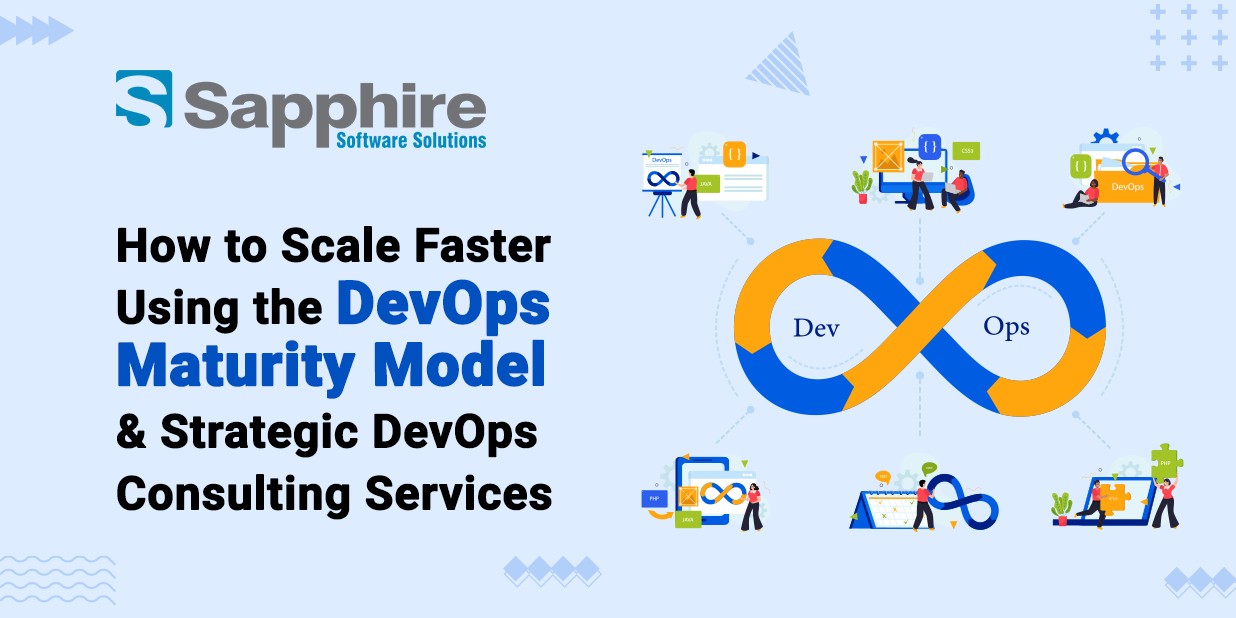
Businesses cannot afford delays in delivering high-quality software. Organizations are under constant pressure to release products faster, respond to market changes promptly, and maintain operational excellence. DevOps has emerged as a transformative approach that bridges the gap between development and operations teams, fostering collaboration, automation, and efficiency. But simply adopting DevOps is not enough. To truly unlock its potential, companies need a structured framework to assess, improve, and scale their DevOps practices systematically.
By understanding the DevOps Maturity Model and leveraging the DevOps Consulting Service, businesses can accelerate their DevOps adoption, streamline operations, and achieve rapid, sustainable growth. In this blog, we will explore the concept of the DevOps Maturity Model, its key factors, stages, and how specialized DevOps services can help organizations scale faster.
What Is a DevOps Maturity Model?
A DevOps Maturity Model is a strategic framework that assesses the current state of an organization’s DevOps practices and provides a roadmap for improvement. Think of it as a compass guiding business from basic, siloed workflows to fully optimized, automated, and collaborative operations. The model measures maturity across multiple dimensions, including culture, processes, technology, and metrics. By evaluating these areas, organizations can identify gaps, prioritize initiatives, and accelerate their DevOps transformation. Unlike generic methodology, a maturity model is dynamic. It not only benchmarks where you are but also outlines a clear path toward continuous improvement.
Key Factors of the DevOps Maturity Model Every Business Should Know
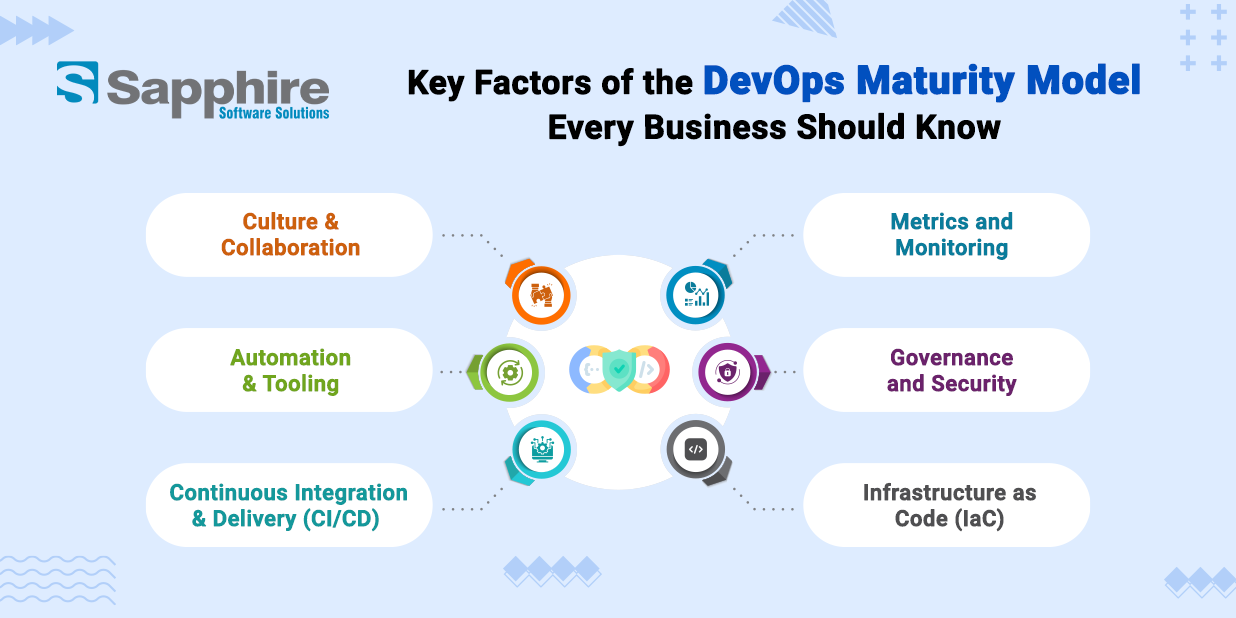
The success of a DevOps transformation relies on addressing specific critical factors. These key factors of the DevOps maturity model provide a holistic view of an organization’s readiness and highlight areas that require strategic attention:
- Culture and Collaboration: DevOps is as much about people as it is about technology. A collaborative culture where development, operations, and business teams communicate openly is essential. Organizations with a strong culture embrace shared responsibility, blameless post-mortems, and continuous feedback.
- Automation and Tooling
Automation lies at the heart of DevOps. From continuous integration/continuous deployment (CI/CD) pipelines to automated testing and infrastructure provisioning, effective tooling accelerates delivery, reduces errors, and enhances scalability. - Continuous Integration and Delivery (CI/CD): Implementing CI/CD practices ensures that software changes are integrated and tested continuously, reducing bottlenecks and enabling faster time-to-market.
- Metrics and Monitoring: Organizations must track key performance indicators (KPIs) such as deployment frequency, lead time, mean time to recovery (MTTR), and defect rates. Monitoring these metrics helps identify inefficiencies and guides improvement initiatives.
- Governance and Security: Mature DevOps practices integrate security (DevSecOps) and compliance into the development lifecycle, ensuring that scaling does not compromise security or quality standards.
- Infrastructure as Code (IaC): Managing infrastructure through code enables consistent, repeatable deployments, minimizing human errors, and supporting rapid scaling.
Stages of the DevOps Maturity Model: From Basic to Optimized
The stages of the DevOps maturity model serve as a roadmap for organizations to progress systematically. While frameworks may vary slightly, most models consist of five stages:
- Initial / Ad Hoc Stage :At this stage, DevOps practices are virtually non-existent. Development and operations function in silos, processes are manual, and releases are infrequent and error-prone. While organizations may see occasional successes, scalability is extremely limited.
- Managed Stage: Here, organizations start standardizing processes and adopt basic automation. Collaboration between teams improves, but practices remain reactive rather than proactive. Metrics are often collected but not consistently analyzed to inform decision-making.
- Defined Stage: Processes are formalized, CI/CD pipelines are established, and teams begin to embrace a culture of continuous improvement. Monitoring, feedback loops, and performance metrics play a central role in driving incremental progress.
- Quantitatively Managed Stage: Organizations in this stage are data-driven. Metrics guide decisions, automation covers most repetitive tasks, and teams can predict and resolve issues faster. Release frequency increases, and product quality improves significantly.
- Optimized Stage: At the optimized stage, DevOps practices are fully integrated across the organization. Continuous experimentation, advanced automation, predictive analytics, and a culture of innovation define operations. Scaling is seamless, and business agility reaches its peak.
Understanding these stages helps businesses pinpoint their current position and plan for the next level of maturity, ensuring that scaling efforts are strategic, efficient, and sustainable.
Business Benefits of DevOps Maturity Model in Scaling Faster
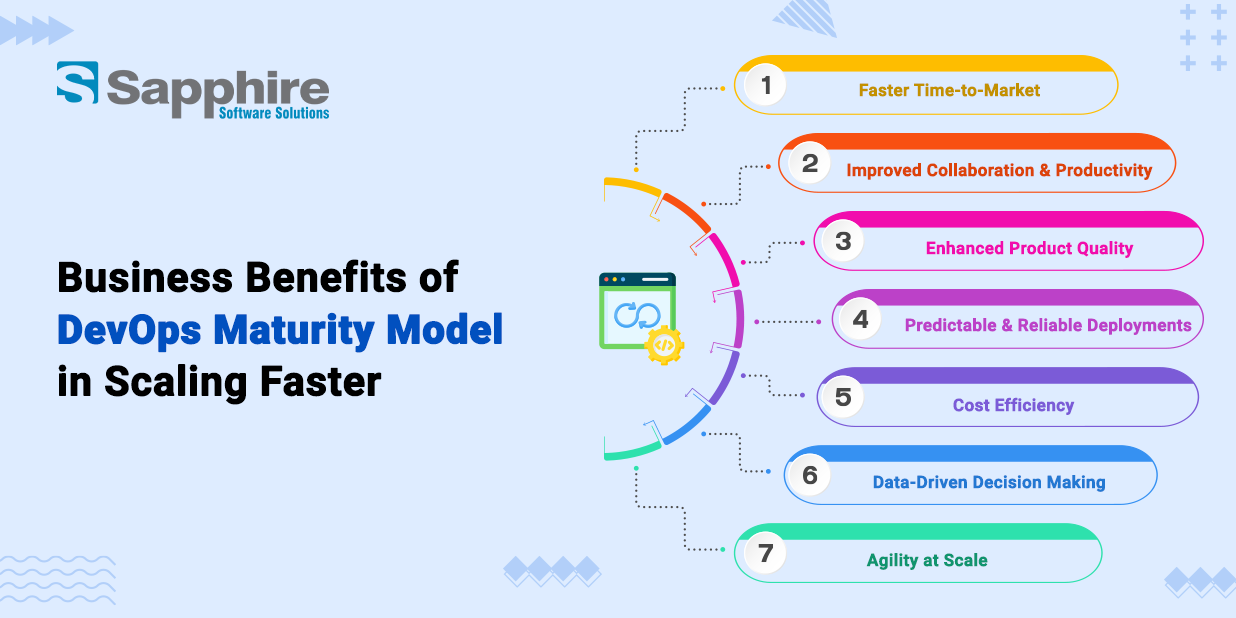
Implementing the DevOps Maturity Model offers tangible benefits for organizations aiming to accelerate growth:
- Faster Time-to-Market: Streamlined processes, automation, and CI/CD pipelines reduce the time from development to deployment, enabling businesses to respond swiftly to market demands.
- Improved Collaboration and Productivity: Cross-functional collaboration eliminates silos, fosters knowledge sharing, and boosts overall team efficiency.
- Enhanced Product Quality: Continuous testing, monitoring, and feedback loops minimize defects and ensure a higher-quality product with every release.
- Predictable and Reliable Deployments: With standardized processes and automated workflows, organizations can deploy confidently, reducing downtime and customer impact.
- Cost Efficiency: Automation and proactive monitoring decrease manual errors and operational overhead, freeing resources to focus on strategic initiatives.
- Data-Driven Decision Making: Metrics and analytics provide actionable insights, allowing organizations to continuously optimize processes, technology, and performance.
- Agility at Scale Organizations can handle increased workloads, support expansion, and launch new services without compromising operational stability.
How DevOps Development Services Accelerate Your Maturity Level?
For organizations aiming to progress through DevOps, Services play a crucial role. These services offer end-to-end support in designing, implementing, and managing DevOps practices, including:
- Building scalable CI/CD pipelines tailored to business needs.
- Automating infrastructure provisioning using Infrastructure as Code (IaC).
- Integrating robust monitoring, alerting, and performance of dashboards.
- Implementing DevSecOps practices to ensure secure, compliant releases.
- Providing training and guidance to instill a collaborative DevOps culture.
By leveraging professional DevOps development expertise, organizations can accelerate their journey from initial or managed stages to defined or optimized stages, significantly reducing the trial-and-error period. DevOps Outsourcing Services: An Efficient Path to High Maturity
For many organizations, building in-house DevOps capabilities can be resource-intensive and time-consuming. DevOps Outsourcing Services offer a strategic alternative, providing access to skilled professionals, best practices, and advanced tools without the overhead of recruitment and training.
Key advantages of outsourcing include:
- Faster Implementation: Expert teams accelerate the deployment of DevOps pipelines and automation strategies.
- Access to Expertise: Outsourced professionals bring experience from diverse industries and cutting-edge practices.
- Cost Efficiency: Avoids the high costs of hiring and retaining full-time DevOps specialists.
- Flexibility: Scale resources up or down based on project requirements.
- Continuous Support: Many outsourcing services provide 24/7 monitoring and incident response.
Outsourcing can be particularly effective for organizations in the early or managed stages of the DevOps Maturity Model, enabling them to leapfrog to higher maturity levels quickly.
How Sapphire’s DevOps Consulting Service Accelerates Your DevOps Maturity Journey?
A trusted DevOps Development Company like Sapphire Software Solutions can transform the way organizations approach DevOps. Sapphire’s consulting framework is designed to assess current maturity, define strategic objectives, and implement tailored solutions that drive measurable business outcomes.
Their approach includes:
- Maturity Assessment: Comprehensive evaluation of culture, processes, tools, and metrics.
- Customized Roadmap: Clear action plans aligned with business goals and DevOps best practices.
- Process Optimization: Standardizing workflows, implementing CI/CD pipelines, and automating infrastructure.
- Advanced Monitoring and Analytics: Enabling data-driven decision-making to identify bottlenecks and optimize performance.
- Ongoing Support and Training: Empowering teams with knowledge, fostering a culture of collaboration, and ensuring continuous improvement.
By partnering with Sapphire, businesses can accelerate their progression through the stages of the DevOps maturity model, achieving operational efficiency, faster releases, and scalable growth.
Conclusion:
The journey toward faster scaling, reliable software delivery, and high-performing digital infrastructure begins with understanding your organization’s DevOps capabilities. The DevOps Maturity Model provides a clear blueprint for this evolution—from basic adoption to fully optimized pipelines.
By embracing the key factors of DevOps maturity, following the stages of maturity, and leveraging expert DevOps Development Services, DevOps Consulting Services, and DevOps Outsourcing Services, businesses can dramatically speed up their transformation. Whether you're just starting out or actively optimizing your DevOps culture, strategic consulting like Sapphire Software Solutions' DevOps expertise helps you avoid pitfalls, accelerate progress, and achieve scalable, future-ready DevOps excellence.