
















Technology is growing day by day, and one of its main initiators among various others is AI Agents. The days of rumour or science fiction dreams are behind us; they are here to stay, and they're transforming the way we construct, administer, and contribute to software at an accelerated pace never imagined before. Whatever you are - a developer, an entrepreneur, or part of the tech community, knowing how they work and are transforming the world of software development is what it takes to be ahead.
What Are AI Agents?
In essence, AI Agents are independent computer programs or autonomous programs that are programmed to sense their surroundings, reason on data, and act to achieve some objectives. Agents differ from conventional programs in that they can learn, modify themselves to new situations, and make informed decisions that do not need continuous human monitoring.
Their design most frequently lies within human thought processes. By recreating how human beings process, learn, and react to data, AI Agents can begin, search for resolutions, and reply to fluctuating tasks. Since they can make changes, they are uniquely suitable to deal with dynamic, difficult systems such as software development, finance, and medicine, to name a few.
How AI Agents Work?
Picture a clever bot that can read a codebase, locate bugs, suggest patches, and commit them with little human interaction. That is the essence of how AI Agents operate. AI Agent functionality is facilitated by a perception-reasoning-action loop:
- Perception: Utilize information from varied sources such as APIs, databases, or code logs.
- Reasoning: Utilize AI models to reason over data, identify patterns, and plan.
- Action: Taking actions such as code generation, user input, or server commands.
This recurring cycle enables AI Agents to behave independently, becoming better over time through learning mechanisms. For instance, in debugging software, an AI Agent may learn from recurring patterns of failure and enhance its problem-solving process.
Several AI Agents are also affected by reinforcement learning, where they are given feedback after an action and discover which direction yields them the optimal results. Natural language processing, machine learning algorithms, and deep learning also aid in their capabilities to learn and perform sophisticated actions.
Types of AI Agents:
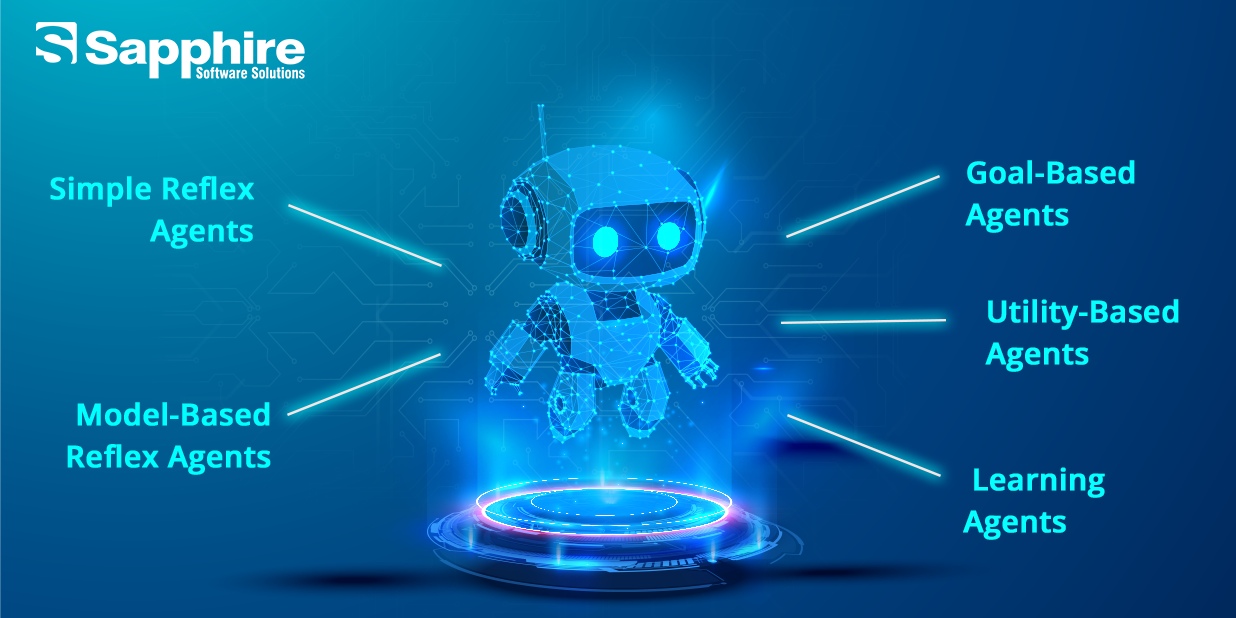
No one model with intelligent agents. Some popular types of AI agents are:
- Simple Reflex Agents: Act on immediate perceptions without bothering about the past. They are the most elementary kind and use condition-action rules.
- Model-Based Reflex Agents: Have an internal state to deal with partially observable environments. This memory component enables improved decisions in the long run.
- Goal-Based Agents: Act to realize some goals, comparing actions based on their outcomes. These agents can plan and determine the best action.
- Utility-Based Agents: Consider a range of factors to select actions resulting in maximum utility or total utility.
- Learning Agents: Enhance their performance over time by learning from experience. These agents evolve and enhance, becoming increasingly complex.
Organizations can use one or all these categories depending on the complexity and need of a project.
AI Agents for Software Development:
Speed and accuracy are important in software development. AI software development agents play their role here. They help with:
- Automatic Code Generation: GitHub Copilot and other tools help write code snippets, saving development time.
- Bug Detection and Fixing: AI Agents detect and fix bugs, making the software more reliable.
- Continuous Integration and Deployment (CI/CD): Seamless CI/CD pipeline by automating deployment and testing.
- Requirement Analysis: Converting user requirements to technical specifications.
Platform choices like GitHub Copilot and other AI agents are now being commonly adopted by development teams. Such agents liberate developers from mundane coding and enable them to work on high-level problems.
AI Coding Agents: Three Ways They Change Coding:
Skip to the end. Here are three real ways that are revolutionizing the game of software development:
- Increased Productivity: It helps developers by automating mundane tasks, enabling them to concentrate on the subtleties of finding a solution.
- Enhanced Code Quality: While they go through massive codebases, they offer optimizations and detect possible defects before they turn into huge issues.
- Reduced Learning Curve: For new developers, AI Coding Agents are personal assistants, giving immediate feedback and recommendations.
Apart from simple code suggestions, AI Agents now take part in architecture decisions, recommending modular architecture and the best algorithms.
Biggest Technical Challenges with AI Agents Today
Although all the hype rings true, writing stable and scalable AI agent software isn't child's play:
- Scalability: Quality performance in large-scale systems.
- Interpretability: It is still hard to know the thought process of the AI Agent.
- Integration: It may be difficult to integrate AI Agents seamlessly into existing systems.
- Ethical Considerations: Avoidance of bias and ethical use of AI is of utmost importance.
Irrespective of whether you are creating with an AI agent builder, to introduce long-term take-up, the primary first step is overcoming these constraints.
There are questions: Do AI agent types really live up to their hype, or are we in a bubble?
The reality is somewhere in the middle. Some applications are real value creation, and others are experimental. For instance, AI agents' crypto integrations indicate the potential in trading strategy in automating, but real-world proper execution is being tested.
But increasing numbers of companies are coming in to implement the tools. AI Agent Development Services are becoming a rapidly expanding market for bespoke agent integration.
A Future Outlook on AI Agents:-
The future of AI Agents is promising, and the advancement of AI agents architecture will result in more advanced applications. The introduction of ai agents openaimodels is opening doors to new opportunities, including natural interaction and more complex task completions. Greater access to ai agent builder software and no-code/low-code environments (ai agents no code) will further make them accessible to everyone, including small businesses.
Firms are increasingly looking for AI Agent Development Services that offer customizable deployment to address specific requirements. It demolishes the barrier to entry and empowers teams with productive automation.
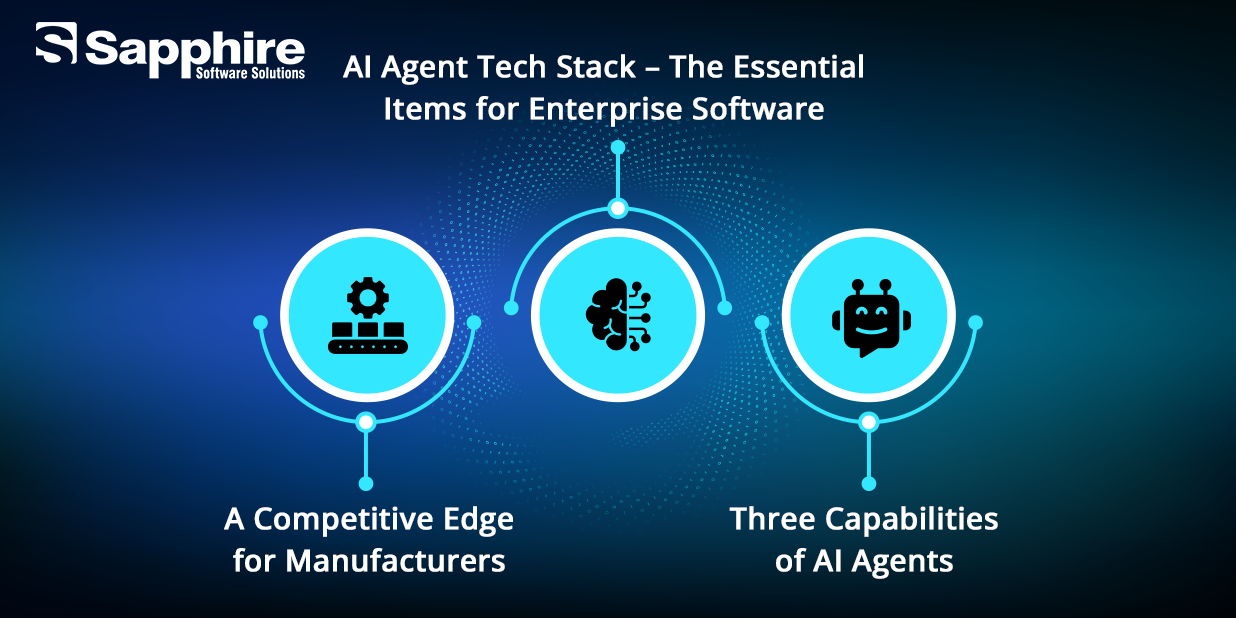
1. A Competitive Edge for Manufacturers:
Manufacturers utilize AI Agents development to automate operations, ranging from predictive maintenance to supply chain management. Using ai agents for business in firms allows firms to attain greater efficiency, downtime savings, and product quality improvement.
In intelligent factories, production lines are controlled by agents, inventory monitoring is done, and equipment wellness is monitored using real-time analysis. Such an extent of self-governance enhances reaction time and reduces man-made mistakes.
Furthermore, the small business flexibility of AI agents also implies that small production settings are also within reach of such a level of analytical power, previously reserved only for industry powerhouses. Predictive modeling, demand forecasting, and smart scheduling are now at everyone's reach.
2. AI Agent Tech Stack - The Essential Items for Enterprise Software
Should you desire scaling with an AI agent architecture, what follows is what you should understand:
- Programming Languages: AI agents, Python programming language is chosen because they have enormous libraries and community backing.
- Frameworks: Developing in the right AI agents framework provides scalability and maintainability.
- Platforms: Execution on a good AI agent platform provides performance and security.
Other needs include data pipelines, API integrations, and cloud infrastructure. Businesses must also invest in monitoring tools to monitor AI agent performance to make sure value continues to be delivered without straying from their intended activities.
3. Three Capabilities of AI Agents:
These are the three skills standouts every good AI agent must have:
- Autonomy: Running without constant human involvement. They decide on their own and act on it.
- Flexibility: Drawing upon experience and knowledge for improved performance. It allows agents to adapt on adapting needs.
- AI Agents for Small Business: Small businesses are also gaining from AI agents for small businesses. Without enormous tech teams, they can still:
- Process email automation
- Route CRM workflows
- Send marketing campaigns
Solutions built with AI agents in Python allow flexible deployment without major costs. It’s a game-changer for lean startups.
How to Build One?
If you’re wondering how to build AI agents, here’s a simple overview:
- Define the Goal: What problem is your agent solving?
- Gather Data: High-quality data is non-negotiable.
- Choose the Framework: LangChain, AutoGPT, or even custom-built tools.
- Test and Deploy: Constant iterations to optimize performance.
New ai agent builder tools facilitate this as never before.
Illustrative Scenario: AI Agents in Engineering
Assume an engineering firm is using AI Agents in their design. AI Agents browse vast databases, offer design improvement recommendations, and even predict possible failures well in advance. With the use of AI agent builder tools, the firm shortens its development phase, saves money, and ensures increased product reliability.
A sample could include the use of agents for simulating environmental stress testing on a new bridge construction. Real-time agents revise models according to constraints on variables and materials, thereby improving the engineering process in terms of reliability and efficiency.
Now consider the same company moving into civil infrastructure. With AI agents to construct software, the firm constructs modular pieces that allow city planners to visualize urban models. The agents model traffic flow, predict growth, and even optimize zoning regulations, translating raw data into solid civic solutions.
Integrating AI agents reduces human error and increases software reliability
Final Thoughts:
The impact of AI Agents on the world of software engineering cannot be ignored. Even while we keep pushing them to their limits, we must ensure that we train humans and AI to work together in a way that these agents enhance our strengths and not replace us. Proper development and deployment will certainly provide AI Agents with a dominant role in determining the future of software development.
Whether you’re an enterprise seeking AI Agent Development Services or a startup exploring an AI Development Company, this technology opens the door to unprecedented innovation and efficiency. From AI agents for customer service to AI agents for small businesses, the opportunities are boundless. Embracing AI agents in software development is no longer an option; it's a strategic imperative. Those companies that embrace this powerful technology now are positioning themselves for long-term success in a rapidly accelerating digital economy.
Want to future-proof your business with AI agents? Build smarter today.