
















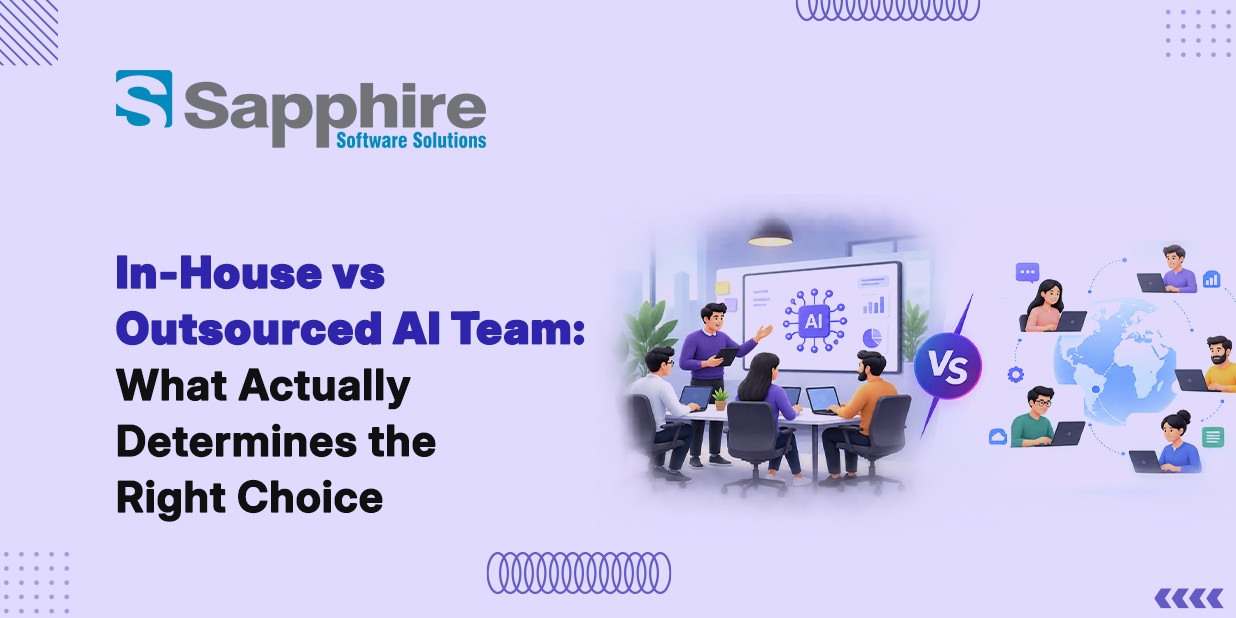
Every company building AI eventually hits the same fork on the road: hire internally or bring in outside help. It's not just a hiring decision — it shapes your cost structure, speed to market, and control over your product's future. Many businesses turn to an Artificial Intelligence Development Company for speed, only to wonder later if they should have built internally instead. This guide breaks down exactly what determines the right choice, so you can decide with confidence instead of guesswork.
What "AI Team" Really Means: The Roles Behind the Buzzword
- Engineers creating and sustaining the data pipelines that power your models
- ML/AI engineers creating and training models
- MLOps engineers deploying and monitoring models in production environments
- Prompt/LLM engineers creating and evaluating LLM systems
- Data scientists verifying results and pointing model development in the right direction
- Domain experts ensuring that the AI solves the business problem
The Core Decision Variables: Product Fit, Cost, Speed, Data Sensitivity, and Talent Scarcity
Five factors drive this decision more than anything else:
- Product fit — Is AI the product itself, or a feature supporting it?
- Cost — Fully-loaded in-house salaries vs. vendor rates
- Speed — How fast you need to ship
- Data sensitivity — Whether you're handling regulated or confidential data
- Talent scarcity — Whether you can hire and retain senior AI talent where you're located
Everything else — culture fit, tooling preferences, management style — is secondary. Get these five right, and the model choice becomes obvious rather than debatable.
The Case for In-House: Domain Knowledge, IP Control, and the Real Costs
In-house strategy works well in cases when AI is part of your offering, and you’re looking at a long-term approach. The internal team gains institutional knowledge, iterates without being constrained by the vendor’s queue and has full control over the model architecture and training data — which is a huge benefit when your competitive advantage lies in the model.
The drawback here is cost and time. In-house team allows maximum flexibility and institutional knowledge, but even the minimum viable team consisting of three engineers will cost you a few hundred thousand dollars per year until you start generating any revenue. The average salary of a software engineer in the United States is about $129,000 per year, not counting recruitment costs, benefits, hardware and the months required to recruit and train senior AI specialists.
In-house is the right call when:
- AI directly shapes your product's value proposition
- You're operating in a highly regulated or security-sensitive sector
- You have a multi-year roadmap, not a single launch
- You can realistically afford and retain senior AI hires
The Case for Outsourcing: Speed, Specialized Skills, and the Real Risks
Outsourcing is the way to go when one requires specialized AI competencies on an urgent basis but without taking the burden of maintaining a full-fledged team. This is where a specialized Artificial Intelligence Development Company comes in handy, offering engineers who have faced the same issue before, skipping months of the hiring process, and scaling up and down as per requirement.
In an established outsourcing environment, the benefits of outsourcing extend far beyond costs; these days, most companies are looking for more of a partnership approach based on results than just cheaper resources. This is reflected in the statistics as well: a vast majority of businesses plan on keeping or increasing their outsourcing budget rather than cutting it back.
But the potential pitfalls are real as well: difficulty communicating over time zones, differing engineering standards among vendors, reduced insight into how decisions are being made, and, worst of all, unclear IP ownership rights if the contracts aren't carefully worded.
Outsourcing tends to fit when:
- You need to ship in weeks or months, not years
- The AI capability supports your product but isn't the product itself
- You need niche expertise (e.g., computer vision, LLM fine-tuning) you won't need permanently
- Local senior AI talent is scarce or unaffordable at your stage
The Hybrid Model: Why Most Companies Actually Land Here
The reality is that most firms do not adopt any single approach, and statistics prove this. The dichotomy of choosing one option either in-house or outsource is slowly replaced by a hybrid approach, when in-house staff does product ownership and business knowledge part, while outside staff takes care of execution capability and methodology.
A common version of this looks like:
- An internal lead or small core team owns architecture, data strategy, and long-term direction
- An external Artificial Intelligence Development Company or specialist pod handles model development, fine-tuning, or MLOps execution
- Sensitive data and IP-critical components stay in-house; everything else is flexible
This model gives you control where it matters most and speeds everywhere else — which is exactly why it's become the default rather than the exception.
A Simple Decision Scorecard: Four Questions to Answer First
Before you hire anyone, answer these four questions honestly.
- Is AI core to your product, or does it support your product?
If customers are paying specifically for how your AI behaves, lean in-house. If AI improves an existing product without being the reason people buy it, outsourcing or hybrid usually wins. - Do you need to ship in weeks, or are you building for the next 3–5 years?
Tight deadlines favor outsourcing or hybrid, since vendors can start immediately. Long roadmaps favor building internal capability, even if it's slower upfront. - Does your data involve regulated or sensitive information?
Healthcare, finance, and government data often require in-house control or very tightly vetted vendors with strong compliance guarantees. If your data is at low risk, this constraint mostly disappears. - Can you realistically hire and retain senior AI talent in your budget and timeline?
If the honest answer is no — because of location, budget, or competition for talent — outsourcing isn't a compromise, it's the more realistic path forward.
Score yourself against these four, and the "right" model for your current stage becomes far clearer than any generic pros-and-cons list can make it.
Conclusion:
There is no universal choice between in-house and outsourced teams—the right approach depends on the stage of development your company is currently in. If your company is developing AI as its main product, has plenty of resources and time, and can hire senior talent, then going in-house can be the best way to maintain control and build a competitive advantage. If, however, you are looking for flexibility, a faster development pace, or specialized expertise, partnering with an experienced Artificial Intelligence Development Company like Sapphire Solutions can be the more effective path. For most companies in 2026, the best solution may lie somewhere in the middle—you maintain control over your idea and strategy while outsourcing its implementation to an experienced technology partner. Get a Free Quote from us and take the next step toward bringing your AI project to life.