
















mid-sized company adds AI to its product. The pilot is doing well. Everyone is happy.Six months later, someone asks for a second AI feature. The team realizes they're starting almost from scratch. Different pipelines. Different integration work. Different testing efforts.
Here's the part most people miss: the expensive piece is rarely the AI model. It's everything wrapped around it — integrations, infrastructure, maintenance, and rebuilding things every time something changes.
Composable AI is a different way to build, so that stops happening.
What Is Composable AI?
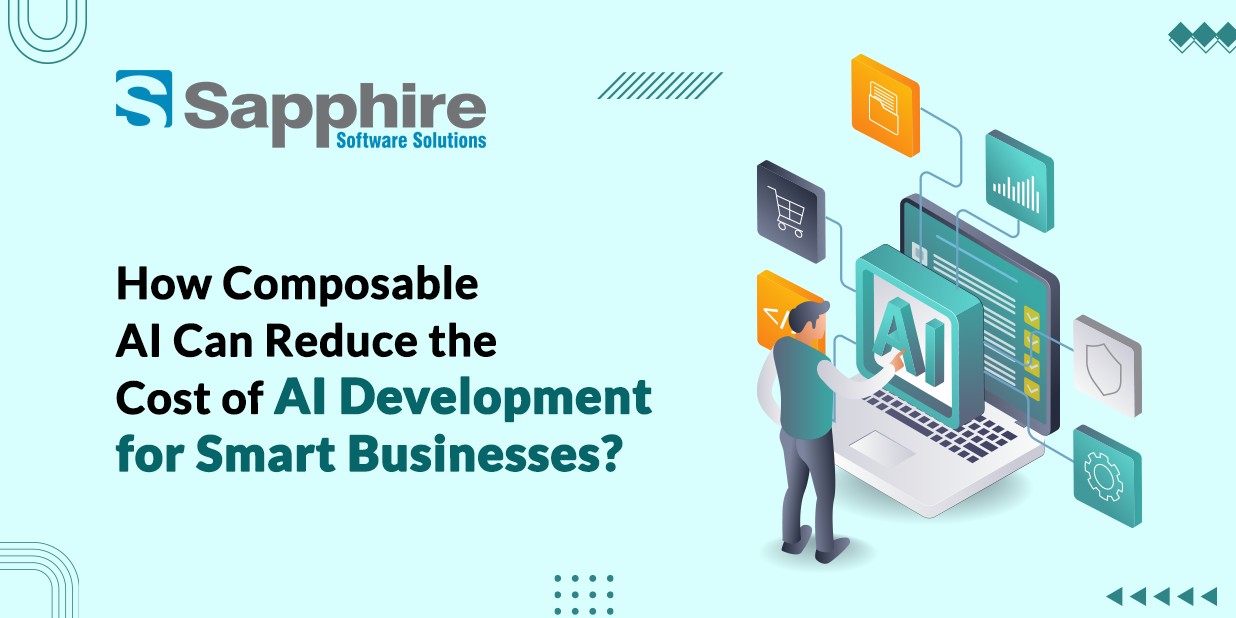
Composable AI is an approach to building AI systems by combining small, specialized AI components ("modules") instead of relying on one large, all-purpose AI system.
Think of it like LEGO for AI: you pick up the pieces you need, connect them, and create a solution suited to a particular business process.
Example
Suppose an e-commerce company wants an AI customer support system. Instead of building one giant AI, it might combine:
- LLM → understands customer questions
- RAG/search module → retrieves product and policy information
- Recommendation model → suggests products
- Moderation model → detects inappropriate content
- Workflow/agent module → decides what action to take
- Analytics module → tracks conversations and outcomes
Each of these can be swapped, upgraded, or reused independently.
Why is it called "composable"?
Because the architecture is composed — assembled from parts based on the requirement, not built as one fixed block.
Customer query → AI model → Knowledge retrieval → Decision → Business system → Response
If a better model comes along later, that one piece gets replaced. Nothing else needs to be touched.
Composable AI vs. traditional AI
| Traditional approach | Composable AI |
| One large AI system | Multiple specialized components |
| Tightly coupled | Modular |
| Hard to replace parts | Components can be swapped |
| Built for one use case | Components can be reused |
| Changes affect the whole system | Changes stay isolated |
Why Traditional AI Development Gets Expensive?
Tightly coupled systems aren't inherently bad. One well-defined use case, built once, works fine this way. The trouble starts when a business needs a second, third, or tenth use case.
Where the costs pile up:
- Rebuilding similar capabilities for every new project
- Components wired directly together, so one change risks breaking several others
- One-off integrations instead of reusable patterns
- Replacing a model means re-engineering large chunks of the app
- Maintenance load grows with every custom, interdependent piece
- Scaling gets unpredictable without clear separation of concerns
- Vendor lock-in, usually discovered only when a business tries to leave
None of this happens because a team did something wrong. Early AI projects get built for speed, and speed favors tight coupling. The bill just arrived later.
How Composable AI Can Reduce Development Costs?
Here's where the savings actually come from.
Reuse instead of rebuilding: A retrieval pipeline built for one app can often serve another with minor rework, not a rebuild.
Replace, don't re-architect: When a component ages out, teams swap that one piece. The rest of the system stays untouched.
The right model for the right task: Not every task needs the most powerful, most expensive model. Route simple tasks to lightweight models and save the heavy reasoning for tasks that actually need it.
Less duplicate engineering: Shared components mean less redundant work across teams and projects.
Faster prototyping: Testing a new idea becomes recombining existing pieces, not starting from a blank page.
Simpler integrations: Well-defined interfaces make it easier to connect new data sources or systems later.
Lighter long-term maintenance: Isolated components are easier to test, debug, and update without side effects elsewhere.
Less vendor lock-in: Loosely connected components mean switching a model or provider is a contained change, not a rebuild.
Simple example
A company builds an internal document search tool using a retrieval layer and a language model. Later, they want a customer-facing chatbot. In a composable setup, that same retrieval layer gets reused with a different interface on top. In a tightly coupled setup, they'd build the retrieval logic again from nothing.
One AI Foundation, Multiple Business Use Cases
The real advantage of compounds — it isn't a one-time saving.
The same foundation — models, retrieval, orchestration, data connections — can support:
- AI chatbot
- AI copilot
- RAG application
- Recommendation engine
- Document processing
- Customer support automation
- Internal knowledge assistant
- AI workflow automation
All drawing from shared infrastructure instead of separate builds.
Most businesses don't stop at one AI feature. Once the first project proves useful, requests tend to follow. A company that's already invested in reusable foundations can respond to those requests quickly and affordably — often the reason an experienced AI Copilot Development Company builds new copilots on top of existing components instead of starting each one from zero.
Composable AI and Agentic AI
There's another cost businesses often overlook forcing one large model to do everything.
Agentic AI — systems that plan, use tools, and take multi-step actions — tend to work better on composable foundations than on a single do-it-all model.
A practical example
Customer request → classification → retrieval → reasoning → business system → action → human approval where required.
Each stage above is a separate, testable, replaceable piece. This modular approach to orchestration and tool use is essentially the operating model behind almost any capable Agentic AI Company today.
The Hidden Savings: Maintenance and Future Changes
Most cost conversations focus on building version one and stop there. But consider what happens next:
- A better model comes out
- API pricing shifts
- A new data source needs connecting
- Security requirements change
- The business needs to scale
In a tightly coupled system, each of these can trigger significant rework. In a composable system, the change is usually contained to one component — swap the model without touching retrieval, add a data source without redesigning orchestration.
This is where the long-term savings actually show up — not in the first project, but in the fifth change six months later.
How Should Businesses Approach Composable AI?
Start with the business problem, not technology. Worth evaluating first: business goals, existing systems, available data, realistic use cases, expected scale, cost structure, security requirements, and long-term maintenance needs.
This is exactly the kind of decision where an outside perspective helps — it's easy to over-engineer with a simple need, or under-architect something meant to grow. An experienced AI Consulting Company can help map out which use cases to justify a composable approach, based on where the business is headed rather than general assumptions.
Sapphire Software Solutions works with businesses at exactly this stage — helping them decide where composability earns its keep and where a simpler build makes more sense.
Conclusion
Composable AI isn't about using more AI, or more tools, or more infrastructure for its own sake. It's about building AI that stays useful, adaptable, and financially sensible as the business grows. The savings aren't automatic. They depend on architecture, reuse, model selection, and how well components are integrated and maintained.
The businesses that benefit most stop asking, "what's the cheapest way to build this one feature" and start asking, "what will it cost to keep changing this over the next three years." That shift in thinking controls the long-term cost of AI more than any single technology choice.
Get a free quote To talk about what a composable AI approach could look like for your business.