
















The startup landscape is no stranger to disruption. From cloud computing to blockchain, emerging technologies have constantly reshaped how businesses launch, grow, and scale. And now, we’re witnessing the rise of another transformative wave, Agentic AI. Unlike traditional artificial intelligence models that wait for inputs, Agentic AI systems can act autonomously, make context-aware decisions, and even pursue long-term goals with minimal human intervention.
For startups, this isn’t just another tech trend; it’s a potential game-changer. Imagine automating entire workflows, responding to customer behavior in real time, or managing complex supply chains without manual oversight. This is not science fiction. It’s what Agentic AI is enabling today.
In this blog, we’ll explore why your startup should care about this shift, how Agentic AI development companies are making adoption seamless, and why now is the perfect time to ride the wave of autonomous intelligence.
What is Agentic AI and Why Does It Matter for Startups?
Agentic AI refers to artificial intelligence systems designed with agency, the ability to make decisions, plan actions, and autonomously pursue defined goals. These agents aren’t just reactive; they are proactive, constantly learning and adapting based on changing environments.
For startups, especially those strapped for resources, the appeal is obvious:
- Automation without complexity
- Decisions made in real time
- Reduced operational costs
- Scalable intelligence for rapid growth
Let’s say you’re building a customer support platform. Traditional AI can help automate replies. Agentic AI, on the other hand, can analyze conversations, learn from user sentiment, adapt its responses, escalate when needed, and even re-train itself on new patterns, all while you focus on your core product.
That’s why Agentic AI matters for startups. It removes the need for large tech teams while offering enterprise-level intelligence from day one.
Exploring Agentic AI Frameworks: Building Blocks for Intelligent Systems
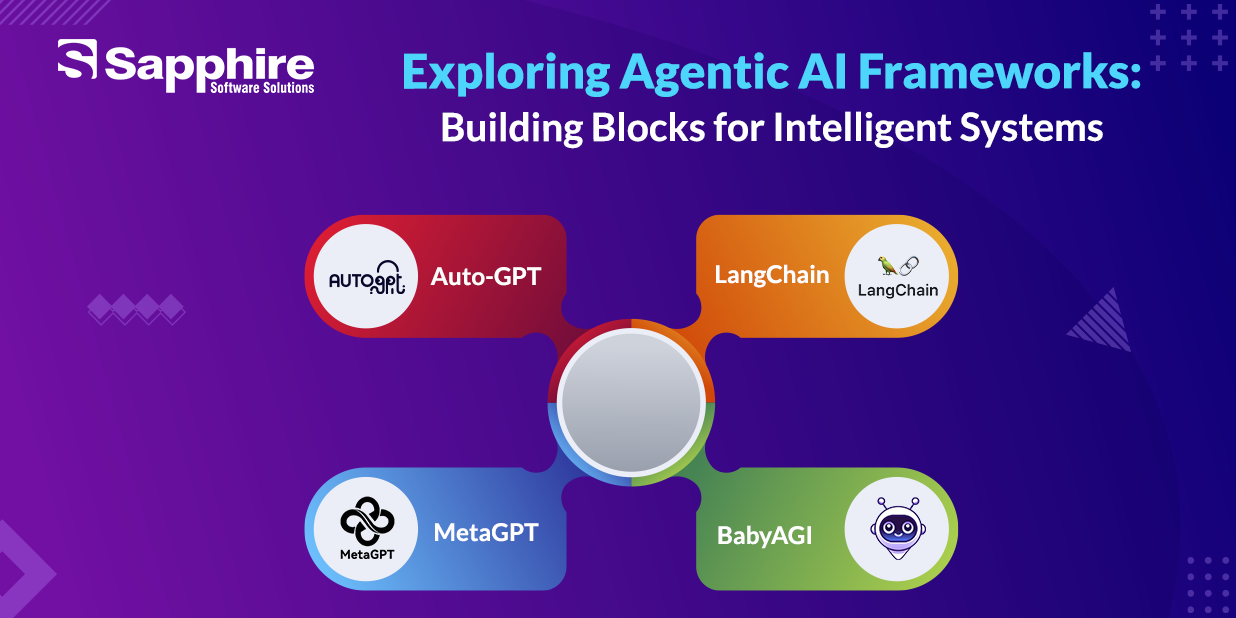
The backbone of any Agentic AIframework, the software infrastructure that enables planning, reasoning, memory, and learning. These frameworks allow AI agents to function like autonomous workers, capable of handling complex tasks with little oversight.
Some popular Agentic AI frameworks include:
- Auto-GPT – an open-source system that chains large language models (LLMs) together with memory and goal-oriented loops
- LangChain – used to create applications that use LLMs to interact with other tools and APIs
- MetaGPT – treats AI agents as if they were part of a software engineering team, assigning them roles, goals, and tasks
- BabyAGI – a task-driven autonomous agent using GPT-4 and vector memory
These frameworks serve as the building blocks for intelligent Agentic systems. They come pre-equipped with memory modules, task prioritization, planning engines, and feedback loops. For startups, leveraging such frameworks means you don’t need to reinvent the wheel. Instead, you can integrate existing modules into your app or platform to accelerate development.
Working with a specialized Agentic AI development company ensures that these frameworks are selected and customized according to your business objectives.
Understanding Agentic AI Architecture: The Backbone of Autonomous Systems
If frameworks are the tools, then Agentic AI architecture is the design blueprint, the layout that defines how components like memory, perception, reasoning, and action come together in a system.
A typical Agentic AI architecture includes:
- Input Interface: receives user data or environmental signals
- Perception Layer: interprets inputs and context
- Memory Store: stores past events, goals, and learning
- Planning Engine: decides what needs to be done and how
- Actuation Layer: executes tasks, communicates with APIs, or interacts with users
For startups, understanding this architecture is crucial. You don’t want a monolithic system that’s hard to debug or upgrade. You want modular components that can scale as your user base grows.
The right Agentic AI development company can help design and implement architectures that are:
- Modular for fast iterations
- Secure to protect user data
- Extensible to connect with external tools
- Optimized for performance even in low-resource environments
In essence, solid architecture ensures that your Agentic AI doesn’t just work today but is ready for tomorrow’s scale.
Essential Agentic AI Tools for Efficient Development:
The world of Agentic AI development is expanding rapidly, with a suite of essential tools now available for efficient, robust, and scalable implementation. These tools help with everything from prototyping to deployment and continuous learning.
Some must-have Agentic AItools include:
- LangChain: chains LLMs with tools, APIs, and memory
- Pinecone or Weaviate: for storing vectorized memories and fast retrieval
- Weights & Biases (W&B): for experiment tracking and model versioning
- Docker & Kubernetes: for containerization and orchestration of Agentic services
- FastAPI: for creating real-time APIs that connect agents with external apps
Startups benefit by using these tools to build faster, iterate quickly, and deploy efficiently. For example, using LangChain in conjunction with vector databases allows your Agentic AI to “remember” past customer interactions, improving future responses without retraining models from scratch.
An experienced development company not only picks the right tools but ensures they work harmoniously within your startup’s ecosystem.
How Microsoft is Shaping the Future of Agentic AI?
When a tech titan like Microsoft invests in Agentic AI, the world pays attention. And they’re not just investing, they're leading the charge.
Microsoft’s Azure AI platform is increasingly tailored to support Agentic AI workflows. Their integration with OpenAI's GPT models (via Azure OpenAI Service) has made it possible for developers to create autonomous systems that are secure, scalable, and enterprise-ready.
They’re also pioneering:
- Prompt orchestration engines that reduce hallucination
- Memory layers for cognitive agents
- AI Studio and AgentFlow for easy design of multi-agent systems
What does this mean for startups? You no longer need to build infrastructure from scratch. By leveraging Agentic AI Microsoft, you can build world-class Agentic applications without massive upfront investment.
Partnering with a company that already works with Microsoft’s Agentic ecosystem can give your startup a significant head start.
Designing Effective Agentic AI Workflows for Your Startup:
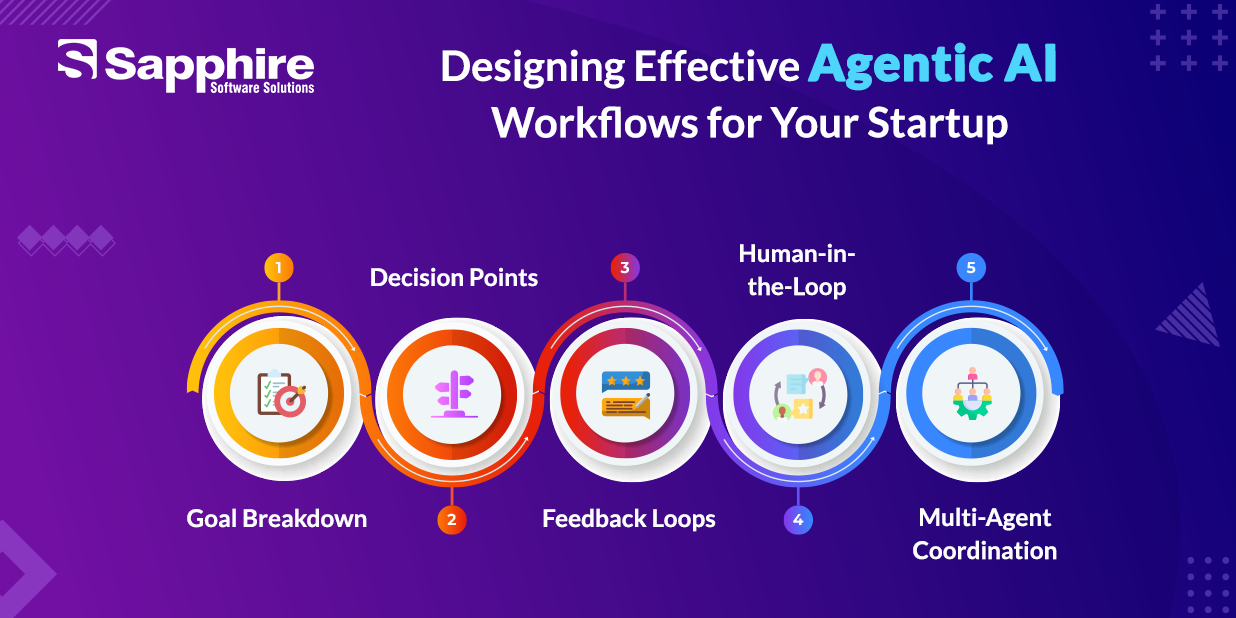
Workflow design is where theory meets action. A poorly designed workflow will make even the smartest AI agent fail. That’s why designing effective Agentic AI workflows is critical, especially for startups where every decision impacts burn rate and user satisfaction.
An effective workflow includes:
- Goal Breakdown: Clearly define what the agent is solving.
- Decision Points: Where the agent must choose between options.
- Feedback Loops: Continuous learning from successes/failures.
- Human-in-the-Loop: Option for intervention or escalation.
- Multi-Agent Coordination: When different agents handle subtasks independently.
Let’s say you run a logistics startup. Your Agentic AI could:
- Monitor inventory levels
- Predict demand spikes
- Trigger reorders
- Negotiate with suppliers
- Optimize delivery routes
All autonomously if the workflow is designed well.
Partnering with the right Agentic AI company helps design these workflows tailored to your goals, constraints, and compliance needs.
Agentic AI Solutions Tailored for Healthcare and Beyond:
While Agentic AI is a boon for most industries, few benefit as much as healthcare. The need for real-time decision-making, adaptive behavior, and data privacy aligns perfectly with Agentic AI’s strengths.
Examples of Agentic AI in healthcare include:
- Virtual health assistants that triage patients and guide them through care pathways
- Intelligent diagnostics that adjust based on symptoms and patient history
- Clinical trial agents that manage recruitment, data collection, and compliance
Beyond healthcare, Agentic AI is transforming:
- Retail: Personalizing shopping experiences
- Finance: Detecting fraud, optimizing investments
- EdTech: Creating custom learning journeys
- Manufacturing: Automating QA and supply chain
Startups across verticals can now access pre-trained agents, tailored workflows, and compliance-ready systems through dedicated Agentic AI development companies.
Comprehensive Agentic AI Services: What to Expect from a Development Company
So, what exactly can an Agentic AI development company do for your startup?
Here’s what a comprehensive service package should include:
- Consultation & Use Case Discovery– Identify where Agentic AIUse cases fit in your business
- Custom Agent Design– Build goal-driven AI agents with role-based architectures
- Toolchain Setup– Integrate LangChain, Pinecone, vector stores, and cloud APIs
- Workflow Engineering– Design scalable, adaptable processes for agent operation
- Testing & Safety– Validate performance, accuracy, and avoid hallucination
- Deployment & Monitoring– Ongoing support with metrics, feedback loops, and scaling
The key value lies in end-to-end ownership. Instead of just handing over a codebase, a top-tier company ensures that your AI agents perform, learn, and evolve with your business.
Why Sapphire is the Right Choice for Your Startup’s Agentic AI Development Needs?
At Sapphire Software Solutions, we understand startups because we’ve helped dozens of them scale through smart, AI-driven solutions.
Why choose us?
- Deep Expertise in Agentic AI frameworks like LangChain, Auto-GPT, BabyAGI
- Startup-Centric Approach – We design lightweight, scalable, cost-effective solutions
- Full Stack Support – From idea to deployment and monitoring
- Microsoft Integration – Leveraging Azure AI, GPT-4, and secure pipelines
- Compliance & Security First – HIPAA, GDPR, SOC2 readiness baked in
Whether you're building a next-gen healthcare app or an intelligent SaaS product, Sapphire provides the clarity, speed, and technical depth to get your Agentic AI solution to market faster with confidence.
Conclusion:
Startups succeed not by doing more, but by doing the right things faster and smarter. With Agentic AI, you unlock the ability to delegate intelligent decision-making to autonomous agents, allowing your core team to focus on vision, product, and growth.
As we've explored, adopting this technology doesn’t require massive budgets or in-house AI experts. With the right partner, like Sapphire Software Solutions, you can access the frameworks, architecture, tools, and talent needed to build Agentic systems tailored to your mission.
The future is not just automated. It’s agentic. And the time to act is now.