
















What is the Best AI Code Assistant?
When talking of the Best AI Code Assistant, it's not an across-the-board answer. The best tool tends to be an AI Code Assistant environment-dependent, based on language support, and project complexity. Nevertheless, there are a couple of names that are always at the top. OpenAI-powered GitHub Copilot is highly praised for its natural language-to-code abilities. There's also the Gemini AI Code Assistant from Google, famous for its cloud-based infrastructure integration. Microsoft's AI Code Assistant, integrated within Visual Studio, provides smooth integration with enterprise-scale projects. The Top AI Code Assistant is usually the one that combines high accuracy with flexibility, providing real-time suggestions and comprehending the developer's intent.
These tools employ sophisticated machine learning and deep learning algorithms to read, comprehend, and write code in real-time and provide real-time feedback. Their utility is in minimizing errors caused by manual coding and allowing developers to concentrate on strategic and architectural issues.
Why AI Code Assistants Are Essential for Business Growth?
From MVP-stage companies to multinational technology behemoths, AI coding tools are transforming software development. With AI Code Assistant Tools, companies can lower the cost of development, accelerate time-to-market, and raise the quality of their software. This is not an automation play—it's an augmentation play. Junior developers can write like seniors with these assistants, while veteran developers can do sprints more quickly.
Also, startups gain through faster delivery of products to market, which provides a competitive advantage. Businesses have enhanced scalability, improved compliance in the form of standardized code, and more efficient team collaboration. In either scenario, AI Codes allow teams to create more, quicker, and better, which in turn directly leads to business expansion.
How to Select the AI Code Assistant Tools?
With more artificial intelligence being incorporated into the software development lifecycle, selecting the optimal AI code assistant tool is a choice that can have a dramatic influence on your development speed, code quality, and team efficiency. But with many high-impact options available in the marketplace — all supporting different ecosystems and applications — making the correct choice requires more than selecting the most publicized name. It involves careful consideration of your technical requirements, team workflows, and long-term business goals.
Start by explicitly defining your foundation development environment — such as programming languages, tech stacks, deployment approaches, and security needs. For instance, if you are mainly developing web applications with JavaScript, Python, or TypeScript, GitHub Copilot has fantastic real-time suggestions and integration with Visual Studio Code and JetBrains IDEs. On the other hand, if you're developing cloud-native applications on Kubernetes and GCP services, Google's Gemini AI Code Assistant is best suited for those scenarios. Teams working on big enterprise applications with C#, F#, or .NET would appreciate Microsoft AI Code Assistant, which includes rich integration with Visual Studio and Azure DevOps pipelines.
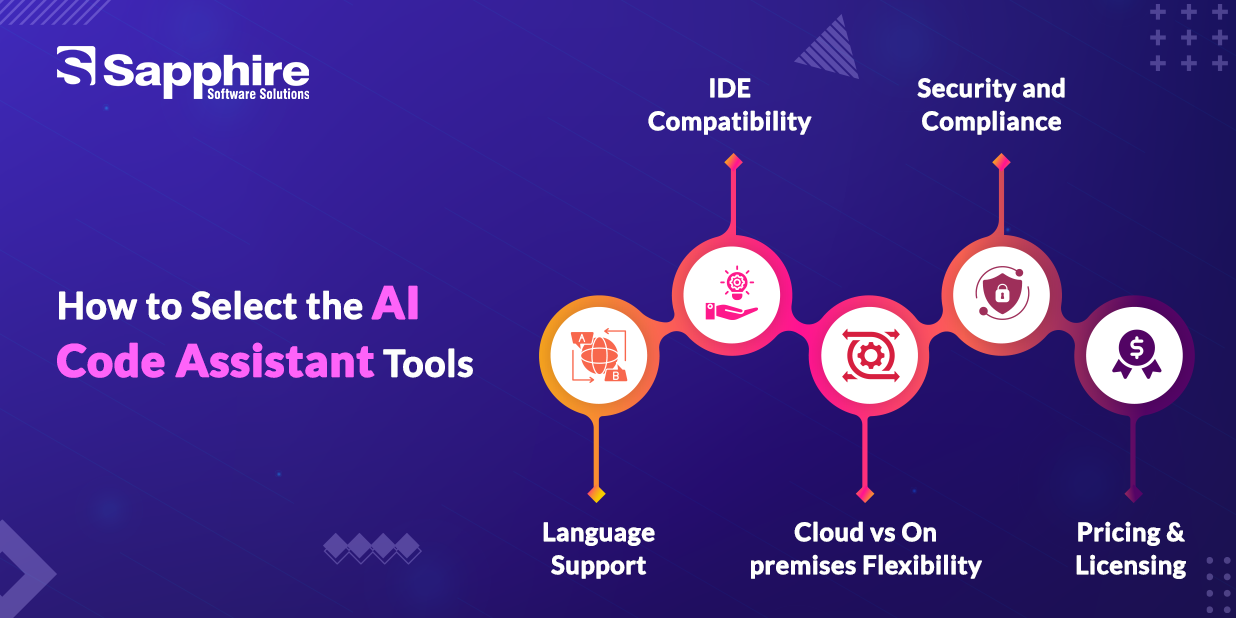
To make the process more organized, you can use an AI Code Assistant Comparison Framework, weighing the following critical factors:
- Language Support: Does the assistant support all the main languages you work with in your repositories? Multi-language support is key for polyglot dev teams.
- IDE Compatibility: Make sure the tool works seamlessly with your development environments (e.g., VS Code, IntelliJ, Eclipse, or proprietary IDEs).
- Cloud vs On-premises Flexibility: Some tools, such as Gemini, are cloud-first, while others might provide on-premises installations — key for organizations enforcing strict data residency policies.
- Security and Compliance: For sectors like finance, healthcare, or defense, code assistants need to adhere to special regulatory environments (e.g., GDPR, HIPAA, SOC 2). Make sure the tool has adequate measures against data privacy, source code, and usage transparency.
- Pricing & Licensing: Assess whether the licensing is within your means — particularly at scale. Most AI assistants cost per seat or usage, which becomes costly in large teams. Also, check whether enterprise support is offered.
Aside from these technical checkmarks, think about how well the tool integrates into your larger software development process. Does it play nicely with your DevOps tools such as GitHub Actions, Azure DevOps, CircleCI, or Jenkins? Does it have support for collaboration features, or does it provide team-level customizability for coding practices and standards?
Also evaluate the quality of documentation, tutorial availability, frequency of updates, and community support — all of which can lower the learning curve and accelerate uptake. Underappreciated is the ability to customize: can the assistant be trained or refined to implement your unique domain logic, naming standards, or API usage patterns?
Best AI Code Assistant for Developers
- In the world of rapid development today, the best AI coding assistant is not merely a matter of speed or bells and whistles — it's a matter of practical support, smart suggestions, and embedded integration with routine workflows. For those who work with multiple frameworks, languages, and deployment targets, AI coding tools are becoming essential partners rather than nice options.
- Among the top choices, GitHub Copilot, powered by OpenAI’s Codex, often stands out. It's widely praised for its intuitive code completions and deep understanding of popular programming languages like Python, JavaScript, and TypeScript. It offers real-time suggestions, documentation help, and boilerplate code generation directly in VS Code or JetBrains IDEs, making it a favorite for full-stack and front-end developers alike.
- The other likely winner is the Google AI Code Assistant, especially in the form of its integration with Gemini AI Code Assistant, which further extends context-awareness by taking more context into account around the code as well as user intention. It supports enterprise-scale environments and is being taken up quickly in DevOps and cloud-native processes.
- Microsoft AI Code Assistant, closely integrated with Visual Studio and Azure, gives enterprise developers a competitive edge within the .NET ecosystem. It stands out for refactoring, API usage, and unit test suggestions — spending hours less during big project cycles.
- Ultimately, the best AI code assistant is the one that complements your tech stack, streamlines your productivity, and scales with your requirements. Whether you're creating a prototype or rolling out an intricate microservices architecture, these helpers eliminate mental load, raise issues early, and introduce efficiency to each coding session.
- As ever-smarter AI assistants keep getting better, they're not just tools anymore — they're teammates that learn from your programming style and work to improve software quality and velocity.
Smartest AI Code Assistants: Are They Truly the Future of Development?
In a sense, yes. The most intelligent AI assistants are not merely about line-of-code prediction. They're about recognizing software design, raising vulnerability alerts, generating documentation automatically, and even testing.
As tools mature, they're becoming go-to co-pilots in the development cycle. With more applications of LLMs (Large Language Models), these assistants are beginning to perform:
- Pair programming in real-time
- Language translation (Python to Java, for example)
- Autocomplete at the logic level
The Smartest AI Assistant will be one that bridges the gap between human instinct and machine efficiency. As such tools become more sophisticated, they'll probably become default components of every IDE and will thus change the very fabric of software engineering.
Should Your Business Invest in Building Custom AI Code Assistants?
While off-the-shelf tools suffice for most, some companies have specialized workflows or compliance requirements. In those instances, creating a custom assistant is appropriate.
A customized AI Code Assistant Tool can:
- Fit your homegrown tech stack
- Include domain-specific logic
- Be integrated into internal CI/CD pipelines
- Provide extra layers of data security
This is particularly applicable for fintech, healthcare, or defense-oriented startups and businesses where data privacy and workflow tailoring are critical. If you have a big dev team or a custom development process, creating your own AI Codes solution may be a game-changer.
Future of AI Code Assistants: What’s Next for Startups and Enterprises?
As AI continues to mature, we’re moving toward assistants that don't just suggest code—they co-create. Future trends include:
- Conversational Coding: Developers will simply explain what they need, and the assistant will generate entire modules.
- Integrated QA: AI tools will not just write code but test, debug, and suggest improvements in real-time.
- Multi-agent Systems: Where one AI handles the UI, another focuses on backend logic, and yet another manages security protocols.
For startups, this translates to quicker pivots and faster MVPs. For corporations, it's staying agile without compromising on security or compliance. With the likes of Google AI Code Assistant and Microsoft AI Code Assistant improving rapidly, the distinction between human and machine-driven development is becoming less clear.
Why Sapphire is Your Ideal Partner for Hiring AI Developers to Build Custom Code Assistants?
Off-the-shelf tools generally fall short of the unique demands modern development teams face. That's where Sapphire steps in — beyond the service provider, Sapphire is a strategic innovation partner in helping you build high-performance, secure, and intelligent AI code assistant solutions tailored to the specific needs of your business.
At Sapphire Software Solutions, one-size-fits-all AI has never been our style. Our methodology is based on extensive customization, domain alignment, and architecture scalability — all to ensure that each AI-based coding assistant we develop is perfectly synchronized with your development objectives, technology stack, and business processes.
Why Hire an AI Developer with Sapphire Software Solutions?
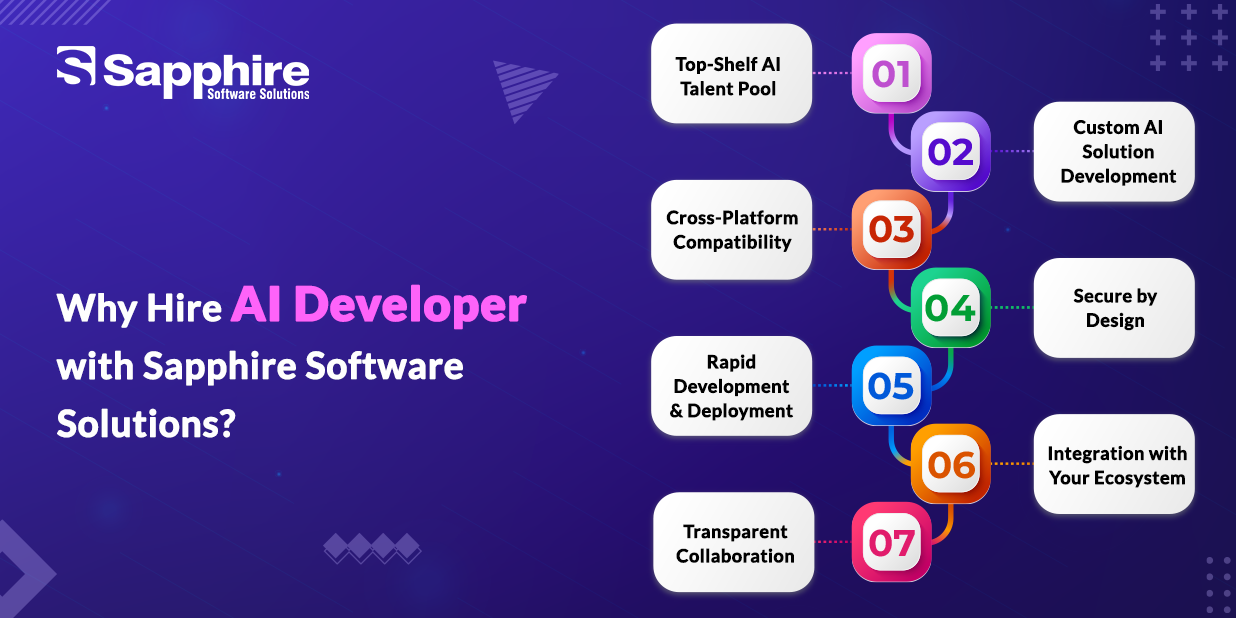
1. Top-Shelf AI Talent Pool:
Our AI engineers aren't generalists — they're specialists in machine learning engineering, NLP, LLM fine-tuning, and full-stack integration, with direct experience in creating GPT-based tools, Copilot-like code assistants, and intelligent auto-documentation systems.
2. Custom AI Solution Development:
From plugin-based IDE integrations to enterprise-level internal coding tools, we develop your AI assistant around your workflows — not vice versa. That translates to tailored support for your languages, libraries, APIs, and naming conventions.
3. Cross-Platform Compatibility:
Need integration with Visual Studio Code, JetBrains, GitHub Actions, or Azure DevOps? Our team has delivered multi-environmental AI solutions that seamlessly operate across platforms, ensuring no disruption in your developer pipeline.
4. Secure by Design:
Your code is your IP — and we handle it as such. We develop AI solutions with data privacy, compliance (GDPR, HIPAA, SOC2), and enterprise-grade security built in. Hosted on cloud or on-premises, your code never goes out of your controlled environment.
5. Rapid Development and Deployment:
Our tested agile delivery method allows us to move from concept to prototype in weeks — not months. We facilitate rapid POCs, MVPs, and scalable production-ready models, with strong documentation and post-launch support.
6. Integration with Your Ecosystem:
Using GitLab, Bitbucket, CI/CD pipelines, Kubernetes, or Docker, our AI developers can build your assistant to integrate with your current infrastructure, repositories, and coding guidelines.
7. Transparent Collaboration:
We collaborate with complete transparency, current progress updates, and open communication channels. You can interview and hire AI Developer, inspect sprints, and make real-time changes based on feedback.
More Than Development: Your Future AI Partner:
We don't just develop and leave at Sapphire. We provide ongoing training and model refinement, shaping the code assistant as your repositories increase, new languages are introduced, or internal code standards change. This includes:
- Ongoing model retraining using private code.
- Ongoing performance testing (accuracy, pertinence, latency).
- Incorporation of developer team feedback loops.
- Constantly updating the AI assistant with new open-source and proprietary model capabilities.
Conclusion:
AI Code Assistants are no longer something out of science fiction. They are here, and they are reshaping how we develop software. From enhancing developer productivity to reducing time-to-market, these tools are not optional in today's competitive landscape.
Whether you're a lean startup or a technology-driven enterprise, using Top AI Code Assistant tools will allow you to code smarter, faster, and more efficiently. It's time to adopt this transition, and if you want to build your bespoke solution, Sapphire can assist you in creating and growing with confidence.