

















The legal industry has traditionally been characterized by its reliance on precedent, meticulous paperwork, and thorough research. However, over the past decade, a steady influx of technology-driven innovations has reshaped how legal professionals work. Among these, AI in Legal stands out as the most transformative force.
Today, law firms, courts, and corporate legal departments are adopting advanced tools that automate repetitive tasks, analyze massive data sets, and deliver insights at unprecedented speed. By embracing AI in the Legal Profession, law firms are moving away from the traditional billable-hour model toward more efficient, data-driven services that benefit both attorneys and clients.
The rise of AI in Legal Technology also reflects a broader trend: clients now demand transparency, faster turnaround times, and cost-effective solutions. Firms that harness AI tools gain a significant competitive edge, not only by reducing overhead but also by offering better strategic advice backed by powerful analytics.
Why AI Is a Game-Changer in Legal Services?
The adoption of AI represents a paradigm shift for law firms worldwide. Previously, legal teams relied on junior associates and paralegals to conduct time-intensive research, draft documents, and sift through discovery materials. Today, AI in Law Firms can accomplish these tasks in minutes with greater accuracy.
Using an AI Legal Assistant, firms can streamline case preparation, due diligence, and compliance checks. These tools can comb through thousands of legal documents, extract relevant clauses, and identify risks far faster than human reviewers. By incorporating AI in Legal Research, lawyers can access curated case law, statutes, and regulatory updates almost instantly, freeing up time for higher-value work.
Moreover, AI in the Legal Industry isn’t just about efficiency; it’s about insight. Predictive analytics powered by machine learning can assess the likely outcome of litigation, evaluate settlement options, and even forecast client needs based on historical data.
This technology also enables lawyers to deliver more tailored and strategic advice. By leveraging, firms can provide clients with clear, data-backed recommendations, transforming their role from legal advisors to business partners.
Key Applications of AI in Legal Firms:-
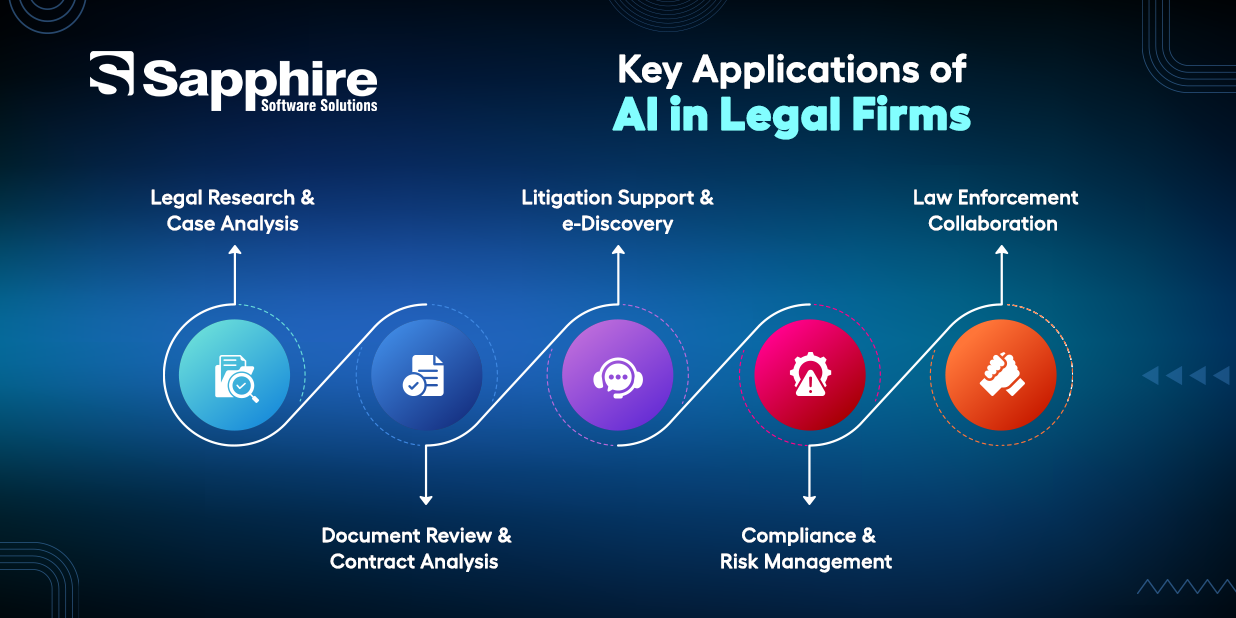
AI has moved beyond buzzword status in law firms as it is now embedded in daily operations. Below are some of the most impactful applications:
-
Legal Research and Case Analysis:
Tools leveraging AI in Legal Research can quickly scan vast databases of case law, regulations, and contracts to find precedents that support a client’s position. This dramatically shortens research time and improves accuracy.
-
Document Review and Contract Analysis:
Manual contract review can take days or weeks. With AI in Legal Technology, firms can automate clause extraction, risk scoring, and compliance checks, allowing attorneys to focus on strategy rather than paperwork.
-
Litigation Support and e-Discovery:
During litigation, firms handle massive volumes of electronic data. AI enables automated categorization, keyword identification, and relevance scoring, which helps lawyers identify critical evidence quickly.
-
Compliance and Risk Management:
By combining predictive analytics with document management, law firms can use AI solutions to proactively identify risks and ensure compliance with evolving regulations.
-
Law Enforcement Collaboration:
Although more relevant to public-sector agencies, AI in Law Enforcement tools can support cross-jurisdiction investigations and digital forensics, which indirectly benefit law firms involved in criminal defense or regulatory matters.
Through these applications, AI in Law Firms is redefining service delivery, freeing up legal professionals to concentrate on advocacy, negotiation, and client relationships.
Key Benefits of AI in Legal System Services for Law Firms:-
The integration of AI in Legal System Services has introduced a new era of operational efficiency and competitive advantage for law firms. Beyond cost savings, these technologies empower legal professionals to deliver higher-quality outcomes for their clients.
-
Greater Efficiency and Reduced Costs:
Tasks that previously took hours or days, such as discovery, contract review, or compliance checks, can now be executed in minutes with the help of AI Legal Assistant solutions. This dramatically reduces billable hours on low-value work, freeing lawyers to focus on strategic matters.
-
Enhanced Accuracy and Risk Mitigation:
Human error in legal research or document review can be costly. By using AI in Legal Technology, firms ensure higher consistency and precision. Advanced algorithms detect anomalies, identify potential legal risks, and cross-reference cases faster than any manual process.
-
Improved Client Experience:
Today’s clients expect fast, transparent, and cost-effective legal services. By adopting AI in Legal Industry tools, firms can provide real-time updates, predictive insights, and data-backed recommendations, elevate the client experience, and strengthen trust.
-
Scalability Across Practice Areas:
Whether dealing with corporate compliance, litigation, or intellectual property, AI in Law Firms enables scalable service delivery. This adaptability allows small and mid-sized firms to compete with larger players without incurring massive operational costs.
Challenges of AI in Legal Firms:-
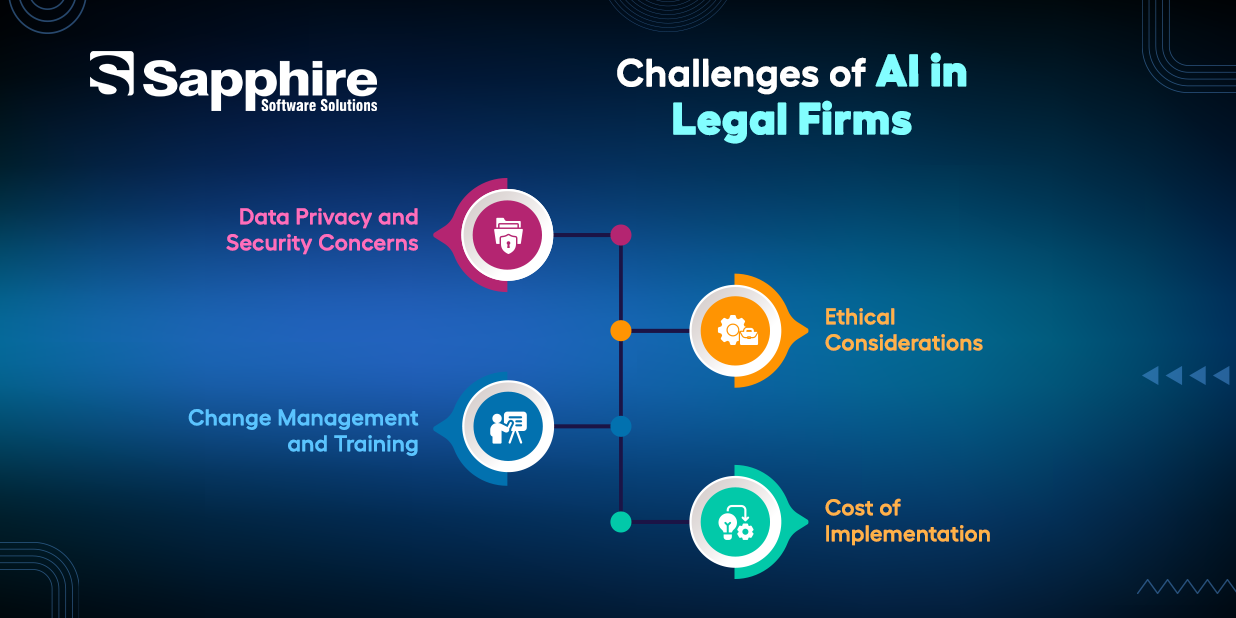
Despite its transformative potential, implementing AI in Legal practices comes with challenges. Law firms must navigate technological, ethical, and regulatory hurdles before fully embracing these tools.
-
Data Privacy and Security Concerns:
With sensitive client information at stake, adopting AI in Legal Technology raises questions about data protection. Firms must ensure compliance with privacy regulations and safeguard against cyberattacks targeting AI platforms.
-
Change Management and Training:
Introducing AI Legal Assistant platforms requires a cultural shift within law firms. Attorneys and staff may be hesitant to adopt new tools without proper training and clear communication about the benefits.
-
Ethical Considerations:
As AI becomes more common, ethical issues arise around transparency, bias in algorithms, and accountability. Firms must develop policies to ensure AI-driven recommendations are fair and defensible.
-
Cost of Implementation:
While AI tools save money over time, the upfront investment can be significant, particularly for small or mid-sized firms. This makes careful planning and phased rollouts essential.
These challenges, however, are not insurmountable. With the right strategy, firms can address these obstacles and unlock the full potential of AI to deliver superior legal services.
Future of Legal Practice with AI
Looking ahead, the adoption of AI in Legal Industry tools will fundamentally redefine how legal services are delivered. Just as e-discovery transformed litigation support, the next wave of innovation will impact everything from contract negotiation to dispute resolution.
One significant trend is the use of AI in Legal Research combined with predictive analytics to forecast litigation outcomes. This capability allows firms to advise clients more strategically, manage risks proactively, and allocate resources more effectively.
Another emerging area involves virtual AI tools that can interact directly with clients, answering basic legal questions, gathering intake information, and providing initial guidance before a lawyer steps in.
Even in public-sector work, the integration of AI in Law Enforcement with private legal practices can lead to more efficient investigations, improved evidence sharing, and stronger defense strategies.
Ultimately, AI in the Legal Profession will move beyond back-office automation to become a core strategic partner for attorneys. Law firms that embrace this shift early will secure a lasting competitive advantage, attract top talent, and deliver better outcomes for their clients.
Why Partner with Sapphire for AI in Legal System Services?
As AI transforms the legal industry, law firms need a trusted technology partner to implement, customize, and scale these solutions effectively. That’s where Sapphire comes in. With deep expertise in AI in Legal System Services, Sapphire helps firms harness the full potential of emerging technologies to streamline their operations and gain a competitive edge.
Sapphire’s approach goes beyond just installing software. The team provides end-to-end support from consulting on strategy to deploying tailored AI solutions. Whether you’re exploring AI Technology for research automation, predictive analytics, or contract management, Sapphire ensures smooth integration with your existing systems.
In addition, Sapphire Software Solutions understands the regulatory and ethical considerations surrounding AI in the Legal Profession. By partnering with us, law firms can confidently deploy advanced AI tools while maintaining client confidentiality, data security, and compliance with evolving legal standards.
Conclusion:
The legal industry is at a pivotal moment. Technology, once considered an optional tool, is now the foundation of modern legal practice. By embracing AI in Legal, law firms can move beyond traditional practices to deliver faster, smarter, and more client-centric services.
Research on predictive analytics, virtual assistants, and even integration with AI in Law Enforcement is transforming the way legal professionals operate. Firms that adopt AI today will be better positioned to serve their clients, compete effectively, and scale efficiently in the years ahead.
Yet, adopting AI is not just about technology; it’s about partnership. By working with experts like Sapphire Software Solutions, law firms can navigate challenges, ensure ethical compliance, and fully leverage AI in Legal System Services for long-term success.
In an industry built on precedent, embracing innovation can feel like a leap. But with the right partner and a clear strategy, law firms can transform that leap into a confident step toward the future of legal practice.