
















Over the past decade, education has shifted from traditional learning methods to dynamic, technology-enabled ecosystems. At the center of this transformation is AI in Education, which is not only modernizing academic experiences but also creating high-value business opportunities. Today, entrepreneurs see education technology as one of the most adaptable and scalable sectors for innovation. The potential spans from personalized learning to automated assessment systems, digital tutoring, and adaptive curriculum delivery.
The use of AI in education goes far beyond introducing smart tools or digital content. It represents a fundamental restructuring of how learners access knowledge, how teachers deliver lessons, and how institutions scale their programs. For entrepreneurs, this sector presents the perfect intersection of technology, market demand, and long-term societal impact. Its momentum is reinforced by rising global digital adoption, the availability of generative models, and growing institutional interest in modernizing learning experiences.
As we explore the business potential of this sector, it becomes essential to understand the importance of AI in education, how it shapes learner outcomes, and what entrepreneurs need to consider when planning investments in this rapidly evolving domain.
The Importance of AI in Education Solutions
The importance of AI in education has grown because educational institutions, governments, and private organizations are facing unprecedented pressure to deliver efficient, scalable, and outcomes-driven learning models. Digital-first education is no longer optional — it's a necessity driven by rising student populations, demand for personalized learning, remote education adoption, and cost-efficient administrative processes.
The key advantage of investing in AI in Education is its ability to scale across markets — from schools and professional training centers to corporate learning and workforce development. Whether entrepreneurs are targeting B2B institutions or direct-to-learner markets, AI-driven tools offer a competitive edge that legacy platforms can no longer match.
In short, the market is not only growing — it is maturing, and AI is becoming the foundation of every modern learning ecosystem.
Generative AI: Transforming Learning Content
The emergence of Generative AI in Education has redefined content creation, assessment design, and the overall learning experience. Traditionally, building high-quality educational material requires large teams of subject experts, content developers, and instructional designers. This process was costly and time intensive. Generative models dramatically simplify this workflow and help educators produce interactive content in minutes.
AI can generate lesson plans, quizzes, reading comprehension exercises, structured modules, and assessment rubrics. It also supports real-time content personalization — one of the fastest-growing areas in the EdTech sector. Learners receive content tailored to their strengths, areas of improvement, learning pace, and preferred formats, enhancing retention and engagement.
Entrepreneurs entering this space can build solutions that blend creativity with predictive learner insights. The goal is to bridge traditional pedagogy with AI-driven flexibility, preparing institutions for the next generation of learning.
Key Benefits of AI in Education for Entrepreneurs
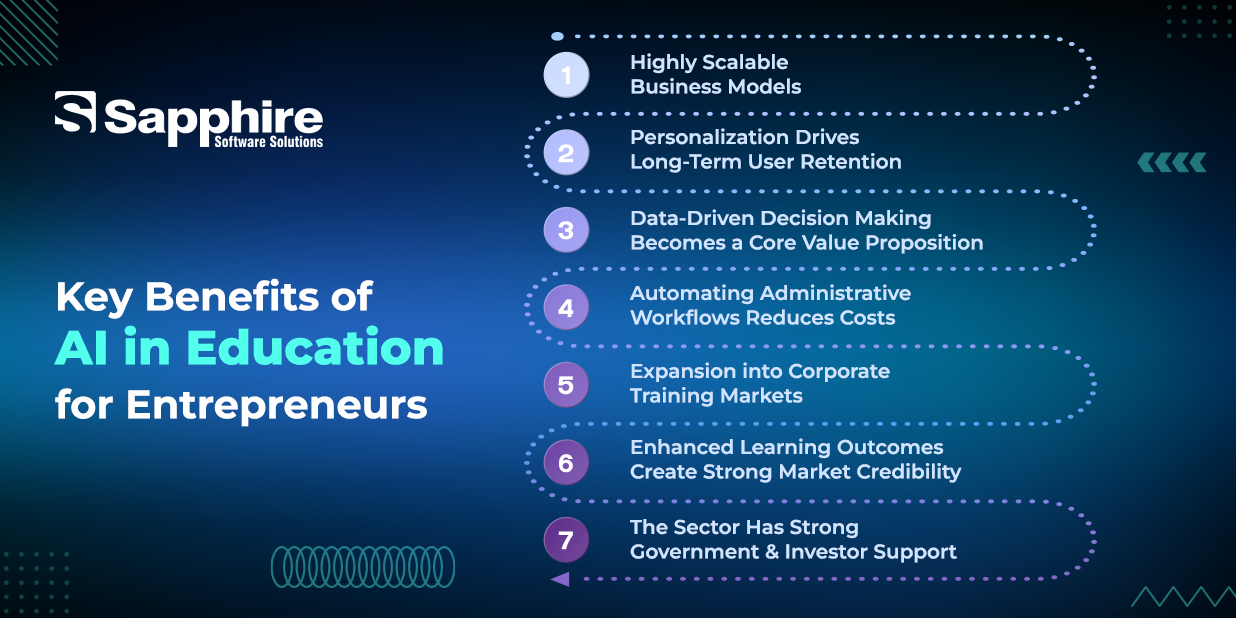
Understanding the benefits of AI in education is crucial for entrepreneurs planning to invest in this sector. Modern educational institutions are eager to deploy tools that can reduce costs, improve student satisfaction, and provide quantifiable performance improvements. For businesses, this creates an attractive environment where well-designed solutions can scale quickly and deliver strong returns.
- Highly Scalable Business Models: AI-powered education platforms can serve hundreds of thousands of learners with minimal additional cost. Automation minimizes the need for large support teams, enabling startups to grow without proportional operational expenses.
- Personalization Drives Long-Term User Retention: Adaptive systems that adjust learning paths based on performance and behavior have higher engagement rates. Entrepreneurs can build recurring subscription models around personalized content delivery and progress tracking.
- Data-Driven Decision Making Becomes a Core Value Proposition: AI systems collect and analyze learning patterns, skill gaps, and behavioral insights. These analytics are immensely valuable to institutions, helping them refine curriculum and teaching strategies.
- Automating Administrative Workflows Reduces Costs: AI tools streamline processes like grading, scheduling, enrollment management, and student support. EdTech businesses offering automation tools tend to have higher adoption among institutions that lack technical capacity.
- Expansion into Corporate Training Markets: AI-driven learning systems are increasingly used for employee upskilling, onboarding, and compliance training. Entrepreneurs can tap into the global corporate learning market, which continues to grow in demand.
- Enhanced Learning Outcomes Create Strong Market Credibility: AI tools that improve student performance, reduce dropout rates, or accelerate skill development become highly trusted by institutions. This trust fuels brand loyalty and long-term contracts.
- The Sector Has Strong Government and Investor Support: Many countries are investing heavily in digital learning frameworks. This support gives entrepreneurs confidence that EdTech innovation will remain in demand across public and private institutions.
Together, these benefits position AI-driven education solutions as one of the strongest investment opportunities for entrepreneurs worldwide.
AI in Education in India
India has become one of the world’s fastest-growing EdTech markets, driven by rising digital adoption, government-led education reforms, and an expanding youth population. The adoption of AI in Education in India is being accelerated by hybrid classrooms, digital assessments, and national initiatives that promote technology-led learning. The environment is ideal for entrepreneurs seeking long-term, scalable growth opportunities.
AI in Education in USA
The United States remains a global frontrunner in AI-driven learning technologies due to strong institutional investment, robust digital infrastructure, and a mature EdTech ecosystem. Demand for AI in Education in USA is rising across universities, K-12 schools, and corporate training programs, primarily driven by personalized learning, predictive analytics, and administrative automation.
AI in Education in UK
The United Kingdom’s education sector has been proactive in adopting digital-first learning models, making it an attractive market for AI-driven innovation. The demand for AI in Education in UK is fueled by the need to enhance learning personalization, improve administrative efficiency, and modernize outdated teaching infrastructure. Institutions are exploring AI-based assessment systems, smart tutoring platforms, and learning analytics to improve outcomes.
AI in Education in Australia
Australia’s education ecosystem has rapidly embraced remote learning, digital classrooms, and hybrid instructional models, especially after nationwide digital transformation initiatives. As a result, the adoption of AI in Education in Australia continues to grow. Institutions are investing in adaptive learning platforms, AI-driven student engagement tools, and systems that support regional and remote learners.
AI in Education in Canada
In Canada, AI adoption is strongly driven by a focus on equality, accessibility, and innovation within the education sector. There is increasing interest in AI in Education in Canada, particularly to support multilingual learning environments, student analytics, and personalized course delivery. Canadian institutions actively invest in digital tools that help streamline teaching workloads, automate assessments, and improve learner outcomes.
AI in Education in UAE
The UAE has positioned itself as a global leader in adopting advanced technologies across industries, including education. The integration of AI in Education in UAE has accelerated due to national strategies focused on digital transformation, smart government initiatives, and future-ready learning ecosystems. Schools and universities in the UAE are rapidly adopting intelligent tutoring systems, immersive learning technologies, and AI-driven performance analytics.
AI in Education in Germany
Germany’s education system is undergoing structural modernization, with institutions increasingly turning to AI for efficiency, personalization, and skill development. Interest in AI in Education in Germany is growing as academic institutions and corporate training centers seek solutions that support digital competency and workforce evolution. AI-enabled systems for automated grading, adaptive instruction, and intelligent learning analytics are becoming essential.
Future Trends: What’s Next for AI in Education
The future of AI in education is moving toward highly intelligent, autonomous, and deeply personalized learning ecosystems. Generative models will evolve into real-time learning companions capable of delivering immersive experiences, contextual guidance, and dynamic content tailored to each learner’s cognitive style. Interactive digital tutors equipped with emotional intelligence capabilities will help learners stay motivated and achieve better outcomes.
AI will also streamline institutional operations by automating curriculum design, workflow assessment, and student support systems. Virtual and augmented reality, combined with AI-driven simulations, will redefine skill development across industries. Entrepreneurs who invest early in AI-based education solutions will gain a long-term competitive advantage as global education systems shift toward experiential, data-driven, and adaptive learning ecosystems.
Conclusion
AI in Education is rapidly evolving into the backbone of modern learning systems, creating a high-value landscape for entrepreneurs ready to innovate. For businesses like Sapphire Software Solutions, this shift presents an exceptional opportunity to build scalable solutions that deliver personalization, automation, and measurable learning outcomes capabilities that institutions and corporations now consider essential. The global demand across markets such as the USA, India, UK, UAE, Australia, Canada, and Germany further strengthens the long-term growth potential of AI-driven EdTech.
Entrepreneurs who invest now can secure early competitive advantage and tap into recurring, high-margin business models. As generative AI, analytics, and adaptive learning technologies continue to expand, the future belongs to companies that merge technical expertise with learner-centric design. In short, AI in Education is not just a technological trend—it is a strategic business investment that enables sustained profitability, global scalability, and industry leadership.