
















For decades, sales depended on people, building relationships, intuition, persuasion, and hard work. But the business landscape has changed. Today’s customers expect speed, personalization, and perfect timing. They don’t want generic cold calls. They want relevant communication at the right moment, with the right message, from the right channel. This change has created a new competitive edge: data-driven selling. At the center of this is AI in Sales.
The use of Artificial Intelligence in Sales allows companies to move beyond traditional methods. Instead of relying on gut feelings, sales teams now use insights from real-time data, behavior patterns, buyer intent, and predictive algorithms. The outcome? Better leads, improved engagement, and more closed deals with less effort.
In this blog, we will explore how businesses are changing lead generation with AI. We’ll look at how to use AI in sales, how AI Sales Agent tools work, share real-world examples of AI in sales, discuss the benefits and challenges, and explain how Sapphire uses advanced AI in Marketing Services to help businesses create smarter, stronger pipelines.
What is AI in Sales and How It Works?
At its core, AI in Sales is about making sales smarter, faster, and efficient through applied machine learning, automation, natural language processing, and predictive analytics. Organizations use Artificial Intelligence in Sales to analyze big datasets, detect signals from buyers, decipher customer psychology, and suggest strategic actions. AI transforms selling from reactive outreach into proactive, insight-driven engagement.
Here's a more detailed look at how Artificial Intelligence in Sales works behind the scenes:
1. Data Collection and Aggregation:
AI continuously compiles data from:
- CRM platforms
- Customer behavior logs
- Website interactions
- Email engagement
- Market analytics
- Social listening
- Purchase history
- Demographic profiling
- Competitor tracking
- Sales activity trends
This isn't just data storage; this is data interpretation. AI then creates a 360° view of every prospect, bringing up behavior patterns that no human would ever be able to notice manually. Over time, the system gets smarter by learning from every customer interaction.
2. Predictive Intelligence:
AI evaluates patterns and predicts outcomes with accuracy that surpasses human estimation.
- When a customer is most likely to buy
- What product are they likely to buy
- Which stage of the funnel are they in
- What pricing sensitivity do they have
- Which objections may arise
- Which messaging tone will drive response
This predictive modeling enables the sales teams to engage leads at the right moment, thus improving conversion rates exponentially.
3. Personalization at Scale:
Instead of sending generic messages, AI facilitates hyper-personalized communication. It can:
- Adjust tone according to user preference.
- Suggest specific product benefits.
- Tailor content to suit the industry
- Deliver personalized advertisements and offers
- Localize language and messaging
Whereas human ability can only tailor services for dozens of customers, AI easily personalizes thousands—simultaneously.
4. Automation of Repetitive Tasks:
AI streamlines the administrative burden by:
- Scheduling follow-ups
- Personalized content recommendations
- Automatically updating CRM fields
- Drafting personalized outreach emails
- Auto-logging of call notes and summaries
- Monitoring email open rates
- Sending reminders and nudges
It frees the sales representatives from mechanical tasks to focus on human-driven selling: building relationships, negotiation, and showing empathy.
5. Decision Aid:
AI serves as a strategic advisor for sales teams by providing real-time recommendations on:
- Which leads to pursuing first (lead prioritization)
- Which opportunities have the highest probability of closing?
- Which deals could be at risk
- Which customers are likely to churn
- Which strategies or scripts work best?
Which channels perform most efficiently? In other words, AI isn't replacing salespeople; it is augmenting their intelligence, magnifying their skills, and helping them continuously make smarter decisions.
How to Use AI in Sales for Smarter Lead Generation?
1. Predictive Lead Scoring:
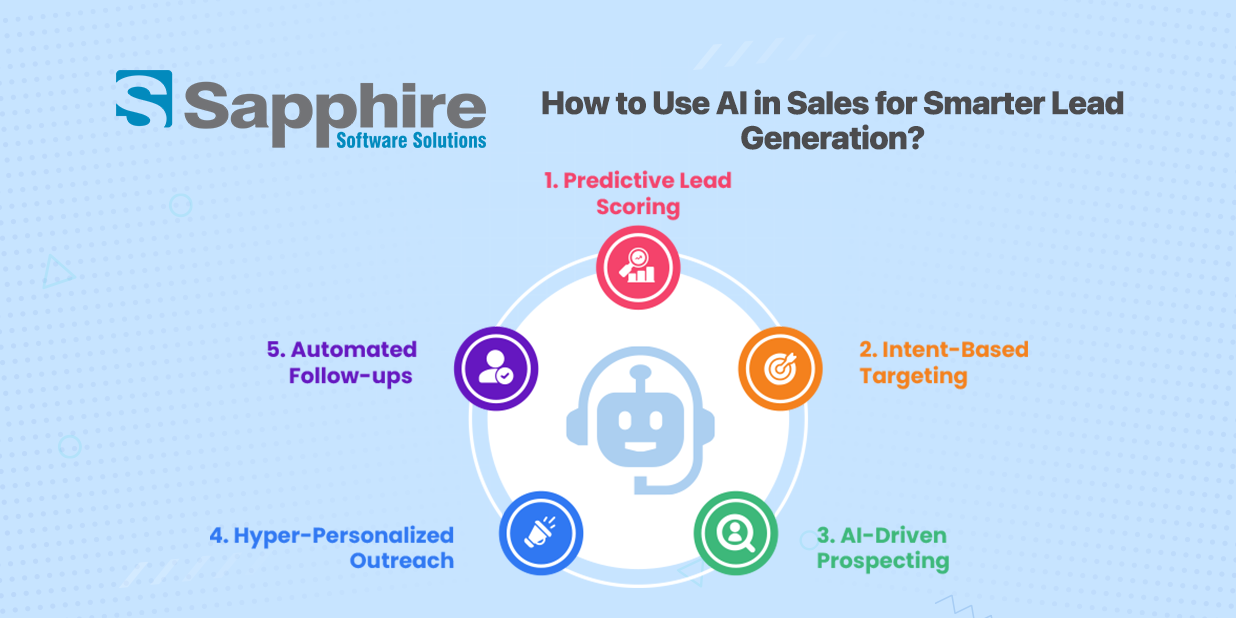
AI scores each lead based on behavior patterns, engagement history, and demographic data. The sales teams get data-backed guidance on who is most likely to buy, rather than manually assessing leads. This helps them prioritize high-value conversations and spend their time where results are truly achievable.
2. Intent-Based Targeting:
AI identifies warm leads by analyzing digital behaviors like:
- Repeated return visits
- interest in product pages
- requests for demonstrations
- subscription to updates
- Pricing analysis
With early detection of intent signals, sellers can reach out at precisely the right moment when buyer interest is peaking.
3. AI-Driven Prospecting:
AI automates the top-of-funnel hunt by sourcing new prospects to match ideal customer profiles. It scans data sources, business directories, and public records for leads that would take humans days to find. This greatly expands outreach possibilities.
4. Hyper-Personalized Outreach:
AI creates communications that address the unique needs of each prospect. From adjusting messaging style to product emphasis, length, and timing, the outreach feels truly thoughtful and relevant, not mass-generated.
5. Automated Follow-ups:
AI removes the #1 reason businesses lose leads: forgetfulness. With automated reminders, nudges, and follow-up sequences, no potential buyer gets neglected.
This automation creates a sales rhythm: consistent, persistent, and highly scalable-something no human could ever maintain.
Role of AI Sales Agents and AI Sales Assistants:-
AI Sales Agent:
An AI sales agent is an autonomous customer-facing AI that interacts directly with prospects, much like a trained salesperson would. It can:
- Engage leads in natural conversation
- Send personalized outreach messages
- Answer customer questions instantly
- Schedule demos or appointments
- Gather and arrange information about customers.
But beyond simple responses, AI sales agents can qualify leads by asking targeted questions about budget, timeline, and needs. They can guide visitors through product options, recommend solutions based on context, and even handle basic objections.
Example:
A visitor lands on the pricing page. The AI sales agent opens a friendly, contextual chat, asking what they are looking for and guiding them through options matching their business size and goals.
This creates warm leads before a human rep enters the conversation.
AI Sales Assistant:
An AI sales assistant works behind the scenes to support internal sales teams in the following ways:
- Suggests the best next step for each lead
- Prepares conversation summaries and logs interactions,
- drafts customized proposals, or emails responses.
- Provides pricing recommendations based on historical data.
- Alerts representatives when the time for follow-ups comes.
It acts like a digital analyst + executive assistant in one, giving more time to the sellers to build relationships rather than manage admin work.
AI Sales Systems:
Integrated backend intelligence engines perform:
- Automated lead scoring based on purchase likelihood
- Smart customer segmentation for targeted outreach
- Deal forecasting to project revenue
- Pipeline analytics for performance monitoring
AI-driven sales optimization strategies. Ultimately, the AI sales systems are the brains behind the modern sales operation: providing structure, insight, and predictive intelligence that enable companies to sell more quickly and smartly.
Real-World AI in Sales Examples:-
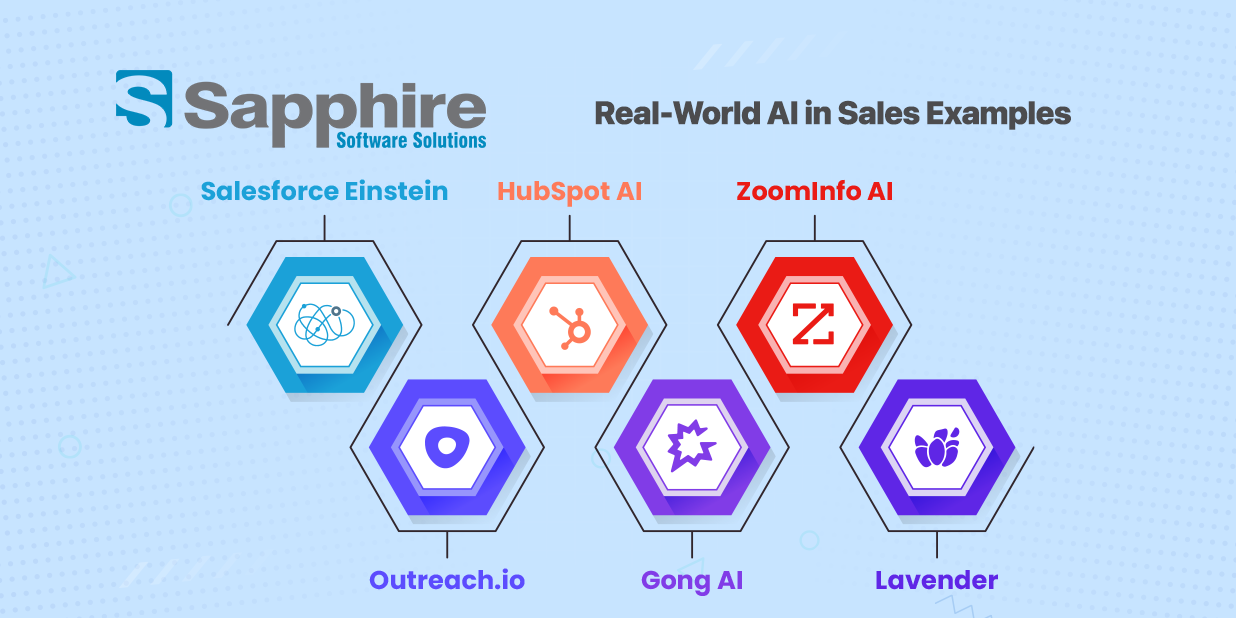
Salesforce Einstein:
Salesforce Einstein embeds AI into the world's most widely used CRM. By analyzing historical sales data, customer interactions, and engagement behaviors, it proactively ranks leads by their likelihood to convert. It doesn't just suggest which leads are "hot"-it predicts churn risk, flags neglected opportunities, and recommends the right messaging approach. This gives reps intelligent insights even before they pick up the phone or hit send on an email.
HubSpot AI:
HubSpot AI makes one of the most time-consuming parts of sales easier to handle, mainly the communication and maintenance involved with CRM. It helps draft personalized outreach emails, rewrites text for clarity or tone, and auto-populates CRM fields, so reps don’t waste hours on manual entry. It can even suggest response wording during live chat interactions, helping teams reply more effectively and close faster.
ZoomInfo AI:
ZoomInfo AI is a powerful lead generation engine, constantly scanning business data, employment records, and industry signals for potential buyers. It identifies ideal customer matches by company size, revenue, tech stack, and intent signals—like job postings or budget shifts. This helps businesses target not just more leads but better ones.
Outreach.io:
Outreach.io uses AI to optimize the timing, frequency, and medium of communication. It analyzes when prospects typically open messages, what wording gets better engagement, and which sequences lead to scheduling or conversion. In essence, this platform does the work of a behavioral marketing psychologist for sales teams.
Gong AI:
Gong AI listens in on sales calls, transcribes the conversations, identifies patterns in selling, and then uncovers what works and what doesn't. It recognizes objections, sentiment changes, and key decision-maker signals-and even coaches reps on things like tone, phrasing, and listening skills. It's like a private sales mentor embedded in software.
Lavender:
Lavender focuses specifically on the effectiveness of email conversions. It analyzes emails in real time for tone, empathy, readability, length, and the power of persuasion. It grades every message and offers suggestions based on proven sales psychology. Many companies report a noticeable uptick in reply rates and positive engagement after using it.
Benefits of Using AI in Sales for Companies:-
1. Better Lead Quality:
AI does not just supply names; it recognizes high-intent prospects based on behavior, purchase signals, demographic relevance, and past engagement. It sifts leads matching ideal customer profiles, flags those positioned for progression in the funnel. Rather than waste hours manually qualifying leads, sales teams confidently understand which to focus on that have the highest likelihood to convert.
2. Higher Conversion Rates:
AI analyzes what messaging, timing, and channels drive response and purchase rates. Delivering personalized communication at optimal touchpoints significantly raises the probability of conversion thanks to AI. Small optimizations such as messaging tone or follow-up timing can make a measurable revenue impact.
3. Improved Productivity of Teams:
Sales representatives often spend 40-50% of their time doing administrative work like CRM entry, follow-ups, and note-taking. AI automates these tasks, freeing reps up to focus on strategic selling and relationship building. With fewer repetitive tasks weighing them down, teams consistently achieve more with less effort.
4. Faster Response Time:
Speed is critical in sales. When a lead fills out a form or requests information, the company that responds first often gets the business. AI responds immediately, even at night or over weekends, to deliver information, qualify for the lead, and not miss any opportunities simply because of human delays.
5. Personalized Engagement at Scale:
Human personalization is constrained by human bandwidth. AI removes that constraint. The tailor's emails, messages, product suggestions-even tone of voice to each prospect. It enables personalization that feels truly human yet operates at machine scale.
How Sapphire Implements AI in Marketing Services for Smarter Leads?
1. AI-Enhanced Lead Discovery:
Instead of traditional list scraping or generic prospecting, Sapphire leverages AI to identify highly relevant prospects based on:
- Behavioral patterns
- Industry relevance
- Past engagement activity
- Customer profiles
- Buyer persona attributes
- Digital footprints across varied platforms
This means businesses don't pursue random leads; they pursue highly contextual leads that actually match the target market of the brand. Sapphire's AI does this, revealing even "hidden" leads that humans tend to pass over: things like dormant buyers, indirect decision influencers, or even customers who give signals for interest only through subtle engagement.
2. Predictive Lead Scoring:
Every lead that is captured is automatically measured for intent and buying readiness. AI assigns a dynamic score based on:
- Probability of conversion
- Urgency
- Interest level
- Historical engagement
- Similarity to past successful leads
This saves the sales teams from wasting their time on cold leads. Instead, they invest efforts in prospects that are most likely to convert into paying customers.
3. Personalized Sales Outreach:
Instead of using uniform messaging, Sapphire's AI enables:
- Tailored email scripts
- Personalized LinkedIn engagement
- This would, naturally, give way to conversational chatbot interactions.
- Targeted SMS campaigns
The system tailors the messaging tone and content to each customer's preference: whether it's analytical, emotional, informal, or corporate. That makes for outreach that feels individual, not automated.
4. AI-Driven Marketing Alignment:
Sapphire bridges the traditional gap between marketing and sales by tying every activity back to a measurable outcome. The areas in which AI is used include:
- Content targeting: delivering the right content to the right audience
- Campaign optimization (optimizing ad spend)
- Buyer journey mapping: tracking every interaction from awareness to purchase
This will ensure that marketing dollars are not spent on broad targeting but instead invested where actual conversions are happening.
5. Human-AI Hybrid Teams:
Sapphire believes in synergy — not a replacement:
AI handles:
- Data analysis
- Research
- Qualification
- Time-sensitive engagement
- Follow-ups
Humans handle:
- Relationship-building
- Negotiation
- Emotional intelligence
- Building trust
This hybrid model ensures that the speed of AI is combined with the empathy of human sales professionals.
6. Continuous Training and Optimization:
AI isn't static - it learns. Sapphire constantly
- Retrains algorithms on new customer data
- Refines models based on campaign results
- Scoring adjustment mechanism based on actual conversion outcomes
Update predictive signals over time. This creates AI that evolves with your business — becoming more accurate, more intuitive, and more profitable the longer it's used.
Conclusion:
AI is redefining the way modern businesses approach sales, lead generation, and customer engagement. With predictive analytics, automated outreach, and real-time personalization, companies are no longer guessing what their customers need—they are acting on accurate insights. When paired with AI in Customer Service, organizations can deliver instant responses, smoother interactions, and consistent customer satisfaction at every touchpoint. This shift transforms sales from a manual, reactive process into a smart, automated, and scalable growth engine.
Sapphire Software Solutions helps businesses harness this transformation by integrating AI seamlessly across marketing and support. Our solutions combine the speed and intelligence of AI with the human understanding needed to close deals and build trust. From identifying high-intent leads to crafting personalized outreach strategies, Sapphire ensures your pipeline grows not just in volume but in quality. Businesses ready to accelerate revenue, enhance customer experience, and stay competitive in the digital era will find Sapphire Software Solutions to be the ideal partner for an AI-powered future.