
















Artificial Intelligence is no longer just an upcoming technology; instead, today, it has become essential for innovation, operational effectiveness, optimization, and competitive advantages in any business sphere. Being an Enterprise AI Development Company, we observe how companies globally start giving more priority to implementing AI to optimize their business operations, improve customer experience, and open new doors for development.
It's important to understand what the executive boards of many corporations in the USA, Canada, UK, India, UAE, and Australia currently ask themselves: "Are we ready for AI?" For the answer, the time has come, because companies adopting AI effectively become more productive, make better decisions, and grow sustainably. On the other hand, those who neglect implementing AI technologies risk losing competitive advantages against those businesses that are actively using intelligent automation, AI-based analytics, and AI strategy. That's why nowadays companies often perform an AI Readiness Assessment.
Understanding AI Readiness in Enterprise Context:
AI readiness is an organization's ability to successfully adopt and use AI throughout all areas of the business. AI readiness entails much more than technology; it includes, but is not limited to, data, technology infrastructure, workforce competency, executive support, and strategic planning.
To be ready for AI, an enterprise must align with its people, processes, and technology so that the business can receive measurable value from the use of AI. Businesses that create a foundation of success on which to implement AI have been proven to be more successful in their journey toward becoming an AI-enabled organization.
Why AI Readiness Has Become a Boardroom Priority?
The top business leaders now understand that AI goes beyond the scope of IT. The application of AI technologies will affect revenue growth, customers' experience, operational efficiency, innovations, and the company's positioning.
Revenue Growth and Business Expansion:
Modern companies use AI in order to personalize customers' experiences, improve their conversion rate, predict behavior, and increase retention. All these elements have a positive impact on revenue generation.
Rising Competitive Pressure:
Leading companies apply AI technologies within their key processes. Therefore, those who do not want to get behind their competitors should adopt artificial intelligence solutions.
Smarter Decision-Making:
The technology allows business leaders to track trends, predict demand, control risks, and make decisions based on available data.
AI Readiness Framework for Enterprises:
An organized framework can enable organizations to evaluate how prepared they are and create an action plan for adopting AI successfully.
Such a framework generally consists of the following elements:
- Data Preparedness
- Technology Preparedness
- Workforce Preparedness
- Alignment in Leadership
- Security & Compliance
- AI Governance
- Change Management
Organizations that take into account all of these elements are well-equipped to scale AI projects and achieve business benefits.
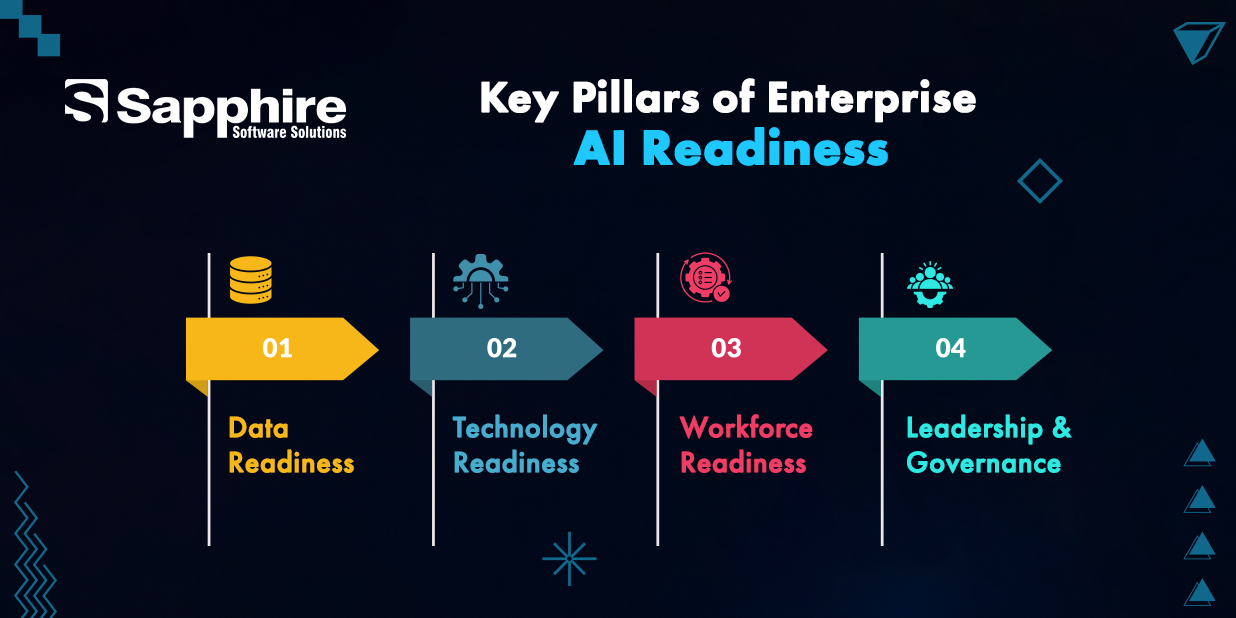
Key Pillars of Enterprise AI Readiness:-
Data Readiness:
AI technology needs accurate, dependable, and easily available data. Good data governance makes sure that AI algorithms get the best data input and generate dependable output. Low data quality is often among the most prevalent issues when adopting AI solutions. Companies undertake an AI Readiness Assessment to assess the maturity of the company’s data environment before deploying AI technology.
Technology Readiness:
Companies need reliable and scalable technology infrastructure, a safe environment, cloud capabilities, and software frameworks that can handle AI applications.
Workforce Readiness:
Employees need to be equipped with the required skills and the confidence to operate in conjunction with AI-enabled technologies.
Leadership and Governance:
Leadership is an important aspect of AI success. The leadership team needs to determine the goals, governance structure, ethics, and financial priorities.
AI Ready Data Centers and Infrastructure Requirements:
The building blocks of an effective infrastructure are imperative in enterprise AI. The organizations need scalable computing capabilities, robust storage solutions, safe networking, and cloud-native infrastructure solutions that can accommodate such tasks.
Enterprises have started making their infrastructure AI-ready as well, where there are powerful computing capabilities that enable the organization to process the information, conduct advanced analytics, and engage with generative AI models. This is because of the rising volume of information that needs to be managed by the enterprise safely and securely.
AI Readiness Assessments: Measuring Organizational AI Maturity:
The organization must determine its present state of readiness before embarking on any AI efforts. With the help of AI readiness assessments, organizations can analyze their own strengths, weaknesses, and areas of improvement.
Some of the key areas analyzed during the AI Readiness Assessment are:
- Data Quality & Governance
- Technology Infrastructure
- Leadership Commitment
- Workforce Capabilities
- Cybersecurity & Compliance
- Policies on AI Governance
Organizations also make use of AI readiness surveys as part of their assessment process.
Skilling for AI Readiness and Workforce Transformation:
Technology itself is not enough to ensure the success of an AI project. The role of workers should not be underestimated here.
When it comes to preparing workers for using artificial intelligence, it will include teaching them the basics of AI, working with related tools, and coping with changing processes. In other words, this category covers various training courses, change management projects, etc.
Workers will be able to cope much faster if their skills and knowledge are upgraded. Instead of replacing workers with artificial intelligence, this tool will enable them to do more valuable tasks.
Conclusion:
As a result of the quick emergence and growth of AI technology, companies need to be ready for changes and implement innovations that will ensure sustainability and growth. Being AI-ready is a business task that is aimed at ensuring the competitiveness and efficiency of operations, increasing revenues, and other key business processes. Thus, being ready to work in conditions where AI is actively used becomes a necessity that helps organizations become leaders in the market. Companies that work on preparing themselves today will be more successful tomorrow.
To speed up your AI transformation process and get some help in this process, consider working with Sapphire Software Solutions, a trusted Enterprise AI Development Company. We have all the necessary expertise to help businesses become AI-ready. Contact us and learn how we can help you benefit from using artificial intelligence technologies for improving your business performance. Get a free quote today and discover how AI readiness consulting can transform your business into the future.