
















Artificial Intelligence is transforming the way businesses operate by enabling intelligent systems that can automate complex workflows, analyze large volumes of data, make context-aware decisions, and continuously improve through learning. At the core of these advanced capabilities lies AI Agent Architecture—the foundational framework that determines how an AI agent perceives its environment, processes information, reasons through challenges, and executes actions to achieve specific business objectives. A well-designed AI agent architecture is essential for building scalable, reliable, and high-performing AI solutions across industries.
As organizations increasingly adopt AI-driven applications, understanding AI Agent Architecture has become critical for business leaders, developers, and technology decision-makers. Whether you're building autonomous AI assistants, enterprise automation platforms, customer support agents, or multi-agent AI systems, the right architectural approach directly impacts performance, scalability, security, and long-term success. In this comprehensive guide, we'll explore the core components of AI Agent Architecture, real-world examples, different architectural models, and industry best practices to help you design intelligent AI systems that deliver measurable business value.
What Is AI Agent Architecture?
Many businesses entering the AI space ask what is AI agent architecture and why it is important. Simply put, it refers to the structural framework that defines how an AI agent receives information, processes inputs, makes decisions, interacts with external systems, and learns from experience.
An effective agent architecture in AI combines multiple technologies, including machine learning, natural language processing, reasoning engines, APIs, databases, and cloud infrastructure into a unified ecosystem.
Core Components of AI Agent Architecture:
Every intelligent AI system consists of several interconnected components that work together to deliver accurate, efficient, and adaptive decision-making.
Perception Layer:
The perception layer collects information from multiple sources, including user inputs, enterprise applications, APIs, IoT devices, databases, websites, and cloud platforms. It acts as the agent's "senses," enabling it to understand its operating environment before making decisions.
Knowledge Base:
A knowledge base stores the information the AI agent uses to answer questions, retrieve business data, understand company policies, and perform reasoning. It may include structured databases, vector databases, documents, enterprise content, or external knowledge repositories.
Reasoning and Decision Engine:
This component evaluates incoming information, applies for logical reasoning, and determines the most appropriate action. It considers business rules, user intent, historical interactions, and contextual information before generating responses or initiating workflows.
Memory Management:
Modern AI agents require both short-term and long-term memory. Short-term memory maintains context during ongoing conversations, while long-term memory stores historical interactions, user preferences, and learned behaviors that improve future performance.
Prompt Management:
One increasingly important element is the AI agent prompt architect, which focuses on designing structured prompts, instructions, guardrails, and interaction patterns that guide large language models toward accurate and consistent outputs.
Action Execution Layer:
Once decisions are made, the AI agent interacts with external systems through APIs, automation platforms, databases, CRM software, ERP systems, or cloud services. This enables the agent to complete real business tasks rather than simply providing information.
Learning and Feedback Mechanism:
Intelligent AI systems continuously improve through feedback loops. User corrections, business outcomes, performance metrics, and operational data help refine future responses, enabling the agent to become increasingly accurate over time.
Security and Governance:
Enterprise AI systems must protect sensitive business information. Security layers include authentication, authorization, encryption, audit logging, compliance monitoring, and access controls that ensure AI agents operate safely within organizational policies.
How AI Agent System Architecture Works: Workflow and Technical Design?
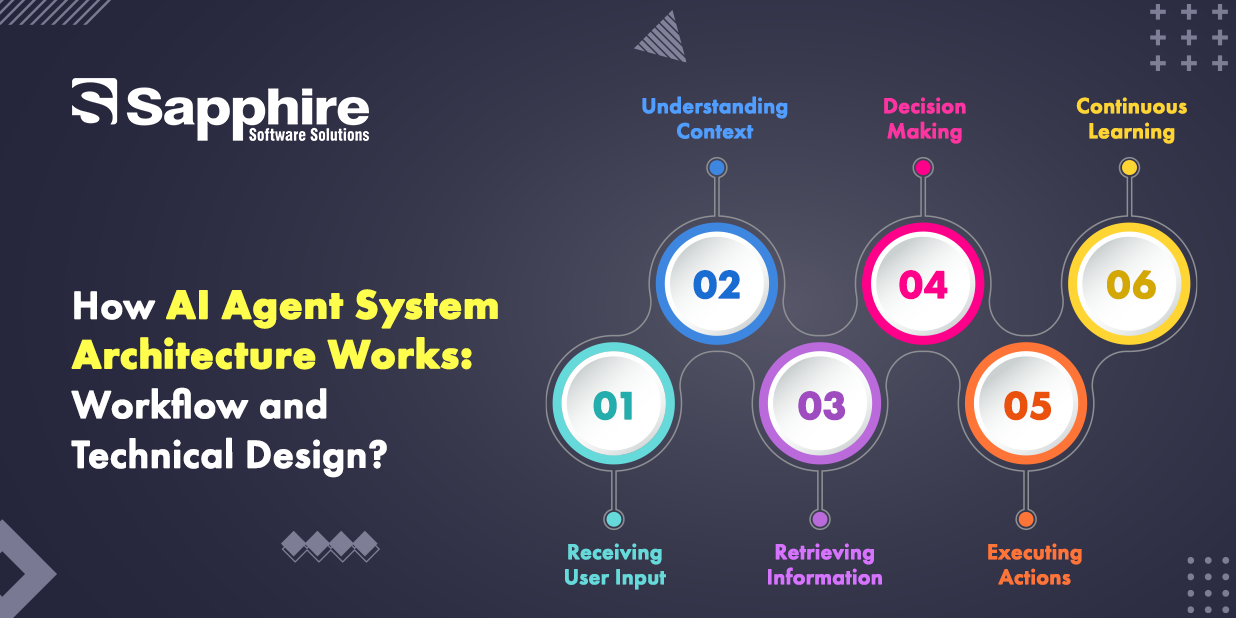
Building an intelligent AI system requires more than connecting a language model to a chatbot interface. Behind every successful AI solution is a carefully planned AI agent system architecture that manages data flow, decision-making, memory, automation, and integrations.
Step 1: Receiving User Input
Every interaction begins when the AI agent receives information. The input may come from a website chatbot, mobile application, voice assistant, enterprise software, email, API, or internal business platform.
Step 2: Understanding Context
Instead of responding immediately, the AI agent analyzes the conversation context, previous interactions, business rules, and available knowledge. This helps the system generate responses that are relevant rather than generic.
Step 3: Retrieving Information
Once the request is understood, the AI agent searches for its connected knowledge sources. These may include:
- Enterprise databases
- Cloud storage
- Company documentation
- CRM systems
- ERP platforms
- APIs
- External knowledge repositories
Step 4: Decision Making
The reasoning engine evaluates available information and selects the most appropriate action. Depending on the request, the AI agent may answer a question, perform calculations, trigger workflows, create reports, or communicate with other software systems.
Step 5: Executing Actions
Instead of simply generating text, enterprise AI agents often perform actual business operations such as:
- Scheduling appointments
- Creating support tickets
- Sending emails
- Updating CRM records
- Processing invoices
- Managing inventory
- Generating dashboards
- Triggering approval workflows
Step 6: Continuous Learning
Modern AI systems monitor user feedback, task completion rates, and operational outcomes. This information helps improve future performance while reducing repetitive mistakes.
AI Multi-Agent Architecture:
As business processes become increasingly complex, a single AI agent is often insufficient to handle every responsibility. This has led to the rise of AI multi agent architecture, where multiple specialized AI agents work together to complete larger workflows.
Advantages of Multi-Agent Systems:
- Specialized Expertise: Each AI agent focuses on a specific responsibility, improving both speed and accuracy.
- Improved Scalability: Organizations can introduce new agents as business requirements evolve without redesigning the entire AI system.
- Parallel Processing: Multiple agents work simultaneously, significantly reducing response times for complex workflows.
- Higher Reliability: If one AI agent experiences issues, other agents continue functioning independently, improving overall system resilience.
- Better Resource Utilization: Different AI models can be assigned to different tasks based on their strengths, optimizing computing resources and operational costs.
- Enterprise Flexibility: Businesses can integrate new departments, services, or automation workflows simply by adding additional specialized agents into the ecosystem.
AI Architect vs AI Engineer: Key Differences
Many organizations confuse the responsibilities of an AI architect and an AI engineer. Understanding AI architect vs AI engineer helps businesses build stronger AI teams and execute projects more effectively.
|
AI Architect |
AI Engineer |
|
|
|
|
|
|
|
|
|
|
|
|
|
|
|
|
How They Work Together:
For successful enterprise AI implementation, businesses need both strategic planning and technical execution.
AI Agent Architecture Best Practices, Frameworks & Real-World Use Cases
Designing an AI agent is not only about selecting the latest large language model. A successful implementation requires scalable architecture, reliable data sources, secure integrations, and continuous monitoring.
Best Practices for Building AI Agent Architecture:
Start with a Clear Business Objective:
Before development begins, define the problem the AI agent will solve. Whether the goal is customer support, workflow automation, sales assistance, or predictive analytics, a clear objective helps shape the architecture and ensures measurable outcomes.
Use Reliable Data Sources:
The quality of an AI agent depends on the quality of its data. Integrating verified databases, enterprise documents, APIs, and knowledge repositories improve accuracy and reduces misinformation.
Build a Modular Architecture:
A modular design makes it easier to upgrade components, integrate new technologies, and scale the solution without affecting the entire system. This approach also simplifies maintenance and future enhancements.
Prioritize Security and Compliance:
Enterprise AI systems often process sensitive customer and business information. Strong authentication, encrypted communication, role-based access control, audit logs, and regulatory compliance should be incorporated from the beginning.
Monitor and Improve Continuously:
AI agents should not remain static after deployment. Performance monitoring, user feedback, analytics, and regular model updates help improve response quality and adapt the system to changing business needs.
Popular Frameworks for AI Agent Development:
Several frameworks help developers build scalable AI agent ecosystems efficiently. Some of the most widely used include:
- LangChain for creating AI workflows and tool integrations.
- LangGraph for building stateful and multi-agent applications.
- Microsoft AutoGen for collaborative AI agent systems.
- CrewAI for role-based AI agent orchestration.
- LlamaIndex for retrieval-augmented generation (RAG) and enterprise knowledge integration.
- OpenAI Agents SDK for developing intelligent AI assistants with advanced tool-calling capabilities.
Real-World Use Cases
AI agent architecture is transforming industries by automating complex workflows and enhancing decision-making.
- Healthcare: AI agents assist with appointment scheduling, clinical documentation, patient support, and medical information retrieval.
- Finance: Intelligent agents automate fraud detection, loan processing, compliance monitoring, and customer assistance.
- Retail and E-commerce: AI systems recommend products, manage inventory, answer customer queries, and personalize shopping experiences.
- Manufacturing: AI monitors equipment, predicts maintenance requirements, and optimizes production schedules.
- Human Resources: AI agents screen resumes, answer employee questions, schedule interviews, and support onboarding processes.
- Customer Service: Intelligent assistants resolve common issues, retrieve account information, and seamlessly transfer complex requests to human agents.
Why Hire an AI Agent Developer for Custom AI Solutions?
While no-code AI platforms are suitable for simple tasks, enterprise-grade solutions require expertise in architecture, integration, scalability, and security. This is why many businesses choose to Hire AI Agent Developers who can design solutions tailored to their unique operational requirements.
Benefits of Hiring an AI Agent Developer:
- Develops AI solutions customized to business workflows.
- Integrates AI with CRM, ERP, cloud platforms, APIs, and internal systems.
- Builds scalable architecture capable of supporting business growth.
- Optimizes AI performance through prompt engineering and workflow design.
- Implements enterprise-grade security and compliance measures.
- Provides ongoing maintenance, monitoring, and performance improvements.
Why Sapphire Is the Best AI Agent Development Company for Building Custom AI Solutions?
As a trusted AI Agent Development Company, Sapphire Software Solutions helps organizations transform AI concepts into scalable, production-ready business solutions.
Comprehensive AI Strategy:
Every engagement begins with understanding business objectives, existing workflows, and technical requirements. This strategic approach ensures AI solutions align with long-term organizational goals.
End-to-End AI Development:
From architecture design and model integration to deployment and ongoing optimization, Sapphire manages the complete AI development lifecycle. Clients benefit from a single technology partner capable of delivering reliable, enterprise-grade solutions.
Enterprise System Integration:
Sapphire builds AI agents that connect seamlessly with CRM platforms, ERP systems, cloud services, business intelligence tools, databases, and third-party APIs, enabling organizations to automate complex operational processes.
Scalable and Secure Solutions:
Every AI solution is designed with scalability, security, and compliance in mind. Modern cloud architecture, secure authentication, encryption, and governance frameworks ensure businesses can confidently deploy AI across critical operations.
Industry Expertise:
Sapphire has experience delivering AI-powered solutions across healthcare, education, finance, logistics, retail, manufacturing, and enterprise sectors. This cross-industry knowledge enables the team to recommend practical AI strategies that deliver measurable business value.
Long-Term Technology Partnership:
Beyond project delivery, Sapphire provides continuous support, maintenance, system optimization, and AI consulting services that help organizations maximize their technology investments and remain competitive in an evolving digital landscape.
Conclusion:
AI Agent Architecture is becoming a critical foundation for businesses looking to automate operations, enhance decision-making, and create intelligent digital experiences. From single-agent solutions to advanced multi-agent AI ecosystems, the right architecture enables organizations to build scalable, secure, and high-performing AI systems that deliver long-term business value. By combining strategic planning, reliable data management, advanced AI models, and seamless enterprise integrations, businesses can unlock new levels of efficiency, productivity, and innovation.
Partnering with an experienced AI development company like Sapphire Software Solutions can help organizations design and implement custom AI agent solutions aligned with their unique goals and operational requirements. Whether you are looking to automate workflows, improve customer experiences, optimize business processes, or build next-generation AI applications, Sapphire’s AI experts can help transform your vision into a production-ready solution. Get a Free Quote today and explore how AI Agent Architecture can accelerate your business growth and digital transformation journey.