
















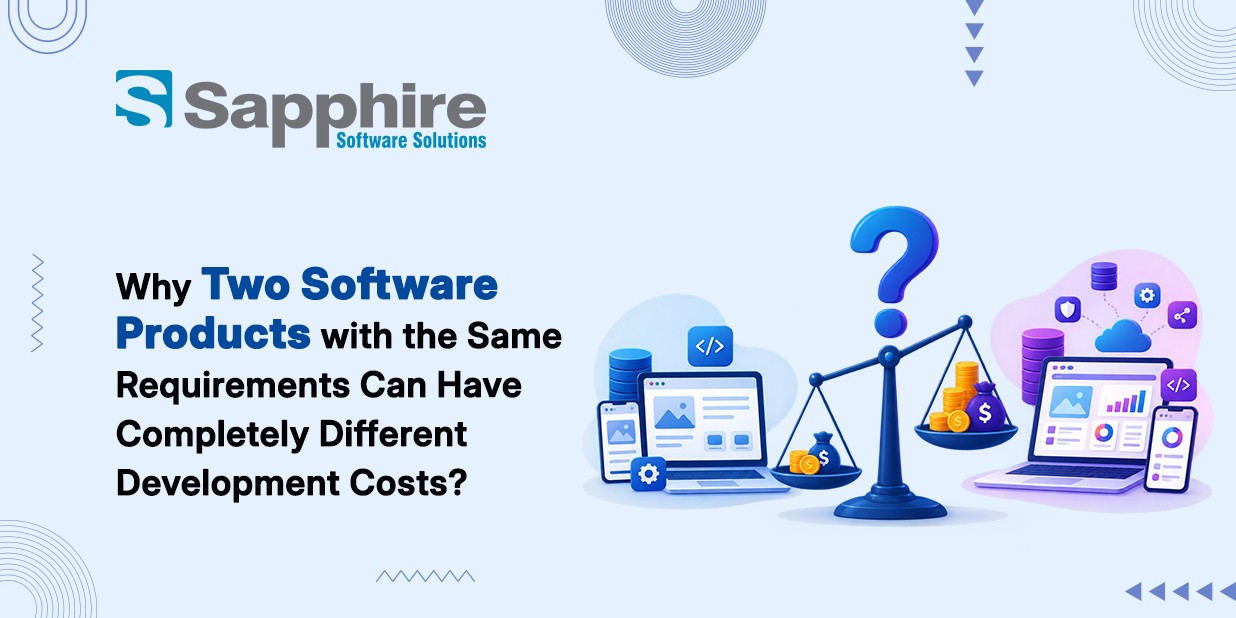
You've probably seen this happen, maybe even to you. Two agencies get the same requirements doc, and somehow one comes back at $60,000 and the other at $150,000. Same features listed. Same screens. Same "must-haves" typed out in the same PDF. And yet the numbers aren't even in the same neighborhood. If you're the one holding both quotations, it's tempting to assume someone's overcharging, or someone's cutting corners. Usually, that's not really what's going on.
A requirements document tells you what has to exist by the end of the project. It rarely says anything about how it gets built, who's building it, or what happens after launch. That gap between "what" and "how" is where most of the price difference actually lives. Let's get into “why”?
1. The Same Requirements, Different Interpretations
A requirement like "users should be able to log in securely" can mean five different things to five different developers.
- One team builds basic email/password authentication in two days.
- Another adds two-factor authentication, social logins, and session encryption — a two-week job.
- A third builds it to enterprise compliance standards (SOC 2, GDPR-ready) with audit logs.
None of them are "wrong." They're just answering the same sentence with a different scope. This is why a proper discovery phase, often part of MVP Development Services, exists — to translate vague requirements into a shared, measurable scope before a single line of code is written.
Why This Matters More Than People Think
Most cost disputes later in a project trace back to this exact ambiguity. It's rarely bad for coding. It's a misread requirement.
2. Team Composition and Talent Location
Two teams can quote wildly different numbers simply because of who's doing the work and where they're based.
| Factor | Impact on Cost |
| Location (US/UK vs. offshore) | Can shift hourly rates by 3–5x |
| Team seniority mix | Senior-heavy teams cost more but ship faster and with fewer bugs |
| In-house vs. outsourced | Outsourcing often reduces overhead but adds coordination time |
| Dedicated vs. shared resources | Dedicated developers cost more per hour but stay focused |
A 5-person senior team in North America might quote $150,000 for an app. A well-managed offshore team with the same skill level, working through structured Software Development Consulting Services, might quote $60,000 for a comparable outcome — not because they're cutting corners, but because their cost base is different.
3. Technology Stack Choices
The requirements document rarely dictates which technology to use — and that decision alone can swing the budget by tens of thousands of dollars.
- Native vs. cross-platform mobile development — native (Swift/Kotlin) usually costs more upfront but performs better long-term; cross-platform (Flutter/React Native) is cheaper initially but may need more optimization later.
- Custom-built vs. framework-based backend — a bespoke backend takes longer to build than one built on an established framework with pre-built modules.
- Cloud infrastructure choices — AWS, Azure, and GCP all price differently, and so does the engineering time needed to configure them properly.
Two teams can technically satisfy the same requirement while making completely different bets on the tech stack, and those bets show up directly in the invoice.
4. Hidden Complexity in "Simple" Features
This is probably the single biggest reason budgets diverge. Some requirements look simply but carry hidden engineering weight.
Example: "Add a Search Bar"
- Basic version: Filters a static list — a few hours of work.
- Smart version: Full-text search with typo tolerance, filters, and sorting — several days.
- Enterprise version: Search across millions of records with sub-second response time — needs a dedicated search engine like Elasticsearch, plus infrastructure and tuning.
A requirements document that just says "search functionality" leaves all three interpretations open. Whoever quotes the lowest number is often quoting version 1, and whoever quotes the highest is quoting version 3 — while the client assumed everyone meant the same thing.
5. Project Management and Development Methodology
How a team runs the project changes the cost too, even with identical requirements.
- Agile with two-week sprints tends to catch scope issues early, which controls cost overruns.
- Waterfall-style fixed-scope contracts may look cheaper on paper but often carry expensive change requests once gaps surface mid-build.
- Lack of a QA process cuts short-term cost but usually adds far more expensive rework later.
A company offering full Custom Software Development services typically bundles proper QA, DevOps, and structured sprint planning into the quote from day one — which is exactly why that number can look higher than a freelancer's estimate that leaves those out entirely.
6. Post-Launch Support and Scalability Planning
Some quotes only cover getting the product live. Others build in room to grow.
- Will the database structure handle 10x users a year from now?
- Is the code documented so a different team can maintain it later?
- Are there a maintenance and bug-fix window included, or is that a separate bill?
Two products can look identical on launch day and cost the same to build — but one was engineered to scale, and one wasn't. That difference doesn't show up in the requirements doc. It shows up 12 months later, in a much bigger bill.
Quick Comparison: Why the Numbers Diverge
| Same Requirement | Low-Cost Approach | High-Cost Approach |
| User authentication | Basic email/password | 2FA + encryption + compliance |
| Search feature | Static filter | Full-text, scalable search engine |
| Team | Junior offshore freelancers | Senior dedicated team |
| Tech stack | Off-the-shelf framework | Custom-built architecture |
| QA | Manual, minimal | Automated + manual testing |
| Scalability | Built for current load | Built for 10x future growth |
So, What Should You Actually Do?
If you're comparing quotes right now, here's a practical approach:
- Ask for a feature-by-feature breakdown, not just a total number.
- Clarify what "done" looks like for each ambiguous requirement — get it in writing.
- Ask about the team composition — who exactly will be working on your project, and at what seniority level.
- Check what's included after launch — support, bug fixes, and scaling aren't always at the base price.
- Don't assume cheaper means worse, or pricier means better — match the quote to your actual growth plans, not just today's feature list.
Final Thoughts
Two software products can have the same requirements and still have completely different development costs. The difference often comes down to how those requirements are interpreted, the expertise and location of the development team, technology choices, hidden feature complexity, QA and project management, and the level of scalability and post-launch support included.
So, when comparing software development quotes, don't focus only on the final price. Look closely at what is included, how the product will be built, who will build it, and whether the solution is designed for your future growth. At Sapphire Software Solutions, we help businesses choose the right technology, development approach, and architecture to build reliable and scalable software without unnecessary costs. Have a software idea or project in mind? Get a Free Quote From Sapphire today and let's discuss how we can turn your requirements into a successful digital product.