















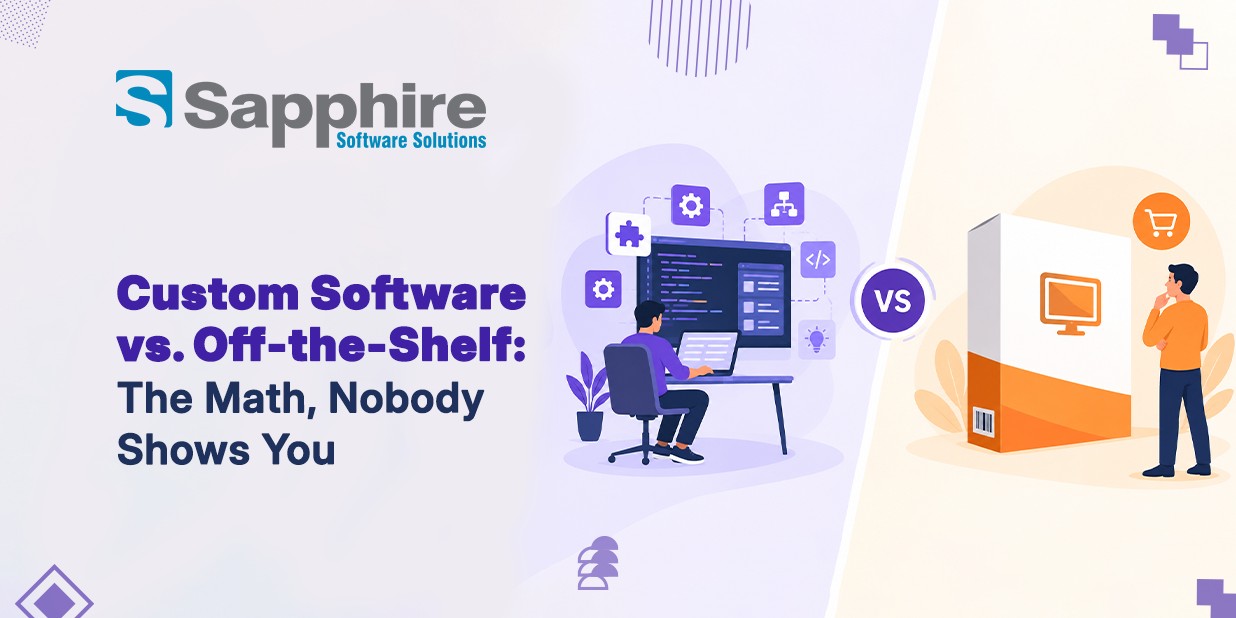
Every comparison article on this topic gives you the same table: custom software costs more upfront, off-the-shelf costs less, custom scales better, off-the-shelf ships faster. True, but useless because none of it tells you at what point one option actually becomes cheaper than the other for your business.
That's a math problem, not an opinion. So instead of another pros-and-cons list, this guide walks through the real formula: total cost of ownership (TCO), the break-even point where custom software starts winning, and the hidden line items that quietly flip the decision in the opposite direction from whatever your gut told you.
The 30-Second Definition
Custom software is built from scratch around one company's specific workflows, data, and users. You own it outright, and every feature exists because you asked for it — this is exactly the kind of work a Custom Software Development Company is built to scope and deliver.
Off-the-shelf software (including most SaaS products) is built once by a vendor and sold to thousands of companies. You rent access to it, and you get the features the vendor decides the broadest market needs — not necessarily the ones you need.
Neither is "better." One is better for your specific numbers, which is exactly what most comparison guides skip.
The Formula Nobody Writes Out: True TCO
Most buying decisions get made off a single number — the sticker price. That's almost never the real cost. The actual comparison is:
TCO = Upfront Cost + (Recurring Cost × Years) + Hidden Costs
For off-the-shelf software:
Setup/Onboarding + (Per-User License × Users × Years) + Integrations + Training + Price Escalation.
For custom software:
Development Cost + (Annual Maintenance % × Development Cost × Years) + Infrastructure + Future Feature Development.
The mistake almost every business makes: comparing only the first term on each side (development cost vs. license price) and stopping there. That's comparing a down payment to a subscription fee and calling it a full cost comparison.
A Worked Example (Real Industry Ranges)
For a mid-sized company (~50 users) evaluating a core business application over 3 years:
According to Clutch's 2026 pricing data, the average custom software project costs approximately $132,480, though GoodFirms' 2026 survey found 66% of small-to-medium projects fall between $30,000–$100,000. If you don't need the full build yet, MVP Development Services typically run $25,000–$80,000 to validate the concept first. Ongoing maintenance is generally 15–20% of build costs annually.
SaaS licensing runs $10–$100/user/month, but subscription fees make up only 25–40% of total 3-year cost once implementation, training ($500–$2,000/user); integrations, and price escalation are included. Forrester's SaaS Transparency Study found that 42% of buyers discovered hidden costs only after signing.
| Cost Component | Off-the-Shelf (SaaS) | Custom Software |
| Upfront/ Year 1 | ~$5,000–$15,000 | ~$60,000–$100,000 |
| Recurring (annual) | ~$18,000/yr (50 users) | ~$14,000/yr (18% of build) |
| Integrations & customization | $2,000–$30,000 | Built in during development |
| Training | $500–$2,000/user, recurring | One-time, lower recurrence |
| Price escalation | Common 10–19%+/yr | None — you control the roadmap |
| 3-year TCO | ~$85,000–$140,000 | ~$100,000–$150,000 |
Read this for the crossover, not the totals. Off-the-shelf wins at low user counts and short timeframes — the upfront gap is too large to close. But every seat added that every year passes, and every price hike moves the crossover closer. Custom cost curve is front-loaded then flattens; SaaS looks cheap in year one and compounds after.
The Break-Even Point
Break-Even Year = (Custom Dev Cost − SaaS Setup Cost) ÷ (Annual SaaS Cost − Annual Custom Maintenance Cost)
Using the ranges above: ($80,000 − $10,000) ÷ ($18,000 − $14,000) ≈ 17.5 years at this specific profile — a long runway, which is why off-the-shelf wins for most small businesses at small scale. That runway collapses fast when:
- User count grows — SaaS pricing is linear per seat; custom's cost per user drops with headcount.
- Vendor price hikes compound — a 10–19% annual increase can turn a 15-year break-even into a 4–5 year one.
- Customization needs to pile up — every workaround or add-on module is a cost SaaS pricing pages never show you.
The Hidden Costs Nobody Lists
Off-the-shelf:
SSO/security tier upgrades, per-viewer or per-seat fees that scale silently, data egress and integration/API fees, vendor lock-in migration costs, and feature-gating that forces a $200/month plan for one $20 feature.
Custom software:
Scope creep from requirements discovered mid-build, key-person dependency on the developer or agency, technical debt from deadline shortcuts, and the "invisible" delay month Clutch's data shows the average project takes 13 months, pushing maintenance costs earlier than budgeted. This is also why a clear post-launch plan covered under most Application Maintenance Services needs to be priced in from day one, not bolted on after launch.
Roughly half of software projects exceed their original budget significantly, and the biggest reported driver isn't scope creeping during the build — it's scope ambiguity before it starts.
Where the Math Points
Custom tends to win when: your user base is large or growing fast, workflows are specific enough to need constant paid customization, software is a core differentiator rather than an internal tool, you're stacking multiple SaaS tools to replicate what one system could do, or integration complexity is high enough that connecting tools costs more than building one.
Off-the-shelf tends to win when: requirements are standard, you need to be live in weeks not months, you lack internal resources to maintain custom code, user count stays small regardless of growth, or the market has already solved the problem well.
Most real businesses land in between: keep an off-the-shelf CRM or ERP for standardized functions, and layer custom software around the specific workflows that aren't — capturing the speed of buying and the fit of building without paying full custom cost for problems the market already solved.
The Bottom Line
There's no universal winner, and any article claiming otherwise hasn't done the math. The decision comes down to running your own numbers — user count, growth trajectory, integration complexity, technical resources — through the formula above and finding your own break-even point. If you'd rather have that analysis run for you than guess at it, our Software Development Consulting Services can map it against your actual numbers before you commit either way.Get a free quote and we'll help you find out which side of the break-even point your business is actually on.