















Artificial Intelligence has rapidly shifted from being a niche research field to a foundational pillar of modern digital businesses. Today, startups and IT entrepreneurs are no longer asking whether to adopt AI, but how to implement it effectively, affordably, and at scale. From recommendation engines and predictive analytics to automation, computer vision, and conversational interfaces, AI is shaping how products are built, marketed, and monetized.
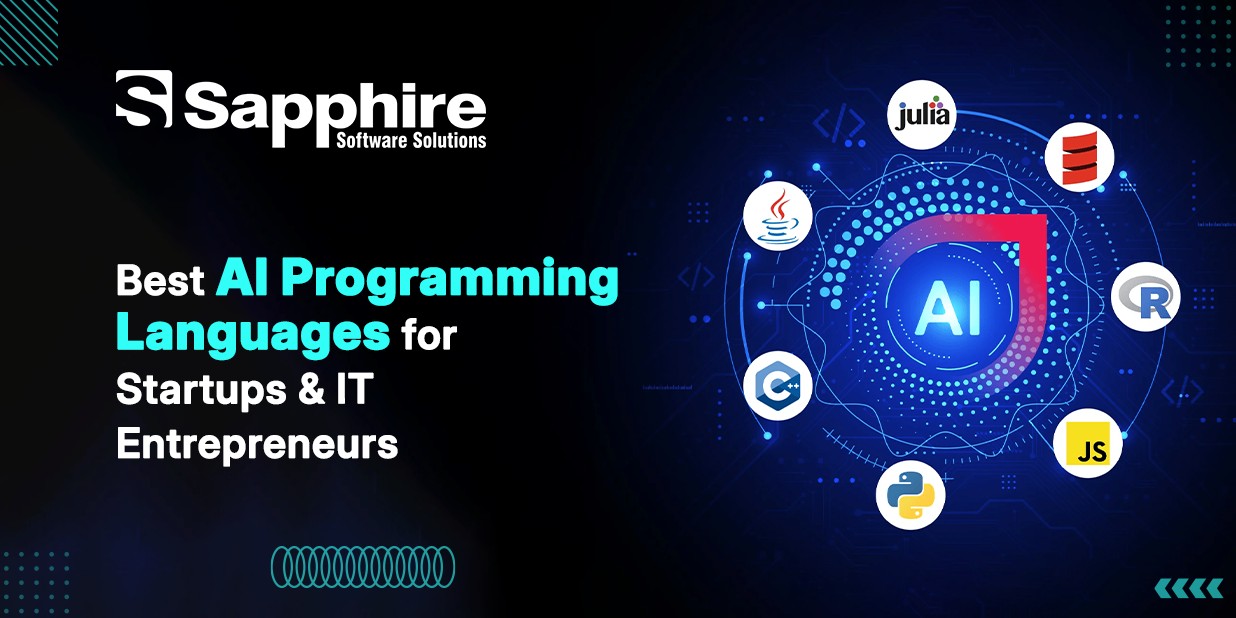
At the core of every AI-powered solution lies a critical technical decision that often determines long-term success: the selection of AI Programming Languages. While many founders focus on algorithms, data, or infrastructure, the programming language used to build AI systems plays an equally decisive role. It influences development speed, performance, scalability, hiring feasibility, integration capabilities, and maintenance costs.
For startups, this decision carries even more weight. Unlike large enterprises, early-stage companies operate with limited resources, tight deadlines, and little margin for error. Choosing the wrong language can lead to slower development, higher costs, technical debt, or even the need for complete rewrites.
This blog explores why programming language choice matters for AI-driven startups, breaks down the most practical options available today, and explains how the right technical foundation can help entrepreneurs build profitable and investor-ready AI products.
Why Programming Language Choice Matters for AI-Driven Startups?
In an AI-first business environment, technology decisions are inseparable from business strategy. The Programming Language used in AI development affects how quickly ideas move from concept to production and how easily products can evolve as user needs grow.
Startups often work under intense pressure to validate ideas, attract users, and demonstrate traction. A language with a mature ecosystem, strong community support, and extensive libraries allows teams to prototype faster, test ideas efficiently, and iterate based on real-world feedback. Faster experimentation cycles are critical for reaching product-market fit before competitors.
Language choice also influences operational efficiency. Some languages enable rapid development but may struggle with performance at scale, while others deliver speed and control but require specialized expertise. Startups must balance immediate development needs with long-term scalability. A poor decision early on can introduce technical bottlenecks that limit growth or increase maintenance costs.
Hiring considerations are equally important. Languages widely used across the AI ecosystem provide access to a global talent pool, making it easier to recruit and scale teams. In contrast, niche languages may offer technical advantages but can slow growth due to limited developer availability.
Ultimately, choosing from the Top AI Programming Languages is not a purely technical decision—it is a business-critical choice that shapes cost structures, delivery timelines, and long-term competitiveness.
Best AI Programming Languages Every Startup Should Consider:
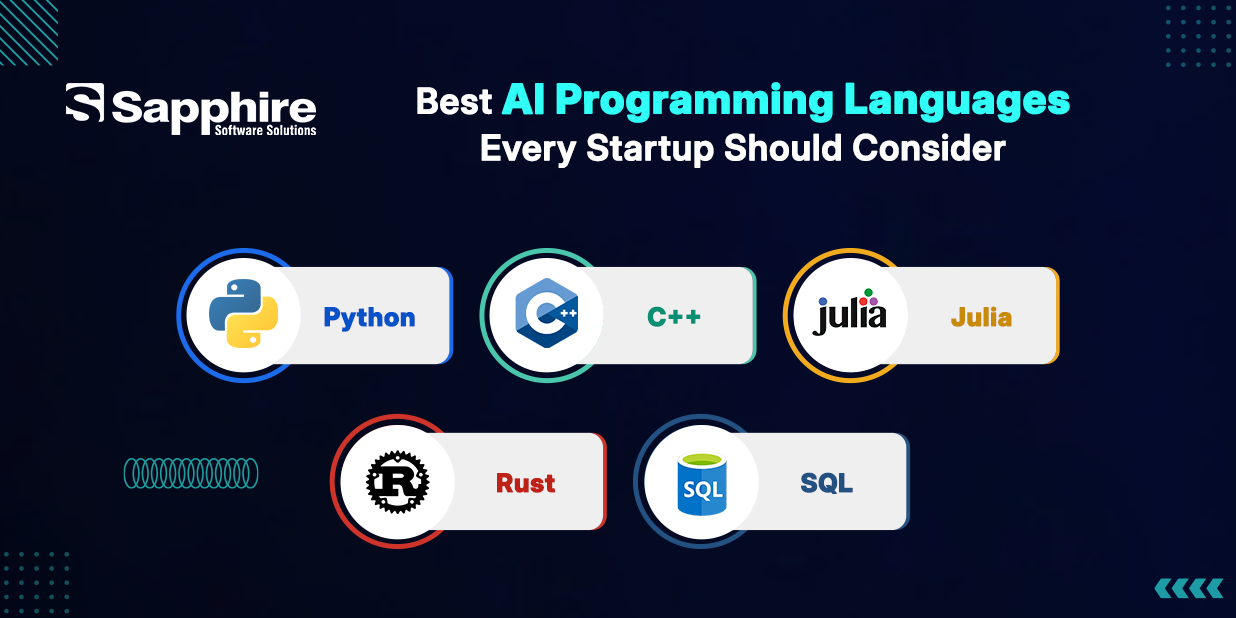
Python:
Python has become the undisputed leader in AI development due to its simplicity, flexibility, and vast ecosystem. It allows startups to move from concept to prototype with minimal friction. Its readability makes collaboration easier across teams, even for developers who are not AI specialists.
The availability of mature frameworks for machine learning, deep learning, natural language processing, and data analysis makes Python a go-to option for experimentation and rapid development. Startups focused on innovation, research, and fast iteration often choose Python to validate ideas quickly before scaling.
C++:
C++ is favored when performance, speed, and memory control are critical. While it requires more development effort than higher-level languages, it delivers unmatched efficiency for compute-intensive AI workloads.
Startups building AI systems for robotics, autonomous systems, real-time analytics, or hardware-integrated solutions often rely on C++ to achieve low latency and high performance. It is particularly valuable when AI models must operate under strict resource constraints.
Julia:
Julia is gaining attention for its ability to combine high-level syntax with near low-level performance. Designed for numerical computing, it is well-suited for startups working on advanced simulations, scientific computing, or complex mathematical modeling.
Its ability to handle large datasets efficiently while maintaining readable code makes Julia attractive for research-heavy AI applications. Though its ecosystem is still growing, its performance advantages position it as a strong contender for specialized AI use cases.
Rust:
Rust emphasizes safety, concurrency, and performance, making it increasingly popular for building reliable AI infrastructure. Startups that prioritize system stability, memory safety, and secure execution environments often explore Rust as a long-term investment.
While the learning curve is steeper, Rust’s ability to prevent common programming errors at compile time makes it ideal for AI systems where reliability is non-negotiable, such as financial or security-focused applications.
SQL:
Though not traditionally associated with AI model development, SQL plays a critical role in data-driven intelligence. AI systems are only as good as the data they process, and SQL remains essential for managing, querying, and transforming structured data.
Startups working with analytics-driven AI, recommendation systems, or business intelligence rely on SQL to prepare and manage datasets efficiently, making it an indispensable part of the AI development stack.
How Choosing the Right AI Language Impacts Startup Costs & Time-to-Market?
For startups, speed and cost efficiency often determine survival. The selection of AI Programming Languages directly affects both development expenditure and time-to-market.
Languages with rich ecosystems reduce the need for building functionality from scratch. Pre-built libraries, frameworks, and tools enable teams to focus on solving business problems rather than reinventing technical components. This accelerates development cycles and shortens product launch timelines.
Hiring costs also vary significantly depending on language choice. Widely adopted languages offer access to a larger talent pool, reducing recruitment time and salary premiums. Specialized languages may require higher compensation or longer hiring cycles, increasing operational costs.
Maintenance and scalability costs must also be considered. Languages that support modular architecture, automation, and cloud-native deployment reduce long-term expenses. A well-chosen language helps startups scale efficiently without incurring excessive technical debt.
In short, language choice shapes how quickly startups can test ideas, attract users, and generate revenue—making it a foundational factor in business success.
Future-Proofing Your Startup: AI Languages That Ensure Long-Term Growth
AI is evolving at an unprecedented pace, and startups must prepare for change from day one. Selecting adaptable Top AI Programming Languages helps ensure systems remain relevant as new frameworks, tools, and deployment models emerge.
Future-ready languages support integration with cloud platforms, data pipelines, and emerging technologies such as edge computing and autonomous agents. They allow startups to enhance existing systems without major architectural changes.
Community support plays a critical role in long-term viability. Languages with active communities evolve faster, receive regular updates, and adapt to industry trends. This reduces the risk of technological obsolescence and ensures access to ongoing innovation.
By choosing languages that balance flexibility, performance, and ecosystem maturity, startups create a foundation that supports growth, experimentation, and resilience over time.
Why Startups Should Hire AI Developers Skilled in the Right Programming Language?
Technology choices are only as effective as the people implementing them. Even the best tools fail without skilled professionals who understand how to apply them strategically. Startups benefit significantly when they hire AI Developers who are proficient in the chosen technology stack.
Experienced AI developers bring more than coding skills—they contribute architectural insight, optimization strategies, and problem-solving expertise. They understand how to balance experimentation with production stability and how to translate business goals into technical solutions.
Hiring developers aligned with the right language reduces onboarding time, improves code quality, and minimizes costly mistakes. It also enables startups to scale faster by building systems that are easier to maintain and extend.
For founders without deep technical backgrounds, working with skilled AI professionals ensures that early decisions support long-term success rather than limiting growth.
How an AI Development Company Can Help Build Scalable & Profitable Products?
Many startups choose to collaborate with an Artificial Intelligence Development Company to accelerate development and reduce risk. Such partners bring proven frameworks, cross-industry experience, and access to specialized talent that would be difficult to assemble internally.
An experienced Enterprise AI Development Company helps startups choose the right programming languages, architectures, and deployment strategies based on business goals rather than trends alone. They also ensure compliance, security, and scalability from the outset.
By leveraging external expertise, startups can focus on product vision, market strategy, and customer acquisition while ensuring technical execution meets enterprise-grade standards. This partnership model often results in faster launches, higher-quality products, and stronger investor confidence.
Conclusion:
Building AI-powered products is no longer reserved for large enterprises with massive budgets. Startups and IT entrepreneurs now have access to powerful tools, platforms, and talent—but success depends on making the right foundational choices.
Selecting the Artificial Intelligence Development Company is one of the most strategic decisions founders will make. It affects speed, cost, scalability, hiring, and long-term adaptability. From rapid prototyping to enterprise-scale deployment, language choice shapes every stage of the AI lifecycle.
By aligning technology decisions with business objectives, investing in the right talent, and leveraging experienced development partners, startups can turn AI into a sustainable growth engine. In a competitive digital economy, the right technical foundation is not just an advantage—it is essential for building scalable, profitable, and future-ready businesses.