
















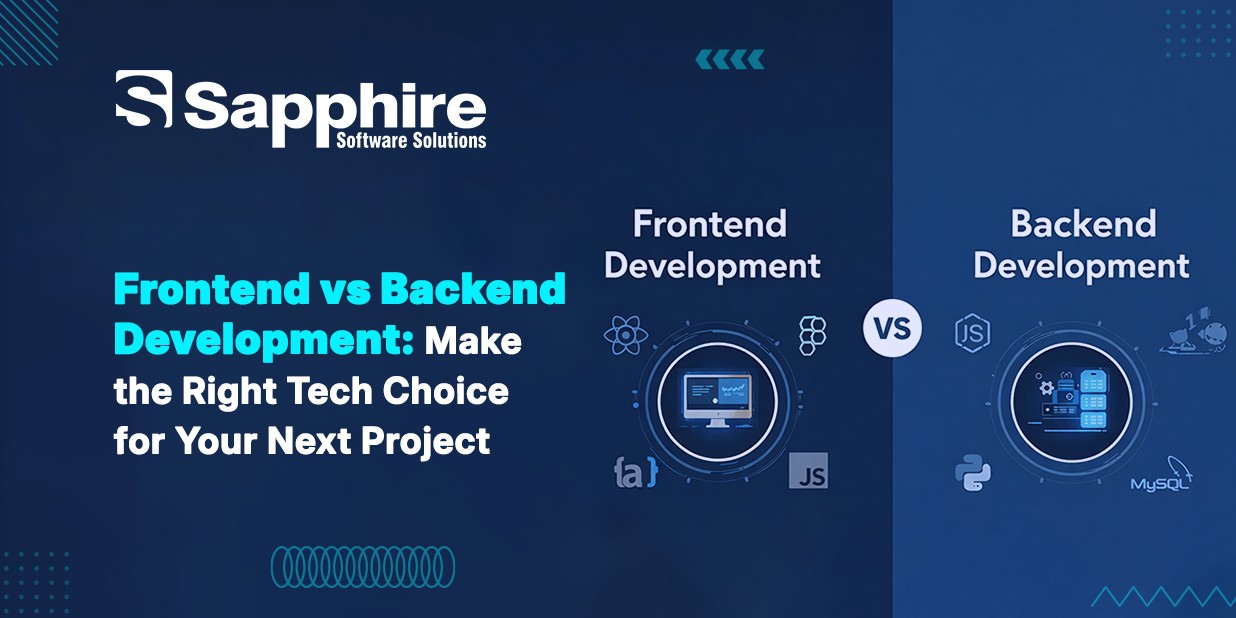
Every serious product conversation eventually hits the same wall: where does our engineering effort go - the frontend or the backend? It's one of those questions that sounds simple until you're the one making the call with a real budget and a real deadline.
Let's be direct: this isn't a choice between two options. The Frontend vs Backend question is about priorities - where you go deep first, what you defer, and what that sequence costs if you get it wrong. A beautifully designed app on a fragile database will collapse the moment real users show up. A bulletproof backend wrapped in a confusing interface will quietly bleed users for months before anyone admits the problem.
This guide covers:
- What is Front-end and Back-end
- Key differences in Frontend vs Backend
- Frontend and Backend languages worth considering
- What are the frontend and backend developer roles in practice
- Is the front-end easier than the backend
- How to choose the right technical direction for your project
- How Sapphire's development services accelerate digital success
If you're planning something new - or untangling something that's gone sideways - this will save you some expensive mistakes.
What is Frontend and Backend?
The frontend is the product as your users experience it — buttons, forms, dashboards, loading states. None of those lives on a server; it all runs in their browser or on their device. That’s why many companies choose to Hire Front End Developers who can craft fast, intuitive, and visually engaging interfaces that turn functionality into a seamless user experience.
What goes into it:
- UI (User Interface) design implementation
- Responsive layouts that work across screen sizes
- User interactions and animations
- Browser rendering performance
- Client-side performance optimization
Here's what gets missed in most comparisons: frontend failures are immediate and public. A broken button, a slow load, an unreadable mobile layout - users don't file tickets, they leave.
What is Backend?
The backend is the engine that makes your product work — authentication, data storage, business logic, and integrations. None of it lives in the user’s view, but all of it determines whether what they see works. Hire Backend Developers to ensure your systems are fast, reliable, and scalable.
Backend responsibilities include:
- Database management and query optimization
- Server-side business logic
- API development and maintenance
- Security implementation and authentication
- Third-party integrations
- Scalability and load management
Frontend vs Backend Development: Key Differences
The differences go well beyond which languages each team uses.
| Aspect | Frontend Development | Backend Development |
| Primary Focus |
|
|
| Runs On |
|
|
| Languages |
|
|
| User Interaction |
|
|
| Performance Concern |
|
|
| Security |
|
|
| Testing |
|
|
Deeper Differences in Frontend vs Backend Development:
Technical Complexity.
Frontend complexity is often underestimated - cross-browser rendering, accessibility, performance budgets. Backend complexity is a different animal: concurrency, database design under load, APIs that security-sensitive clients will hammer. Neither is trivial.
Scalability Impact.
Backend architecture determines whether you serve a hundred users or a hundred thousand. Frontend determines whether those users stay. Both matter - they just operate at different points in the journey.
Business Risk.
A broken frontend erodes trust publicly, in real time. A weak backend creates failures that are harder to see but costlier to fix.
Frontend and Backend Languages You Should Know:
Stack decisions follow you. Pick the wrong one, and you're either locked into a framework that can't scale or paying senior engineers to maintain something overdue for replacement.
Frontend Languages:
HTML, CSS, and JavaScript are the foundation. What matters more in practice is the framework on top:
- React - component-based, widely adopted, strong ecosystem
- Angular - opinionated, fits large enterprise apps well
- Vue.js - lighter, flexible, faster to pick up
Backend Languages:
Backend choices have more variation:
- Python - clean syntax, strong ecosystem. Django makes it fast to ship.
- Java - verbose but stable. Spring Boot is enterprise-proven.
- PHP - still running more of the web than people admit. Laravel has matured significantly.
- Node.js - JavaScript on the server. Great for real-time features and a large talent pool.
When selecting Frontend and Backend languages, the factors that trip people up aren't technical -they're practical. Who can you hire? What does your team know? How fast do you need to move?
Frontend vs Backend Developer Roles:
Frontend Developer:
Frontend developers live at the intersection of design and engineering. They translate mockups into something that responds to clicks, screen sizes, slow networks, and accessibility tools. Day-to-day: implementing UI/UX components, optimizing rendering speed, maintaining cross-browser behaviour, and managing application state. Their work is judged by users who have no idea what went into it.
Backend Developer:
Backend developers rarely get credit when things go right - their work shows up most when something breaks. They think about edge cases, data consistency, and what happens when thousands of users hit the same endpoint at once. In practice: designing database schemas, building APIs, handling auth, and enforcing security at every layer.
|
Role Factor |
Frontend Developer |
Backend Developer |
| Works With |
|
|
| Focus |
|
|
| Debugging |
|
|
| Optimization |
|
|
The Frontend vs Backend developer comparison isn't about who matters more. It's about recognizing that these are genuinely different skill sets - and building a team that has both.
Is Frontend Easier Than Backend?
Ask this in any engineering team, and you'll get an argument. The honest answer is more nuanced than either side admits.
Why Frontend Might Feel Easier
- You see results instantly - change a color, reload, done
- Less infrastructure to set up before you can write meaningful code
- Faster feedback loop between writing and testing
- Broader beginner resources and more forgiving entry points
Why Backend Might Feel Harder
- Data modelling decisions made early have consequences for years
- Security mistakes are often invisible until they're catastrophic
- Performance issues under real load require a different mental model
- Distributed systems introduce failure modes that are genuinely hard to reason about
Is front-end easier than backend stops being a useful question at production scale. A frontend handling real-time updates and complex state is hard. A backend managing distributed transactions and compliance is hard. They're just hard in different ways.
How to Choose Between Frontend and Backend for Your Project?
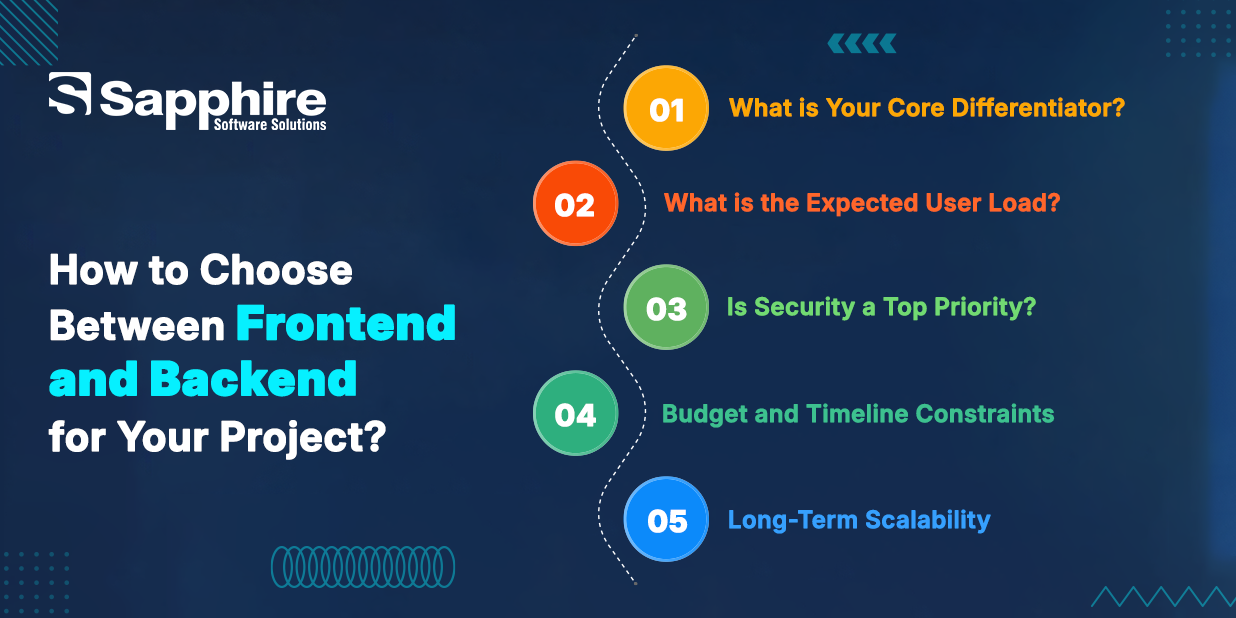
Frameworks and comparisons are useful up to a point. At some stage, you need to make a call for your situation.
What is Your Core Differentiator? - Products competing on user experience - consumer apps, marketplaces - need a frontend that earns its keep. Products competing on reliability or automation need a backend that won't become the bottleneck.
What is the Expected User Load? - Retrofitting backend architecture under live traffic is one of the most expensive problems in software. Build for growth before you need it.
Is Security a Top Priority? - Healthcare, fintech, legal - these aren't sectors where you add security later. Compliance needs to be designed in from the start.
Budget and Timeline Constraints - An MVP that ships beats a perfect system that doesn't. Lean backend, clean frontend, validate your assumptions - then build for scale.
Long-Term Scalability - Casual backend decisions made in sprint one are expensive to undo. Custom Backend Development Services exist to avoid this - architecture for where you're going, not just where you are.
How Sapphire's Front End and Backend Development Services Boost Your Business Success?
Sapphire Software Solutions doesn't hand frontend and backend work to separate teams who rarely talk. We treat them as one problem - because from your users' perspective, they are.
As a Front End Development Company, we build interfaces that perform in production, not just in design reviews:
- Performance-optimized UI tested under real conditions
- Component architecture built to be maintained, not just shipped
- Mobile-first, responsive design as a default
- Accessibility compliance built in from the start
- SEO-friendly implementation
On the backend, our Custom Backend Development Services cover the things that determine whether a product lasts:
- Scalable server architecture for where you're going, not just today
- API-first development that keeps your options open
- Cloud-ready infrastructure
- Authentication and security meet real compliance requirements
- Database design that holds up under actual load
Conclusion:
The Frontend vs Backend conversation is worth having - just not as a competition. These disciplines solve different problems, carry different risks, and require different expertise. Products that treat them as one unified concern tend to come out ahead. What is Front End and Back End at its core: one handles what users experience, the other determines whether that experience holds up. Frontend and Backend languages set the boundaries of what's possible. Frontend vs Backend developer roles define who owns each layer. And is front-end easier than backend is the wrong question - ask instead which layer your product needs most, right now, given where you're headed.
The companies that get this right don't always have bigger budgets. They just make the architectural decision earlier and more deliberately. If you want help getting that decision right, the team at Sapphire Software Solutions is available. Request a Free Quote and let's talk through the right path forward.