

















Moving your company’s infrastructure to code will give your business a significant upgrade. Manually setting up servers and systems will no longer be necessary. Modern IT teams are under immense pressure to deliver reliable, scalable infrastructure at breakneck speed—without breaking the budget. Here's where Infrastructure as Code (IaC) shines. Think of IaC to bring software engineering rigor—like version control, testing, and modular design—to infrastructure. This results in repeatable, predictable, and highly automated deployments.
In this blog, we’ll explore how Infrastructure as Code (IaC) transforms IT operations by:
- Saving time and cutting costs for DevOps teams
- Enabling faster, more reliable deployments
- Supporting a true DevOps culture
- Leveraging powerful IaC tools, languages, frameworks, and services
- Illustrating why IaC is a smart, strategic investment
We’ll also highlight Sapphire’s Infrastructure as Code Services, showcasing how expert guidance ensures teams maximize IaC benefits from day one.
What is Infrastructure as Code (IaC)?
Infrastructure as Code (IaC) is the practice of provisioning and managing IT infrastructure using code and automation instead of manual processes. By using declarative or imperative scripts, teams can define computer instances, storage, networking, security policies, and more—all in version-controlled files.
Key principles of IaC include:
- Idempotence: You can run the equal IaC code repeatedly with the identical result—no marvel float.
- Version control: Infrastructure configurations are saved in structures like Git, taking into consideration history, auditability, and rollback.
- Automation: Deployments end up as repeatable pipelines, lowering human errors.
- Modularity: Modular components (templates, modules, policies) promote reusability.
Types of IaC:
- Declarative: Define the preferred very last state (e.g., “I need three web servers at the back of a load balancer”).
- Imperative: Define the precise steps to attain that state (e.g., “Create network, then create example, then observe policy…”).
Role of Infrastructure as Code in DevOps:-
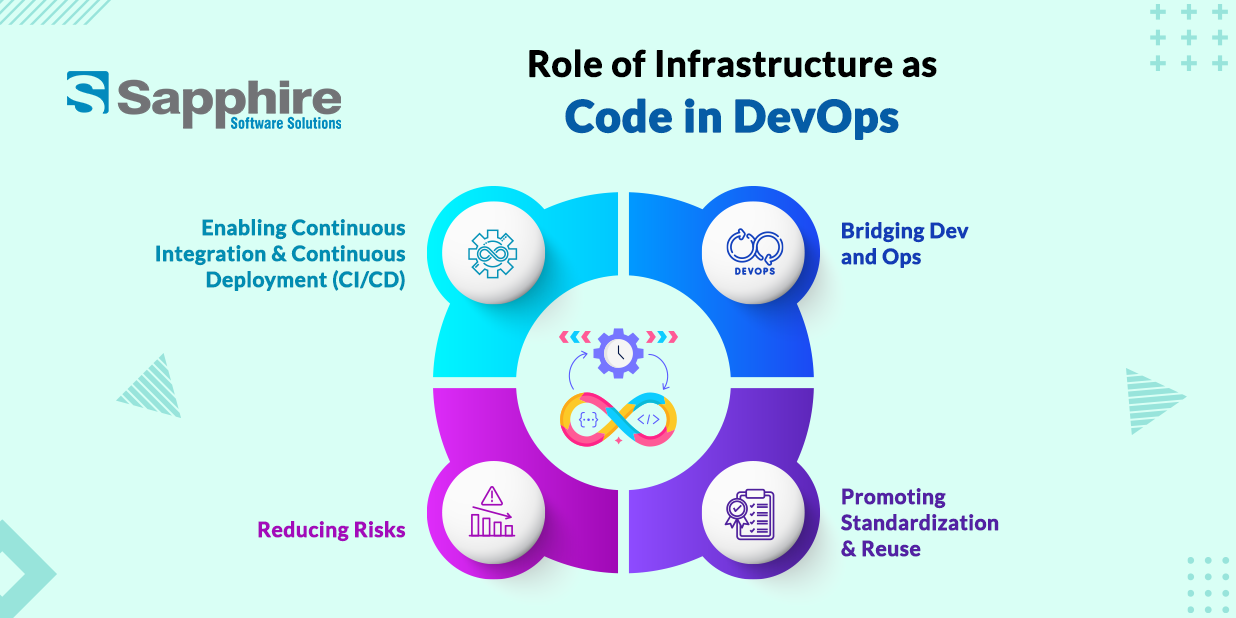
1. Enabling Continuous Integration & Continuous Deployment (CI/CD):
With IaC, infrastructure provisioning turns into a part of your CI/CD pipeline. Just as developers commit code and trigger check suites, your group can now dedicate adjustments to infrastructure definitions. Automated pipelines then lint templates, run checks (e.g., the use of gear like Terratest or Kitchen-Terraform), provision or replace environments, and install applications—all with minimal human intervention.
2. Bridging Dev and Ops:
IaC allows developers to take part actively in infrastructure layout, making infrastructure changes peer-reviewed, versioned, and examined similarly to software code. This fosters communication and collaboration between teams.
3. Reducing Risks:
Automation minimizes manual work, misconfiguration, and hidden dependencies. Infrastructure adjustments may be examined in staging environments earlier than affecting manufacturing. Audit trails from model management additionally improve transparency and compliance.
4. Promoting Standardization & Reuse:
By constructing Infrastructure as Code Frameworks, teams can create reusable modules, permitting constant configurations throughout tasks and environments.
By embedding IaC into the DevOps lifecycle, groups can release faster, with more self-belief, and with fewer errors.
How IaC Saves Time and Improves Efficiency?
1. Automated Provisioning & Deprovisioning:
Previously, setting up a new environment—test, staging, or production—involved a cascade of manual tasks, opening tickets, allocating IPs, installing software, and configuring firewalls. That's often a multi‑day process.
With Infrastructure as Code DevOps pipelines:
- A repository commits trigger provisioning
- IaC engines spin up resources in minutes
- Once testing completes, environments can be torn down cleanly
This approach saves days—or even weeks—per environment setup.
2. Reduced Downtime & Faster Recovery:
In the event of failure or infrastructure drift, IaC definitions can be used to:
- Rebuild entire environments
- Scale horizontally to meet peak demand
- Roll back to previous known-good configurations
This equates to improved uptime and faster issue resolution.
3. Versioning, Collaboration, and Testing:
IaC brings software engineering best practices:
- Code reviews prevent misconfigurations before deployment
- Automated tests validate that resources meet desired specs before provisioning
- Peer collaboration increases collective ownership and domain knowledge
Use Terraform modules, CloudFormation stacks, or Ansible roles, complete with tests—before any resource is provisioned.
4. Eliminating Humans-in-the-loop Errors:
Manual interventions are prone to:
- Typos in instance types
- Missing tags or credentials
- Misapplied security rules
IaC automates these configurations, enforcing validation before execution.
5. Speed of Experimentation:
Want to prototype a feature or test a new service? IaC lets you spin up sandboxes within minutes, experiment safely, and tear them down without lingering costs.
Cost Savings with Infrastructure as Code:-
1. Resource Efficiency & Scaling:
IaC facilitates autoscaling and ephemeral environments:
- Shut down non‑production environments when idle
- Leverage auto-scaling for demand spikes and scale down during off-peak
- Generate cost reports based on IaC definitions to identify wasted resources
This nimble resource management can reduce cloud spend by 20–50%.
2. Reduced Operational Overhead:
IaC reduces:
- Time spent on manual provisioning
- Incidence of downtime or misconfiguration
- Maintenance costs from UI‑based server drift
Less manual effort means more focus on impactful engineering.
3. Avoiding Configuration Drift and Incident Cost
When infrastructure configurations deviate from their intended state:
- Issues become hard to diagnose
- Debug efforts escalate
- Root-cause identification delays resolution
IaC ensures uniformity, avoiding costly firefights and unanticipated downtime.
4. Compliance & Audit Readiness:
IaC definitions can automatically enforce:
- Security policies
- Encryption requirements
- Logging and monitoring configurations
This reduces compliance costs and speeds audit readiness—saving teams thousands in legal or operational fees.
5. Predictable Pricing:
Budgeting becomes easier when infrastructure is code-defined:
- IaC files describe your environment
- A quick plan phase provides cost estimates
- Pre-pull resource usage numbers from tools like AWS Pricing API or Azure Cost Management
Popular Infrastructure as Code Tools
To implement Infrastructure as Code Solutions, numerous tools have emerged—each tailored for different platforms, styles, and developer preferences. Here’s a breakdown:
| Tool | Style | Strengths | Use Cases |
|---|---|---|---|
| Terraform | Declarative | Cloud-agnostic, strong module ecosystem | Multicloud, advanced dependency management |
| AWS CloudFormation | Declarative | Native AWS support, integration with AWS services | AWS-only shops, deep AWS feature coverage |
| Azure Resource Manager (ARM) & Bicep | Declarative | First-class Azure support, Bicep simplifies ARM templates | Azure-first environments wanting strong IaC support |
| Google Cloud Deployment Manager | Declarative | Native to GCP; Python/Jinja support | GCP-focused teams |
| Pulumi | Imperative (uses general-purpose languages) | Use JavaScript, Python, C#/Go | Developers wanting type safety and code reuse |
| Ansible | Imperative | Open-source agentless; ideal for config management | Orchestrating on-prem & cloud servers |
| Chef/Puppet/Salt | Imperative/Declarative | Mature config-management ecosystems | Legacy systems; infrastructure state management |
These Infrastructure as Code IAC tools vary in scope—from fully declarative cloud provisioning to config management and orchestration. Choosing the right tool depends on your environment, team skills, and long-term strategy.
Infrastructure as Code Languages and Frameworks:
Alongside tools, several languages and frameworks enable IaC development:
- HashiCorp Configuration Language (HCL) – Terraform's user-friendly DSL that’s expressive yet easy to read
- YAML / JSON – Syntax used in CloudFormation, ARM, and many CI pipelines
- Bicep – Domain-specific language built for simpler Azure IaC development
- Python, JavaScript, TypeScript, Go, C# – Used by Pulumi and CDK frameworks
- Domain-specific tools:
- AWS CDK (Cloud Development Kit) – Write AWS infrastructure in high-level languages
- Azure Bicep – Syntax‑enhanced abstraction over ARM templates
- Google CDK for Terraform – Combines Terraform’s core with popular languages
These Infrastructure as Code Languages and frameworks help teams write maintainable, testable, and reusable infrastructure modules. For example, Python-based Pipelines can test IaC logic using unit tests, while reusable CDK constructs enable better collaboration and standardization.
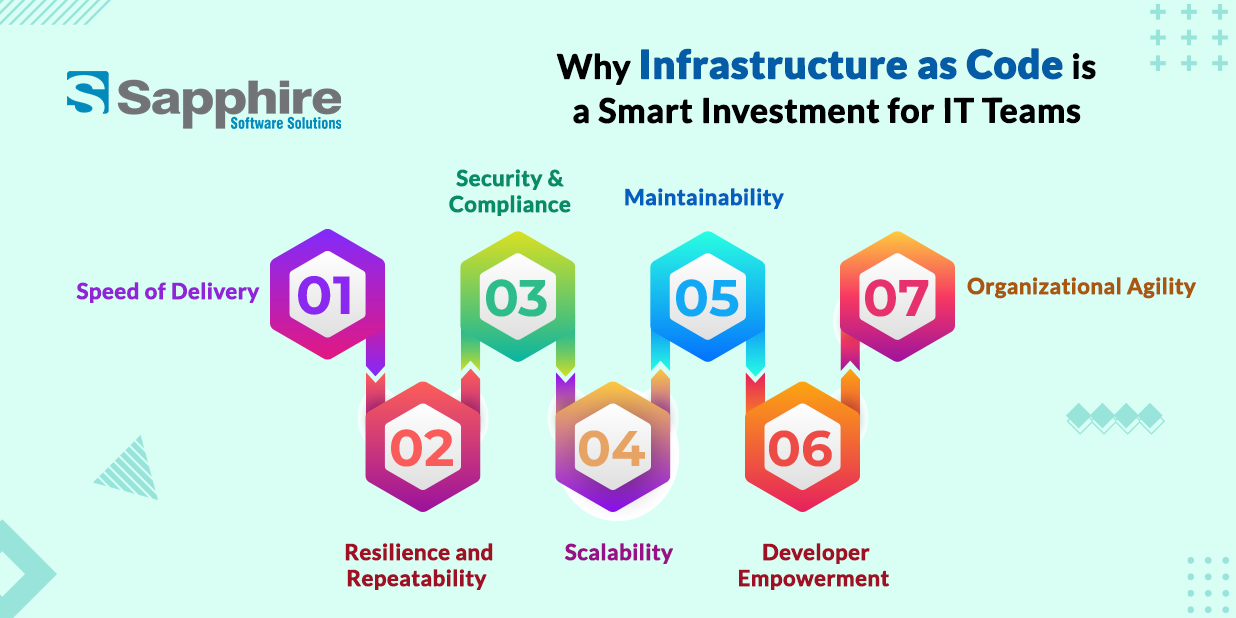
Why Infrastructure as Code is a Smart Investment for IT Teams?
Teams in 2025 are focusing on:
- Reduced time-to-market
- Resilience and observability
- Cost predictability
- Security and compliance by design
Here’s why Infrastructure as Code Frameworks are a strategic investment:
- Speed of Delivery: Version-controlled infrastructure enables rapid changes and deployment via automated pipelines.
- Resilience and Repeatability: Entire environments—development, staging, production—are defined in code. PoC builds become repeatable and testable.
- Security & Compliance: Security is baked into IaC via policy-as-code tools like Open Policy Agent (OPA) or AWS CloudFormation Guard. This allows for code-level policy enforcement before provisioning.
- Scalability: IaC enables horizontal and vertical scaling in a consistent, automated manner, supporting spikes in demand and global reach.
- Maintainability: Refactoring modules, testing changes, and auditing versions are second nature with code-based definitions—unlike brittle spreadsheets or scripts.
- Developer Empowerment: By abstracting infrastructure complexity through modular IaC patterns, developers can self-serve resources with guardrails, freeing up specialists to focus on optimization and innovation.
- Organizational Agility: When you need to pivot quickly—say, launching a new service or entering a new region—IaC makes it straightforward and low-risk. It’s the backbone of a cloud-first, innovation-driven culture.
Get Started with Sapphire’s Infrastructure as Code Services:
Ready to take your organization to the next level? Sapphire Software Solutions’ Infrastructure as Code Services offer a holistic, expert-driven approach:
- IaC Maturity Assessment: We’ll scope your current environment, identify automation gaps, shadowed systems, and process inefficiencies.
- Tooling Strategy: Recommendations tailored to your needs—Terraform, Pulumi, AWS CDK, Bicep, Ansible, or a hybrid stack—for optimal flexibility and alignment.
- ModularIaCBlueprinting: Design reusable modules, templates, and pipelines based on best practices. Built-in CI/CD, drift detection, and tagging are enforced from day one.
- Governance & Compliance: Implement policy-as-code using industry standards—HIPAA, GDPR, SOC2—integrated into pipelines, so you stay compliant by default.
- Developer Enablement: Train teams in IaC Languages (HCL, Bicep, TypeScript, Python), test frameworks (Terratest, Kitchen), and platform integration.
- Migration & Implementation: Whether you're lifting and shifting workloads or launching new architectures, Sapphire executes and validates environments in live scenarios.
- Operational Support: Post-deployment monitoring, cost optimization, drift management, and evolution of IaC frameworks with changing business needs.
- Ongoing Optimization: Our FinOps and architecture specialists periodically audit IaC for performance (autoscaling), cost efficiency, and security.
With Sapphire’s Infrastructure as Code Services, your organization can:
- Slash provisioning lead time by up to 80%
- Save 30–50% in cloud and management costs
- Reduce configuration errors and incidents by >= 60%
- Securely enforce governance across multiple teams and environments
Conclusion:
Infrastructure as Code is a transformative shift—one that’s no longer merely price range-pleasant, but essential for preserving pace with today’s dynamic, cloud-first global. By defining and coping with environments with code:
- Time is reclaimed through automation, versioning, and fast new releases.
- Money is saved through optimized aid usage, fewer incidents, and transparent infrastructure planning.
- IT groups emerge as extra agile, resilient, and scalable.
Whether you are building a multicloud setup with Terraform, embracing Azure’s local IaC gear, or developing a modular Pulumi framework, adopting Infrastructure as Code DevOps brings company-grade delivery practices to each corner of your operation.
At Sapphire Software Solutions, we specialize in imposing these principles, expertly constructing Infrastructure as Code Solutions which are green, compliant, and destiny evidence. Make clever funding: undertake Infrastructure as Code Services and turn infrastructure from a bottleneck into your aggressive benefit. With polished IaC frameworks, built-in governance, developer-best templates, and fee optimization baked in—you’ll be turning to secure, scalable, and resilient infrastructure at warp velocity.
Investment now ends in returns in time, money, and organizational functionality—Sapphire is right here to guide each step.