
















In 2026, businesses are under more pressure than ever to deliver digital products faster, smarter, and more securely. Whether you’re building an enterprise application, a SaaS platform, or a mobile solution, one major strategic question stands in your way: should you build internally or partner with an external expert? The debate between In-House Development and Outsourcing isn’t new. But today’s economic conditions, rising developer salaries, cybersecurity threats, and rapid AI-driven transformation have reshaped the decision-making landscape. If you’re a CTO, CEO, digital transformation leader, or founder, this blog will help you understand the real cost and risk differences between building internally and outsourcing to Sapphire Software Solutions — widely recognized as a Top IT Company of India.
What is In-House Development?
Before comparing strategies, let’s clarify what we mean by "in-house development."
In simple terms, it refers to building software using your own internal employees rather than external vendors. An in-house development team typically includes developers, designers, QA engineers, DevOps specialists, project managers, and security experts who work exclusively for your company.
With in-house development software, the entire lifecycle — planning, coding, testing, deployment, and maintenance — happens within your organization.
Key Characteristics:
- Full control over the team and processes
- Direct communication
- Internal intellectual property ownership
- Long-term workforce commitment
On paper, this model looks appealing. You own the talent, the systems, and the delivery timeline. But the real picture includes cost, scalability challenges, and risk exposure — which we’ll explore shortly.
What is Outsourcing Development?
Outsourcing development means partnering with an external expert firm to design, build, and maintain your software products.
Companies offering Outsourcing Software Development Services provide skilled teams, infrastructure, and technical leadership without requiring you to hire internally. Instead of building everything from scratch, you collaborate with an experienced outsourcing software development company that already has domain expertise and technical maturity.
Outsourcing models in 2026 often include:
- Dedicated development teams
- Project-based engagement
- Staff augmentation
- Hybrid delivery models
When executed correctly, outsourcing allows companies to scale rapidly while minimizing operational overhead.
Benefits of Outsourcing vs In-House Development:-
Let’s compare both approaches strategically.
- Speed to Market:
- Internal hiring can take 3–6 months per developer in today’s competitive talent market. Outsourcing partners already have skilled teams ready to deploy.
- If speed matters, outsourcing usually wins.
- Access to Specialized Expertise:
- Emerging technologies like AI, blockchain, cybersecurity, and cloud-native architecture require niche expertise. Building this capability internally is expensive and time-consuming.
- Outsourcing partners often bring cross-industry experience that internal teams may lack.
- Scalability:
- Internal teams grow slowly. If you suddenly need 10 additional developers, hiring, onboarding, and training can delay projects significantly.
- Outsourcing allows instant scaling up or down depending on business demand.
- Focus on Core Business:
- Internal development demands management attention — HR, payroll, training, infrastructure, compliance, and retention.
- Outsourcing lets leadership focus on business growth rather than operational complexity.
Cost Comparison: In-House vs Outsourcing:-
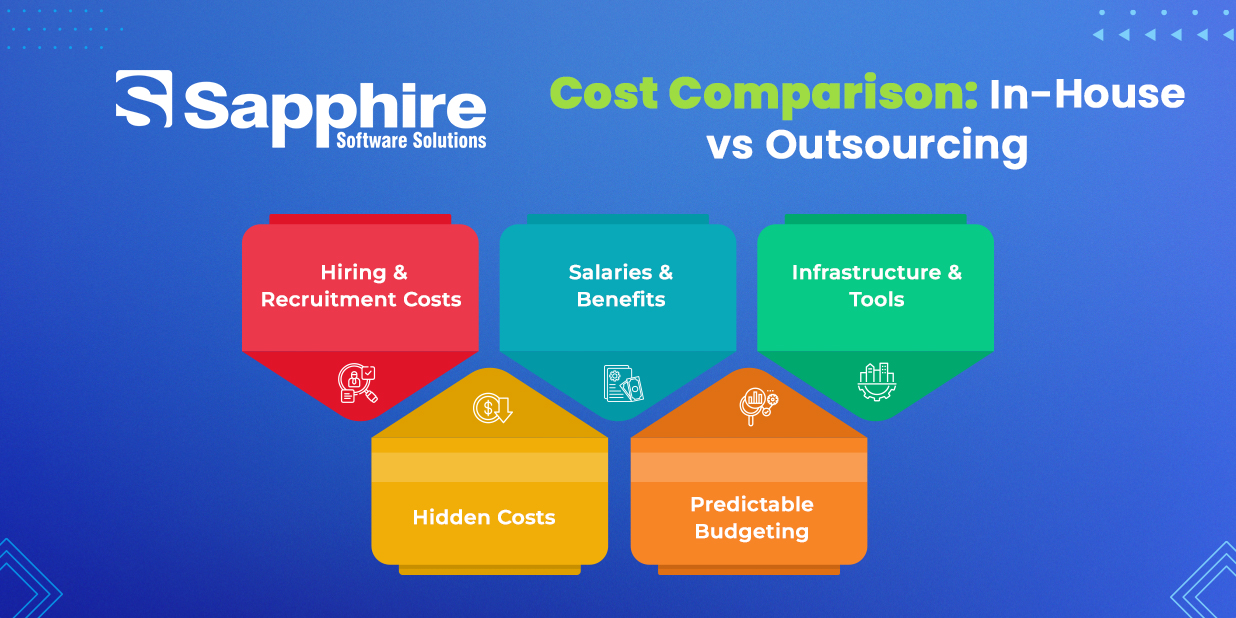
Cost is often the primary decision factor. But businesses frequently underestimate the true expense of internal development.
- Hiring & Recruitment Costs: For internal teams, you must account for:
- Recruitment agency fees
- HR overhead
- Interviewing time
- Onboarding costs
Outsourcing eliminates these recurring hiring expenses.
- Salaries & Benefits: In 2026, skilled developers command high salaries, especially in the US, UK, and Europe. Beyond base pay, companies must provide:
- Health insurance
- Bonuses
- Paid leave
- Retirement contributions
- Training budgets
Outsourcing bundles these costs into a predictable contract.
- Infrastructure & Tools: Internal teams require:
- Office space or remote setup
- Hardware
- Software licenses
- Security systems
- Cloud infrastructure
Outsourcing companies already maintain enterprise-grade infrastructure.
- Hidden Costs: Internal projects often experience:
- Employee turnover
- Skill gaps
- Productivity variance
- Management overhead
These hidden costs inflate budgets significantly.
- Predictable Budgeting: Outsourcing typically offers:
- Fixed-cost contracts
- Milestone-based payments
- Transparent pricing
For many organizations, outsourcing reduces development cost by 30–50% compared to internal builds.
Risk Comparison: In-House vs Outsourcing:-
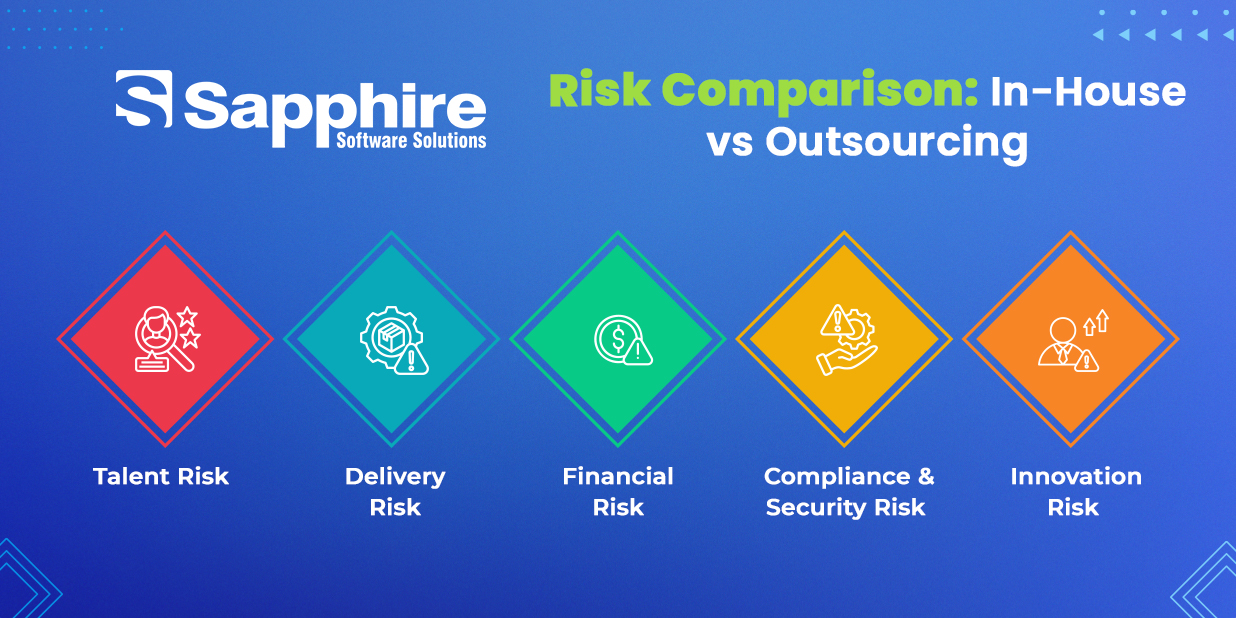
Cost matters — but risk matters more.
- Talent Risk: Internal teams face:
- Employee attrition
- Skill shortages
- Burnout
- Hiring delays
When a key developer leaves mid-project, knowledge loss can derail timelines.
Outsourcing partners mitigate this risk through structured knowledge management and backup resources.
- Delivery Risk: Internal teams sometimes lack cross-industry experience. This can lead to:
- Poor architectural decisions
- Security vulnerabilities
- Scalability limitations
Experienced outsourcing partners bring proven frameworks and methodologies.
- Financial Risk:
- High fixed costs make internal teams risky during economic downturns. Salaries remain constant even when project demand drops.
- Outsourcing converts fixed costs into flexible operational expenses.
- Compliance & Security Risk:
- Cybersecurity threats in 2026 are more sophisticated than ever. Maintaining internal security teams requires constant investment.
- Established outsourcing companies follow international compliance standards, secure coding practices, and audit-ready documentation.
- Innovation Risk:
- Internal teams sometimes operate in isolation, limiting exposure to innovation trends.
- Outsourcing partners work across multiple industries, gaining broader technological insight.
How to Choose the Right Outsourcing Partner?
Outsourcing success depends heavily on partner selection. Here’s what to evaluate:
- Proven Track Record: Review case studies, client testimonials, and portfolio strength.
- Technical Expertise: Ensure the partner has experience in your required technology stack.
- Transparent Communication: Look for clear reporting systems and defined project management structures.
- Scalability Model: Can they expand your team quickly if required?
- Security & Compliance Standards: Verify certifications, data protection measures, and coding standards.
- Cultural Alignment: Shared business values and time-zone compatibility improve collaboration.
Choosing the wrong partner increases risk — but choosing the right one accelerates growth.
Why is Sapphire the Ideal Outsourcing Software Development Company?
When evaluating the right outsourcing partner in 2026, Sapphire Software Solutions stands out because of its proven track record and measurable credibility. Established in 2002, the company brings with it 23+ years of experience in delivering end-to-end software development services The company has completed 1500+ projects for 2800+ satisfied clients worldwide, ranging from startups to large enterprises. With a team of 200+ skilled IT professionals, Sapphire offers scalable and flexible development models that help businesses accelerate digital transformation without the challenges of building internal teams. Their expertise spans across 18+ industry verticals, serving clients in 30+ countries, which highlights their international reach and technical versatility.
In addition to its extensive portfolio, Sapphire has earned 300+ reviews on Clutch, reflecting high levels of client satisfaction in project delivery, communication, and technical excellence. The company maintains an impressive 95% client retention rate, demonstrating long-term partnerships and consistent service quality. Trusted by 20+ Fortune 500 companies, Sapphire meets enterprise-grade standards for performance, security, and compliance. For businesses evaluating in-house development vs outsourcing, partnering with Sapphire significantly reduces operational burden while improving speed and scalability.
Strategic Decision Framework for 2026:
Here’s a simplified decision guide:
| Scenario | Best Approach |
| Core proprietary product requiring full IP control | In-house |
| Rapid scaling startup | Outsourcing |
| Limited internal tech expertise | Outsourcing |
| Long-term R&D innovation lab | In-house |
| Budget-sensitive digital transformation | Outsourcing |
| Temporary development needs | Outsourcing |
The right choice depends on business goals, budget, risk tolerance, and timeline urgency.
Real-World Example
Consider a mid-sized enterprise planning a digital transformation initiative.
Option 1: Internal Build
- 12-month hiring cycle
- 20% budget overruns
- Talent retention risk
- Infrastructure expansion
Option 2: Outsourcing to Sapphire
- Immediate team allocation
- 30% cost reduction
- Faster MVP launch
- Scalable expansion
The difference isn’t just cost — it’s business momentum.
Conclusion:
The debate between internal development and outsourcing is no longer black and white. In 2026, businesses must weigh flexibility, scalability, cost efficiency, and long-term strategic alignment. Internal development offers control, cultural alignment, and deep product ownership—but comes with high fixed costs and scalability limitations. Outsourcing delivers speed, global expertise, and financial flexibility—while requiring careful partner selection to mitigate risks.
As markets become more competitive and technology cycles accelerate, companies that choose the right development model will gain a decisive advantage. Whether you build internally or collaborate externally, the key is alignment with your business goals and the courage to adapt in a rapidly evolving digital landscape.
If you’re evaluating your next software project in 2026, take time to assess not just immediate costs—but long-term value, resilience, and innovation potential. That’s where the real competitive edge lies.