
















The world is entering a new era where artificial intelligence is stepping beyond screens and servers to operate in the physical world. Machines and robots can now sense, think, and act autonomously in a breakthrough known as Physical AI, where intelligent software merges with mechanical systems to perform real-world tasks with human-like adaptability.
For decades, AI has focused mainly on analyzing data and automating decisions in digital environments. However, that form of intelligence lacked a tangible connection to the physical world. Physical AI bridges this gap by integrating perception, motion, and cognition. Whether a robotic arm is assembling microchips, an autonomous vehicle is navigating a warehouse, or a medical robot assisting in surgery, this technology is transforming industries that rely on physical precision.
Pioneering companies like Sapphire Software Solutions, known for driving innovation in automation and robotics, are at the forefront of this movement. By blending machine learning, real-time sensing, and embedded intelligence, Sapphire is helping industries reimagine what’s possible when machines can both think and act.
What is Physical AI, and how does it work?
What is Physical AI?
It refers to systems that combine intelligence with embodiment machines capable of perceiving their environment, making decisions, and performing physical actions. Unlike virtual AI models that exist only as software (like chatbots or data tools), Physical AI robots integrate both computational logic and mechanical structure.
For instance, a delivery drone powered by Physical Intelligence AI can detect obstacles, reroute in real time, and complete its mission safely, improving its performance after every run.
This intelligence relies on three key layers:
- Perception: Sensors and cameras gather real-world data such as motion, distance, or temperature.
- Cognition: Algorithms interpret this information using neural networks and reinforcement learning.
- Action: Motors or actuators execute precise movements based on AI decisions.
Together, these layers mimic human adaptability, seeing, reasoning, and acting. In manufacturing, a robot might adjust its assembly speed when material resistance changes. In healthcare, surgical systems can adapt to micro-variations in tissue during procedures.
The true breakthrough lies in Physical Intelligence AI, where machines learn and evolve autonomously. They analyze outcomes, refine performance, and operate with minimal human oversight. This enables organizations to build safer, smarter, and more efficient environments across production floors, hospitals, and logistics hubs.
Generative Physical AI: Teaching Machines to Think and Act Creatively
Generative Physical AI takes intelligent automation further by giving machines the ability to design, optimize, or innovate based on context. It’s not about following fixed rules; it’s about generating new solutions.
Imagine a Physical AI robot that rearranges a factory floor layout for better space utilization, or a prosthetic that adjusts in real time to a user’s unique movement style. These systems use generative models similar to how GPT creates text, but they apply them to physical actions and design.
Here’s how it functions:
- Generative modeling: AI simulates thousands of possibilities (e.g., optimizing weld patterns or material usage).
- Physical execution: These insights connect to robotic control, ensuring realistic, effective motion.
- Continuous learning: Every task improves future performance, merging creativity with precision.
It enables design innovation, supply chain optimization, and medical personalization. In logistics, it can dynamically map delivery routes based on energy and congestion. In healthcare, it tailors robotic movement to patient anatomy.
As Sapphire’s technology experts highlight, this is the missing link between virtual reasoning and real-world execution, enabling machines not just to act smartly but to think creatively while doing so.
What Makes a Physical AI Startup Different from Traditional AI Companies?
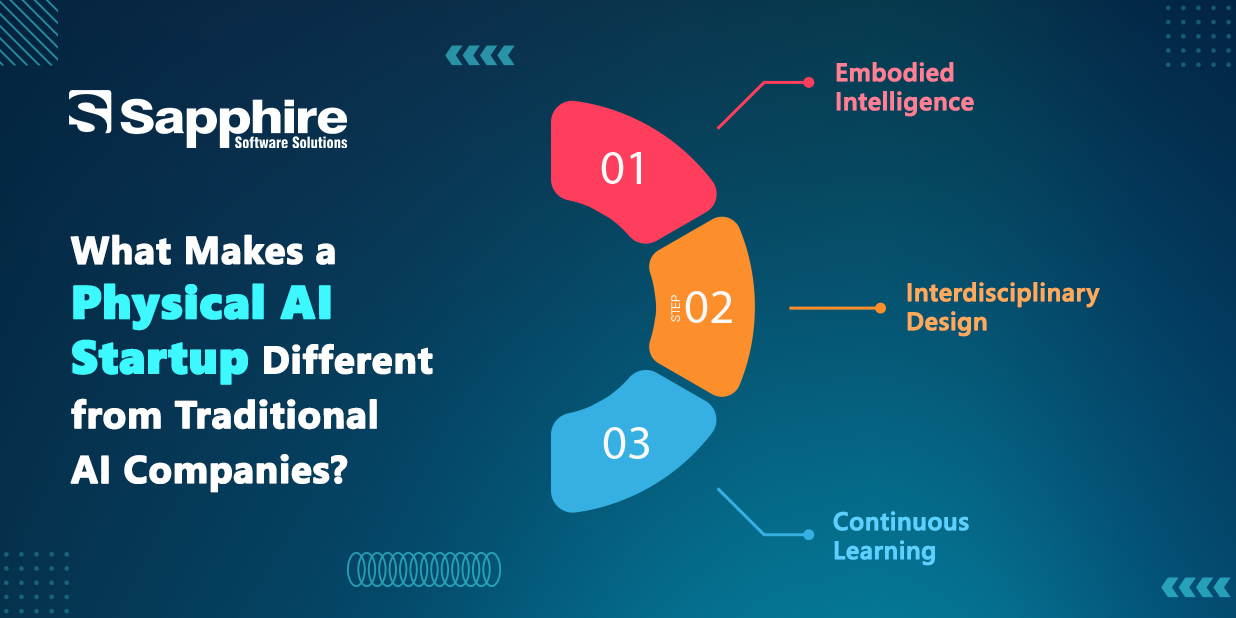
The surge of Physical AI startups marks a defining evolution in the global innovation ecosystem. Unlike software-driven AI firms that specialize in analytics or NLP, these ventures combine robotics, AI, and mechanical engineering.
Key differentiators include:
- Embodied Intelligence: Instead of code confined to computers, these companies build machines that autonomously function in real environments.
- Interdisciplinary Design: Their teams merge data science with hardware, materials, and motion design.
- Continuous Learning: Devices adapt based on sensor feedback and environmental changes.
Though resource-intensive, this model is revolutionizing industries like manufacturing, logistics, and medicine. From precision robots to autonomous fleets, Physical AI startups deliver measurable efficiency, cost reduction, and resilience.
Sapphire Software Solutions exemplifies this approach, collaborating with enterprises to co-develop systems that merge intelligent automation with real-world engineering, accelerating innovation while ensuring reliability and safety.
Physical AI Agents and the Human-Machine Collaboration Era:
We’re entering an era where humans and intelligent machines coexist in true collaboration. Physical AI agents represent this shift, with autonomous partners that interpret intent, execute tasks, and learn continuously. Unlike virtual assistants, these agents operate in real spaces—assembly lines, hospitals, and logistics centers—where timing and precision are critical. Leading AI Agent Development Company is now focusing on creating these sophisticated systems, enabling organizations to harness the full potential of human-machine collaboration.
For instance:
- In healthcare, a Physical AI assistant can anticipate a surgeon’s next move or adjust instruments dynamically.
- In logistics, AI agents coordinate with human teams to pack and move goods more efficiently.
This human-machine partnership delivers:
- Improved Safety: Robots manage hazardous or heavy-duty tasks.
- Consistency: Machines maintain steady output without fatigue.
- Skill Enhancement: Workers gain decision support from intelligent systems.
- Behavioral Learning: Agents refine actions by observing human experts.
This collaboration transforms work itself, creating hybrid environments where intuition meets precision.
How a Physical AI Company Like Sapphire Is Bridging the Gap Between AI and Reality?
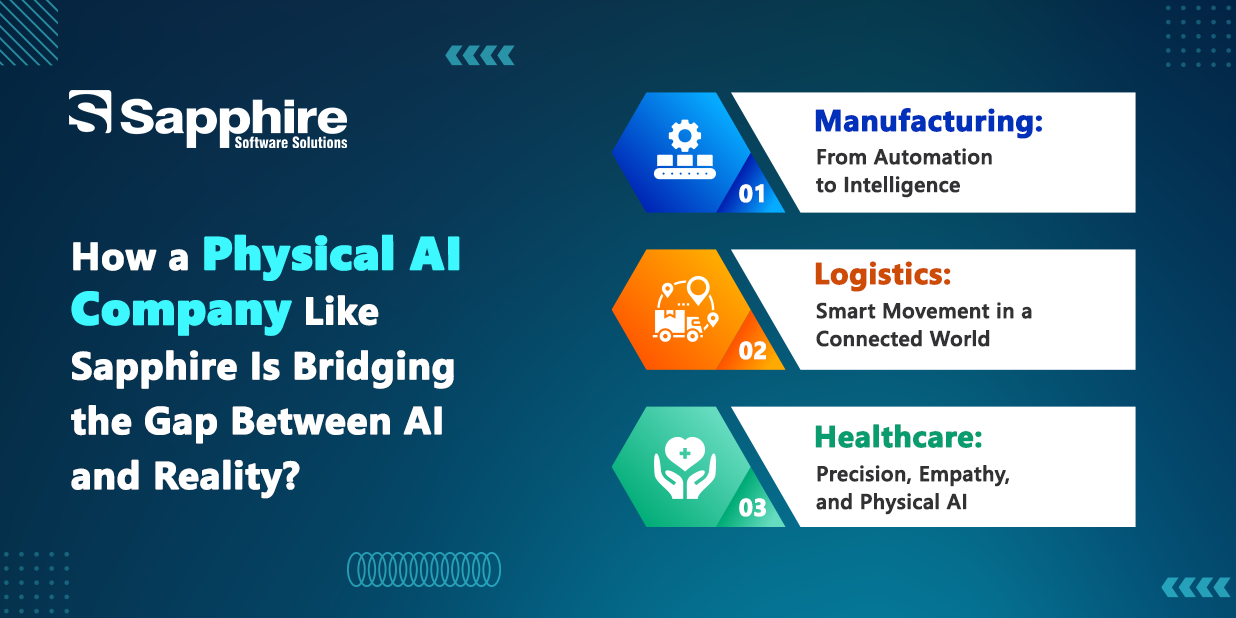 While AI has mastered digital reasoning, its next leap lies in connecting cognition with physical capability, an area that Physical AI company is actively advancing.
Sapphire Software Solutions develops AI-powered physical systems that combine robotics, automation, and continuous learning. Unlike static automation, these systems think, perceive, and adapt to respond intelligently to environmental changes.
1. Manufacturing: From Automation to Intelligence
Legacy automation follows fixed routines. Sapphire’s Physical AI elevates this to intelligent adaptation. Robots can analyze data, predict fatigue, and self-adjust to sustain precision and performance.
Key results:
- Adaptive Production Lines: Robots coordinate workflows and detect inefficiencies.
- Predictive Maintenance: AI foresees equipment issues before they halt production.
- Energy Optimization: Systems learn to reduce power waste while improving throughput.
This shift redefines manufacturing, replacing rigid workflows with agile, learning-driven operations that continuously optimize performance.
2. Logistics: Smart Movement in a Connected World
The logistics sector thrives on timing, scale, and precision, perfect conditions for Physical AI innovation. Sapphire’s intelligent agents operate in warehouses and fleets to coordinate movement, reroute dynamically, and optimize resources.
Highlights include:
- Smart Warehouses: Robots handle diverse items, track inventory, and collaborate with staff.
- Fleet Learning: Vehicles analyze routes, traffic, and priorities in real time.
- Supply Resilience: AI systems predict disruptions and adjust networks accordingly.
Sapphire’s systems blend automation with human oversight, ensuring transparency and safety while maximizing efficiency.
3. Healthcare: Precision, Empathy, and Physical AI
In healthcare, Physical AI robots are redefining care delivery and diagnostics, enabling precision while preserving empathy.
Sapphire’s healthcare initiatives integrate Generative AI with robotics to support surgeons, caregivers, and patients alike:
- Surgical Robotics: Tools adapt to patient-specific anatomy in real time.
- Rehabilitation Devices: Smart prosthetics adjust dynamically to gait and motion.
- Patient Support Systems: Robots deliver medicine, assist the elderly, and manage hospital logistics.
Sapphire’s approach emphasizes trust and human understanding, designing assistants that read tone, gesture, and movement to enhance care, not replace compassion.
Convergence of Digital and Physical Intelligence:
The most exciting frontier lies where digital AI meets mechanical execution, enabling systems that perceive, decide, and act cohesively.
Emerging possibilities include:
- Autonomous Micro-Factories: Small-scale, AI-controlled units producing components on demand.
- Physical AI in Daily Life: Robots assisting at home or in service sectors.
- Generative Construction Design: AI-driven planning that directs robots in physical assembly.
However, this convergence demands robust ethics and oversight. Sapphire prioritizes transparency, ensuring every AI-driven decision remains auditable and explainable.
By fusing edge computing, robotics, and cognitive AI, Sapphire is building connected ecosystems as the foundation of tomorrow’s sentient industries.
Challenges and the Road Ahead:
The evolution of Physical AI brings both opportunities and complexities. Key challenges include:
- Hardware Software Harmony: Synchronizing mechanical precision with AI logic.
- Data Quality: Capturing rich, real-time sensor data to train reliable models.
- Ethics & Safety: Ensuring accountability in autonomous decisions.
- Scalability: Expanding across industries with modular, cost-effective solutions.
- Compliance: Meeting emerging global standards for robotics and automation.
Despite these barriers, progress is accelerating through open innovation and collaboration among research labs, startups, and enterprises.
Sapphire’s vision is to make Physical AI systems scalable, connected, and accessible, enabling organizations of all sizes to adopt intelligent automation and unlock measurable outcomes.
Conclusion:
As the boundaries between the digital and physical worlds continue to blur, Physical AI is redefining how industries operate, innovate, and scale. What was once theoretical is now tangible — intelligent machines are building, moving, and healing alongside us, unlocking unprecedented levels of efficiency, safety, and creativity.
At Sapphire Software Solutions, we’re not just observing this transformation — we’re driving it. Our expertise in AI-powered automation, robotics, and embedded intelligence empowers businesses to move beyond static processes and embrace adaptive, data-driven ecosystems that learn and evolve in real time. Whether it’s optimizing production lines, revolutionizing logistics, or enhancing healthcare precision, we partner with forward-thinking organizations to bridge imagination and implementation.
Are you ready to explore how Physical AI can transform your business?
Let’s build the future together. Contact us today to discuss your automation goals, explore partnership opportunities, or schedule a personalized consultation.