
















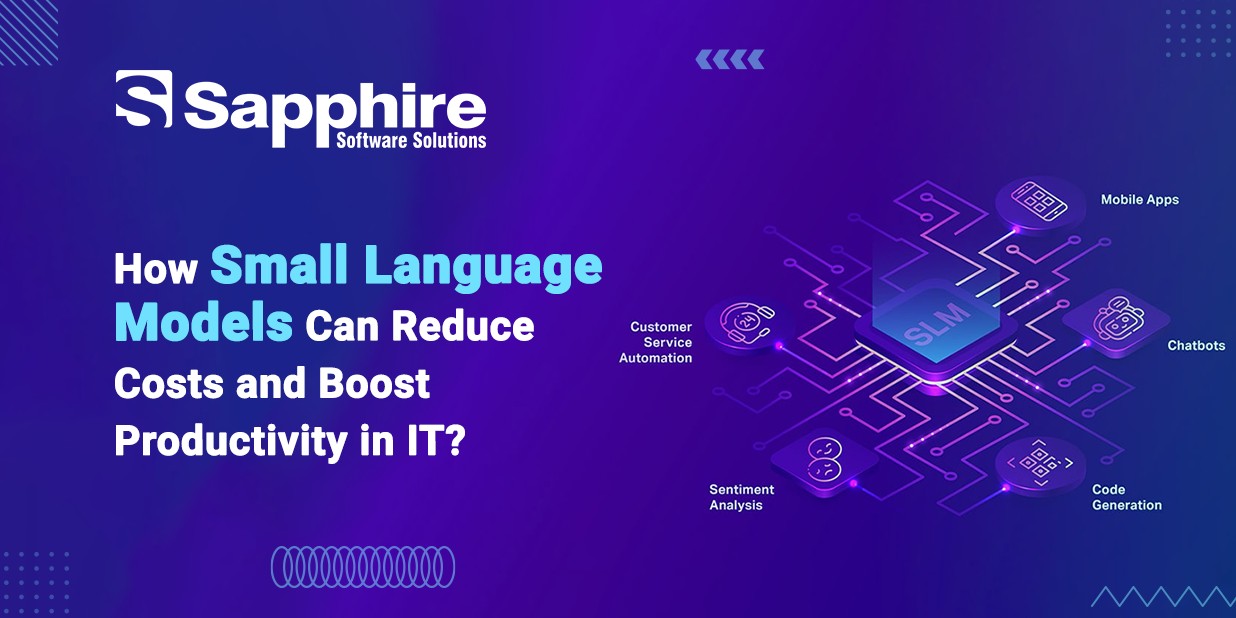
In today’s fast-paced technology landscape, speed and efficiency are critical. IT teams are under more pressure than ever to innovate rapidly, reduce operational costs, streamline workflows, and deploy new solutions that help organizations stay competitive. As more businesses turn to artificial intelligence (AI) to drive automation and productivity, a key question continues to emerge: Do we really need large, resource-intensive AI models to achieve meaningful results?
Surprisingly, the answer is no.
With the rise of Small Language Models (SLMs), organizations now have access to AI systems that are faster, lighter, more cost-effective, and capable of delivering powerful performance for common IT workflows. While large models like GPT-4 or Gemini Ultra often dominate industry headlines, SLMs provide a practical alternative—offering enterprise-grade value without the massive infrastructure investment often associated with large-scale AI.
In this blog, we take a deep dive into how small language models work, why they matter, and the measurable improvements they can help organizations achieve across cost efficiency, productivity, accuracy, and operational agility. We will also highlight examples of leading SLMs, explain the key differences between small language models vs. large language models, explore emerging small vision-language models, and discuss why companies are increasingly partnering with experts like Sapphire to maximize their AI potential.
What Are Small Language Models and How Do They Work?
A Small Language Model (SLM) is an artificial intelligence (AI) system trained on text but built with fewer parameters—usually between 1B and 15B—compared to the very large systems known as LLMs, helping readers understand what large language models are in contrast.
Here is how SLMs work:
- Lightweight Architecture: SLMs employ compact neural networks with optimized layers, enabling them to run efficiently on medium-scale hardware. This not only reduces latency and computing consumption but also achieves strong performance.
- Targeted Learning: Rather than broad general-purpose training, small language models are typically trained for domain-specific applications such as IT support, software debugging, log analysis, documentation, or cloud automation.
- Efficient Context Handling: SLMs manage smaller context windows compared to giant LLMs, but they process the most relevant queries faster—making them extremely effective for repetitive IT tasks.
- Less Costly Deployments: Because SLMs consume far fewer resources, they can be deployed on local servers, on-prem systems, and even edge devices—reducing dependence on expensive cloud GPUs and lowering operational costs significantly.
Ultimately, Small Language Models demonstrate that intelligence is rooted in efficiency, not size. They deliver speed, accuracy, and daily usefulness for teams—especially in IT—proving their value over traditional large systems and reinforcing the growing importance of compact model language solutions.
Small Language Models vs Large Language Models:
Grasping the differences between Small Language Models and large language models is essential for determining the right AI strategy. Many organizations today want to understand what large language models are and how they compare to SLMs, especially as the industry shifts toward more efficient architectures.
- Cost-Effective: Large models require enormous GPU clusters that are costly to operate. In contrast, Small Language Models can run efficiently on typical servers, VMs, or even laptops—resulting in potential cost reductions of up to 90%.
- Deployment Flexibility: SLMs can run on-premises, providing enhanced data privacy and regulatory compliance. Meanwhile, LLMs typically depend on third-party cloud platforms, which introduce limitations and potential concerns around control and security.
- Performing Specific Tasks: While large models excel at broad general reasoning, a small model that is properly fine-tuned often delivers superior performance on targeted, domain-specific tasks.
- Speed: SLMs respond faster due to their significantly smaller parameter count—an advantage that can make a critical difference in real-time IT decision-making and system workflows.
- Low Risk: Managing an SLM on a local device or through self-hosting reduces the risk of data leakage commonly associated with cloud-based LLMs, strengthening organizational security.
How Small Language Models Boost Productivity in IT Teams?
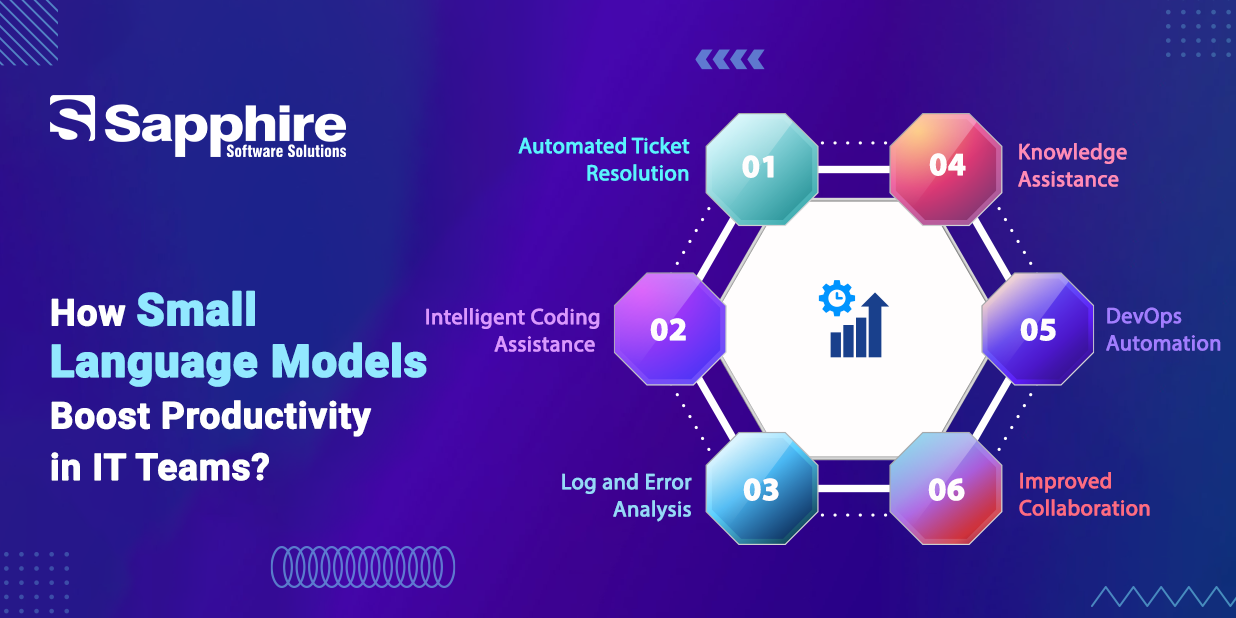
Small Language Models (SLMs) are not just a means of saving expenses; they are a powerful way to increase output and operational efficiency. Below are small language model examples that show exactly how SLMs help IT functions do more while spending less.
- Automated Ticket Resolution: SLMs can classify, rank, and even draft solutions to common IT support tickets, reducing the workload on support teams.
- Intelligent Coding Assistance: They help developers debug, document, and optimize code intelligently—without relying on costly cloud APIs. This is where SLM-powered tools excel compared to traditional large models.
- Log and Error Analysis: Small Language Models can identify anomalies and scan system logs much faster than humans, enabling quicker incident resolution.
- Knowledge Assistance: SLMs can pull answers from internal documents, SOPs, and wikis instantly when used as internal knowledge assistants—making them perfect for IT teams that need fast and accurate information retrieval.
- DevOps Automation: They can generate CI/CD scripts, manage monitoring workflows, and automate deployments, all triggered by contextual prompts. This reinforces the value of SLMs in technical operational pipelines.
- Improved Collaboration: SLM-based chat systems improve communication between teams by documenting technical context clearly, reducing confusion, avoiding bottlenecks, and enabling faster turnaround times across departments.
Real-World Examples of Small Language Models:
Phi-3 Mini:
Phi-3 Mini is a lightweight 3.8B parameter model built for tasks where speed, accuracy, and efficiency are essential. Despite its small size, Phi-3 demonstrates exceptional performance in chat-based IT support, internal knowledge automation, and scripting assistance.
Mistral 7B:
Mistral 7B is among the most widely adopted open-source SLMs, known for its impressive reasoning, summarization, and coding strengths. Organizations use it for code generation, API-driven automation, and technical document analysis. IT teams rely on Mistral 7B to automate developer workflows, improve debugging processes, and power intelligent search engines capable of interpreting complex technical documentation.
Llama 3 8B:
Llama 3 8B delivers strong, general-purpose performance that rivals much larger models but with a significantly lighter computational footprint. Enterprises deploy it for internal chatbots, reducing helpdesk workloads and instantly retrieving answers from internal knowledge bases in everyday IT operations.
Gemma 7B:
Gemma 7B excels in reasoning, long-form summarization, and data interpretation. It is frequently used to analyze technical reports, extract insights from logs, and support analytics automation.
List of Small Language Models:
The ecosystem of Small Language Models has been rapidly expanding as businesses continue shifting toward this efficient and cost-friendly class of AI systems. The following small language models examples represent some of the most widely adopted options across IT, automation, analytics, and internal AI copilots:
One of the most recognizable families is Microsoft’s Phi series: Phi-2, Phi-3 Mini, and Phi-3 Small. These models are praised for delivering strong performance relative to their size, making them a natural fit for everyday IT tasks, chat-based tools, and internal automation.
Another leading competitor is Mistral 7B, a widely used open-source model known for its balanced reasoning, summarization, and coding support. Its excellent ratio of performance to size makes it a developer favorite for automation and lightweight inference.
Meta’s compact yet powerful Llama 3 8B model continues to see high demand for internal enterprise chatbots and knowledge assistants thanks to its impressive general-purpose performance. Meanwhile, smaller-footprint inference and reasoning tasks are often handled best by Google’s 2B and 7B models.
Beyond these, models such as GPT-4o Mini, Qwen 2.5 7B, Stable 3B & 7B, and Tiny Llama highlight the rapid innovation happening across the SLM landscape. Each offers specialized strengths—from code interpretation to advanced conversational assistance.
Taken together, these Small Language Models signal a future where smaller, faster, and more efficient systems become central to enterprise AI adoption—proving that impact is no longer about size, but about intelligent and efficient model language design.
Benefits and Drawbacks of Small Language Models:
Benefits:
Small Language Models come up with a number of advantages that make them especially well-suited for IT teams and enterprise workflows. One of the most significant benefits is cost reduction: because SLMs require far fewer computational resources than massive LLMs, businesses can run them on standard servers or on-premises hardware without investing in expensive GPUs or cloud subscriptions.
Another major advantage is speed and efficiency. SLMs generate faster responses due to fewer parameters and operate at much lower latency—critical for real-time IT support, automation scripts, and internal AI copilots. Some companies even pair SLMs with emerging small vision language models for multimodal tasks requiring both text and visual interpretation.
Drawbacks:
However, Small Language Models are not without limitations. They can fall short in deep reasoning tasks compared to very large LLMs and may struggle with highly complex or multi-step queries. Their shorter context windows can reduce performance on long documents unless supported by external memory tools or optimized architectures. Finally, achieving high accuracy often requires fine-tuning, which can add initial setup time depending on the use case.
Why IT Businesses Trust Sapphire as Their LLM Development Company for Small Language Model Solutions?
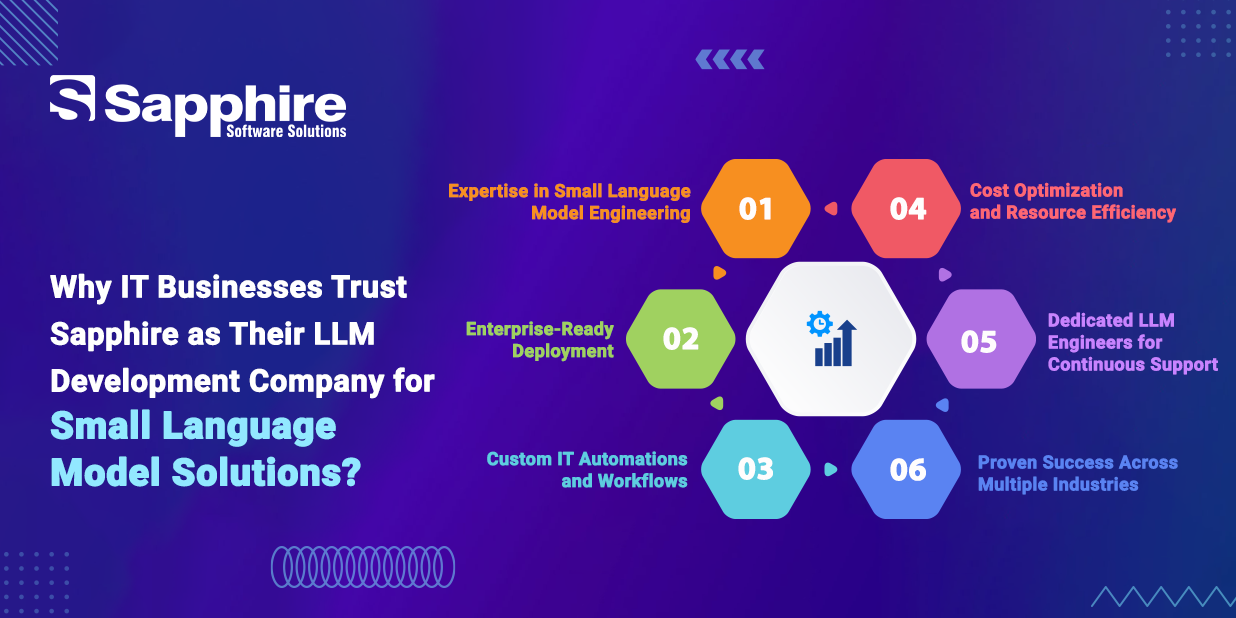
Sapphire Software Solutions has built a solid reputation as one of the leading LLM Development Companies, helping enterprises adopt Small Language Models that improve efficiency, reduce costs, and enhance overall IT performance. As organizations explore what small language models are, how they differ from what large language models are best suited to their needs, Sapphire stands out as a trusted expert in implementing practical, high-performing AI solutions.
Here's why IT teams consistently choose Sapphire as their AI partner:
1. Expertise in Small Language Model Engineering:
Sapphire’s engineering team specializes in evaluating, selecting, and fine-tuning the best SLMs for each use case. They understand the strengths of leading models such as Mistral 7B, Llama 3 8B, and Phi-3 Mini—ensuring the chosen model aligns perfectly with business workflows, performance needs, and budget goals.
2. Enterprise-Ready Deployment:
Sapphire delivers flexible deployment options that allow businesses to maintain full control of their data while benefiting from low-latency performance. Seamless integration with existing IT systems makes SLM adoption faster and more secure.
3. Custom IT Automations and Workflows:
Whether automating helpdesk ticketing, accelerating DevOps pipelines, improving code reviews, or simplifying documentation processes, Sapphire builds domain-specific workflows powered by SLMs.
4. Cost Optimization and Resource Efficiency:
Sapphire evaluates compute usage, workflow demands, and long-term operational requirements to build AI architectures that significantly reduce cloud consumption and GPU dependency—helping companies operate more efficiently.
5. Dedicated LLM Engineers for Continuous Support:
Organizations can directly hire LLM engineers from Sapphire to maintain, optimize, and scale their AI systems. This ensures peak performance, rapid issue resolution, and continuous model improvement.
6. Proven Success Across Multiple Industries:
Sapphire has deployed SLM-based automation across IT, fintech, SaaS, telecom, healthcare, and cybersecurity sectors—demonstrating strong adaptability for diverse business needs and technical environments.
Conclusion:
Enterprises today face a paradox: they need AI intelligence to stay competitive, yet traditional large language models demand resources that often outweigh their practical benefits. Small language models (SLMs) resolve this tension, offering precision, speed, and cost-efficiency without compromising performance. From streamlining IT support to accelerating DevOps pipelines and automating internal knowledge workflows, SLMs transform everyday operations into high-value, intelligent processes.
For organizations ready to harness AI that is both scalable and practical, partnering with a trusted LLM Development Company like Sapphire Software Solutions is the differentiator. Our expertise in selecting, fine-tuning, and deploying small language models ensures tailored solutions that maximize efficiency, minimize costs, and deliver measurable impact. With Sapphire, enterprises are not just adopting AI—they are embedding intelligence into the core of their IT operations, driving innovation while maintaining full control over data and infrastructure.