


















Why Most Sprint Retrospective Action Items Never Get Done
Action items rarely fail because teams don't care. They fail because of a few predictable habits:
- They're vague. "Improving communication" sounds nice, but no one knows where to begin.
- They have no owners. When a task belongs to everyone, it belongs to no one.
- There are too many. A list of ten items guarantees that none get real attention.
- They disappeared after the meeting. Notes get buried in a doc; nobody opens again.
In many teams, an agile retrospective turns into a ritual of venting rather than a tool for improvement. The fix is not more meetings. It is better to follow through.
What Makes a Good Retrospective Action Item
A strong action item is small enough to finish and specific enough to verify. Before you write one down, check that it is:
- Specific: It describes exactly what will change.
- Owned: One person named is responsible.
- Time-bound: It has a clear deadline, ideally within the next sprint.
- Measurable: You can tell, without debate, whether it is done.
- Realistic: The team has the time and authority to complete it.
If an item fails against any of these checks, rewrite it until it passes. A scrum retrospective should end with a few sharp commitments, not a wish list.
How to Write Sprint Retrospective Action Items in 5 Steps
Step 1:
Start with the root cause. Don't fix symptoms. If deployments keep slipping, ask why before deciding what to do.
Step 2:
Pick the top one into three problems. Vote as a group and focus on what hurts most. Fewer commitments mean higher completion rates.
Step 3:
Turn each problem into a concrete task. Replace "better testing" with "add automated checks for the login flow."
Step 4:
Add the owner and the deadline. Write both directly into the action item, so nothing is left to memory.
Step 5:
Define what "done" looks like. One short sentence is enough, such as "Done when all new pull requests run through the checklist."
How to Assign Ownership So Action Items Don't Get Dropped?
Ownership is the single biggest predictor of whether an action item survives. Here is how to make it stick:
- Ask volunteers first. People follow through on tasks they choose.
- Keep it to one owner. Others can help, but one person is accountable.
- Match tasks to strengths and capacity. Don't hand work to someone already buried.
- Confirm out loud. Have each owner say "I've got this" before the meeting ends.
- Don't default to the Scrum Master. Their role is to facilitate, not to carry every task.
Ownership also means permission. Make sure the owner has the time and authority to act, even if that means moving other work out of the sprint.
How to Track and Review Action Items Between Retrospectives?
The gap between meetings is where good intentions fade. Build light but consistent tracking into your normal routine:
- Put action items in the sprint backlog. Treat them like real work, not side notes.
- Mention them in daily stand-ups. A thirty-second check keeps them visible.
- Use one shared board or list. Everyone should know where to look.
- Open the next retro with a review. Spend the first five minutes on what got done, what didn't, and why.
This opening check works as a mini sprint retrospective review. It builds accountability and shows the team that their feedback leads somewhere. If an item keeps slipping, either break it into smaller pieces or drop it honestly.
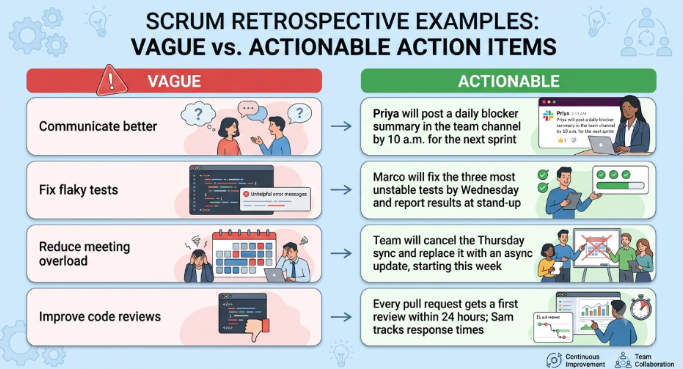
Notice how each rewrite names a person, sets a timeframe, and describes visible proof of progress.
Sprint Retrospective Ideas That Lead to Better Action Items
A tired format produces tired results. Fresh sprint retrospective ideas can surface problems the usual routine misses, and they naturally lead to sharper actions:
- Start, Stop, Continue:
Simple and effective for quick, practical changes.
- Sailboat:
Wind and anchors represent what pushes the team forward and what slows it down.
- 4Ls (Liked, Learned, Lacked, Longed For):
Great for uncovering both wins and gaps.
- Mad, Sad, Glad:
Helps teams talk openly about how work actually feels.
- Timeline review:
Walk through the sprint day by day to spot patterns and turning points.
Rotate formats every few sprints. The goal is not novelty for its own sake, but better conversations that end with clear next steps.
Sprint Retrospective Questions to Ask Before You Close the Meeting
Before the meeting ends, a few well-chosen sprint retrospective questions can confirm your action items are solid:
- Which one change would make the biggest difference in the next sprint?
- Does every action item have a name and a date next to it?
- What could block us from finishing these?
- How will we know, in two weeks, that this worked?
- Is anything on this list something we'd be fine skipping?
If the team struggles to answer any of these, pause and fix the item right there. Five extra minutes now save a repeat conversation later.
Conclusion
Effective sprint retrospectives are not just about identifying problems—they are about turning those insights into measurable improvements. By keeping action items specific, assigning clear ownership, setting realistic timelines, and reviewing progress consistently, Agile and Scrum teams can improve collaboration, reduce recurring challenges, and deliver better results of sprint after sprint. A disciplined approach to retrospective action items helps organizations build a culture of continuous improvement and make every sprint more productive.
If you’re looking for an experienced Agile Development Services to improve your software development processes, build high-performing Agile teams, or deliver scalable software solutions, Sapphire Software Solutions can help. Our team brings the right combination of Agile expertise, technical capabilities, and business-focused development practices to help you achieve your goals. Get a free quote today and let’s discuss how we can help turn your software development challenges into measurable business results.