
















In today’s hyper-connected world, the pace of technological change is accelerating rapidly. Businesses that want to thrive must embrace innovative digital solutions to streamline operations, enhance customer experiences, and uncover new growth opportunities. Among the transformative technologies shaping this future, the Internet of Things (IoT) stands out as a gamechanger.
IoT app development lies at the heart of this revolution, enabling the creation of applications that connect physical devices to digital networks, facilitating seamless communication, automation, and data-driven decision-making. As organizations increasingly embark on digital transformation journeys, IoT applications are becoming indispensable tools to unlock operational efficiency and innovation.
This blog explores why IoT app development is pivotal for digital transformation, what it entails, the technologies involved, the benefits it offers, and how partnering with a leading IoT App Development Company like Sapphire Software Solutions can be the key to success.
What is IoT App Development?
To fully appreciate the significance of IoT in digital transformation, it’s important to first understand what is IoT app development. Simply put, IT is the process of designing, building, and deploying applications that allow IoT devices—ranging from sensors and smart appliances to industrial machines—to connect to networks and interact with each other and with end users.
These applications serve as the interface between the physical world and data processing systems. They collect real-time data from connected devices, analyze it, and enable automated or manual responses. Unlike traditional software, apps must manage continuous data streams from a wide variety of devices, often with constraints such as limited processing power and intermittent connectivity.
IoT applications come in many forms:
- Consumer apps like smart home controllers, fitness trackers, and connected cars.
- Enterprise solutions include asset management, supply chain monitoring, and predictive maintenance.
- Public sector uses such as smart cities and environmental monitoring.
Each use case requires customized development to address specific device types, data volume, latency needs, and security requirements. The complexity and diversity make IoT application development a specialized field requiring cross-disciplinary expertise.
Understanding Digital Transformation in the Modern Era:
Digital transformation is more than adopting new technology—it is a cultural and operational shift that redefines how organizations operate and deliver value. It involves embedding digital technologies into all aspects of a company, from internal workflows to customer interactions and product offerings.
Today’s digital transformation is driven by several converging trends:
- The explosion of data and the need for real-time analysis is important.
- The rise of cloud computing enables scalable, on-demand resources.
- Advances in artificial intelligence (AI) and machine learning (ML) providing predictive and automation capabilities.
- The proliferation of connected devices through IoT is important.
Together, these forces empower businesses to become more agile, customer-centric, and efficient. Digital transformation enables companies to innovate rapidly, offer personalized experiences, and optimize operations through data insights.
In this context, IoT app development services are a foundational pillar—it supplies the tools to capture and act on data from the physical environment, making digital transformation tangible and actionable.
How IoT App Development is Driving Digital Transformation?
Accelerates digital transformation by enabling enterprises to harness real-world data and embed intelligence into everyday processes. Here’s a deeper look at the mechanisms through which applications drive this change:
1. Enhanced Operational Visibility:
IoT apps connect devices across factories, supply chains, buildings, and beyond, providing real-time visibility into asset status, environmental conditions, and operational parameters. This transparency allows for:
- Early detection of issues before they escalate.
- Data-driven scheduling of maintenance to avoid costly downtime.
- Monitoring resource consumption to improve efficiency.
2. Automation and Intelligent Decision-Making:
By integrating AI and ML within IoT apps, companies can automate routine tasks such as adjusting temperature controls, reordering inventory, or optimizing machine performance. This reduces human error and frees staff to focus on higher-value activities.
3. Personalized Customer Experiences:
IoT apps enable tailored interactions based on device data and user behavior. For example, smart wearables can offer health tips based on biometric data, while connected vehicles can customize driving settings for each user. This personalization boosts satisfaction and loyalty.
4. New Business Models:
Supports innovative revenue models such as usage-based pricing, subscription services, and outcome-based contracts. These models create continuous revenue streams and deepen customer relationships.
5. Improved Collaboration and Integration:
IoT apps facilitate seamless data sharing across departments and partners, breaking down silos, and enabling coordinated decision-making and process optimization.
In essence, IoT applications transform static systems into dynamic, interconnected ecosystems that adapt and improve continuously, embodying the very essence of digital transformation.
Key Benefits of IoT App Development for Businesses:
The strategic adoption of IoT applications offers substantial advantages:
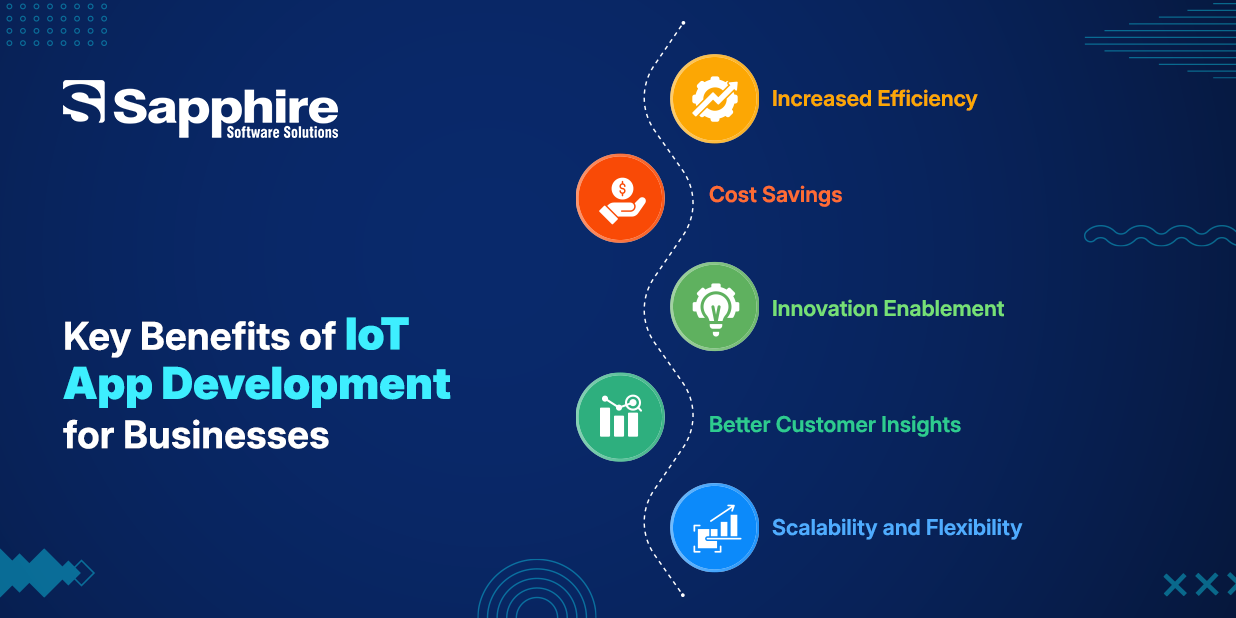
- Increased Efficiency: Continuous monitoring and automation optimize resource utilization, reduce waste, and enhance productivity.
- Cost Savings: Predictive maintenance minimizes downtime and repair costs, while smarter energy management lowers utility expenses.
- Innovation Enablement: IoT apps provide the data and tools necessary to develop new products, services, and business models.
- Better Customer Insights: Real-time data from IoT devices provides a deeper understanding of customer preferences and usage patterns.
- Scalability and Flexibility: IoT applications can grow with your business, accommodating new devices, locations, and functionalities seamlessly.
These benefits collectively empower businesses to not only keep pace with change but lead their industries in innovation and service excellence.
IoT App Development Architecture Explained:
The architecture of IoT apps is designed to manage complex interactions between devices, data, and users while ensuring performance, reliability, and security. The primary layers include:
- Device Layer: This layer consists of the physical IoT devices—sensors, actuators, cameras, wearables—that collect and sometimes act on data. These devices vary widely in capabilities and protocols.
- Connectivity Layer: Devices communicate with networks via wireless or wired technologies such as Wi-Fi, Bluetooth, Zigbee, or cellular networks. This layer ensures data transmission to processing systems.
- Edge Computing Layer: To reduce latency and bandwidth use, some data processing happens close to the devices at the edge of the network. Edge computing supports real-time analytics and decision-making.
- Data Processing Layer (Cloud Layer): Data is aggregated, stored, and analyzed in cloud platforms or centralized servers. This layer uses big data tools and AI algorithms to extract insights and manage large-scale IoT deployments.
- Application Layer: This user-facing layer provides interfaces such as mobile apps, web dashboards, or APIs to monitor devices, visualize data, and control connected assets.
Each layer must work in harmony to deliver responsive, scalable, and secure IoT solutions that meet business needs.
Core Technologies Used in IoT Application Development:
Relies on an ecosystem of cutting-edge technologies:
- Cloud Computing: Provides elastic, scalable infrastructure for data storage and processing.
- Artificial Intelligence and Machine Learning: Enable predictive analytics, anomaly detection, and intelligent automation.
- Big Data Analytics: Processes massive volumes of data for trend analysis and decision support.
- Edge Computing: Processes data locally to reduce latency and enhance responsiveness.
- IoT Application Platforms: Integrated environments offering device management, data analytics, and app development tools, which accelerate development and deployment.
- Security Solutions: Encryption, authentication, and secure communication protocols to safeguard data and devices against cyber threats.
These technologies collectively empower IoT application development teams to build robust, scalable, and secure solutions.
Challenges and Security Issues in IoT App Development:
Despite its transformative potential, it faces several challenges:
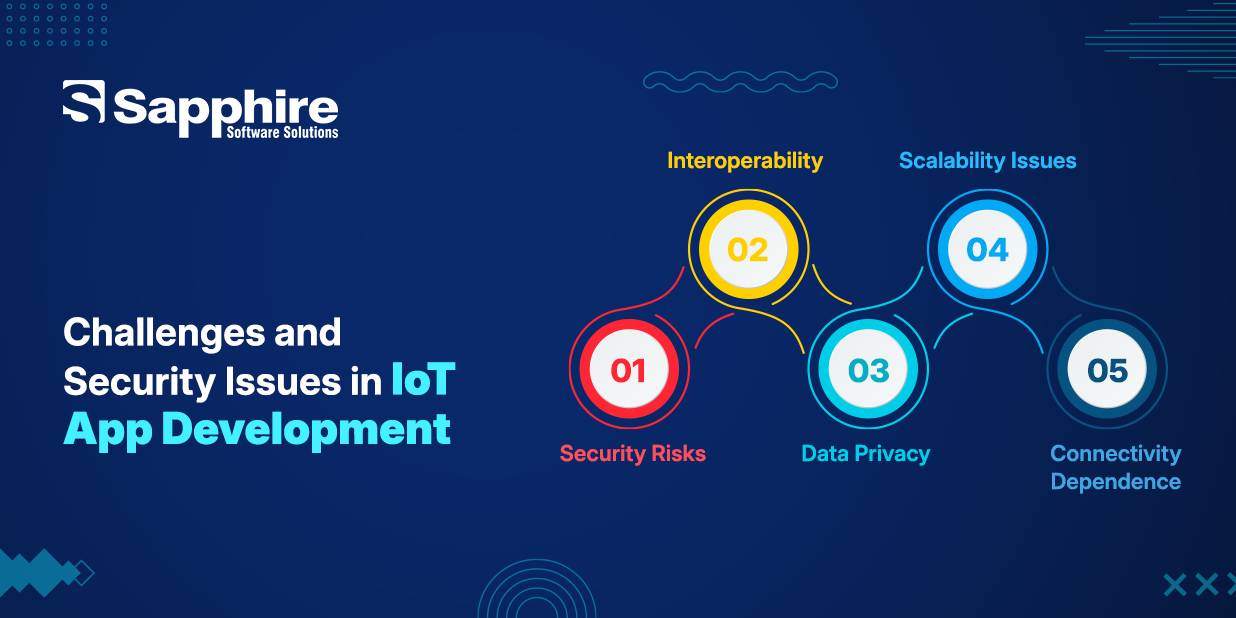
- Security Risks: IoT devices often have limited processing power, making it difficult to implement strong security measures. This vulnerability can expose systems to hacking, data breaches, and unauthorized control.
- Interoperability: The vast variety of IoT devices, communication protocols, and standards complicate integration efforts, leading to fragmented ecosystems.
- Data Privacy: Collecting sensitive personal and operational data requires compliance with regulations such as GDPR and CCPA. Ensuring user consent and protecting privacy are crucial.
- Scalability Issues: As the number of connected devices grows exponentially, managing network load, data processing, and device updates becomes complex.
- Connectivity Dependence: Reliable network connections are essential for real-time functionality. Connectivity disruptions can impact service delivery.
Addressing these challenges requires a holistic approach encompassing secure software development practices, standardized protocols, robust testing, and strong partnerships with experienced IoT app developers.
Why Sapphire as an IoT App Development Company is Essential for Successful Digital Transformation?
Choosing the right partner is vital for unlocking the full benefits of digital transformation. Sapphire Software Solutions stands out as a trusted IoT App Development Company committed to delivering end-to-end solutions tailored to your business needs.
- Expertise Across the IoT Spectrum: Sapphire’s team brings deep knowledge in hardware integration, software development, cloud platforms, AI, and security, ensuring comprehensive solutions that function seamlessly.
- Customized Development: Understanding that each business has unique challenges, Sapphire crafts bespoke applications designed to meet specific operational goals and user requirements.
- Scalable and Secure Solutions: Sapphire builds future-ready apps leveraging scalable cloud infrastructure and implementing industry-best security practices to protect your data and devices.
- Full Lifecycle Support: From initial concept and prototyping through development, deployment, and ongoing maintenance, Sapphire supports your digital transformation journey at every stage.
- Proven Track Record: With a portfolio spanning industries like manufacturing, healthcare, logistics, and smart cities, Sapphire combines technical excellence with practical business insight.
By partnering with Sapphire, companies gain access to an advanced IoT application platform and expert guidance that dramatically reduce risks and accelerate time-to-market.
Conclusion:
As businesses continue to embrace digital transformation, IoT app development is no longer a future investment—it is a strategic necessity. From improving operational efficiency and enabling real-time decision-making to creating innovative customer experiences and new revenue opportunities, IoT empowers organizations to stay competitive in an increasingly connected world. Companies that leverage intelligent IoT solutions today will be better positioned to adapt to changing market demands, reduce costs, and drive sustainable business growth in the years ahead.
At Sapphire Software Solutions, we help businesses harness the full potential of IoT through scalable, secure, and customized IoT application development services tailored to their unique requirements. Whether you're looking to automate processes, optimize operations, or build next-generation connected products, our team is ready to turn your vision into reality. Contact us today to discuss your project and get a free quote from our IoT experts. Let’s build a smarter, more connected future for your business.