

















In today’s fast-paced digital era, businesses need to deliver applications quickly, securely, and reliably to keep pace with market demands. Traditional methods of application deployment often create challenges such as long setup times, inconsistent environments, and scaling limitations. These bottlenecks directly affect competitiveness, innovation, and customer satisfaction.
This is where containerization and, particularly, Docker come into play. With its ability to package applications into lightweight, portable containers, Docker simplifies development, testing, and deployment across different environments. It ensures that what works on a developer’s laptop will also work in testing and production with minimal surprises.
Organizations that embrace containerization unlock significant advantages: faster release cycles, improved collaboration between development and operations, and scalable application delivery. When paired with DevOps Development Services, Docker becomes a powerful enabler of continuous integration and continuous delivery (CI/CD), empowering teams to deliver better software faster.
In this blog, we’ll explore what Docker is, why it’s a game-changer for DevOps, its architecture, essential software and tools, and the critical role of specialized development services. We’ll also discuss why hiring a skilled professional makes a difference and how the right company, such as Sapphire, can help organizations achieve their goals with confidence.
What is Docker?
At its core, Docker is an open-source platform that enables developers to build, ship, and run applications inside containers. Unlike traditional virtual machines, which require an entire operating system to run, Docker containers share the host system’s kernel. This makes them lightweight, fast, and highly efficient.
What makes Docker unique is its simplicity. Developers can build images using straightforward syntax in a Docker file, define dependencies clearly, and share those images easily with other team members. With this approach, development teams can work in consistent environments, eliminating conflicts and improving collaboration.
Docker also integrates seamlessly with cloud platforms and orchestration tools like Kubernetes, making it a cornerstone of modern cloud-native development. Abstracting infrastructure complexities allows developers and operations teams to focus on delivering features instead of managing servers.
Why Use Docker and Why is it a Game-Changer for DevOps?
The popularity of Docker is no accident. Its rise coincided with the increasing adoption of DevOps, a methodology aimed at breaking down silos between development and operations teams to achieve faster, more reliable software delivery.
One of the biggest advantages of Docker is consistency across environments. A container built on a developer’s laptop will behave the same way when deployed on testing servers, staging environments, or production. This eliminates bugs caused by environmental discrepancies and accelerates the release cycle.
Another major benefit is scalability. With Docker containers, businesses can scale applications horizontally by spinning up additional containers as demand increases. This elasticity ensures applications remain responsive even during peak usage.
Finally, cost efficiency cannot be ignored. Containers consume fewer resources compared to virtual machines, allowing organizations to optimize infrastructure usage. This leads to significant savings, particularly in large-scale deployments.
When paired with DevOps Development Services, Docker enables companies to automate not just deployment but also monitoring, logging, and rollback processes. It transforms the way organizations approach software delivery, reducing risk and boosting customer satisfaction.
Understanding Docker Architecture:
Behind the simplicity of Docker lies a powerful and flexible architecture designed to support the entire container lifecycle. To fully appreciate the value it brings, it’s important to understand its main components.
At the heart of the system is the Docker Engine, the runtime that builds, runs, and manages containers. The engine has three core elements:
- Server (Daemon): Responsible for creating and managing Docker objects such as images, containers, and networks.
- REST API: Provides communication between the client and daemon, enabling programmatic interactions.
- Client: The command-line interface (CLI) that users interact with to send instructions to the daemon.
Networking and storage are also integral to Docker Architecture. Containers can communicate with each other using virtual networks, and data persistence can be achieved through volumes. This flexibility allows complex applications with multiple services like databases, APIs, and frontends to work together seamlessly.
By combining these components, Docker provides a powerful, modular system that can support simple apps as well as enterprise-scale microservices architectures. Its design abstracts infrastructure complexities, enabling teams to focus on application innovation rather than system configuration.
Essential Docker Software and Tools for Development:
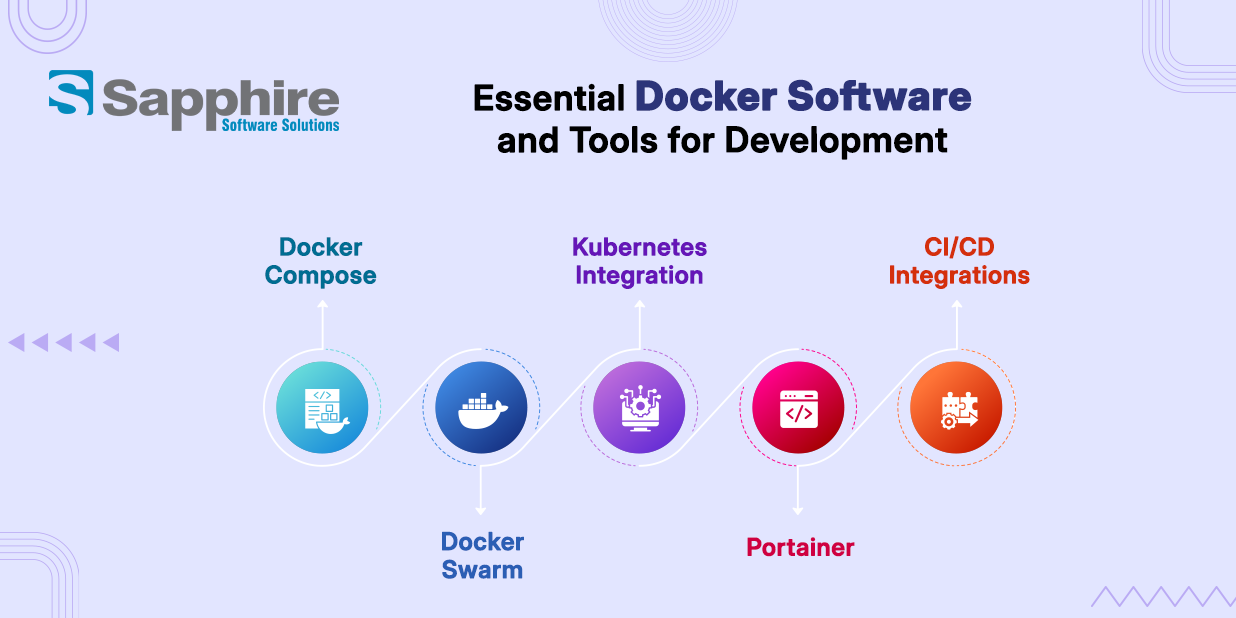
While Docker itself provides the foundation, developers often rely on an ecosystem of supporting applications to maximize productivity. This ecosystem includes essential Docker Software and complementary Docker Tools that simplify container management and integration.
Some of the most widely used tools include:
- Docker Compose: Allows developers to define and manage multi-container applications using a simple YAML file.
- Docker Swarm: Provides native orchestration for clustering and scaling containers, though Kubernetes has become more popular for larger workloads.
- Kubernetes Integration: While not part of Docker’s core, Kubernetes is often paired with Docker for advanced orchestration and scaling.
- Portainer: A lightweight management UI that simplifies container monitoring and administration.
- CI/CD Integrations: Jenkins, GitLab CI, and GitHub Actions can all integrate with Docker, enabling automated build and deployment pipelines.
Developers also rely on IDE integrations, such as Docker extensions for Visual Studio Code, which streamline containerized development workflows.
Role of Docker Development in Modern IT Solutions:
Modern IT solutions increasingly demand agility, scalability, and cost efficiency. Traditional deployment models often fail to meet these requirements, leading to delays, resource wastage, and operational inefficiencies. This is where Docker Development comes into focus, enabling businesses to streamline how applications are created, tested, and deployed.
Docker also enhances security practices. Containers can be isolated, reducing the attack surface. Security tools can scan images before deployment, ensuring that vulnerabilities are addressed early in the pipeline.
From small startups to large enterprises, Docker has become the backbone of IT transformation. Its role extends beyond development into operations, monitoring, and scaling. In industries such as finance, healthcare, retail, and logistics, Docker-powered solutions are enabling organizations to remain competitive in a fast-changing technological landscape.
Comprehensive Docker Development Services Offered by Experts:
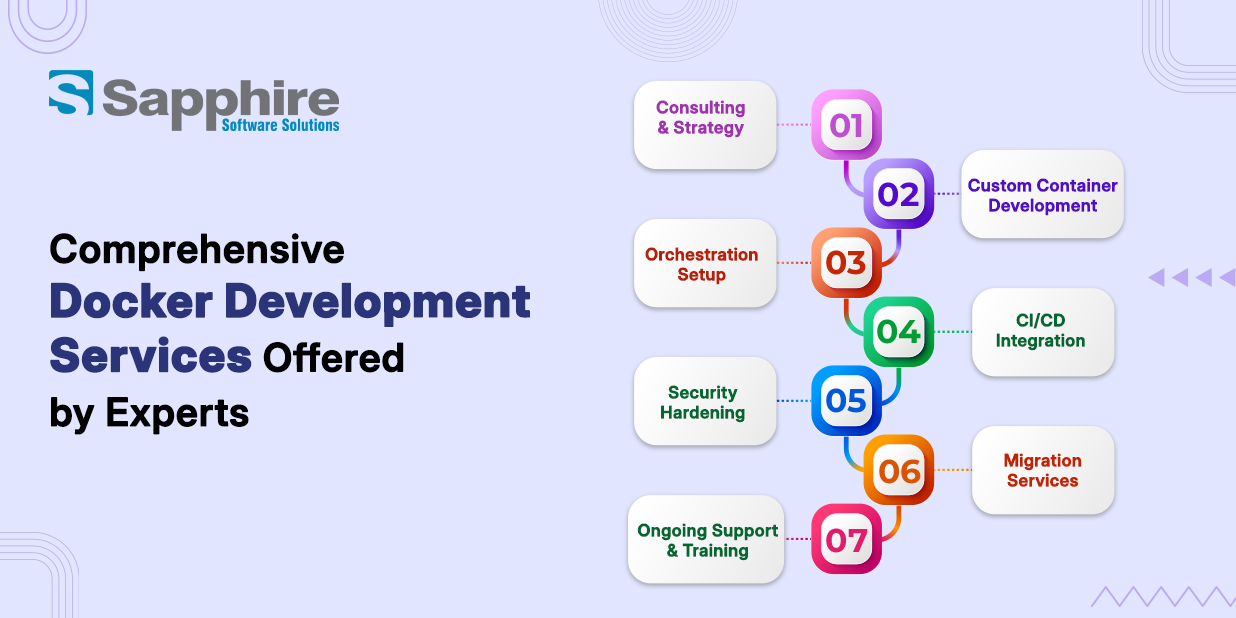
While Docker as a platform is powerful, unlocking its full potential often requires guidance from specialists. Professional Docker Development Services cover a wide spectrum of capabilities that ensure organizations adopt containerization effectively.
These services typically include:
- Consulting & Strategy: Experts evaluate an organization’s current infrastructure and processes to design a roadmap for container adoption.
- Custom Container Development: Developers create optimized containers tailored to specific business applications and workflows.
- Orchestration Setup: Specialists configure Kubernetes or Docker Swarm to manage container clusters for scalability and resilience.
- CI/CD Integration: Teams implement automated pipelines to accelerate development and reduce manual intervention.
- Security Hardening: Services often include vulnerability scanning, secure configuration, and monitoring for compliance.
- Migration Services: Legacy applications can be containerized, helping businesses modernize without costly re-engineering.
- Ongoing Support & Training: Continuous support ensures smooth operations, while training empowers in-house teams to manage containers confidently.
By engaging experts, organizations avoid common pitfalls such as inefficient container design, misconfigured orchestration, or overlooked security gaps. Ultimately, these services provide a bridge between technical innovation and business outcomes, ensuring that Docker is not just implemented but strategically leveraged for long-term growth.
Why Hiring a Skilled Docker Developer Matters?
Adopting containerization isn’t just about using technology; it’s about how effectively it’s applied. A Docker Developer plays a crucial role in designing, building, and maintaining containers that align with organizational goals.
When businesses hire Docker developer talent, they gain access to expertise that goes beyond coding. These professionals bring deep knowledge of cloud platforms, orchestration frameworks, and security practices. They can troubleshoot complex issues, optimize resource allocation, and prevent costly downtime.
In addition, skilled developers ensure future proofing. As technology evolves, they stay updated on the latest best practices, tools, and integrations. This foresight helps organizations remain competitive without constantly re-engineering their systems.
Without dedicated expertise, organizations risk inefficient containerization, inconsistent deployments, and potential security vulnerabilities. By contrast, with the right talent, Docker becomes a strategic enabler of business success.
How Docker Enhances DevOps Development Services?
DevOps is centered on speed, collaboration, and automation, while Docker provides the consistency and scalability that enable these principles to thrive.
Containers reduce the friction between development and operations teams. Developers can package applications with all dependencies, ensuring smooth handoffs to operations. This eliminates “works on my machine” issues that previously slowed deployments.
Security and rollback are also enhanced. Docker images can be versioned, allowing quick rollback if something goes wrong. Automated scanning ensures that vulnerabilities are identified before deployment.
By combining Docker with DevOps methodologies, organizations achieve a culture of continuous improvement. Teams release features more quickly, adapt rapidly to customer feedback, and consistently deliver higher-quality products.
Why Choose Sapphire as Your Trusted Docker Development Company?
Selecting the right partner can make the difference between a successful containerization journey and a costly experiment. Sapphire stands out as a trusted Docker Development Company due to its holistic approach, technical expertise, and proven track record.
Here’s what makes Sapphire a reliable choice:
- End-to-End Expertise: From strategy and consulting to development, orchestration, and support, Sapphire offers a full spectrum of services.
- Customized Solutions: The team tailors Docker implementations to align with each client’s unique business goals and industry requirements.
- Proven DevOps Integration: Sapphire specializes in aligning containerization with CI/CD pipelines, enabling faster and more reliable releases.
- Security-First Approach: By incorporating best practices and advanced monitoring tools, Sapphire ensures containers remain secure throughout their lifecycle.
- Scalable Engagement Models: Whether businesses need consulting, full-service implementation, or dedicated experts, Sapphire offers flexible collaboration models.
- Industry Recognition: With extensive experience in digital transformation, Sapphire has helped organizations across industries modernize their IT operations.
Choosing Sapphire means gaining a partner that not only implements Docker effectively but also aligns containerization with broader digital transformation objectives. Businesses can confidently embark on their DevOps journey, knowing they have the support of experts committed to their success.
Conclusion:
In today’s fast-paced digital environment, adopting Docker containerization is essential for businesses aiming to accelerate software delivery while reducing operational costs. With consistent and portable application environments, Docker enables faster release cycles, improved collaboration between development and operations teams, and seamless scalability to meet evolving market demands.
Partnering with a trusted Docker development company like Sapphire Software Solutions ensures your containerization journey aligns perfectly with your business objectives. From initial consulting and custom container development to orchestration and CI/CD integration, Sapphire provides end-to-end solutions tailored to your unique needs. This approach not only enhances security and operational efficiency but also empowers your teams to focus on innovation rather than infrastructure challenges.
By choosing Sapphire, your business gains a reliable partner dedicated to driving faster innovation, optimized IT costs, and sustainable growth. Embracing Docker with expert guidance positions your organization to stay competitive, deliver high-quality software consistently, and confidently scale for the future.