
















In today's rapidly evolving digital environment, software has become a critical dependency for organizations to support their core business functions, interface with customers, and innovate. To develop a successful IT solution, however, one needs to understand, plan, and then employ principles of good software design. Although anyone can build an application of some kind, developing a good piece of software that has longevity requires deep knowledge and skill.
From improving scalability and maintainability to security and performance, software design principles are an essential aspect of software design that can help produce software that functions and is future-ready. They are the foundation of good software development for applications that are highly robust, efficient, and user-friendly.
In this blog, we will explore the meaning of software design, principles of the software development lifecycle, key software design principles in software engineering, and how software design principles can be applied to increase quality and assurance for reliability and efficiencies to drive business outcomes. Further, we will also highlight the need to hire the right developers and partner with the right software development company to embed software development principles.
What is Software Design?
To appreciate why software design matters, we should first answer a very simple question: What is software design?
In its most simple form, the definition of software design is creating, organizing, and planning a software system to serve business or user needs. It is the process of taking abstract requirements and ideas and transitioning them into an actual coded software system.
In software engineering, design is often the guideline for developers to act on. In other words, the designer must identify all system components, define the relationships between system components, and enable all components to work together seamlessly. It is very similar to constructing a building; before the first brick is laid, a thorough architectural plan has been drafted to account for the stability, aesthetics, and longevity of the building.
There are two levels of software design.
- High-level design (HLD): Defines the architecture of a system, including the modules, components, how data flows, and how systems communicate with each other.
- Low-level design (LLD): Defines the details of the component; class structure, algorithms, databases, and user interface logic.
When organizations commit to design principles around their software system design, they can reduce complexity, enhance collaboration between teams, and produce a final product that generally aligns with human expectations.
Generally, it is design that turns ordinary solutions into exemplary software that scales easily and performs well under pressure.
Understanding Software Development Lifecycle Principles
The development of every effective software delivers a methodical and stately journey of development called the Software Development Lifecycle (SDLC). The SDLC principles ensure that your way of working from ideation through to deployment is predictable, efficient, and high-quality.
The typical processing of the SDLC is:
- Requirement Analysis- Gathering and Documenting the business needs.
- Planning- Parsing out the timelines, budgets, and how we are going to accomplish the development.
- Design- Creating a process of detailed blueprints based on the requirements.
- Development- Producing the actual code based on the software design principles.
- Testing- Validating the functionality, performance, and security.
- Deployment- Shipping the product to the end users.
- Maintenance- Improving and updating the software continuously.
The SDLC principles will serve as the guardrails to keep your project on track, including transparency, risk planning, and collaborating with the stakeholders.
By following these principles, the team will be able to see problems early, improvements in communication, and consistency in quality. As shown in the example, following some of the secure software design principles in the early stages often leads to less risk of continuous vulnerabilities in production phases.
Core Software Design Principles in Software Engineering:-
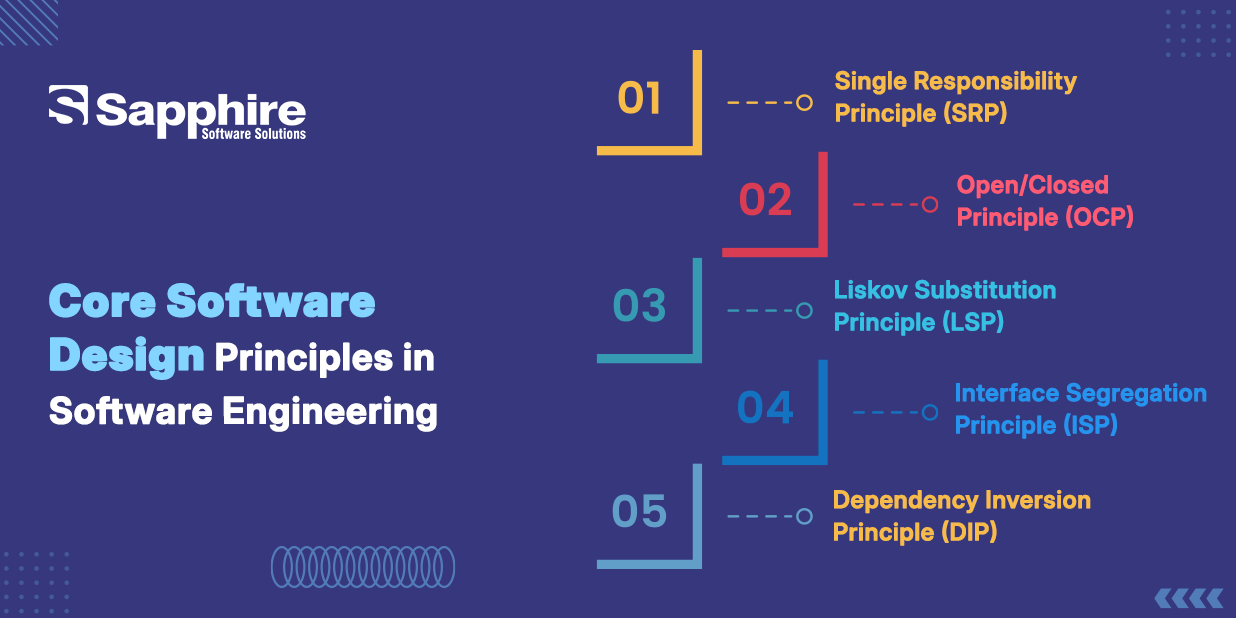
To design maintainable and scalable systems, software engineers employ well-tried software design principles. These are guidelines to ensure clarity, flexibility, and robustness in the development process. Let us discuss some of the most important ones:
- Single Responsibility Principle (SRP): A class or a module should have a single, and only one, reason to change. This makes it easier to maintain, test, and extend the system.
- Open/Closed Principle (OCP): Software modules should be open to extension but closed to modification. This means that the developers can extend new features without modifying the code in place, thus preventing unwanted interference.
- LiskovSubstitution Principle (LSP): There should be substitutability of derived classes by their base classes without the application being affected. It gives flexibility and reusability of code.
- Interface Segregation Principle (ISP): Clients should not have to depend on interfaces that they do not use. Interfaces being minimal keeps things lean and reduces the unnecessary dependencies.
- Dependency Inversion Principle (DIP): The high-level modules must never depend on low-level modules; both must depend on abstractions. This separation makes the code more modular and testable.
These five, all known as the SOLID principles, are the roots of clean, maintainable, and scalable code.
Impact of Software Design Principles on Development Efficiency:
Sound software design principles are not abstracts—they have a direct, quantifiable effect on efficiency, cost, and overall software quality.
If design principles are adhered to upfront, developers can predict potential issues early on, resulting in fewer bugs, less rework, and shorter development cycles. A well-designed system provides for more seamless collaboration among teams, simpler onboarding for new developers, and lower long-term maintenance costs.
For example, the use of software system design principles assists in modularizing code so that it can be tested and debugged as separate components rather than affecting the overall system. This modularity allows teams to reuse such components in future projects and save both time and money.
Security and performance are two other aspects that stand to gain a great deal. Incorporating secure software development practices like data encryption, authentication, and input validation minimizes vulnerabilities and meets industry standards. At the same time, optimized architecture allows for improved scalability and response time.
From a business standpoint, embracing these principles makes return on investment (ROI) better. Easier-to-modify and easier-to-upgrade software enables companies to react to changing markets, ship new features sooner, and drive increased user satisfaction—all of which map directly to long-term success.
Hiring the Right Talent for Software Design:
Even the best principles do not work without having the appropriate people to execute them. Executing good software design principles requires companies to have professionals who know architecture, scalability, and security. It is for this reason that most organizations today prefer to hire software developers with established experience in design-centric development. A developer not only knows coding but also understands how design decisions impact long-term performance and ease of maintenance.
When you Hire Dedicated Software Developers, you get committed professionals working exclusively for your project. They share the same goals as you, operate in agility paradigms, and maintain your software architecture uniformly from inception to completion.
The appropriate developer also knows the subtleties of software development lifecycle concepts, allowing for more harmonious collaboration between design, testing, and deployment teams. They can anticipate potential weaknesses early in the process and recommend architectural enhancements that balance both cost and performance.
Collaboration with the Top Software Development Services partner gives your business an edge. Seasoned experts blend imagination with technical excellence, with each line of code playing a part in a scalable, secure, and high-quality solution.
Why Businesses Choose Sapphire as Their Top Software Development Company?

Where the integration of technical competence, design innovation, and business insight is concerned, Sapphire Software Solutions is one of the leading software development firms that is sought after by international clients. The process is disciplined, and the company brings together software development lifecycle thinking combined with state-of-the-art agile approaches. Each project—a mobile application, enterprise software, or cloud solution—is built with care, scalability, and user experience in mind.
The firm is very much focused on safe software design practices, whereby all solutions are developed with a security-first mentality. From data security to API security, compliance, and encryption, Sapphire's frameworks protect both business and user interests. In addition, developers at Sapphire Software Solutions are schooled in principles of software design in software engineering, so every piece they create favors modularity, maintainability, and performance. Their method enables customers to quickly scale systems, add new features, and future-proof digital investments.
By bringing strategic thinking, innovation, and engineering excellence together, Sapphire empowers companies to successfully navigate the complex digital world, bringing ambitious concepts to scalable, secure, and high-performing software products.
Conclusion:
In the competitive digital landscape, software design principles are not just technical guidelines—they are strategic business enablers. Organizations that embrace these principles can achieve scalable, maintainable, and high-performing solutions that respond quickly to market demands, enhance security, and maximize return on investment.
Partnering with the Top Software Development Company ensures these principles are implemented correctly from day one. At Sapphire Software Solutions, we combine deep technical expertise, disciplined software development lifecycle practices, and a design-first approach to deliver solutions that drive real business outcomes. By focusing on modularity, performance, and security, we help businesses future-proof their digital investments while accelerating innovation and growth.
Choosing Sapphire Software Solutions means choosing a partner that not only builds software but builds software that works—efficiently, securely, and reliably—so your business can stay ahead in an ever-evolving digital world.