
















Just a few years ago, artificial intelligence was little more than a buzzword tossed around in conference rooms. Today, AI is driving business decisions in real time, automating repetitive tasks, enhancing customer experiences, and uncovering insights that teams would have missed entirely. As AI shifts from “future potential” to “daily operations,” more companies are realizing they can no longer afford to ignore it.
But the moment businesses decide to explore AI, they all face the same question: “How much does AI actually cost?” Some assume it’s far beyond their budget and hesitate to begin. Others jump in expecting a small investment, only to be surprised when development, data preparation, and infrastructure expenses grow rapidly.
The truth is simple: AI development isn’t a one-size-fits-all purchase. What you want to build, the complexity of your data, the level of intelligence you need, and how deeply AI integrates into your existing systems all influence the total cost. And without the right guidance, budgets can spiral quickly.
As an experienced AI Solutions Company, we created this guide to give business leaders clear, realistic answers about the true Cost of Implementing Artificial Intelligence—without jargon, without hype, and without hiding what really drives expenses. If you're planning to leverage AI strategically, this is the clarity you need before you begin.
Why Understanding AI Development Cost Matters for Businesses?
Most people don't realize this: AI projects rarely fail because the technology sucked. They bombed because somebody messed up the money part. Pick smarter starting points. Don't burn four months on something doomed from day one.
What's Knowing How Much AI Costs Worth to You?
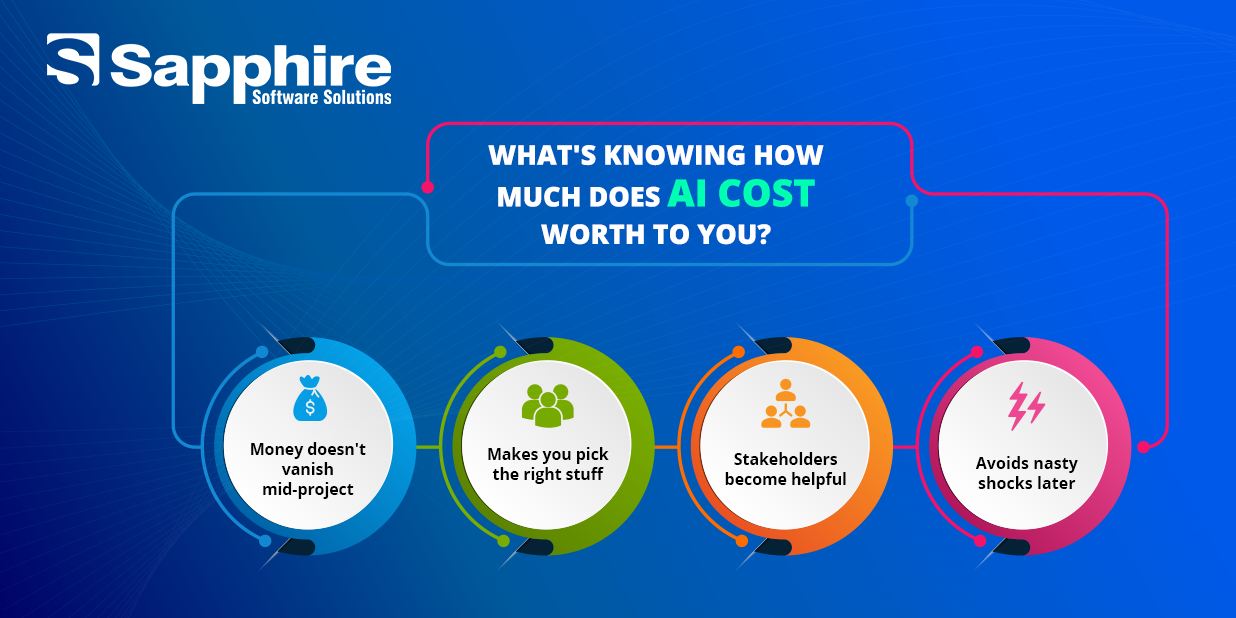
Money Doesn't Vanish Mid-Project:
Lost track of how many teams start strong, cruise to month four, suddenly go "oh shit, we never budgeted for cleaning this data." Or training expenses. Or those cloud bills multiplying weekly. Everything stops cold.
Makes You Pick The Right Stuff:
AI handles chatbots, predictions, recommendations, fraud detection, images, and full automation—but trying everything at once gets you nowhere. Understanding costs forces focus on what moves your business forward.
Stakeholders Become Helpful:
Show up with solid numbers—what we're building, cost breakdown, expected returns—watch people flip from questioning everything to supporting you. Happens every single time.
Avoids Nasty Shocks Later:
AI isn't install-and-forget like regular software. Models drift over weeks. Data shifts constantly. You're monitoring, updating, and retraining forever.
Cost of Implementing Artificial Intelligence: What Businesses Should Know
A. Key Factors That Shape AI Implementation Costs:
What You're Building:
Building a chatbot versus computer vision? Totally different games. Predictive models versus recommendation systems? Not even close. Two months for some. Eight for others. Complex always costs more—can't escape it.
Your Data Mess (This kills Most Budgets):
Got clean data sitting ready? Congratulations, you're ahead of most companies out there. Data scattered everywhere, half unlabelled, formats inconsistent? That prep time murders your schedule and money. Watched it wreck projects personally.
Custom Versus Stealing Existing Models:
Use GPT or grab existing ML models, save serious cash. Building something custom for your weird, specific needs?
Infrastructure (Everybody Forgets This One):
AI training eats GPUs alive. Not cheap. Cloud storage bills? Painful. Real-time processing? Even worse. Infrastructure costs sneak up behind you faster than anything.
B. Typical AI Implementation Cost Range:
Numbers from actual builds I've watched:
- Basic AI automation: Approximately $8,000–$25,000
- Chatbots and NLP: Approximately $10,000–$50,000
- Custom ML models: Approximately $20,000–$250,000
- Computer vision: Approximately $30,000–$150,000
- AI-powered apps: Approximately $15,000–$250,000
- Full platforms: Approximately $80,000–$500,000+
- Enterprise systems: Approximately $250,000–$2M+
Where your lands depend entirely on your specific needs.
How Much Does It Cost to Build an AI System?
Let's break How Much Does It Cost to Build an AI System into actual phases that happen.
Discovery & Planning: Approximately $2,000–$15,000
Figuring out if this idea even works. What data do you have? Whether it's possible. Skip this, and you're guessing blindly through the whole build. Not smart.
Data Preparation: Approximately $10,000–$150,000
Everybody underestimates this phase. Everybody. Gathering data, cleaning the mess, labelling everything, and organizing for training. Garbage in means garbage out. Zero shortcuts here.
Model Development: Approximately $20,000–$200,000
Engineers choose algorithms, design architecture, and build actual workflows. This eats the biggest chunk of AI Development Cost usually—it's the brain you're creating.
Training & Tuning: Approximately $10,000–$150,000
Models bomb on first attempts. Always. Training needs GPUs (expensive as hell), running cycles repeatedly, tweaking parameters constantly. Advanced models demand way more time.
Integration: Approximately $10,000–$120,000
Your shiny AI needs to connect to apps, websites, CRMs, and whatever APIs you're running. More connections equal more headaches and hours.
Testing & Deployment: Approximately $5,000–$80,000
Before launch day, testing everything thoroughly, deploying to the cloud, monitoring setup, and logging infrastructure. Prevents disaster when actual users arrive.
Ongoing Maintenance: Around 15%–30% yearly
Models drift and need retraining. Data needs constant refreshing. The infrastructure needs optimization work. Budget now or face surprises twelve months out.
AI App Development Cost: Pricing Breakdown and Considerations
What's the actual AI App Development Cost these days?
AI apps are loaded with features that make users feel like they're understood. These include personalized suggestions, clever automation, voice capabilities, chatbots, and insights you can see right away.
Range: Approximately $15,000–$250,000+
Price changers:
Complexity levels. Single predictive feature runs cheaply. A full multi-module intelligent app runs expensively. Huge gap there.
Model choices. Basic ML stays affordable. LLM-powered features get pricey fast from APIs and complexity.
Real-time requirements. Instant results mean bigger infrastructure spending. Can't avoid it.
Platform spread. iOS only stays cheaper than iOS plus Android plus web. Simple math there.
AI Chatbot Development Cost: How to Budget for Your Project
Chatbots everywhere now—customer support, lead generation, internal help. AI Chatbot Development Cost swings wildly depending on intelligence requirements.
Range: Approximately $10,000–$150,000+
Basic FAQ automation. Not smart, but cheap and quick to deploy.
NLP bots: Approximately $10,000–$40,000. They actually understand language instead of matching keywords blindly. Major step up.
LLM-powered bots: Approximately $25,000–$150,000. Feel almost human. Connect to systems, complete tasks, don't just answer questions.
Cost drivers: Data volumes, intelligence needs, multi-language requirements, real-time integrations, API charges from OpenAI/Claude/Gemini.
AI Software Development Cost: From MVP to Enterprise Solutions
AI Software Development Cost shifts based on your development stage.
MVP: Approximately $20,000–$80,000. Core features validating your concept and testing market interest.
Mid-level software: Approximately $80,000–$300,000. Dashboards, user management, integrations, better models, automation capabilities.
Enterprise software: Approximately $300,000–$2M Heavy workloads, massive user bases, mission-critical operations that can't fail.
AI Agent Development Cost: What It Takes to Build Intelligent Agents
AI agents work differently. They plan, make independent decisions, and take autonomous action. That's why AI Agent Development Cost runs higher than regular AI.
Range: Approximately $30,000–$500,000
Cost drivers:
Agent complexity: Simple research agents cost way less than autonomous multi-agent systems coordinating together.
Custom LLM work: Fine-tuning your own model versus calling APIs? Costs multiply incredibly fast.
Autonomy requirements: More independence demands more safety rules, heavier testing, and constant monitoring. Can't skip anything there.
Integration depth: Agents reading emails, analyzing files, updating CRMs, triggering workflows—every connection adds engineering hours.
Security demands: Enterprise setups need encryption, role controls, audit trails, and governance structures. Nothing's cheap there.
Why Choosing Professional AI Development Services Like Sapphire Ensures ROI?
Choosing the right development partner can save your business months of delays and thousands of unnecessary expenses. At Sapphire Software Solutions, we help organizations take control of their AI Development costs, reduce ongoing cloud spending, and build future-ready AI systems that deliver measurable ROI.
Why these matters are simple: you need a team of dedicated engineers and experienced ML scientists who have successfully delivered complex AI platforms before. Our proven development frameworks, optimized workflows, and strategic architecture decisions significantly reduce inefficiencies and lower the overall OpenAI Development Cost. With flexible collaboration models, reusable components that speed up delivery, and secure foundations built for long-term growth, Sapphire ensures your AI initiatives stay on budget, on schedule, and aligned with your business goals.
Conclusion:
At the end of the day, AI isn’t expensive — building the wrong thing, in the wrong way, with the wrong partner is what drains budgets. The companies winning right now aren’t the ones spending the most; they’re the ones spending smart. They understand exactly what they need, what it should cost, where the risks are hiding, and how to turn every dollar into measurable value.
That’s where choosing the right AI Development Services partner becomes a competitive advantage instead of a cost. With Sapphire Software Solutions, you’re not guessing your way through the process. You get a team that’s already solved the data messes, infrastructure headaches, and integration nightmares most businesses underestimate. We help you pick the right starting point, cut unnecessary complexity, reduce ongoing GPU/cloud burn, and build AI that boosts revenue, automates real workflows, and generates leads — not just “sounds cool in meetings.” If you’re serious about using AI to grow faster, reduce operational drag, and build smarter digital experiences, then it’s not just about “How much does AI cost?” anymore. It’s about how quickly it starts paying you back. Ready to build AI that moves your business forward — without blowing your budget?
Let Sapphire Software Solutions show you how to do it the smart way.