















Efficiency may no longer be a luxury in today's rapidly changing digital market, but rather a requirement. All businesses, be it small startups or large enterprises, have to manage their operations, data, finances, supply chains, and customer relationships in real time constantly. Traditional systems are often not capable of meeting speed, scalability, and flexibility requirements. This is the reason why a Cloud-Based ERP System can be considered a revolutionary solution.
Enterprise Resource Planning (ERP) systems have been at the core of business operations. Nevertheless, after the advent of cloud computing, ERP has turned into a more powerful, accessible, and affordable solution. Cloud-based ERP Solutions are the means of achieving business goals that include but are not limited to increased productivity and cost savings, as well as real-time decision-making.
In this blog, we will learn thoroughly how cloud ERP systems function, their benefits for small and large enterprises, their comparison with a web-based ERP system, and the great importance of ERP Software Development Services. Also, we’ll describe the reason why Sapphire Software Solutions, as the right ERP Development Company, can be the turning point in your successful ERP implementation.
What Is Cloud Cloud-Based ERP System?
In order to fully grasp its influence, we should first understand what a cloud-based ERP system is. A Cloud-Based ERP System is an enterprise resource planning solution that runs on cloud infrastructure instead of local servers. The business accesses its ERP via the internet instead of installing the software on each computer or maintaining the hardware in-house.
Essentially, business operations such as finance, inventory, HR, manufacturing, procurement, sales, and customer management are consolidated in one integrated system, which can be accessed anytime and from anywhere.
Small businesses can afford to start with essential modules and increase their capacity as they grow. Large enterprises, on the other hand, enjoy the benefits of enterprise-grade performance, security, and global accessibility.
To put it simply, cloud ERP is the integration of:
- Centralized business data
- Real-time access from any location
- Automatic software update, Lower IT dependency
- Improved system reliability
The centralized, always-on aspect is what makes cloud ERP a revolutionary tool for businesses of any size.
How Cloud-Based ERP Solutions Work?
Understanding cloud-based ERP solutions is one factor that could explain their incredible efficiency. In fact, these systems run on secure cloud servers supported and maintained by the service provider. With the use of web browsers or dedicated apps, and together with their login details, users can access the ERP.
Basically, it functions as follows:
- First of all, business data such as finance records, orders, employee details, inventory levels, and supplier information are stored in one central cloud database. Therefore, this is a way to ensure a single source of truth across the departments.
- Secondly, the staff from different departments can log in simultaneously and work on the same system. For example, a sales executive who places an order instantly updates the inventory, finance, and production systems without any delay.
- Thirdly, the cloud ERP vendor takes care of the computing power, updates, backups, and cybersecurity measures. The enterprises are free from the worries of server crashes, lack of storage, and hard disk upgrades.
Real-time visibility, arguably the most significant feature of a cloud-based ERP system, is that managers can, through live dashboards, track cash flow, production schedules, supply chain performance, and customer behavior all at the same time.
Cloud-Based ERP Advantages for Small Businesses:
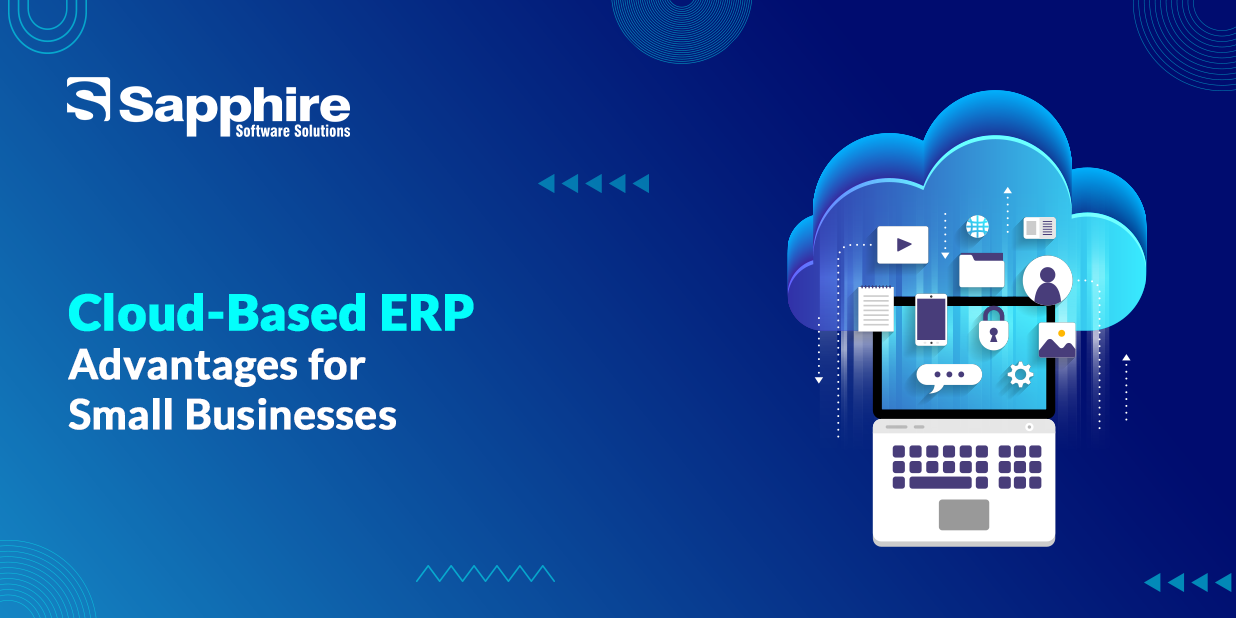
For startups and SMEs, the decision of which ERP to use is usually what separates the ones that grow from those that remain stagnant. Small businesses stand to gain a lot more from cloud-based ERP than just cost savings.
This is probably the single most significant advantage that contributes to the growth of cloud computing. A cloud-based ERP system for a small business runs on a subscription model, thus eliminating the need for a big investment of capital at the start. Small businesses are now able to get access to functionalities that are of a high standard without the necessity of purchasing a server or having a big IT team.
Moreover, the cloud-based ERP system for small businesses is very intuitive. Business owners gain full control over their finances, stock, and sales from wherever they want - be it the office, a business trip, or even at home if they practice remote working.
Automation is definitely a great way to improve productivity. Tasks such as invoicing, tax calculations, payroll processing, and inventory updating are done automatically, thus lessening the chance of human error and saving time.
One critical question that many entrepreneurs come up with is: What is the main advantage of having a cloud-based ERP system for your small business? The answer is very simple - agility. With small businesses being enabled to do this, reaction to market changes, customer demands, and financial situations will be faster, er as they will not be hindered by obsolete systems.
To summarize, cloud ERP offers small businesses the capability to:
- Challenge big corporations
- Work with a smaller number of employees
- Have a better overview of the cash flow
- Provide better customer service
- Make informed decisions based on data
Cloud ERP Efficiency for Large Enterprises:
While small businesses have the advantages of being affordable and agile, large enterprises can leverage scale, control, and performance. With a Cloud-Based ERP System, big companies can effectively manage complex operations spread over multiple regions, departments, and business units.
One of the significant advantages is the use of centralized data for worldwide locations. No matter if the business is spread over different countries or even continents, cloud ERP is the solution that makes sure all business data is integrated into one single system.
The next advantage is top-notch security and compliance. The major cloud ERP platforms secure their systems with a variety of measures, including encryption, multi-factor authentication, data backups, disaster recovery, and compliance with regulations. These security measures are often much stronger than what most enterprises can achieve internally.
Automation can also be elevated to new heights in large organizations. Tasks like high-volume transactions, payroll for thousands of employees, compliance reporting, and supply chain coordination become drastically more efficient.
Large-scale organizations also benefit from the cloud-based ERP advantages, such as:
- Swift implementation across various international offices
- Decreased demand on the IT infrastructure
- Better system uptime and availability
- More advanced business intelligence and forecasting
Such a level of control and efficiency across the entire enterprise is what positions cloud ERP at the core of digital transformation.
Cloud-Based ERP vs Web-Based ERP Systems:
Many businesses confuse cloud ERP with a web-based ERP system, but they are not the same. Both can be accessed through the internet; however, their architecture and functionality are drastically different.
A web-based ERP system is usually set up on private servers or third-party hosting environments. Even though users can access it through a browser, the system still needs to be updated manually, maintained, and the servers managed by the business or a hosting provider.
On the other hand, a Cloud-Based ERP System is designed on a real cloud infrastructure like AWS, Azure, or Google Cloud. It provides features like dynamic scaling, automated updates, built-in disaster recovery, and global load balancing.
Where else to find the biggest differences? The cost structures of the two are very different. Web-based ERP is normally tied with quite substantial upfront setup and customization fees. Cloud ERP is a subscription-based service, and thus, pricing is more or less the same every month.
Once again, security is a factor that differentiates them. Cloud ERP providers embrace cybersecurity compliance standards and invest heavily in their security infrastructures, whereas web-based systems rely largely on the security measures implemented by the organization.
In short:
- Web-based ERP = browser access + traditional hosting
- Cloud ERP = cloud-native + scalability + automation + continuous updates
Cloud ERP is the best option for modern enterprises with a long-term ROI and the need for flexibility.
Role of ERP Software Development Services in Cloud ERP:
These services are the ones that make sure that cloud ERP solutions are not only customized but also integrated and optimized for business workflows.
ERP development services are instrumental in the organization's capability to:
- Customize different modules for finance, HR, supply chain, manufacturing, and sales
- Incorporate ERP with CRM, BI tools, eCommerce platforms, and mobile apps
- Data migration from legacy systems in a secure manner
- Develop personalized reporting and dashboard systems
- Set up automation workflows
- Help the business comply with regulatory requirements
For instance, a manufacturing company might need production planning and quality control modules that are exceptionally customized. A retail business could require real-time inventory management along with POS integration. Standard ERP platforms cannot meet such demands unless they are professionally customized.
This is exactly the reason why picking up ERP Software Development Services of the highest quality is the way to make sure that your cloud ERP is not merely operational but is, in fact, strategically supporting your business objectives.
Why Sapphire Should Be Your Trusted ERP Development Company for Cloud ERP System?
Finding the right ERP Development Company should be among the most important things you need to consider on your digital transformation journey. Sapphire Software Solutions is a trusted leader that stands out in providing secure and business-specific cloud ERP solutions.
Sapphire has the experience of building, customizing, and deploying cloud-based ERP systems across different industries—manufacturing, healthcare, finance, logistics, education, retail, and enterprises.
These are the reasons why companies rely on Sapphire:
- We offer a complete range of ERP services extending from business analysis and solution architecture to development, migration, deployment, training, and support after the launch.
- Sapphire is a cloud-native ERP development specialist who guarantees scalability, performance, and security to the highest degree.
- The team is acquainted with both cloud-based ERP Solutions and industry-specific workflows, thus enabling them to make accurate adjustments without a compromise in system stability.
- Sapphire has different engagement models that are cost-effective and are suitable for startups, SMBs, and large enterprises.
Most importantly, Sapphire is not just producing software; it is producing long-term digital efficiency and business outcomes that can be measured.
Conclusion:
Investing in a cloud-based ERP system is no longer just a technology upgrade—it’s a strategic move that can transform your business operations. From real-time insights and automated workflows to enhanced security and scalability, cloud ERP enables businesses of all sizes to operate more efficiently, make smarter decisions, and stay ahead in a competitive market.
At Sapphire Software Solutions, we don’t just provide ERP software—we deliver customized, industry-specific solutions that align with your unique business needs. Whether you’re a small startup aiming for agility or a global enterprise managing complex operations, our cloud-native ERP solutions ensure performance, reliability, and measurable business outcomes.
Take the next step in your digital transformation journey: connect with Sapphire today for a free ERP consultation or a tailored ERP readiness assessment. Let us help you turn your business challenges into opportunities for growth and efficiency.