
















I watched a founder I work with burn through eight months and most of her seed round last year. Not because the idea was wrong - the market validated it within weeks. The problem was the Software Development Technologies she built on. They worked fine at first. They stopped working at scale. And by the time that became obvious, she’d already missed her window.
That story is more common than people admit. The trending software development technologies you choose don’t just affect your product’s performance - they shape your timeline, your hiring, your costs, and how much optionality you have six months from now. This piece walks through the ones that are moving the needle today, and why they matter if you’re building something that needs to last.
If you’d rather get straight to building, Sapphire is a Top Software Development Company in USA worth reaching out to.
What is Software Development Technology?
Software Development Technology is everything your team uses to build software—the languages, frameworks, tools, and workflows that take an idea and turn it into something people can use. It’s a broad category on purpose, because all of it matters.
The part that most entrepreneurs underestimate is how much these choices affect each other. Within software development and information technology, a mismatch between your frontend and backend can create bottlenecks that take months to diagnose. A workflow that works for a team of five will collapse at twenty. The Software Development Technology Trends worth tracking are the ones that have already been stress-tested by teams who hit those exact problems.
Why IT Entrepreneurs Must Follow Software Development Trends?
I’ve seen this happen enough times to know how it starts. Nobody makes a conscious decision to fall behind on software development and the latest technologies. There’s always something more urgent—a feature to ship, a client to close, a fire to put out. But tech debt accumulates quietly, and one day you’re looking at a stack that your engineers are embarrassed to work in, and competitors are shipping in days what takes your team weeks.
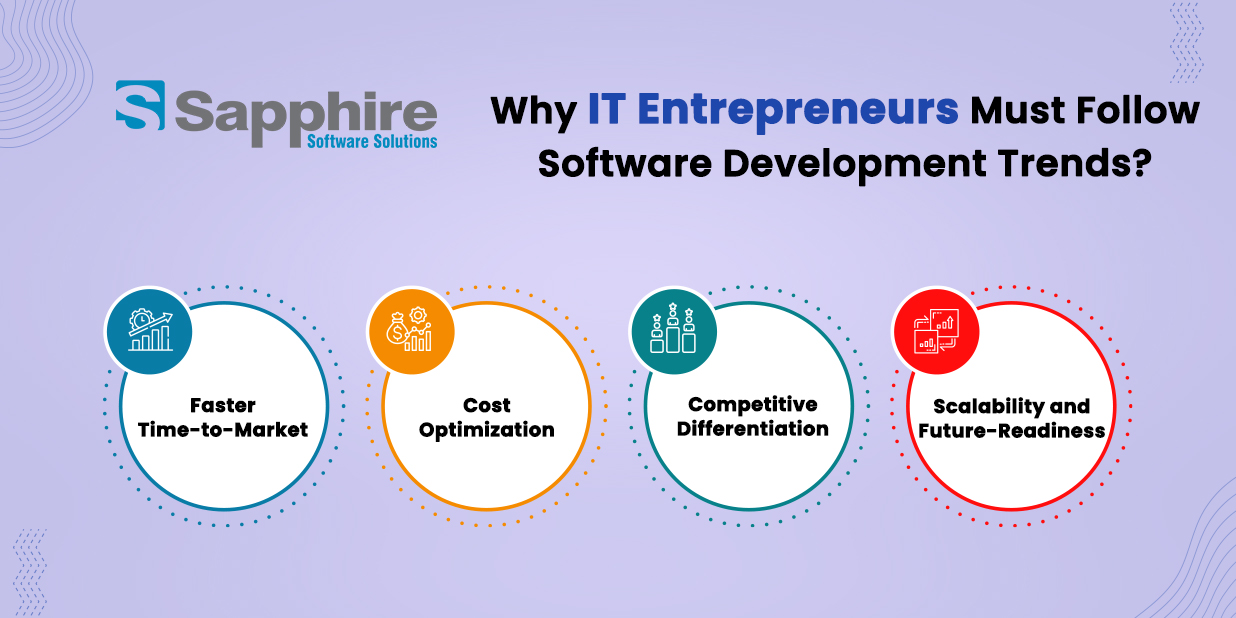
Faster Time-to-Market:
Modern tooling doesn’t just speed up development—it compresses the feedback loop. You ship something, you see how people use it, you adjust. I’ve seen teams cut their release cycle from monthly to weekly just by tightening up their CI/CD setup, and the difference in how fast they learn what users want is dramatic.
Cost Optimization:
A few years ago, running a software team meant paying for infrastructure you barely used half the time. Cloud-native tools changed that. You pay for what you need, when you need it. Add DevOps automation on top of that, and you’re removing entire categories of manual work that used to require dedicated engineers.
Competitive Differentiation:
The right list of software development technologies behind your product creates advantages that compound over time—load times that don’t degrade, security that holds up under scrutiny, experiences that don’t frustrate users into leaving. None of that is visible on day one. All of it shows up by month six.
Scalability and Future-Readiness:
Microservices, cloud-native platforms, distributed architectures; these aren’t buzzwords for the sake of it. They’re the approaches teams adopted after learning, sometimes painfully, that monolithic systems have a ceiling. If you’re building now, building with scale in mind from the start will save you a rebuild later that you really don’t want to do.
Top Trending List of Software Development Technologies:-
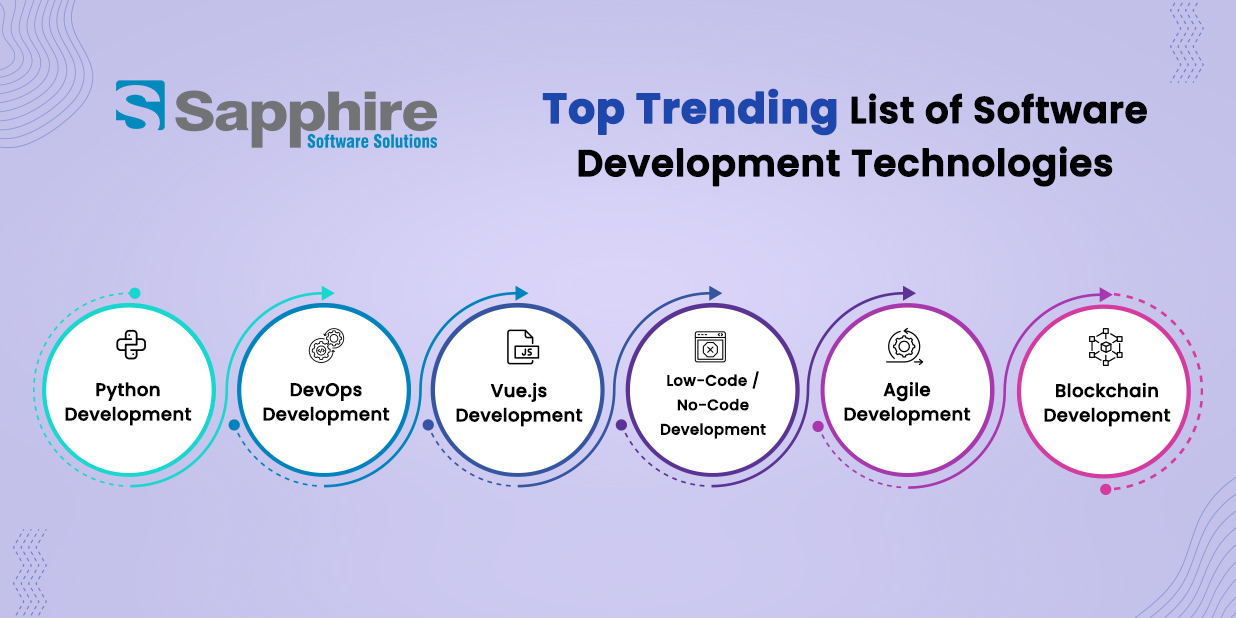
These are the technologies worth understanding right now. Not all of them will apply to your product, but each one is reshaping some part of how software gets built.
1. Python Development:
If you’ve hired a backend engineer in the last two years, there’s a good chance Python was on their resume. It’s taken over more of the development landscape than most people outside the industry realise—not just AI and machine learning, where it dominates, but standard web development too. Django and FastAPI have made it possible to go from concept to working API in days, not weeks. Many companies now rely on Python Development Services to accelerate their projects while ensuring scalable, maintainable code.
2. DevOps Development:
Picture a deployment that goes wrong at 2 am on a Friday. Someone’s pushing a fix, someone else is trying to figure out what broke, and nobody’s entirely sure what’s running in production. That scenario gets a lot less likely when DevOps is set up properly. Automated pipelines, continuous monitoring, infrastructure as code—these are the things that turn chaotic releases into boring, predictable ones. Partnering with a DevOps Development Company can make this process seamless, ensuring your systems are reliable, scalable, and always ready for production.
3. Vue.js Development:
Vue.js is the framework I’d point someone toward if they told me they needed a polished frontend and didn’t want to spend three weeks getting up to speed on a new tool. It’s lightweight, it handles single-page applications well, and the learning curve is genuinely forgiving. It won’t win a popularity contest against React, but for a lot of projects, Vue.js Development Services offer a practical, efficient solution to build responsive, maintainable frontends quickly.
4. Low-Code / No-Code Development:
Low-code and no-code aren’t going to put developers out of work. That’s been the headline for years, and it hasn’t happened, and it won’t. What these platforms do well is let founders and small teams build internal tools and quick MVPs without writing a line of code. I’ve seen companies validate entire business models using no-code prototypes before spending a single dollar on custom development. Partnering with the Best Low-Code / No-Code Development Company can amplify these efforts, providing expert guidance to turn prototypes into scalable, production-ready applications. That alone makes them one of the most underrated entries on any list of software development technologies.
5. Agile Development:
The teams that struggle most with Agile are usually the ones that adopted the label without changing how they work. Stand-ups become checkbox rituals. Sprints become fixed-length waterfalls with a different name. But when a team genuinely builds in small cycles and adjusts based on what they learn, the output is noticeably different—fewer wasted months, tighter alignment between what the business needs and what gets shipped. Partnering with an Agile Development Company can help ensure teams deliver value consistently while staying adaptable to change.
6. Blockchain Development:
Blockchain’s reputation took a hit when the crypto bubble burst, and a lot of people stopped paying attention to it for everything else. That was a mistake worth correcting. In logistics, healthcare, and financial services, it’s solving a problem that’s genuinely difficult to solve any other way: creating shared records that nobody owns but everybody can trust. While it’s not the right tool for most projects, Affordable Blockchain Development Services make it accessible for businesses that want to explore secure, decentralized solutions without breaking the budget.
How Software Development Technologies Are Transforming Businesses?
The companies seeing the biggest shifts right now aren’t the ones with the biggest budgets - they’re the ones using the right Software Development Technologies for their size. Cloud infrastructure means a five-person startup can have the same deployment flexibility as an enterprise. Automation handles monitoring, testing, and scaling without dedicated ops staff. And the data flowing through these systems is starting to drive actual product decisions, not just fill reports that nobody reads. These changes aren’t coming. They’re already the default for teams building smart.
How to Hire Software Developers for Trending Technologies?
The best interview questions I’ve seen for hiring developers aren’t about the tools they already know—it’s about a tool they had to learn fast and how they went about it. When you Hire Software Developers for roles involving software development and the latest technologies, adaptability is worth more than a perfect resume. The developer who figured out a new framework in two weeks will serve you better than the one who’s been on the same stack for five years and hasn’t moved.
If you’d rather skip the trial and error, working with a Beyond Technologies Software Development Company gets you past that stage fast. You get developers who’ve already been tested on real projects, and your team starts shipping instead of onboarding.
Why Sapphire is a Top Software Development Company for Emerging Technologies?
Sapphire built its name as a Top Software Development Company by doing the unglamorous work well - shipping products that held up after launch, working in industries like healthcare and finance where a bug isn’t just a bug, and learning the emerging stacks before clients started asking for them. They’re not the team that’s going to experiment with your budget. If you’re at a point where you need to get the tech right and don’t have time to get it wrong, they’re worth a call.
Conclusion:
The trending software development technologies covered here aren’t going to change overnight, but the gap between teams that understand them and teams that don’t is already wide - and it’s getting wider. You don’t need to master all of them. You need to know enough to make the right call on the next project, and the one after that.
If you’re building something and you want to avoid the kind of costly detours that slow most companies down, start with the right stack and the right people. Sapphire Software Solutions can help with both. Get a free quote and get the conversation going.