
















As AI systems grow in number, complexity, and impact, organizations face challenges around compliance, bias, data privacy, accountability, and operational control. This is where AI Governance becomes not just a safeguard, but a powerful accelerator for responsible growth. In this blog, we’ll explore how governance enables companies to scale AI safely and faster—without slowing innovation—while laying out the groundwork for long-term enterprise success.
What Is AI Governance?
AI governance refers to the policies, processes, standards, and oversight mechanisms that guide how AI systems are designed, deployed, monitored, and improved across an organization.
At its core, governance answers critical questions such as:
- Who is accountable for AI decisions?
- How do we ensure ethical and unbiased outcomes?
- How do we stay compliant with regulations?
- How do we manage risk without blocking innovation?
Rather than being a constraint, effective governance creates clarity. It defines guardrails that allow teams to innovate confidently, knowing there’s a structured way to manage risk, quality, and responsibility.
Think of AI governance like traffic rules in a growing city. Without them, chaos slows everyone down. With them, movement becomes faster, safer, and more predictable.
Why AI Governance Is Critical for Rapid AI Scaling?
Many organizations rush into AI adoption with pilot projects that perform well in isolation. The problems emerge when these pilots need to scale across departments, geographies, and user groups.
Without governance, companies often face:
- Inconsistent AI behavior across teams
- Difficulty tracking models and data lineage
- Regulatory exposure and legal uncertainty
- Loss of trust from customers and employees
- Slower deployment due to rework and approvals
Ironically, lack of governance slows AI adoption, not the other way around.
A well-defined governance approach:
- Eliminates ambiguity in decision-making
- Reduces friction between business, legal, and technical teams
- Enables faster approvals through standardized processes
- Builds confidence among leadership and regulators
Organizations that invest early in governance can move from experimentation to enterprise-wide deployment much faster—because they don’t have to pause every time a new risk appears.
AI Governance Framework: Building a Strong Foundation
A robust AI Governance framework provides the structural backbone for scaling AI responsibly. It ensures consistency, transparency, and accountability across the entire AI lifecycle.
While frameworks vary by organization, strong ones typically include:
- Clear Roles and Ownership: Every AI system should have defined ownership—from data stewards and model developers to business sponsors and risk managers.
- Ethical and Responsible AI Principles: Organizations must define what “responsible AI” means for them, including fairness, explainability, and human oversight.
- Data Governance Alignment: AI is only as good as the data it learns from. Governance frameworks ensure data quality, privacy, and lawful usage.
- Model Lifecycle Management: From development and testing to deployment and retirement, every model should follow standardized processes.
- Continuous Monitoring and Auditing: AI systems evolve. Governance ensures ongoing performance, bias detection, and compliance checks.
By formalizing these elements, companies reduce uncertainty and create repeatable processes that support faster scaling.
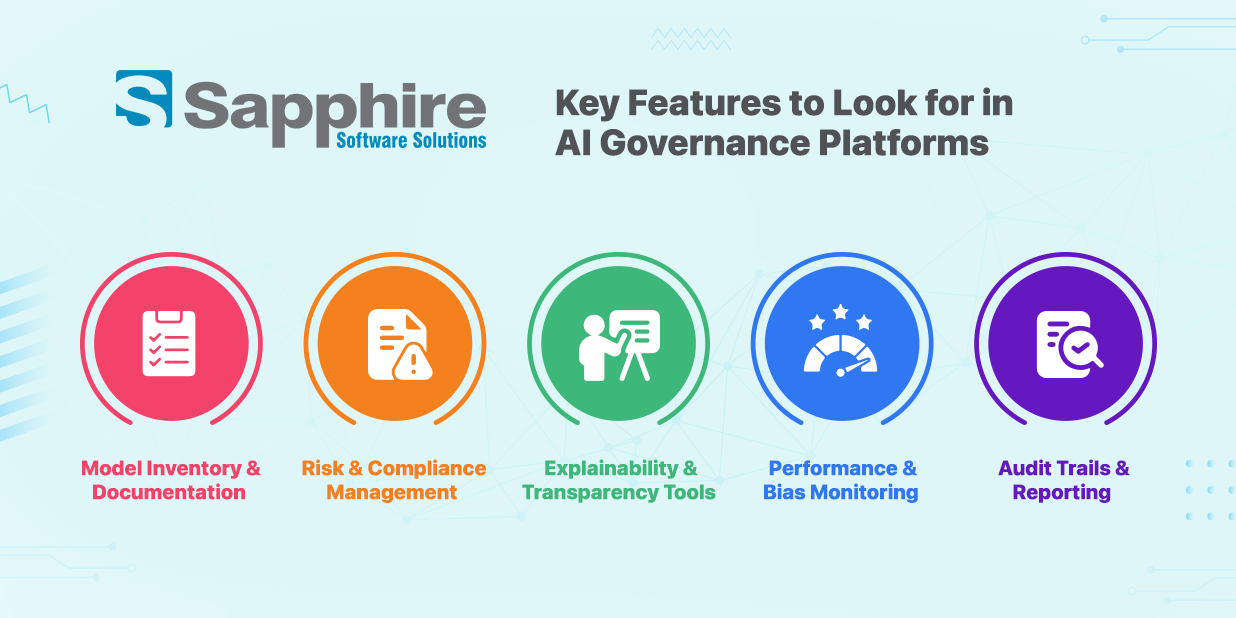
Key Features to Look for in AI Governance Platforms:
As AI ecosystems grow, manual governance becomes impractical. This is where AI Governance platforms play a critical role.
The right platform acts as a centralized control tower, offering visibility and automation across AI initiatives.
Key features to look for include:
- Model inventory and documentation: A single source of truth for all AI models in production.
- Risk and compliance management: Built-in workflows for regulatory checks and approvals.
- Explainability and transparency tools: Insights into how models make decisions.
- Performance and bias monitoring: Real-time alerts when models drift or underperform.
- Audit trails and reporting: Essential for internal reviews and external compliance.
With the right platform in place, governance becomes scalable, repeatable, and far less intrusive for development teams.
Choosing the Right AI Governance Model:
There is no one-size-fits-all AI Governance model. The right approach depends on organizational size, industry regulations, and AI maturity.
Common governance models include:
- Centralized Governance: A single team oversees all AI initiatives. This works well for highly regulated industries, but can slow innovation if overly rigid.
- Federated Governance: Central standards with distributed execution. Business units innovate independently while following shared rules.
- Hybrid Governance: A balanced approach combining central oversight with local flexibility—often the most effective for enterprises scaling AI rapidly.
The key is alignment. Governance should support business goals, not exist in isolation. When governance aligns with strategy, it accelerates adoption instead of blocking it.
How AI Governance Accelerates AI Deployment?
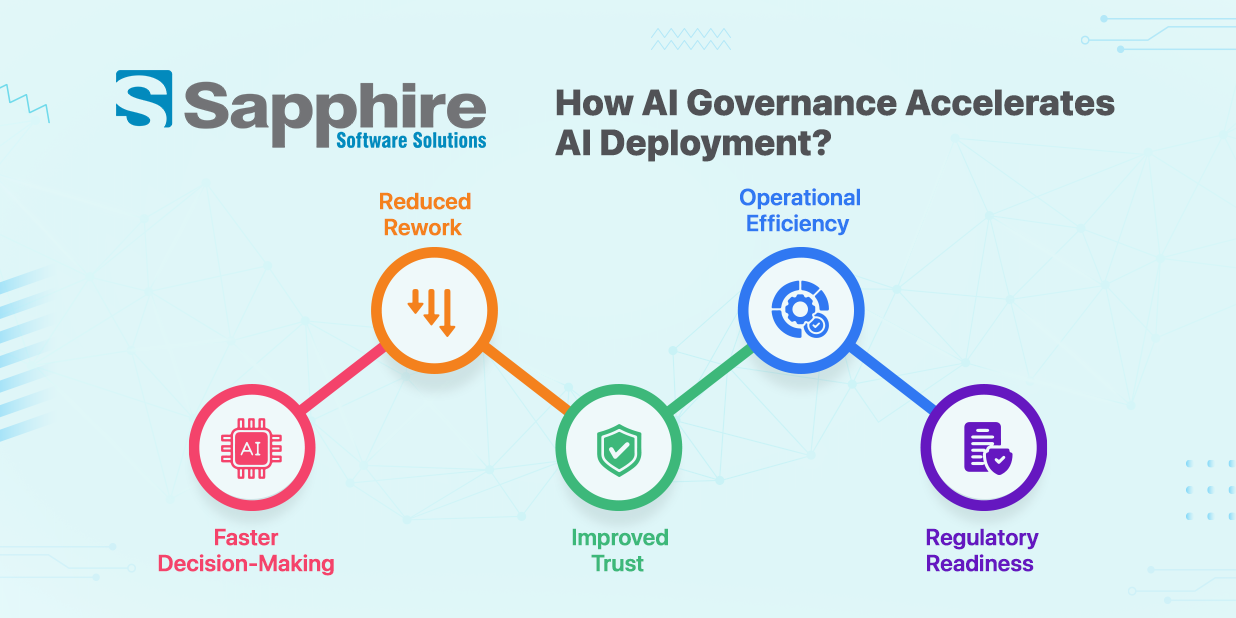
It may sound counterintuitive, but governance is one of the fastest ways to deploy AI at scale.
Here’s how:
- Faster Decision-Making: Clear policies reduce endless debates about risk, ownership, and compliance.
- Reduced Rework: Standardized processes prevent costly redesigns caused by overlooked requirements.
- Improved Trust: When stakeholders trust AI systems, approvals happen faster and adoption increases.
- Operational Efficiency: Reusable templates, tools, and workflows speed up development cycles.
- Regulatory Readiness: Instead of reacting to audits, governed organizations are always prepared.
In short, governance transforms AI deployment from a series of one-off experiments into a scalable production engine.
Future of AI Governance and Enterprise AI Growth:
As AI becomes more autonomous and generative, governance will shift from static rules to adaptive systems.
Future trends include:
- Automated compliance checks embedded into development pipelines
- Continuous risk scoring for AI models
- Stronger alignment with global AI regulations
- Greater focus on explainability and accountability
- Mandatory AI Governance training for technical and non-technical teams
The demand for skilled leadership is also growing, with organizations increasingly relying on an AI Governance professional to bridge technology, ethics, and business strategy.
Companies that invest early in governance will be better positioned to adopt advanced AI capabilities without hesitation or fear.
Why Choose Sapphire as Your Generative AI Development Company for Governed AI Scaling?
Scaling AI responsibly requires more than just technology—it requires experience, structure, and foresight.
Sapphire stands out as a trusted Generative AI Development Company because we embed governance into every stage of AI development. From design and data strategy to deployment and monitoring, we help enterprises innovate with confidence.
Our approach ensures:
- AI solutions aligned with business goals
- Built-in compliance and risk controls
- Transparent and explainable models
- Faster time-to-market without compromising safety
Whether you’re looking to modernize operations, enhance customer experience, or launch new AI-driven products, Sapphire provides the expertise and structure needed for sustainable AI growth. If your organization is ready to scale responsibly, now is the time to hire Generative AI Engineer teams that understand both innovation and governance.
Conclusion:
AI governance is no longer just a compliance checkbox—it’s a strategic accelerator for organizations looking to scale AI safely and efficiently. By implementing clear policies, ethical standards, and structured oversight, businesses can reduce risk, build trust, and deploy AI solutions faster without compromising quality or accountability. Companies that embrace governance are better positioned to turn AI experimentation into enterprise-wide impact.
As a trusted Generative AI Development Company, Sapphire helps organizations integrate governance into every stage of AI development. From designing scalable models to ensuring compliance, our expertise enables faster innovation with confidence. Partnering with Sapphire means your AI initiatives are not only cutting-edge but also transparent and aligned with long-term business goals.