
















Artificial intelligence is rapidly becoming one of the most influential technologies, shaping the future of businesses worldwide. From customer support automation and predictive analytics to intelligent software systems and generative AI platforms, organizations are integrating AI into almost every part of their operations. These growing AI Challenges affect not only development teams but also business strategy, customer trust, operational efficiency, and digital transformation initiatives. Organizations that fail to prepare for these obstacles may struggle with poor ROI, inconsistent system performance, security vulnerabilities, and regulatory concerns.
This article explores the biggest AI-related challenges enterprises are expected to face in 2026 and how organizations can overcome them to build sustainable and future-ready AI ecosystems.
Why AI Challenges Matter for IT Leaders?
- One of the most common questions businesses ask today is, What are the Challenges of Artificial Intelligence in real-world implementation? While AI creates opportunities for automation, innovation, and smarter decision-making, it also introduces several technical and operational difficulties that organizations must manage carefully.
- One of the primary reasons AI-related issues matter is that these systems directly impact business outcomes. If AI models generate inaccurate predictions or biased recommendations, businesses may face operational failures, compliance problems, or damaged customer trust. Even minor implementation mistakes can create large-scale consequences.
- Another challenge is the rapid evolution of AI technology. New models, automation tools, frameworks, and platforms emerge constantly. IT departments must adapt quickly while maintaining stability across existing enterprise systems. This creates pressure to modernize infrastructure without disrupting ongoing operations.
- As AI adoption grows, leadership teams must balance innovation with responsibility. Enterprises that successfully manage AI complexity will be better positioned to remain competitive in the future digital economy.
The Biggest AI Challenges in 2026 for Enterprises:
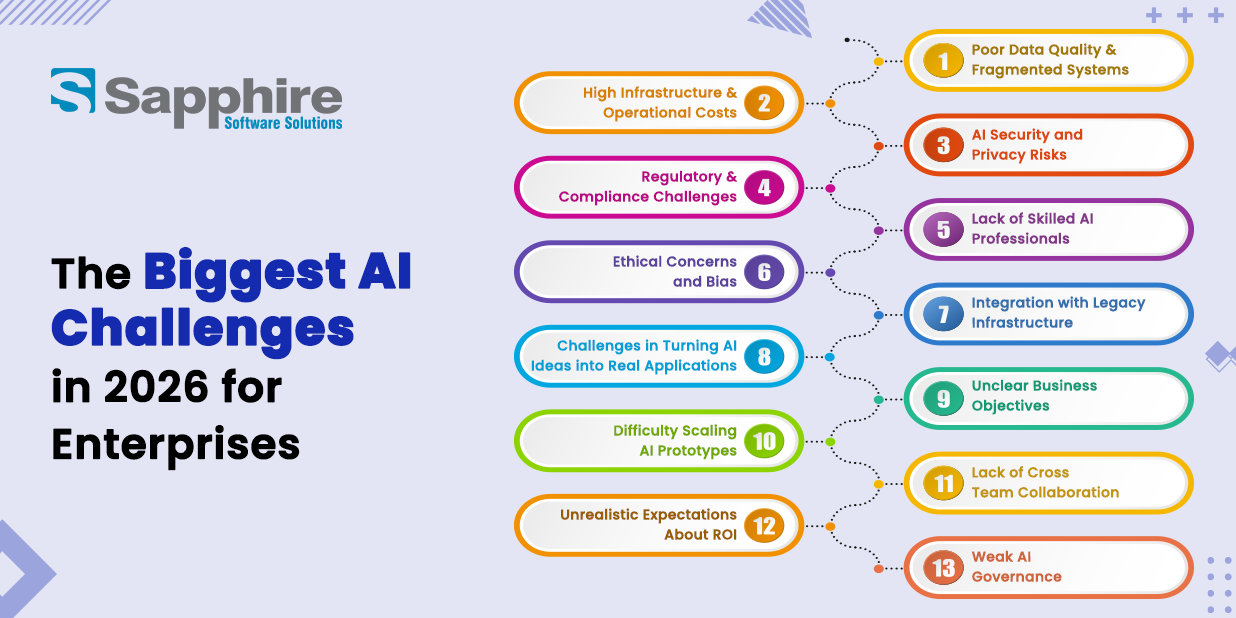
As businesses scale out their AI initiatives, several major concerns are expected to dominate enterprise technology discussions. These Challenges in AI Development will impact organizations across industries.
Poor Data Quality and Fragmented Systems:
AI systems rely heavily on accurate, structured, and high-quality data. Unfortunately, many enterprises still operate with disconnected databases, inconsistent records, and outdated information systems.
High Infrastructure and Operational Costs:
Enterprise AI systems require substantial computing resources. Training large models, managing cloud infrastructure, and maintaining scalable environments can become extremely expensive. Many organizations initially assume AI will reduce costs immediately, but long-term operational expenses often exceed expectations.
AI Security and Privacy Risks:
AI applications process large volumes of sensitive business and customer data. This creates new cybersecurity vulnerabilities that traditional security frameworks may not fully address. Threats such as prompt injection, model manipulation, and unauthorized data exposure are becoming increasingly sophisticated. Businesses must strengthen AI security measures to protect enterprise systems effectively.
Regulatory and Compliance Challenges:
Governments worldwide are introducing stricter AI regulations focused on transparency, fairness, and accountability. Organizations must ensure their AI systems comply with evolving legal standards. Failure to follow compliance requirements can lead to legal risks, financial penalties, and reputational damage. Enterprises need governance strategies that support responsible AI adoption.
Lack of Skilled AI Professionals:
Demand for experienced AI engineers, machine learning specialists, and prompt experts continues to exceed supply. Companies are struggling to recruit qualified talent capable of building and managing enterprise-grade AI systems. This skill shortage increases hiring costs and slows innovation. Many businesses are now focusing on internal training programs to close capability gaps.
Ethical Concerns and Bias:
AI models can unintentionally produce biased or discriminatory outcomes if training datasets contain imbalances or inaccuracies. This creates serious ethical and reputational concerns for organizations. Businesses must continuously monitor outputs and implement responsible AI frameworks to ensure fairness and transparency across automated systems.
Integration with Legacy Infrastructure:
Many enterprises still depend on outdated systems that were never designed for AI integration. Connecting modern AI platforms with legacy environments often becomes technically difficult and time-consuming. Without proper architecture planning, AI implementation can create operational inefficiencies instead of improving productivity.
Challenges in Turning AI Ideas into Real Applications:
Many businesses have ambitious AI visions but struggle when moving from experimentation to production-ready deployment. These Challenges in developing AI Application projects often emerge because organizations underestimate implementation complexity.
Unclear Business Objectives:
Some companies adopt AI simply because it is trending rather than identifying a specific operational problem to solve. Without measurable goals, projects lose direction quickly. Successful AI initiatives always begin with clearly defined business outcomes and realistic expectations.
Difficulty Scaling AI Prototypes:
AI prototypes may work effectively in small test environments but fail during enterprise-scale deployment. Performance bottlenecks, infrastructure limitations, and inconsistent datasets often emerge as systems grow. Scalable architecture planning is essential from the earliest stages of development.
Lack of Cross-Team Collaboration:
AI adoption affects multiple departments, including operations, IT, customer service, compliance, and management teams. Poor communication between departments slows implementation and creates operational friction.
Unrealistic Expectations About ROI:
Many organizations expect AI to deliver immediate returns without recognizing the need for continuous optimization and monitoring. In reality, AI systems improve gradually over time. Businesses that approach AI as a long-term investment typically achieve more sustainable results.
Weak AI Governance:
Without governance frameworks, AI systems can create security, ethical, and operational risks. Organizations need policies for data usage, model validation, transparency, and accountability. Strong governance helps ensure consistent and responsible AI deployment.
How AI Is Changing Traditional Software Development?
Artificial intelligence is transforming modern software engineering workflows in several important ways. Development teams increasingly rely on intelligent systems to automate repetitive tasks, improve productivity, and accelerate delivery cycles.
One major transformation involves AI-assisted coding. Intelligent coding platforms can generate boilerplate code, suggest improvements, identify vulnerabilities, and automate repetitive programming activities. This allows developers to focus more on architecture and innovation.
Despite these advancements, organizations still face What are the Challenges in Software Development when integrating AI into engineering processes. Teams must ensure code quality, maintainability, and security while collaborating effectively with AI-generated outputs.
Another challenge is dependency on automation. Developers still need to validate AI-generated code carefully to avoid introducing vulnerabilities or architectural inconsistencies. Human expertise remains essential even in highly automated development environments.
What Are the Challenges in Product Development Using AI?
Artificial intelligence is reshaping product innovation across industries. However, businesses continue facing several What are the Challenges in Product Development when integrating AI into customer-facing products and enterprise solutions.
Rapidly Changing Customer Expectations:
AI innovation evolves quickly, causing customer expectations to shift constantly. Features that appear advanced today may become outdated within a short period.
Businesses must continuously improve products to remain relevant and competitive.
Balancing Innovation and Simplicity:
Some organizations focus too heavily on advanced AI functionality while neglecting usability. Overly complex products can confuse users and reduce adoption rates.
Successful AI products combine intelligent capabilities with simple and intuitive experiences.
Continuous Data Dependency:
AI-powered products depend heavily on ongoing data collection and analysis. Without strong data pipelines, predictive features and personalization capabilities become unreliable.
Managing high-quality data remains essential for long-term product success.
Bias and Reliability Issues:
Bias in AI systems can negatively impact user experiences and damage brand reputation. Organizations must continuously audit and monitor outputs to ensure fairness and reliability.
Regular testing helps reduce risk and improve customer trust.
Long-Term Maintenance Requirements:
Unlike traditional software, AI-powered systems require continuous retraining, monitoring, and optimization. Models evolve and must adapt to changing business conditions.
Organizations need long-term support strategies to maintain performance and scalability.
How IT Leaders Can Overcome AI Challenges?
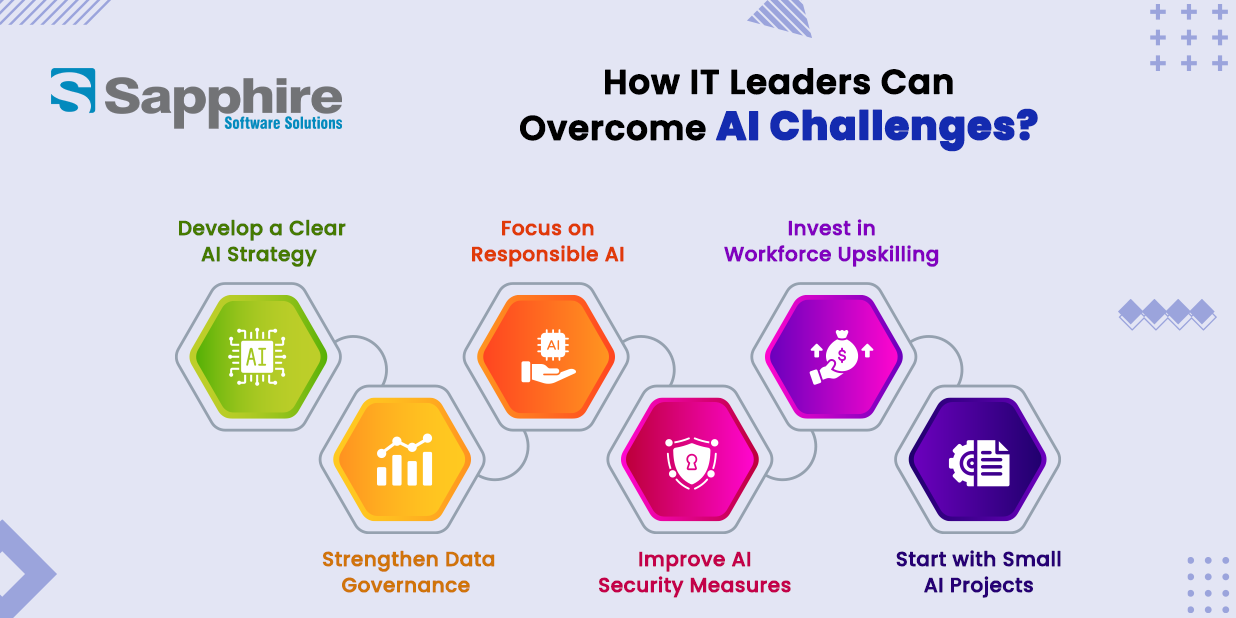
Although AI introduces significant complexity, organizations can overcome these issues through strategic planning and structured implementation practices.
Develop a Clear AI Strategy:
AI initiatives should align with measurable business goals. Every implementation must solve a specific operational challenge or improve customer experience.
Clear KPIs help organizations evaluate performance and measure long-term value.
Strengthen Data Governance:
High-quality data remains the foundation of reliable AI systems. Businesses should establish strong governance frameworks for data collection, storage, privacy, and accessibility.
Structured data management improves scalability and system accuracy.
Focus on Responsible AI:
Organizations must prioritize transparency, fairness, and accountability when deploying AI systems. Ethical governance frameworks help reduce bias and improve trust.
Responsible AI practices also support regulatory compliance.
Improve AI Security Measures:
AI-specific cybersecurity strategies are becoming increasingly important. Enterprises should protect models, datasets, APIs, and automation systems from emerging threats.
Continuous monitoring helps identify vulnerabilities before they impact operations.
Invest in Workforce Upskilling:
Businesses should train internal teams on AI technologies, automation platforms, and governance practices. Building internal expertise improves long-term adaptability and reduces hiring dependency.
Start with Small AI Projects:
Instead of attempting large-scale transformation immediately, organizations should begin with focused AI use cases.
Smaller implementations provide valuable insights while reducing operational risk during early adoption phases.
Why Businesses Choose Sapphire, an Artificial Intelligence Development Company, for AI Implementation?
As enterprise AI adoption becomes more complex, businesses increasingly seek trusted technology partners capable of guiding successful implementation strategies. Sapphire has established itself as a reliable Artificial Intelligence Development Company by helping organizations navigate AI transformation effectively.
Sapphire Software Solutions focuses on building scalable, secure, and business-oriented AI solutions tailored to industry-specific requirements. Rather than applying generic systems, the company develops customized AI strategies aligned with organizational goals and operational needs.
One of Sapphire’s key strengths lies in its structured implementation methodology. From data preparation and infrastructure planning to deployment and optimization, every stage is carefully managed to ensure reliability and long-term scalability.
By combining technical expertise with strategic business acumen, Sapphire helps organizations implement AI with confidence and achieve sustainable digital growth.
Conclusion:
Artificial intelligence will continue transforming industries throughout 2026 and beyond. However, alongside innovation comes a growing set of technical, operational, ethical, and financial challenges that enterprises must address carefully. From infrastructure costs and security vulnerabilities to scalability issues and governance concerns, organizations face an increasingly complex AI landscape that demands strong leadership and strategic planning.
The future belongs to businesses that can balance innovation with responsibility, automation with oversight, and rapid transformation with long-term stability. Organizations that approach AI strategically today will be better prepared to lead tomorrow’s digital economy. Contact us Today to get a free quote.