
















Artificial intelligence has moved from being a futuristic concept to a practical business tool that is actively reshaping industries. Among the most talked about advancements are Large Language Models (LLMs) and Generative AI systems. While these terms are often used interchangeably, they are not the same thing. Understanding their distinction is critical for companies that want to invest wisely in AI-driven transformation.
In simple terms, discussions around “what is LLM vs generative AI” usually revolve around scope and capability. One is a subset of the other, but both play unique roles in modern AI ecosystems. Businesses that understand this difference are better positioned to choose the right tools, reduce costs, and scale efficiently.
This blog explores both technologies in depth, compares their capabilities, and explains how organizations can strategically use them for growth and innovation.
What is Generative AI?
Generative AI refers to artificial intelligence systems designed to create new content. This content can include text, images, videos, music, code, and even synthetic data. Unlike traditional AI systems that only classify or predict outcomes, generative models produce original outputs based on patterns learned from large datasets.
At its core, Generative AI Development Company relies on deep learning architectures such as transformers, diffusion models, and generative adversarial networks (GANs). These models learn from massive datasets and then generate outputs that mimic real-world data. Businesses are increasingly adopting generative AI because it reduces manual effort, accelerates content creation, and enhances personalization at scale.
What is an LLM (Large Language Model)?
An LLM is trained in vast amounts of text data from books, websites, articles, and other written content. This training allows it to understand grammar, context, sentiment, and even reasoning patterns in language.
LLMs can perform tasks such as:
- Writing articles and emails
- Answering questions
- Summarizing documents
- Translating languages
- Generating code
- Acting as conversational assistants
Unlike traditional rule-based systems, LLMs do not follow predefined instructions. Instead, they predict the next word in a sequence based on probabilities learned during training. This enables them to produce highly natural and context-aware responses. Modern examples of LLMs include systems like GPT-based architectures, which are widely used in chatbots, virtual assistants, and enterprise automation tools.
LLM vs Generative AI: Core Differences Explained
To clearly understand “llm ai vs generative ai,” it is important to break down their relationships and differences.
Generative AI is the broad umbrella term that includes all systems capable of generating content. LLMs, on the other hand, are a subset of generative AI that focuses exclusively on language-based outputs.
Key Differences Between LLM and Generative AI:
|
Feature |
Generative AI |
LLM |
|
Purpose |
|
|
|
Output Types |
|
|
|
Scope |
|
|
|
Main Function |
|
|
|
Use Cases |
|
|
|
Technology Base |
|
|
When Should a Business Use LLM Solutions?
Businesses should consider LLMs when their primary need revolves around language, communication, or documentation-heavy processes.
Some ideal scenarios include:
- Customer Support Automation: LLMs can power chatbots that handle customer queries 24/7, reducing operational costs and improving response times.
- Content Generation: Marketing teams can use LLMs to create blog posts, social media captions, product descriptions, and email campaigns.
- Knowledge Management: Organizations can deploy LLM-powered internal assistants that summarize documents, answer employee queries, and retrieve insights from large knowledge bases.
- Software Development: Developers can use LLMs to generate code snippets, debug errors, and improve productivity.
- Multilingual Communication: LLMs help businesses translate content and communicate across global markets seamlessly.
Companies that rely heavily on written communication can significantly benefit from LLM integration.
When Should a Business Use Generative AI Solutions?
Generative AI should be used when a business needs creativity, multimedia content, or cross-modal capabilities beyond text.
- Product Design and Prototyping: Generative AI can help designers create product mockups, architectural designs, or fashion prototypes quickly.
- Marketing and Branding: Businesses can generate images, videos, and ad creatives for campaigns without needing large production teams.
- Entertainment and Media: Film studios, gaming companies, and music producers use generative AI to create visuals, sound effects, and immersive experiences.
- Synthetic Data Creation: In industries like healthcare and finance, generative AI can produce synthetic datasets for training models without compromising privacy.
- Personalization at Scale: E-commerce platforms use generative AI to create personalized product recommendations, banners, and visuals for users.
In short, generative AI is ideal when creativity and multimodal output are required.
How do these AI Technologies Impact Business Growth and Efficiency?
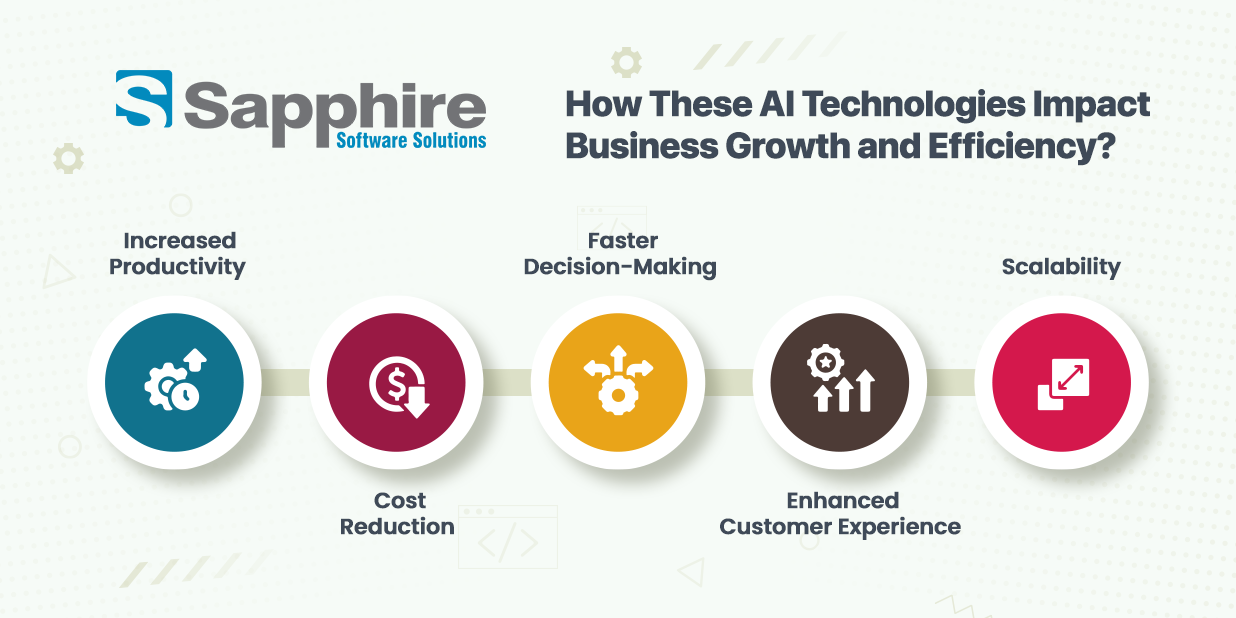
The adoption of both LLMs and generative AI has a direct impact o hours or days can now be completed in minutes. Whether it is writing reports or designing visuals, AI significantly reduces workload.
- Cost Reduction: Companies can minimize expenses related to content creation, customer support, and design by automating repetitive tasks.
- Faster Decision-Making: AI systems can analyze large datasets and provide insights quickly, enabling leaders to make informed decisions faster.
- Enhanced Customer Experience: Personalized interactions powered by AI improve customer satisfaction and engagement.
- Scalability: Businesses can scale operations without proportionally increasing human resources, making growth more sustainable.
Overall, these technologies are not just tools but strategic assets that redefine operational efficiency.
Role of Sapphire as a Generative AI Development Company in LLM and AI Solution Building:
Organizations need expert partners to design and deploy scalable AI systems. A professional Generative AI Development Company plays a critical role in bridging the gap between advanced AI models and real-world business applications.
Companies like Sapphire Software Solutions specialize in building tailored AI solutions that integrate both LLMs and generative AI technologies. As a leading LLM Development Company, Sapphire Software Solutions focuses on creating intelligent systems that understand business context, automate workflows, and enhance communication efficiency.
Their expertise includes:
- Designing custom LLM-powered chatbots
- Developing enterprise-grade generative AI applications
- Integrating AI into existing business systems
- Building multimodal AI solutions for text, image, and video generation
- Ensuring data security and compliance in AI deployments
By leveraging deep technical knowledge and industry experience, Sapphire helps businesses transition from traditional workflows to AI-driven ecosystems. This enables organizations to stay competitive in an increasingly digital world.
Conclusion:
The debate around LLMs and generative AI is not about choosing one over the other, but about understanding how they complement each other. LLMs specialize in language intelligence, while generative AI expands creativity across multiple formats. For businesses, the real value comes from strategically combining both technologies to improve efficiency, automate processes, and unlock new opportunities for innovation and growth.
As AI continues to evolve, companies that adopt these technologies early will gain a strong competitive advantage in customer experience, productivity, and scalability. If you are planning to integrate LLM or generative AI solutions into your business, Sapphire Software Solutions can help you design and implement the right strategy. Get in touch with our experts today to get a free quote and start your AI transformation journey.