
















Modern enterprises are no longer limited by a lack of data—they are challenged by how quickly and effectively they can turn vast, fast-moving information into meaningful business outcomes. Every customer interaction, digital transaction, and connected system continuously generates data, but without the right intelligence layer, most of it remains underutilized.
AI Cloud bridges this critical gap by merging advanced artificial intelligence with the elasticity and scalability of cloud computing. This combination enables organizations to analyze complex datasets in real time, automate decision-making processes, and unlock predictive insights that drive smarter business strategies. When paired with Cloud Integration Services, businesses can seamlessly connect multiple systems, applications, and data sources into a unified ecosystem, ensuring faster operations, improved accuracy, and enhanced enterprise intelligence.
What Is AI Cloud and How It Works in Modern Enterprises?
At its core, AI Cloud refers to cloud platforms that integrate artificial intelligence capabilities with scalable computing infrastructure. Rather than purchasing expensive servers and maintaining complex on-premises systems, businesses access AI-powered resources through cloud environments that offer flexibility, reliability, and continuous innovation.
How AI Cloud Works:
The process typically follows several interconnected stages:
Data Collection:
Information is gathered from multiple business systems including CRM platforms, ERP software, websites, IoT devices, mobile applications, customer interactions, and third-party sources.
Cloud-Based Processing:
Instead of storing data on local servers, information is securely transferred to cloud infrastructure where computing resources automatically scale based on workload requirements.
Artificial Intelligence Analysis:
AI models analyze incoming data to identify patterns, customer preferences, operational bottlenecks, business risks, and future opportunities.
Business Automation:
Based on AI recommendations, automated workflows execute repetitive tasks such as document processing, customer support responses, inventory management, fraud detection, and predictive maintenance.
Continuous Learning:
Unlike static software, AI models improve continuously as new business data becomes available, increasing accuracy, and delivering better recommendations over time.
Role of AI Cloud in Transforming Enterprise Data Management:
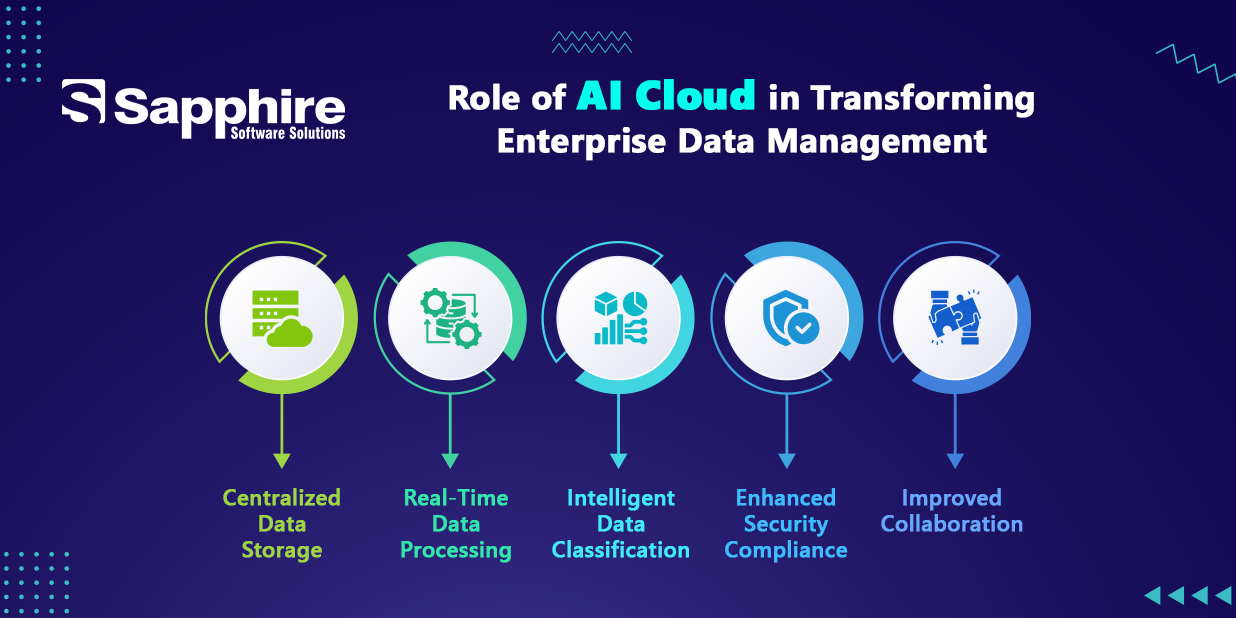
Data has become one of the most valuable business assets. However, simply collecting information does not create value. This is where,
Centralized Data Storage:
Instead of maintaining isolated databases across departments, businesses consolidate information into secure cloud platforms. Employees gain controlled access to consistent, up-to-date information regardless of their location.
Real-Time Data Processing:
AI-enabled cloud platforms process incoming information immediately rather than waiting for scheduled reports. Business leaders receive real-time dashboards that reflect current operational performance, customer behavior, and market trends.:
Intelligent Data Classification:
Artificial intelligence automatically categorizes documents, customer records, financial transactions, images, and business files. This reduces manual organization while improving search accuracy and accessibility.
Enhanced Security and Compliance:
Modern cloud environments include intelligent threat detection, automated security monitoring, encryption, identity management, and compliance controls. AI continuously monitors unusual activities, helping organizations respond quickly to potential cybersecurity threats.
Improved Collaboration:
Cloud-based data management allows employees across different departments and geographic locations to collaborate using the same information. Teams can access updated reports, dashboards, and documents without worrying about version control or data inconsistencies.
How AI Cloud Enables Intelligent Automation Across Business Processes?
Businesses today are under constant pressure to deliver faster services, reduce operational costs, and improve customer satisfaction. The combination of AI and cloud technology enables organizations to build intelligent workflows that can analyze information, make decisions based on predefined rules, and continuously improve through machine learning.
Automating Customer Service:
Modern businesses receive thousands of customer inquiries every day through websites, mobile apps, emails, and social media platforms. AI-powered chatbots and virtual assistants can instantly respond to common questions, recommend products, resolve service requests, and escalate complex cases to human agents when necessary.
Streamlining Document Processing:
Organizations handle invoices, purchase orders, contracts, insurance claims, employee records, and compliance documents daily. AI cloud solutions automatically extract information from these documents, classify data, validate entries, and route files to the appropriate departments.
Improving Financial Operations:
Finance departments benefit from intelligent automation by simplifying expense management, invoice processing, fraud detection, budgeting, and financial reporting. AI continuously monitors transactions, identifies unusual activities, and provides real-time insights that help organizations maintain financial accuracy and regulatory compliance.
Enhancing IT Operations:
AI Cloud Computing monitor servers, applications, and networks around the clock. They detect unusual patterns, identify security threats, predict infrastructure failures, and recommend preventive maintenance before problems affect business operations.
AI Cloud for Enterprise Intelligence: Turning Data into Decisions
Organizations generate valuable data every second, but data alone has little value unless it can support better decision-making. A modern AI Cloud Architecture integrates multiple business systems into a unified environment where artificial intelligence continuously analyzes operational data, customer interactions, financial performance, and market trends.
Real-Time Business Dashboards:
Executives no longer need to wait for weekly or monthly reports. AI-powered dashboards provide live performance indicators, allowing decision-makers to respond immediately to changing business conditions.
Predictive Business Forecasting:
Machine learning algorithms analyze historical business data alongside current market conditions to forecast customer demand, sales performance, inventory requirements, and revenue growth. These predictions help organizations make proactive decisions rather than reacting to unexpected situations.
Customer Behavior Analysis:
AI identifies customer preferences, purchasing habits, browsing behavior, and engagement patterns. Marketing teams use these insights to personalize communication, improve customer experiences, and increase conversion rates.
Operational Performance Monitoring:
Business leaders gain visibility into production efficiency, employee productivity, equipment utilization, and workflow performance. AI identifies bottlenecks that may otherwise remain hidden, enabling continuous operational improvement.
Risk Management:
AI continuously evaluates operational risks, cybersecurity threats, financial anomalies, and compliance issues. Early identification allows businesses to minimize disruptions before they escalate into larger problems.
Key Benefits of AI Cloud for Businesses and IT Infrastructure:
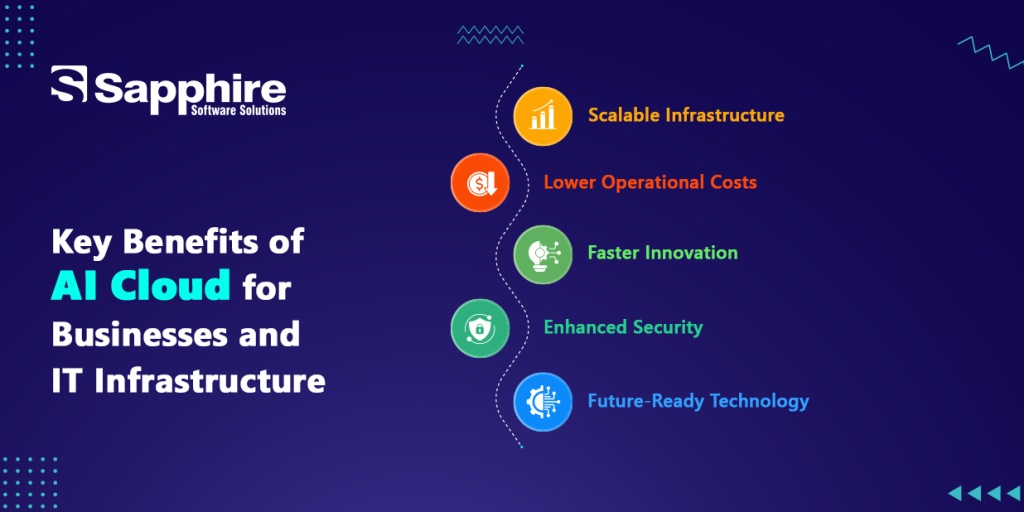
Organizations across industries are adopting AI-powered cloud technologies because they offer measurable business advantages beyond traditional IT systems. Whether supporting startups or global enterprises, intelligent cloud platforms improve flexibility, scalability, and operational performance.
Scalable Infrastructure:
Business requirements constantly evolve. Cloud platforms automatically scale computing resources based on demand, eliminating the need to purchase expensive hardware that may become underutilized during slower periods.
Lower Operational Costs:
Businesses reduce expenses related to infrastructure maintenance, hardware upgrades, energy consumption, and IT administration. Pay-as-you-use pricing models allow organizations to invest only in the resources they actually consume.
Faster Innovation:
Cloud environments provide immediate access to AI services, development tools, analytics platforms, and machine learning capabilities. This accelerates software development, product innovation, and digital transformation initiatives.
Enhanced Security:
Leading AI Cloud Providers implement enterprise-grade security measures including encryption, identity management, automated threat detection, vulnerability monitoring, and disaster recovery capabilities.
Future-Ready Technology:
As artificial intelligence continues to evolve, cloud platforms automatically introduce new features, services, and innovations without requiring businesses to completely rebuild their IT infrastructure.
Companies partnering with an experienced AI Cloud Company gain access not only to advanced technology but also to strategic guidance that ensures successful implementation, integration, and long-term optimization.
Real-World Applications and Industry Use Cases of AI Cloud:
The impact of AI-powered cloud solutions extends far beyond IT departments. Organizations across industries are using intelligent cloud platforms to solve operational challenges, improve customer experiences, and make better business decisions.
Healthcare:
Hospitals and healthcare providers use AI-powered cloud platforms to manage electronic health records, assist in medical imaging analysis, schedule appointments, and monitor patients remotely.
Retail and E-commerce:
Retailers use intelligent cloud platforms to analyze customer purchasing behavior, recommend personalized products, forecast inventory requirements, and optimize pricing strategies.
Banking and Financial Services:
Financial institutions process millions of transactions every day. AI-powered cloud systems help detect fraudulent activities, automate loan approvals, assess financial risks, and provide personalized financial recommendations. These technologies improve both customer experience and regulatory compliance.
Education:
Educational institutions use AI cloud platforms to personalize learning experiences, automate administrative tasks, monitor student performance, and provide intelligent learning recommendations. Teachers gain valuable insights that help improve educational outcomes.
Smart Cities:
Governments and municipalities are implementing intelligent cloud technologies to improve traffic management, monitor public utilities, optimize energy usage, enhance waste management, and strengthen public safety through real-time data analysis.
Future Trends of AI Cloud in Data, Automation, and Enterprise Systems:
The future of enterprise technology will increasingly depend on intelligent cloud ecosystems that combine automation, artificial intelligence, and advanced analytics. As AI models become more sophisticated and cloud infrastructure continues to evolve, businesses can expect even greater levels of automation and decision support.
Generative AI Integration:
Cloud platforms are beginning to integrate generative AI into everyday business operations. Organizations will increasingly use AI to generate reports, summarize meetings, create software code, draft business documents, and assist employees with complex tasks.
Autonomous Business Operations:
Future enterprise systems will automate complete business workflows with minimal human intervention. AI agents will coordinate scheduling, procurement, customer service, financial approvals, and operational planning while continuously optimizing business performance.
Edge AI and Hybrid Cloud:
Businesses with connected devices and IoT infrastructure will combine cloud intelligence with edge computing. Data can be processed closer to its source while maintaining synchronization with centralized cloud systems, reducing latency, and improving response times.
Industry-Specific AI Models:
Cloud providers will continue developing specialized AI solutions tailored to industries such as healthcare, manufacturing, finance, retail, and logistics. These customized models will provide higher accuracy while addressing unique business challenges.
Enhanced Cybersecurity:
Artificial intelligence will play an increasingly important role in detecting cyber threats, preventing attacks, and automatically responding to security incidents before they impact business operations.
Why Businesses Choose Sapphire for AI Cloud and Cloud Integration Services to Drive Digital Transformation?
Successful AI cloud implementation requires more than choosing the right technology. Organizations also need a strategic partner capable of designing scalable architectures, integrating business systems, and ensuring long-term performance.
End-to-End AI Cloud Solutions:
Sapphire delivers complete AI cloud solutions, from strategy and architecture design to deployment, integration, testing, and ongoing support. Every solution is customized to meet industry-specific requirements and future business objectives.
Custom Cloud Application Development:
As an experienced Cloud Application Development Company, Sapphire develops secure cloud applications that improve business efficiency, automate workflows, and support digital innovation across multiple industries.
Seamless System Integration:
Many organizations operate multiple software platforms that do not communicate effectively. Sapphire provides advanced Cloud Integration Services that connect ERP systems, CRM platforms, business applications, databases, and third-party services into a unified ecosystem.
Enterprise Automation Expertise:
Sapphire helps businesses automate repetitive processes using artificial intelligence, machine learning, and intelligent workflows. This reduces operational costs while improving productivity and service quality.
Scalable Digital Transformation:
Whether supporting startups or global enterprises, Sapphire develops cloud solutions that grow alongside business requirements. Organizations can expand operations without rebuilding their technology infrastructure.
Conclusion:
The convergence of artificial intelligence and cloud computing is redefining how modern enterprises operate, compete, and grow. Businesses are no longer relying on fragmented systems or manual decision-making processes—instead, they are adopting intelligent, connected cloud ecosystems that transform raw data into actionable insights, automate critical workflows, and enable faster, more accurate business decisions.
As organizations continue their digital transformation journey, adopting AI-powered cloud solutions is becoming essential for staying competitive in a rapidly evolving market. With the right strategy, architecture, and integration approach, businesses can unlock new levels of productivity and innovation. Sapphire Software Solutions empowers enterprises to achieve this transformation through advanced AI solutions, modern cloud architectures, and seamless system integration capabilities.
Get a Free Quote today and discover how Sapphire Software Solutions can help you build a smarter, scalable, and future-ready digital ecosystem.