

















Most businesses have lived through this at some point: requirements shift mid-project, priorities change, and by the time the software finally ships, it no longer matches what the market needs.
This is the exact problem Agile software development was designed to solve. Instead of committing one rigid plan for months on end, work gets broken into smaller cycles. Teams build, review, adjust, and build again — stay close to the business the whole way through. The results back this up. <cite index="9-1">Agile projects fail only 9% of the time, compared to 29% for Waterfall projects</cite>. <cite index="9-1">Overall, Agile achieves a 64% success rate versus 49% for Waterfall</cite>.
In this article, we'll walk through what Agile means, how it works in practice, and why the right development partner makes all the difference.
What Is Agile Software Development?
Simply put, Agile software development means building software in short, focused cycles rather than one long, uninterrupted push.
A team plans a manageable piece of work, builds it, tests it, gathers feedback, and repeats the process. No one tries to predict every detail six months in advance, because in software, that plan rarely survives in contact with reality.
This changes how teams collaborate day to day. Developers, designers, and business stakeholders stay in ongoing conversation instead of a single handoff followed by months of silence. When priorities shift, and they usually do, the team can adapt without derailing the entire project.
That flexibility is a large part of why <cite index="7-1">Agile teams reach their goals faster and are roughly twice as likely to succeed compared to teams using traditional Waterfall methods</cite>.
What Is Agile Software Development Methodology?
Agile isn't a single set of rules — it's an umbrella term covering several methodologies, each built around the same core idea: iterate, collaborate, and adapt.
- Scrum – the most widely used approach, organizing work into fixed sprints with regular check-ins and reviews.
- Kanban – visualizes work on a board and limits how much is in progress at once, keeping bottlenecks visible.
- Extreme Programming (XP) – emphasizes technical discipline, including pair programming and continuous testing.
- Lean – focused on eliminating anything that doesn't add real value for the end customer.
Most companies don't follow a single framework to the letter. They combine elements based on team size, project complexity, and client requirements.
What matters most isn't the label — it's whether the core principles show through: people over rigid process, working software over excessive documentation, and responsiveness over a fixed plan.
Key Agile Software Development Practices
A methodology only delivers results when it's backed by consistent, disciplined habits. These are the practices that make Agile work in day-to-day delivery:
- Sprint planning – the team commits to a focused, achievable set of goals for the next one to four weeks.
- Daily stand-ups – short check-ins where progress and blockers are surfaced early, before they become larger issues.
- User stories – requirements written from the customer's perspective, keeping the team focused on real value.
- Continuous integration and testing – code is tested and merged frequently, catching issues while they're still inexpensive to fix.
- Sprint reviews and retrospectives – the team presents completed work, gathers feedback, and reflects honestly on what's working.
- Backlog grooming – priorities are reassessed regularly, keeping the team focused on what matters most right now.
Individually, none of these practices are complex. Their real value comes from consistent execution, sprint after sprint, until they become part of how the team naturally works.
Agile Software Development Stages: From Idea to Launch
While Agile avoids a single upfront master plan, the journey from concept to launch still follows a clear structure.
Discovery and envisioning
The team works with stakeholders to define business goals, target users, and overall scope, setting direction without over-specifying details.
Backlog creation
Requirements are translated into user stories and prioritized, with the highest-value and highest-risk items addressed first.
Sprint planning and execution
Work proceeds in short cycles, typically one to four weeks, with each sprint producing a working, testable increment.
Review and feedback
Stakeholders evaluate the product at the end of each sprint and provide input that shapes the next cycle.
Retrospective and adjustment
The team reviews its own process, not just the product, and makes improvements accordingly.
Release and iterate
Features are often released incrementally, allowing the business to realize value and gather real user data sooner.
This cycle continues until the product meets its goals, and in most cases, continues well beyond launch as the software evolves alongside the business.
Key Agile Software Development Benefits for Businesses
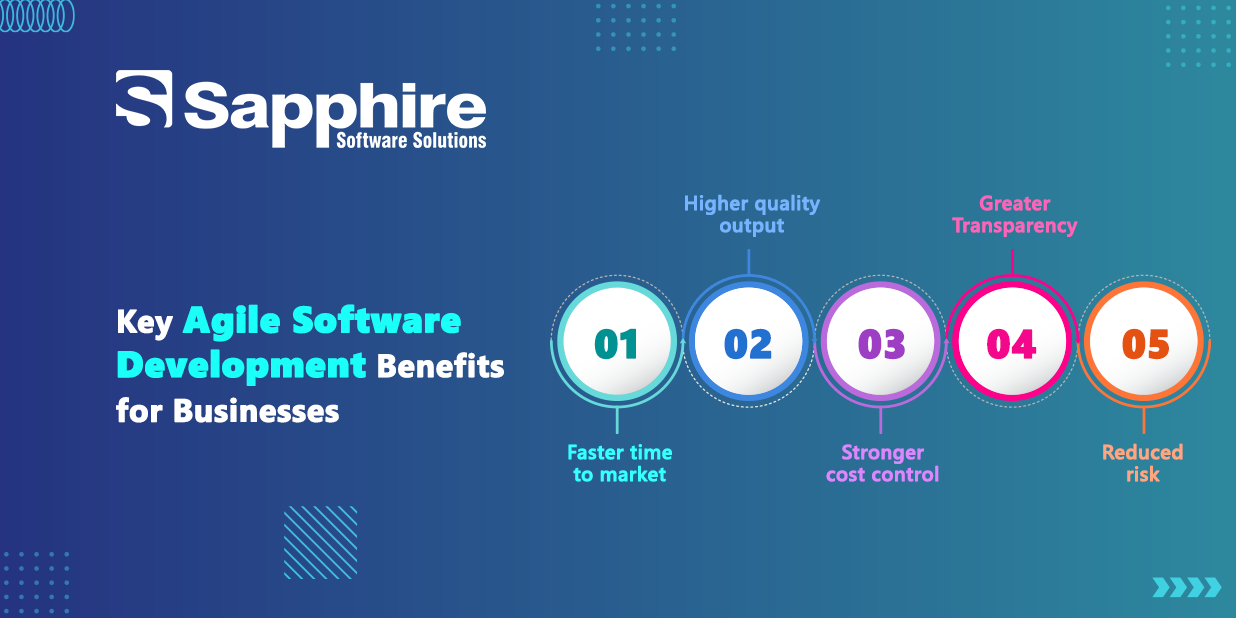
The advantages of Agile are measurable, not just theoretical. Key benefits include:
- Faster time to market
Working features are delivered in weeks rather than waiting for a single large release. - Higher quality output
Continuous testing throughout the process reduces costly, late-stage defects. - Stronger cost control
Regular priority reviews prevent budget from being spent on features that don't deliver value.
- Greater transparency
Clients see consistent progress rather than waiting months for a single reveal.
- Reduced risk
A wrong turn is identified within a two-week sprint rather than after a year of investment.
Collectively, these benefits help businesses build software that stay aligned with real goals throughout development, not just at the outset.
Why Choose Sapphire as Your Agile Software Development Company?
Many companies claim to follow Agile. Fewer apply it with real discipline and consistency.
At Sapphire Software Solutions, sprints are structured around genuine business priorities, not a generic template. Clients maintain visibility into progress at every stage, and feedback loops are short enough that course corrections happen early, before they become costly.
What sets our approach apart is the balance between technical rigor and close collaboration:
- Engineers follow clean coding standards and continuous integration practices to keep releases stable and reliable.
- Product owners and business analysts stay closely aligned with client goals, not just the backlog.
- Our process adapts to each project, rather than forcing every client into the same framework.
Whether working with a startup validating a new idea or an enterprise modernizing a legacy system, as a leading Agile Software Development Company Sapphire tailors its Agile approach to deliver software that reflects what the business needs, when it needs it.
Conclusion
Choosing the right Agile Software Development Services can make a significant difference in how quickly and effectively your business turns ideas into reliable software. With an Agile approach, businesses can reduce development risks, respond faster to changing market needs, improve product quality, and maintain better control over time and costs. At Sapphire, we combine Agile practices, technical expertise, and continuous collaboration to build scalable software solutions that stay aligned with your business goals.
Whether you are launching a new product, modernizing an existing application, or looking to improve your software development process, Sapphire can help you move from idea to implementation with confidence. Ready to build better software with an Agile approach? Get a Free Quote from Sapphire Software Solutions today and let’s discuss how we can turn your business requirements into a high-quality solution.