
















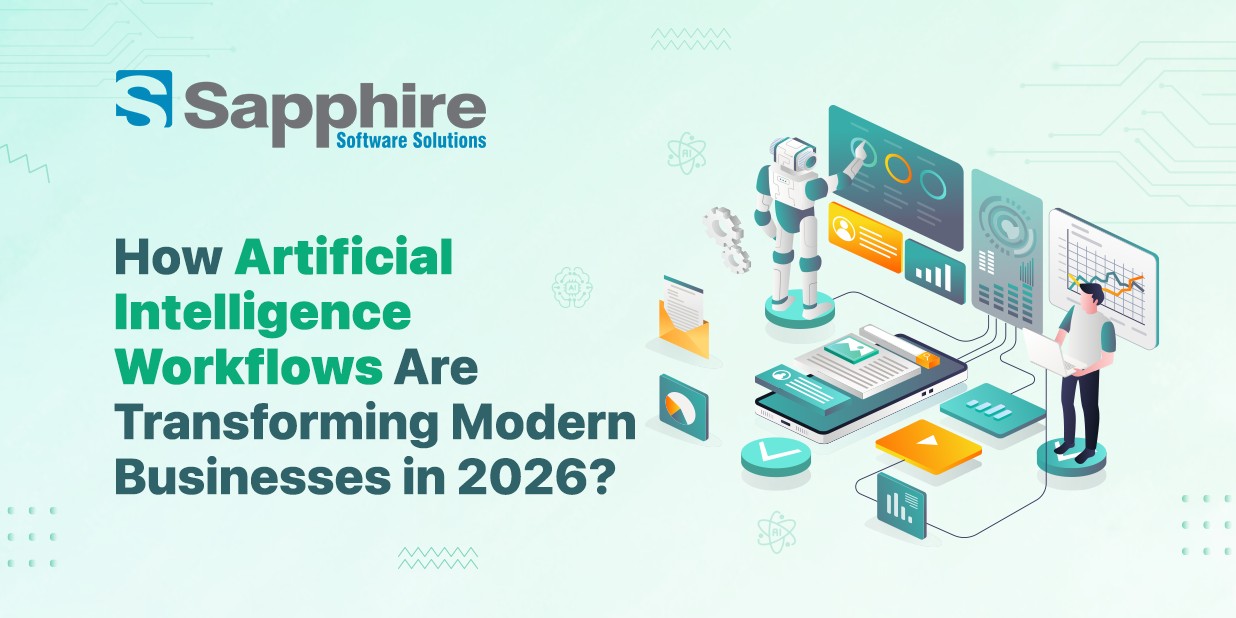
In 2026, the question for forward-thinking enterprises is no longer whether to adopt artificial intelligence, but how strategically and deeply embed it into core business operations. The real transformation lies in AI-powered workflows—intelligent systems that seamlessly connect people, enterprise applications, data sources, and decision-making processes into a unified, self-optimizing ecosystem. Unlike traditional automation tools that operate in silos, modern AI workflows continuously learn from real-time data, adapt to changing conditions, and drive end-to-end process optimization. As an emerging AI Solutions Company, Sapphire recognizes that businesses leveraging intelligent workflow automation gain measurable advantages in efficiency, accuracy, scalability, and competitive positioning.
Today’s organizations operate in fast-paced, globally connected, and highly complex markets where manual processes and rule-based automation simply cannot keep up. AI workflows empower businesses to shift from reactive operations to predictive and proactive decision-making. Across industries—including finance, healthcare, manufacturing, retail, logistics, and SaaS—companies are reducing operational bottlenecks, minimizing human error, and accelerating approvals through AI-driven workflow automation. By integrating advanced analytics, machine learning, and intelligent decision engines, an experienced AI Solutions Company can help enterprises transform fragmented processes into agile, data-driven systems that deliver higher productivity, improved customer experiences, and sustainable growth.
What Are Artificial Intelligence Workflows?
To grasp the effects of Artificial Intelligence Workflows, it is necessary to move beyond traditional automation. An AI workflow is a structured process of tasks, decisions, and actions driven by AI models, not by predefined rules. Unlike traditional workflows, which are static and do not change, AI workflows learn from data and adapt their processes according to the results. It is a combination of machine learning models, data pipelines, business logic, and automation tools in one intelligent process. For instance, instead of just routing a support ticket based on keywords, an AI workflow evaluates support ticket sentiment, urgency, customer history, and the predicted resolution time before determining the next course of action.
The reason why AI workflows are so effective is that they can deal with complexity and uncertainty. Traditional automation is based on “if-then” logic. AI workflows, on the other hand, identify patterns, predict outcomes, and adapt dynamically. This makes them perfect for environments that are subject to rapidly changing conditions, such as customer service, supply chain management, fraud detection, and sales operations.
Another key feature of AI workflow is the concept of feedback loops. Each step taken by the workflow results in the creation of data, which is in turn, used to improve the decision-making process. This results in smarter, faster, and more accurate processes over time.
What Is Automation in AI?
To understand the full potential of AI workflows, an understanding of the definition of automation in AI must be established. As indicated by its definition above, automation primarily describes the use of artificial intelligence to carry out tasks, to make decisions, and/or to make process improvements through minimal human input with continual learning from data.
Automated processes that are considered traditional depart primarily focus on efficiency of tasks through predictable repetition. They automate tasks that are repetitive and rule-based, such as transferring files and data entry. AI automation provides the same level of predictability as traditional automations do; yet AI automation allows for the introduction of intelligence into the objective. AI automation is capable of processing ambiguity and utilizes machine learning techniques to analyze patterns and make decisions based on probability rates instead of following static instructions.
In answering the question posed by many organizations about what automation in AI is, the response will be adaptability. An AI automation system will improve its performance as it continues to learn from outcomes and detect pattern anomalies in data; thus, continuously changing its workflow based on changes in input. For instance, an AI based approval process will learn the historical rate of approvals versus rejections for types of requests submitted and will accordingly route requests to either the (but typically) rejected queue or the (and typically the) approved queue.
AI in Workflow Automation: How It Works
To comprehend AI Work Automation, it is essential to view the integration of three distinct elements – Data (or information), Intelligence, and Execution – as one cohesive entity. At its primary level, AI-based work automation utilizes a continuous cycle of data ingestion and analysis, decision-making, execution, and learning.
The initial phase of AI-based workflows is the collection of data. Workflows pull their collected data from many different sources, including customer interactions, transactional systems, devices, logs, documents, and application programming interfaces (APIs). This data serves as the basis for making intelligent decisions.
The second phase is analyzing the data. AI-powered workflows utilize AI models to analyze and interpret incoming data to determine patterns, classify types of information, estimate potential outcomes, and assess risks.
The final phase of AI workflows is learning. AI workflow systems will continuously monitor the results of their actions by feeding information back into the AI model. Over time, the workflows will be more precise and effective and continue to improve their respective performance.
Key Components of AI-Based Workflow Automation:
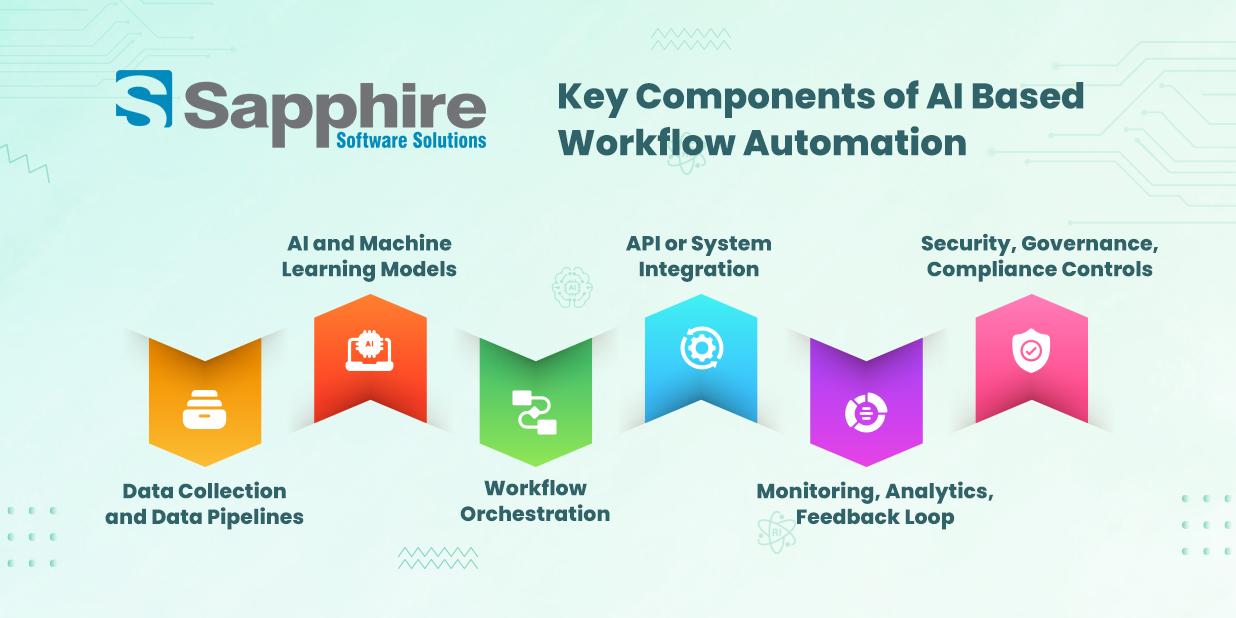
A collection of interconnected components drives successful AI workflow automation through collaboration. These components form intelligent, adaptable, and scalable workflows. Every piece contributes to the successful delivery of automations with tangible returns to the business rather than merely improving efficiencies in isolation.
1. Data Collection and Data Pipelines:
The backbone of any AI workflow is data. AI automations are developed with continual data input from a multitude of sources, including CRM systems, ERP systems, customer interactions, sensors, documents, emails, and APIs.
2. AI and Machine Learning Models:
AI workflow models typically incorporate text-based workflows using Natural Language Processing (NLP), forecasting using predictive models, or risk management through anomaly detection. These models become increasingly "smarter" over time due to experience through continual learning.
3. Workflow Orchestration:
Workflow orchestration applies to the appropriate order to achieve the desired outcome. This gives an organization the ability to manage its workflow as a series of tasks with dependencies, together with providing a means to handle exceptions in the execution of the workflow and automate workflows based on changing conditions.
4. API or System Integration:
AI workflows will have to regularly communicate and work together between existing enterprise systems (CRMs, ERPs, cloud-based platforms, tools for analysis, and third-party service providers).
5. Monitoring, Analytics, Feedback Loop:
Continuous Monitoring of a workflow creates a method for measuring the performance, accuracy, speed, and results of each workflow. Additionally, there should be a feedback loop process for feeding the results of every workflow back into the AI models that implement the workflows, enabling the AI to continuously improve and optimize over time.
6. Security, Governance, Compliance Controls:
Enterprise-grade AI workflows will require role-based access control, audit trails, encryption, and compliance monitoring to ensure enterprise systems can maintain a secure, transparent, and compliant workflow when they are processing transactions.
Benefits of Implementing Artificial Intelligence Workflows:
The execution of Artificial Intelligence Workflows provides business value that extends beyond mere efficiency improvements.
- Speed of operations is one of the most significant benefits of AI workflows. AI workflows complete tasks in seconds that would take hours or days to complete manually. This enables faster decision-making and response times.
- Another significant benefit of AI workflow is cost savings. AI workflows automate decision-intensive and repetitive tasks, reducing labor and operational costs for businesses.
- Scalability is also improved by AI workflows. Businesses can scale to meet growing demands without necessarily adding more staff, making scalability more feasible.
- Employee productivity is also increased by AI workflows. Employees have more time to focus on business initiatives rather than routine tasks.
- From a customer service perspective, AI workflows enable faster service, personalization, and proactive engagement, resulting in increased customer satisfaction and loyalty.
- AI workflows enable businesses to make informed decisions. Continuous learning and monitoring enable businesses to make recommendations based on data insights.
These benefits make AI for workflow optimization a business imperative for contemporary enterprises in 2026.
How to Get Started with AI Workflow Automation in Your Business?
To begin with, AI workflow automation requires the selection of the right use cases. Enterprises should target processes that are repetitive, data-intensive, and often delayed or error-prone.
Secondly, it is necessary to evaluate data readiness. Well-organized and well-structured data is a prerequisite for the success of AI. Spending data governance from the very start has long-term benefits. It is important to select the right tools and partners. Enterprises can benefit from Workflow Automation Software Development professionals to develop efficient AI workflows. Pilot projects are also important. Enterprises should begin with a small and impactful workflow, analyze the outcome, and then scale up.
Why Sapphire Is the Preferred AI Solutions Company for AI Workflow Automation?
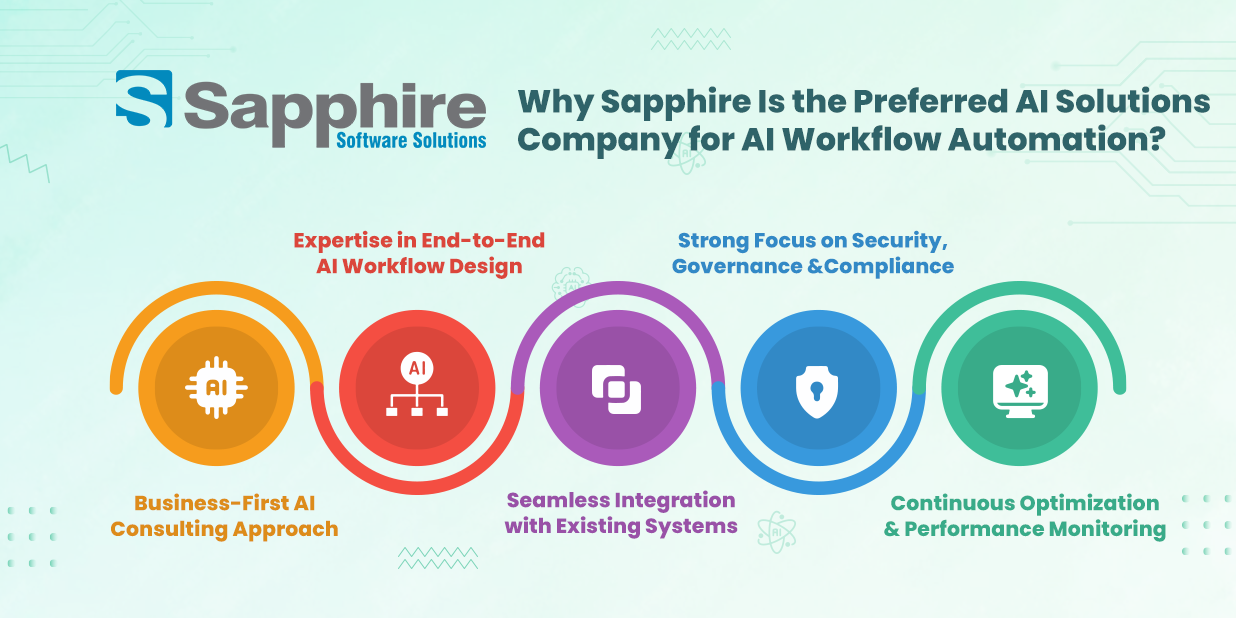
Sapphire has emerged as a reliable AI Solutions Company for organizations seeking to leverage intelligent, scalable, and result-oriented workflow automation using AI. The key to its success is not only in its technical delivery but also in ensuring that AI workflows are aligned with actual operational and business needs.
1. Business-First AI Consulting Approach:
Sapphire starts every project with a comprehensive discovery and consulting process. AI Consulting Company, it aims to understand existing workflows, pain points, data readiness, and tangible KPIs before suggesting any automation.
2. Expertise in End-to-End AI Workflow Design:
At Sapphire, complete Artificial Intelligence Workflows are designed, not just point automations. This end-to-end design ensures smooth integration between systems, teams, and processes, leading to intelligent, dynamic, and trustworthy workflows.
3. Seamless Integration with Existing Systems:
Sapphire’s AI workflows are designed to seamlessly integrate with existing systems such as CRMs, ERPs, cloud infrastructure, analytics software, and third-party APIs. This makes it possible to achieve enterprise-level automation as opposed to automating isolated tasks.
4. Strong Focus on Security, Governance, and Compliance:
Enterprise-level security is integrated into every Sapphire AI workflow. This includes implementing role-based access controls, audit trails, data encryption, and compliance checks to ensure that AI workflows are compliant with regulatory and governance standards from inception.
5. Continuous Optimization and Performance Monitoring:
AI workflows developed by Sapphire are dynamic. They are designed to learn from their performance outcomes and optimize over time through continuous monitoring and feedback loops.
Conclusion:
Artificial Intelligence Workflows are redefining how modern enterprises operate in 2026. From intelligent automation and predictive decision-making to real-time optimization and scalable operations, AI-powered workflows are transforming businesses from process-driven organizations into data-driven, self-optimizing enterprises. Companies that strategically implement AI workflow automation are not just improving efficiency—they are unlocking measurable ROI, accelerating innovation, reducing operational risk, and strengthening their competitive positioning in rapidly evolving markets.
For organizations ready to move beyond experimentation and implement AI at scale, partnering with an experienced AI Solutions Company is the critical next step. Sapphire Software Solutions empowers businesses to design, integrate, and continuously optimize end-to-end AI workflows aligned with real business goals. The future belongs to enterprises that act decisively—those who transform their workflows today will define industry leadership tomorrow.