
















Software innovation has become a core business strategy, influencing how organizations streamline operations, engage customers, and scale efficiently. What once functioned as a support layer now drives automation, decision-making, and competitive advantage. As market expectations continue to rise, businesses are under pressure to deliver faster, smarter, and more reliable digital solutions that can adapt to constant change.
The real challenge for modern enterprises is not whether to build applications, but how to develop them intelligently and sustainably. Outdated IT systems, rigid development models, high infrastructure costs, security concerns, and slow-release cycles limit growth and responsiveness. To overcome these barriers, organizations are increasingly adopting Artificial Intelligence Software Development Services to accelerate innovation, automate workflows, enhance data-driven insights, and deliver personalized user experiences at scale.
Professional software development partners enable this transformation by aligning technology with business objectives. Beyond building applications, they integrate AI, machine learning, cloud-native architecture, and secure system design into a unified development roadmap. For companies like Sapphire, leveraging AI-driven software development is a strategic move to build future-ready applications that deliver measurable business impact and long-term competitive advantage.
What is Artificial Intelligence (AI) in IT Services?
To comprehend the transition to professional app builders, the first thing we need to do is to define Artificial Intelligence (AI) in IT clearly. Artificial Intelligence (AI) in IT refers to smart systems in IT that enable machines to imitate human logic, AI to solve not only easy but also difficult problems, handle huge amounts of data, identify trends, forecast outcomes, and seamlessly merge with IT ecosystems with very little human intervention. In essence, this covers everything from automated infrastructure management to AI, powered application behavior, and backend intelligence.
Artificial Intelligence in IT is not one single technology concept. It is a layered stack that comprises:
- Machine Learning (ML) for making predictions
- Natural Language Processing (NLP) for enabling communication
- Computer Vision for understanding images and video
- Intelligent Automation for doing repetitive tasks
- Cloud-based AI services for scaling
- AI-driven APIs for software behavior
- AI model training and deployment frameworks
The purpose of AI in IT is to improve the IT systems, make them quicker, allow them to predict more, and diminish manual efforts.
How Artificial Intelligence is Shaping IT Services?
In many ways, the incorporation of AI in the IT field is already underway, and it seems that it won't take long for the full-scale implementation to be visible. AI has been used in many areas, from automation and predictive analytics to intelligent software development, and is still evolving and shaping the future of IT services.
The biggest ICT revolution that AI technologies bring in is:
1. Smarter Software Development:
AI is capable of creating, simplifying, optimizing, and even clarifying the code based on language instructions given by the user. This not only helps to shorten the development time and reduce human errors but also scales up the output of the developers.
2. Automation of IT Operations:
Most of the monotonous activities, such as ticketing, documentation, system logging, monitoring, backups, and maintenance, are automated, thus saving both time and manpower.
3. Real-Time Decision Systems:
One of the main features of AI, AI-powered dashboards, is that they show real-timely tics for sales, operations, and business intelligence, thereby enabling instant strategic decisions.
4. Predictive Infrastructure Management:
AI, AI-powered systems constantly monitor the environment to detect unusual situations that are unusual in the network, forecast the failure of the systems, optimize the use of cloud resources, and recommend the scaling of the servers, as well as issuing the alerts automatically.
5. Improved Customer Engagement:
24/7 engagement and personalized support can be achieved through AI, based chatbots, virtual agents, and AI sales assistant tools that are customer, friendly and friendly.
Key Benefits of AI in IT Services:
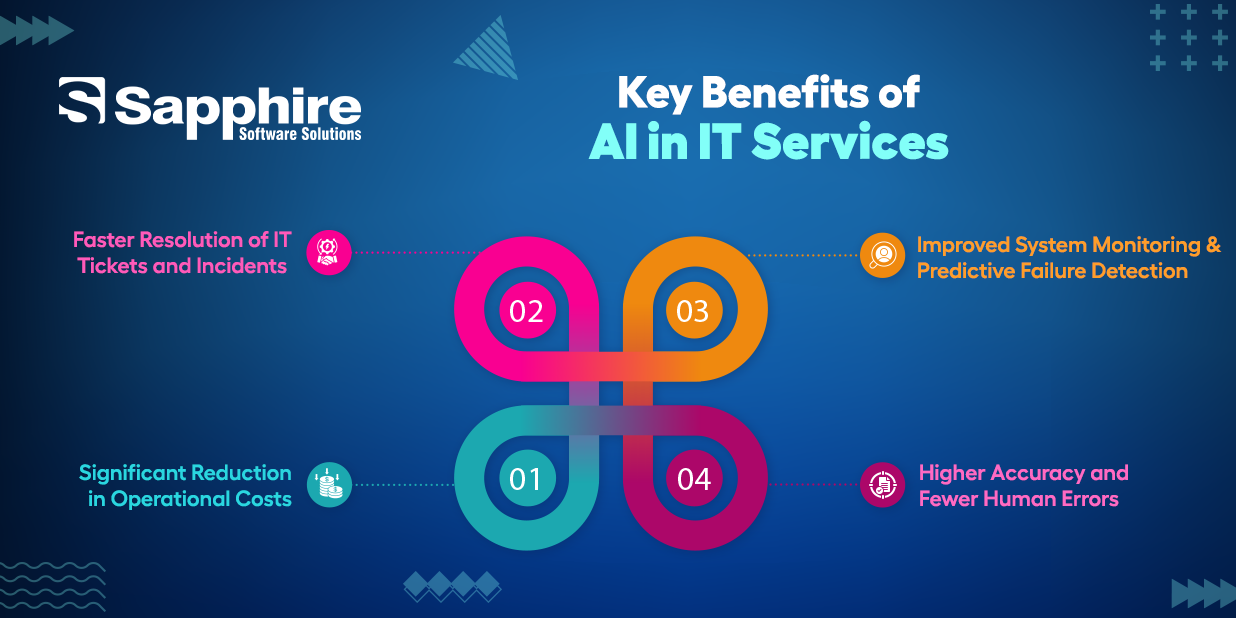
The integration of Artificial Intelligence in IT services has transformed the IT department from a cost center to a strategic enabler. Understanding this area clearly requires knowing the basics first: What is Artificial Intelligence in IT? Simply, AI in IT is about giving the systems the ability to analyze, automate, predict, and optimize the operations that were human supervision. This change is bringing tangible benefits to IT teams as well as to businesses.
1. Significant Reduction in Operational Costs:
One of the main ways by which AI cuts operational costs is the situation in which it reduces the need for an expensive infrastructure through automating various tedious tasks like monitoring, logging, backups, system diagnostics, and incident routing. These activities are taken care of by AI at scale, hence companies put less load on servers, manual labor hours, and long-term costs. It results in a direct reduction in IT operating expenditures, which means that the same level of services can be maintained for less money without being of lower quality.
2. Faster Resolution of IT Tickets and Incidents:
In a very short time, AAI-driven support agents can dissect error records, understand the nature of incidents, push tickets, and even draft fixes.
3. Improved System Monitoring and Predictive Failure Detection:
AI continuously watches system health, detects anomalies, predicts infrastructure failure, and triggers alerts before outages occur. This proactive approach reduces downtime, prevents escalation, and allows IT teams to fix issues early rather than firefight them after impact.
4. Higher Accuracy and Fewer Human Errors:
Manual IT operations often suffer from oversight, fatigue, or inconsistency. AI-driven workflows standardize processes, validate outputs, automate data entry, and eliminate many common operational errors, improving reliability across IT functions.
Custom AI Development Services for IT Companies:
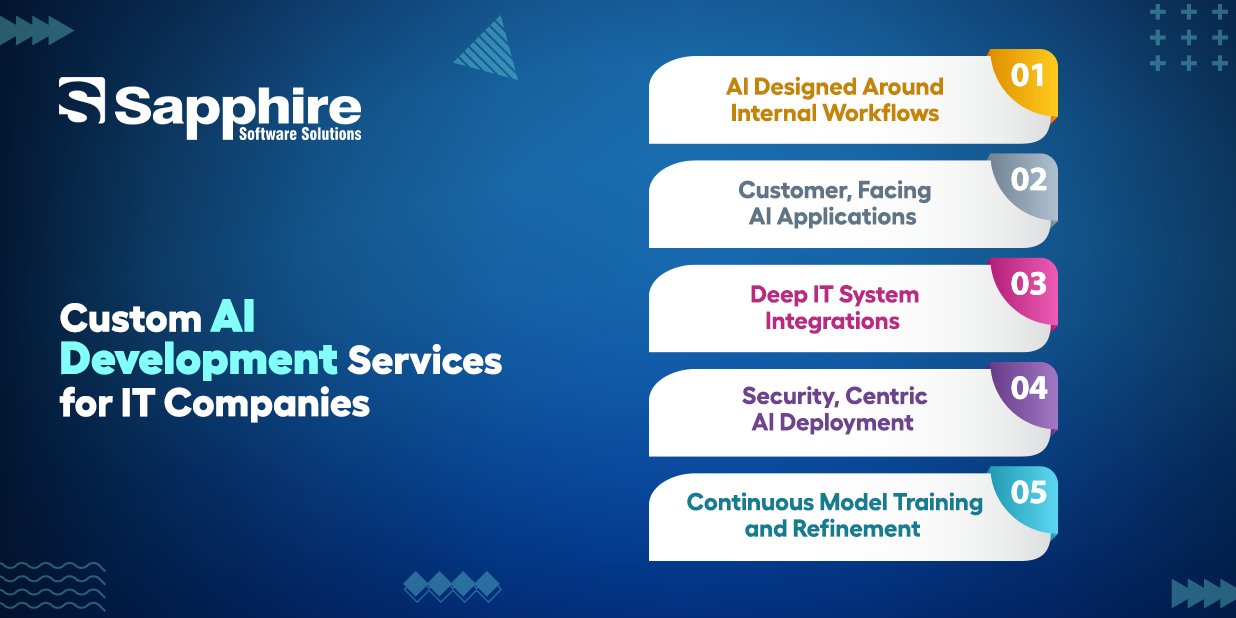
AI deployment is only really effective when the technology is integrated with actual business processes. In such a case, the services of AI software development and AI app development become indispensable.
1. AI Designed Around Internal Workflows:
Custom AI models are developed after a thorough analysis of the real IT operations, like ticket resolution cycles, DevOps handoffs, customer support behavior, documentation standards, compliance requirements, and internal communication flow. As a result, the AI is a reflection of the company’s actual working method.
2. Customer, Facing AI Applications:
Custom AI enables the creation of smart applications that can interact with users 24/7, providing conversation summaries, lead qualification, onboarding process automation, answering contextual questions, and human team delegation in case of escalation. These systems, by their nature, have the potential to enhance customer engagement and increase the conversion rate.
3. Deep IT System Integrations:
With custom AI, integration with CRM platforms, analytics engines, cloud infrastructure, helpdesk systems, payment modules, IoT dashboards, and internal knowledge bases becomes effortless. Consequently, it facilitates the sharing of intelligence in real life and time across different departments.
4. Security, Centric AI Deployment:
Usually, custom AI deployments are on, premise or private cloud environments with encrypted pipelines and governance guardrails. It is very important for data-sensitive industries like healthcare and fintech.
5. Continuous Model Training and Refinement:
AI is not static. Custom services include feedback loops, retraining real IT data, refinement based on conversion outcomes, workflow improvements, and regular accuracy upgrades.
Why AI is Essential for the Future of IT Services?
Artificial intelligence is rapidly evolving from a behind-the-scenes support function into a strategic capability for IT-driven organizations seeking speed, accuracy, and long-term visibility. Today, AI is no longer limited to basic automation; it is embedded across applications, infrastructure, security frameworks, and customer engagement platforms. Through Artificial Intelligence App Development Services, businesses can build intelligent systems that analyze data in real time, anticipate outcomes, and support informed decision-making across the enterprise.
One of the most significant advantages of modern, cloud-based platforms is scalability without the burden of heavy infrastructure ownership. When enhanced with AI, this scalability becomes predictive rather than reactive. AI-powered applications can identify unusual system behavior, forecast performance bottlenecks, and automatically recommend or trigger capacity adjustments—prevent disruptions before they impact operations. This level of intelligence enables organizations to maintain high availability and performance while optimizing costs and resources.
Why Sapphire is the Leading Artificial Intelligence Development Company for IT Services?
Sapphire Software Solutions has been consistently developing its image as a reliable Artificial Intelligence Development Company, especially among IT companies that require AI systems to be designed for a real operational effect, rather than just a surface-level automation. Many organizations put money into AI tools but have difficulties in associating these tools with measurable results because of deployment complexity, security requirements, integration depth, and model governance that local experienced engineering ownership to handle all these aspects. By integrating structured AI development expertise with a deep understanding of real-world IT systems, Sapphire is bridging this gap.
One of the main reasons that companies count on Sapphire is the company's ability of the company to carry out Artificial Intelligence in IT services via controlled, scalable, and secure deployments. When executives ask, "What is Artificial Intelligence in IT?", Sapphire makes sure the response is given through architecture, AI that can forecast failures, optimize infrastructure, enhance customer engagement, and automate IT workflows without internal teams getting overwhelmed. Their teams develop AI modules that can be seamlessly integrated into support desks, CRM environments, analytics engines, and private cloud ecosystems via encrypted pipelines, role-based access, audit trails, compliance, and first governance.
Conclusion:
As businesses continue to navigate rapid digital change, artificial intelligence has become a foundational capability rather than an experimental technology. Organizations that successfully adopt AI are not only improving operational efficiency but also gaining the agility, insight, and scalability required to compete in dynamic markets.
By leveraging Artificial Intelligence Integration Services, companies can seamlessly connect AI-driven intelligence with their current infrastructure, applications, and data ecosystems. This approach ensures faster adoption, reduced risk, and optimized performance without disrupting ongoing operations. At the same time, Artificial Intelligence Development Services enable businesses to build custom, future-ready solutions tailored to their unique goals—whether that means automation, predictive analytics, intelligent decision-making, or enhanced customer experiences.
For forward-thinking organizations, investing in AI is a strategic move toward long-term growth and innovation. Partnering with an experienced AI development provider allows businesses to move beyond experimentation and implement results-driven AI solutions that create sustainable competitive advantages. Now is the time to transform intelligence into impact and position your business for the next phase of digital leadership.