
















With AI dominating our digital destiny, the need for trust and transparency in AI systems has exploded. Today's businesses are no longer satisfied with merely the results AI delivers; they also need to know how those results arrived. This is where Explainable AI (XAI) steps in. Explainability is rapidly becoming an essential element in AI transformation strategies today since it will help demystify the black-box nature of advanced models. Transparency and interpretability in AI decisions can be achieved by organizations to maintain accountability, ensure ethical compliance, and boost user trust.
The motivations to integrate Explainable AI models into your digital strategy are numerous, ranging from regulatory needs to ethical AI deployment. In this blog, we will delve into why explainability cannot be an afterthought but a core pillar in any AI plan. We'll go in-depth into how Explainable AI in Finance, Healthcare, and Education is transforming decisions, the most important Explainable AI methods, and why collaborating with a Leading AI Development Company like Sapphire can be the game-changer.
What is Explainable AI (XAI)?
Explainable AI, abbreviated as XAI, is a collection of techniques and methodologies that render the outcomes and operations of machine learning algorithms comprehensible to humans. Unlike conventional AI systems that operate like black boxes—providing outputs without rationale—XAI guarantees that all the decisions taken by the AI are explainable in terms that humans can understand.
With the inclusion of Explainable AI models, organizations are able to track and decode the actions a model follows in order to arrive at a particular point. This is particularly important in high-risk sectors such as finance, healthcare, and law, where decisions have to be transparent and explainable.
One of the most popular uses of XAI is through Explainable AI Python libraries like LIME, SHAP, and ELI5. Data scientists use these extensively to understand complex models and present them in a meaningful way to stakeholders. Regardless of whether you're debugging an AI system or complying with regulatory requirements, XAI provides your models with transparency and trustworthiness to work in high-stakes environments.
Role of Explainable AI in Modern AI Transformation:
AI transformation is about more than embracing new technologies—introducing AI in ways that complement business values, ethics, and regulatory frameworks. This is where Explainable AI comes into play. XAI fills the gap between the potential of AI and its practical, reliable deployment.
Imagine implementing an AI system that assists with the approval of loans. Without explainability, customers and regulators could struggle to see why a specific applicant was rejected. With Explainable AI, stakeholders are able to break down the process of decision-making, making sure that it's unbiased and consistent with institutional guidelines.
Additionally, as businesses adopt AI across departments, from marketing to operations, stakeholders require greater transparency into how these smart systems work. Explainable AI for llm, for example, allows businesses to guarantee such models deliver insights that are both valuable and interpretable, reducing reputational and operational risks.
Key Benefits of Explainable AI for Businesses:
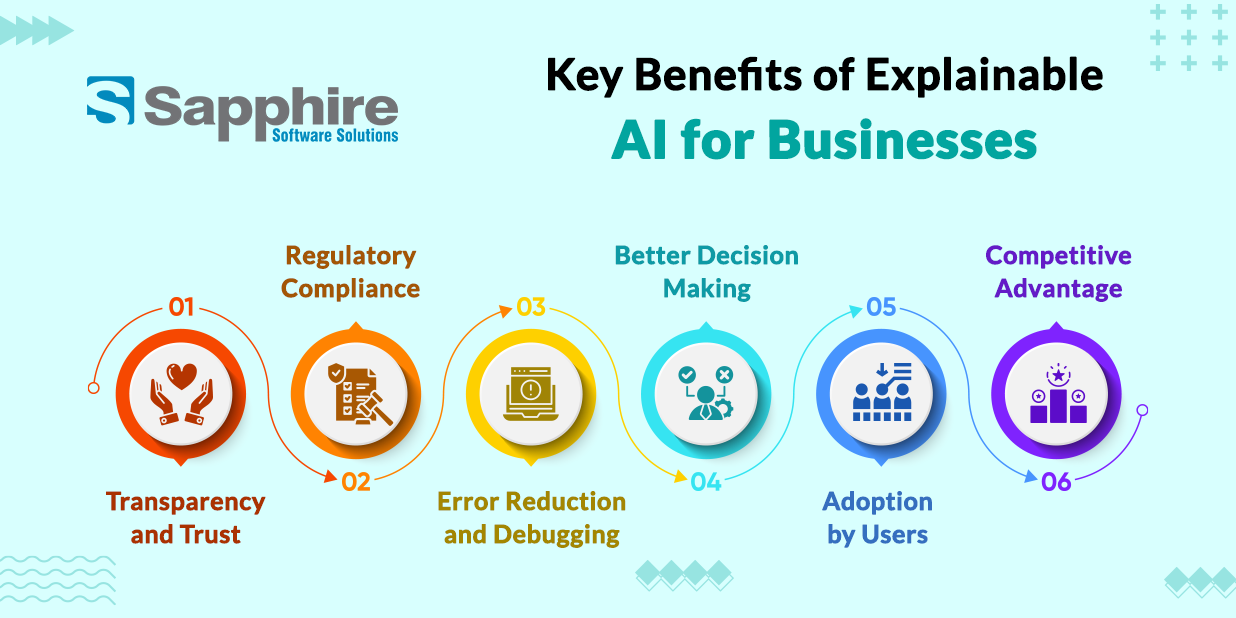
The use of Explainable AI yields several business benefits:
- Transparency and Trust: By demystifying AI decisions, companies are able to create increased trust with stakeholders, customers, and regulators.
- Regulatory Compliance: Numerous industries are currently bound by AI-related compliance requirements. Explainable AI XAI facilitates these requirements by logging model reasoning and explanations.
- Error Reduction and Debugging: Knowledge of how AI models come to decisions enables teams to identify and resolve biases or errors effectively.
- Better Decision-Making: With Explainable AI models, business organizations are able to better assess model suggestions, improving strategic planning.
- Adoption by Users: The workforce and customers are more inclined to trust and adopt AI tools if they know how they work.
- Competitive Advantage: Businesses embracing explainability have a positive reputation and are more responsive to regulatory updates and market demands.
With the use of Cost-Effective AI Development Services that specialize in XAI, a company's innovation, reputation, and customer loyalty can therefore be greatly enhanced.
Different Types of Explainable AI Models:
XAI models are of two general types:
- Intrinsic Explainability Models: These are interpretable models in and of themselves, such as decision trees, linear regressions, and rule-based models. These models are easier to understand but less capable of managing complex data.
- Post-hoc Explainability Techniques: These consist of tools and methods that explain complex models after the fact. These include LIME (Local Interpretable Model-Agnostic Explanations), SHAP (SHapley Additive exPlanations), and ELI5.
Sophisticated Explainable AI Python libraries, such as SHAP, are now used extensively to gain insights into black-box models such as neural networks or ensemble approaches. These libraries provide important scores for every feature, which enables teams to better interpret the contribution of every variable to the ultimate decision.
Understanding which model type to implement is based on your application, compliance requirements, and the nature of the data is important. Most Explainable AI Startups nowadays are providing new solutions specific to certain industries, so XAI is more easily accessible than ever before.
How Explainable AI is Transforming Key Industries: Finance, Healthcare and Education:-
Explainable AI in Finance:
In finance, AI technology is applied to all sorts of processes, ranging from credit assessment to fraud detection and algorithmic trading. But without transparency, they have significant issues with trust and compliance.
Explainable AI in Finance allows institutions to verify AI-driven decisions, for instance, the reason a customer received or was denied a loan. Regulation also demands that decisions affecting individuals be explained and fair. XAI enables financial companies to comply with these requirements while also enhancing internal auditing and model debugging.
Firms using explainability have a better chance of passing audits and mitigating litigation threats, so XAI is a forward-thinking investment to ensure long-term fiscal security.
Explainable AI in Healthcare:
The health sector relies on AI largely for diagnosis, suggesting treatment, and tracking patients. However, trusting these systems is only feasible when physicians and patients know how AI arrives at a decision.
Explainable AI in Healthcare deepens this trust. For example, when an AI system suggests a treatment pathway, physicians can look at the explainable output to find out why it is most appropriate for the patient. This improves communication between physicians and patients, minimizes liability risks, and results in improved clinical outcomes. Explainability is also essential during medical professional training, where XAI insights can act as rich learning tools.
Explainable AI in Education:
In schools, AI assists in individualizing learning trajectories, grading assignments, and even the identification of at-risk students. But students and teachers must know how these systems assess performance and predict.
Explainable AI in Education enables teachers to rely on AI-driven suggestions and change their approach to teaching based on those. For example, if a student is identified as requiring special assistance, explainable results can show whether it was due to activity metrics, test results, or attendance. Transparency in education AI also leads to trust from parents, regulatory bodies, and organizations that the technology is being used ethically to mold the next generation.
Top Explainable AI Techniques Every Business Should Know:
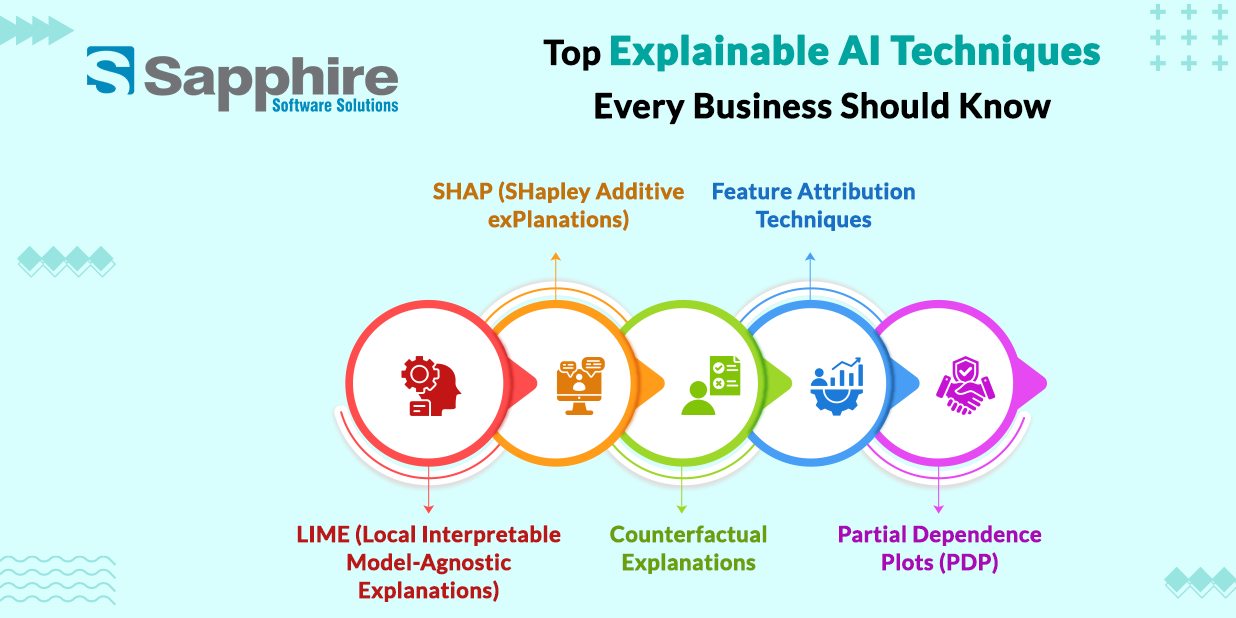
Some of the best Explainable AI XAI methods companies should implement are as follows:
- LIME (Local Interpretable Model-Agnostic Explanations): Explains black-box model predictions locally for single predictions.
- SHAP (SHapley Additive exPlanations): Produces a consistent, theory-backed feature of importance.
- Counterfactual Explanations: Demonstrates how altering input values might have produced other results.
- Feature Attribution Techniques: Techniques such as permutation importance assist with determining feature importance.
- Partial Dependence Plots (PDP): Display how input features relate to predictions.
These libraries are natively supported across Explainable AI Python environments and aid in filling the technical chasm between data science teams and stakeholders without technical expertise.
Why Sapphire is Your Top AI Development Company for Explainable AI Solutions?
At Sapphire Software Solutions, we recognize that effective AI change doesn't end at precision—it must also be explainable, ethical, and reliable. That's why we incorporate Explainable AI at the center of every project we undertake.
Whether you’re a financial institution needing regulatory-compliant models or a healthcare provider requiring transparent diagnostic systems, our team of seasoned experts delivers customized Affordable AI Development Services that meet your industry’s unique needs. As a Top AI Development Company, Sapphire employs the most advanced Explainable AI XAI techniques and tools like SHAP, LIME, and ELI5, ensuring clarity at every stage of AI deployment.
From building sector-specific Explainable AI models to embedding explainability in mass deployments, Sapphire is your go-to responsible AI adoption partner.
Conclusion:
As AI continues to transform all aspects of business and day-to-day life, explainability has become an indispensable pillar of ethical, efficient, and scalable AI adoption. From facilitating trust and compliance to enhancing internal functions, the benefits of Explainable AI are numerous.
By utilizing tools such as Explainable AI Python libraries, using sophisticated Explainable AI xai methods, and incorporating customized Explainable AI models, companies can future-proof their AI initiatives and be competitive.
Whether you're starting your AI journey or want to upgrade your existing systems, prioritize explainability as one of the fundamental pillars of your AI transformation. And when you're ready to make that happen, team up with a Top AI Development Firm like Sapphire that has domain expertise, technical expertise, and a true passion for responsible innovation.