

















Artificial Intelligence is transforming the way businesses operate, compete, and grow, creating opportunities for faster decision-making, leaner operations, and innovative products that were previously unimaginable. Teams leveraging AI can streamline processes that once required large analyst teams, accelerate product development, and gain deeper insights from data. However, the real game-changer comes when organizations integrate sustainability into their AI strategy. Companies that address energy efficiency, infrastructure optimization, and regulatory compliance early not only reduce their environmental impact but also unlock cost savings, improve scalability, and strengthen their long-term business resilience.
Equally important is the role of AI in driving sustainable development. Intelligent systems are now being used to optimize energy grids, reduce waste in manufacturing, and support cleaner, smarter cities, turning AI into a force for environmental solutions. Businesses adopting eco-conscious AI solutions today position themselves as innovators who balance performance, responsibility, and efficiency. By partnering with top-tier AI development providers, companies can build systems designed for sustainability from the start, ensuring operational excellence, regulatory readiness, and measurable environmental impact—all while future-proofing their growth in a rapidly evolving market.
Why Sustainable AI Development Is the Next Big Opportunity for Businesses?
Sustainability is no longer a trend - it's a business necessity. Strip away the ethical framing entirely,y and what you're left with is still a strong commercial argument for sustainable AI development. Let me walk through why.
Reducing Operational Costs Through Efficiency:
I've talked to enough engineering teams to know that AI infrastructure costs have a way of quietly becoming everyone's problem eventually. Compute overruns, bloated models that nobody wants to touch, cloud bills that grew faster than the systems justified - it's common. Sustainable AI addresses this by forcing better design decisions earlier: leaner architectures, smarter resource allocation, and training cycles that aren't running longer than they need to.
Improving ESG Compliance and Investor Trust:
ESG has moved from feel-good reporting to actual due diligence criteria. When investors ask about environmental practices now, they want specifics, not statements. Organizations implementing AI for sustainable development can provide those specifics, and the credibility that comes with it shows up in valuations and investor relationships in ways that are concrete and measurable.
Competitive Advantage and Brand Leadership:
Customers are more attuned to the gap between what companies say and what they do than most marketing teams account for. Sustainable AI is an operational choice that's visible and verifiable - and that's exactly the kind of evidence that builds real brand loyalty rather than borrowed goodwill.
Preparing for Future Regulations:
The regulatory trajectory around technology's environmental impact isn't ambiguous. It's tightening. Organizations with sustainable AI development already embedded in their operations are going to experience upcoming compliance requirements very differently from those who wait.
Creating New Innovation Opportunities:
Sustainability has become its own product category. Carbon tracking, energy optimization, real-time environmental monitoring - tools like Greenlight AI and greenhouse AI are proof that there's genuine market demand here, not just internal necessity.
Why Businesses Can't Ignore Sustainable AI Development?
Look, I get it. When there are immediate targets to hit and roadmaps to execute, sustainability can feel like a conversation for next quarter. But next quarter keeps arriving, and the cost of delay compounds.
Energy costs are genuinely hurting organizations running inefficient AI right now - not hypothetically, right now. Sustainable AI development addresses this through design decisions that should have been defaults from the beginning.
Regulatory requirements are being written and finalized in major markets as you read this. The organizations building compliance into their AI foundations today are going to be in a fundamentally different position than those who retrofit it later under deadline pressure.
Customer behaviour around sustainability is documented and directional — it's moving one way, and it's not reversing. Businesses implementing sustainable AI solutions benefit from that movement. Those who don't will eventually need to account for why.
How AI Can Help Sustainability Across Industries?
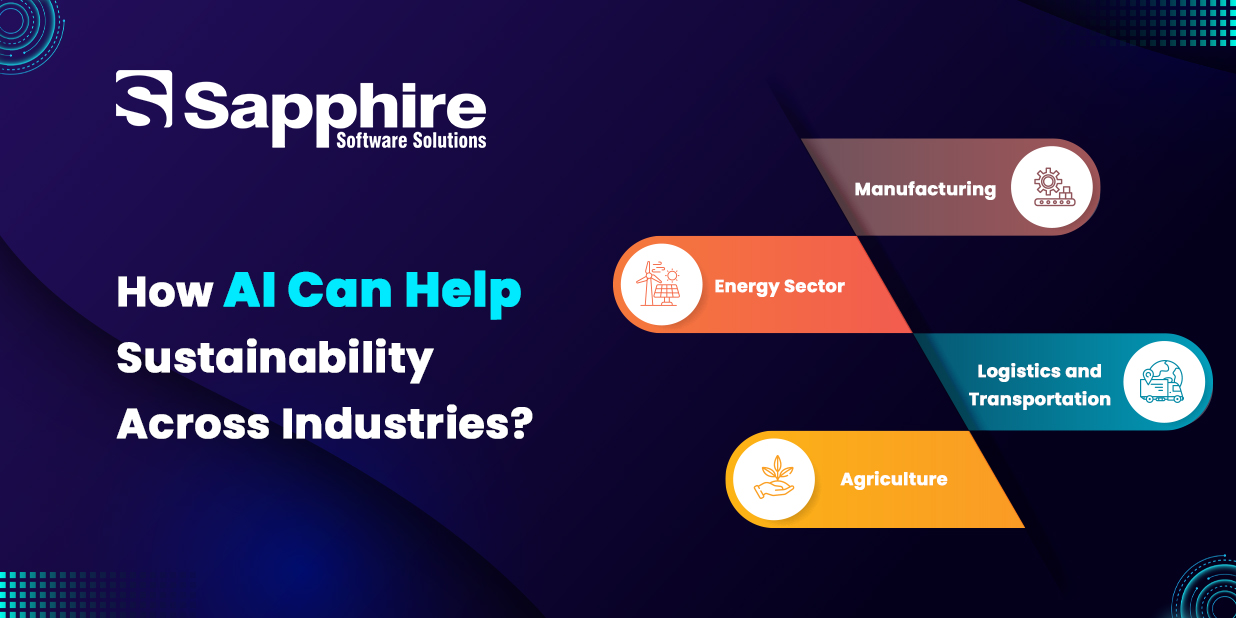
People ask how can AI help sustainability and sometimes expect a theoretical answer. What I prefer to give is a concrete one, because the applications are specific enough to deserve specificity.
Manufacturing:
Real-time energy optimization adjusts consumption to actual production demands rather than worst-case assumptions. These are AI for sustainable development applications running in real facilities, producing documented savings.
Energy Sector:
It is where AI is doing something genuinely important for the clean energy transition — making renewable sources more predictable and economically viable through better forecasting and smarter grid management. That's not incremental improvement; it's infrastructure-level impact.
Logistics and Transportation:
Small efficiency gains per vehicle across large fleets add up to meaningful fuel savings and emissions reductions - and they show up in both the environmental report and the operating budget.
Agriculture:
This is a sector where sustainable AI development solves environmental and economic problems simultaneously. Precision tools help farmers apply inputs exactly where needed, reducing waste and cost while maintaining or improving yields.
What are the Sustainable AI Environmental Implications, Challenges, and Opportunities?
1. Environmental Implications of AI:
- AI systems, especially large models, consume massive amounts of electricity.
- Data centers powering AI emit significant greenhouse gases if powered by fossil fuels.
- Manufacturing AI hardware (GPUs, TPUs) relies on rare materials, water, and energy.
- Short hardware lifecycles contribute to electronic waste.
- AI can indirectly help the environment by optimizing energy use and monitoring ecosystems.
2. Challenges in Achieving Sustainable AI:
- High energy demand for training and deploying advanced AI models.
- Lack of transparency in measuring AI’s carbon footprint.
- Dependence on centralized, resource-heavy data centers.
- Balancing performance and sustainability often conflicts with commercial goals.
- Absence of global standards for environmentally responsible AI.
3. Opportunities for Sustainable AI:
- Developing energy-efficient AI models through techniques like pruning or quantization.
- Using AI to tackle environmental problems: climate prediction, renewable energy optimization, and biodiversity monitoring.
- Green data centers powered by renewable energy with efficient cooling systems.
- Extending hardware lifecycle and promoting recycling to reduce e-waste.
- Policy-driven incentives and regulations encouraging carbon-conscious AI development.
Implementation Roadmap for Sustainable AI in Organizations:
Sustainable AI development needs more than intention - it needs a sequence that works.
Start with a genuinely honest audit. Not a presentation-ready version - a working one. Where are inefficiencies living? Where is energy being consumed without proportional value? Where are quick wins available without rebuilding everything?
- Work on model optimization next: Leaner architectures, reduced complexity, and overhead that's eliminated rather than carried indefinitely.
- Make deliberate infrastructure decisions: Matching environments and hardware to real workload demands rather than defaulting to whatever's easiest to provision.
Treat monitoring as ongoing work, not a launch milestone.
Tools like Greenlight AI and Greenhouse AI provide continuous visibility that catches problems before they become structural costs. And choose your partner based on demonstrated capability. The Best AI Development Services provider has done this before and can do it correctly from the start.
Choosing the Best AI Development Services for Sustainable AI:
Choosing the right AI development partner is like picking a co-pilot for a long journey—every choice they make affects the path ahead. The best AI service providers don’t just focus on speed or performance; they think about sustainability from day one. They design energy-efficient models, suggest infrastructure powered by renewable sources, and implement processes that minimize waste. This approach means your AI systems are not only faster and smarter but also kinder to the planet, balancing innovation with responsibility in a way that pays off over the long run.
Beyond the environmental benefits, sustainable AI services also make business sense. Optimized models reduce electricity costs, smart infrastructure lowers maintenance needs, and careful planning allows systems to scale without ballooning energy use. Working with a partner who values sustainability transforms abstract ideals into tangible results: measurable carbon reductions, cost savings, and AI solutions that can grow responsibly. In today’s world, choosing such a partner isn’t just good for the planet—it’s a strategic decision that shapes resilient, efficient, and future-ready AI for years to come.
How Can an AI Solutions Company Like Sapphire Drive Sustainable AI Development?
Sapphire Software Solutions works as a specialized AI Solutions Company that treats sustainable AI solutions as core engineering work rather than a positioning statement. From model development through infrastructure design and optimization, Sapphire brings the expertise to make AI for sustainable development show up in actual metrics - energy consumption, efficiency benchmarks, and operational cost reductions. Things you can measure and report on with confidence.
Conclusion:
AI is genuinely transformative - I believe that without reservation. What I also believe is that the way most organizations are currently building it isn't sustainable over any honest time horizon, and that gap between current practice and responsible practice is where a significant competitive opportunity is sitting right now.
Businesses committing to sustainable AI development are building something that holds up: systems that perform, cost structures that make sense over time, regulatory positions that don't require emergency fixes, and reputations built on what they do rather than what they say. Sustainable AI solutions are a present competitive advantage, and the organizations treating them that way is widening a lead that will be difficult to close later. The Best AI Development Services provider is where that work begins. Request a free quote today.