
















Quantum computing, a theoretical physics concept not long ago, is quickly becoming a force of disruption within the tech sector. Though still in its early days, tech holds the promise of computational strength vastly greater than that of traditional systems, and it's on its way to changing everything from cryptography to AI. For IT specialists and software developers, learning about the impact of quantum computing is no longer a choice—it's becoming a requirement. As industries start searching and incorporating quantum solutions, fundamental changes are already emerging in how we conceptualize algorithms, speed of processing, security, and even software design.
The emergence of Quantum Computing Languages, the development of Quantum Computing Encryption, and growing demand for talented Quantum Computing Engineers highlight a revolutionary shift in the IT environment. At the same time, conceptual models such as the Quantum Computing Multiverse are expanding the limits of what is achievable, challenging innovators to rethink how information can be processed and used.
This blog goes in-depth into the newly rising impact of quantum computing on IT solutions and software development, giving an overall idea about existing trends and prospects. We'll also see how industry giants such as Sapphire are positioning themselves with this revolutionary technology to offer next-generation solutions.
How Quantum Computing Languages Are Shaping the Future of IT Software Development?
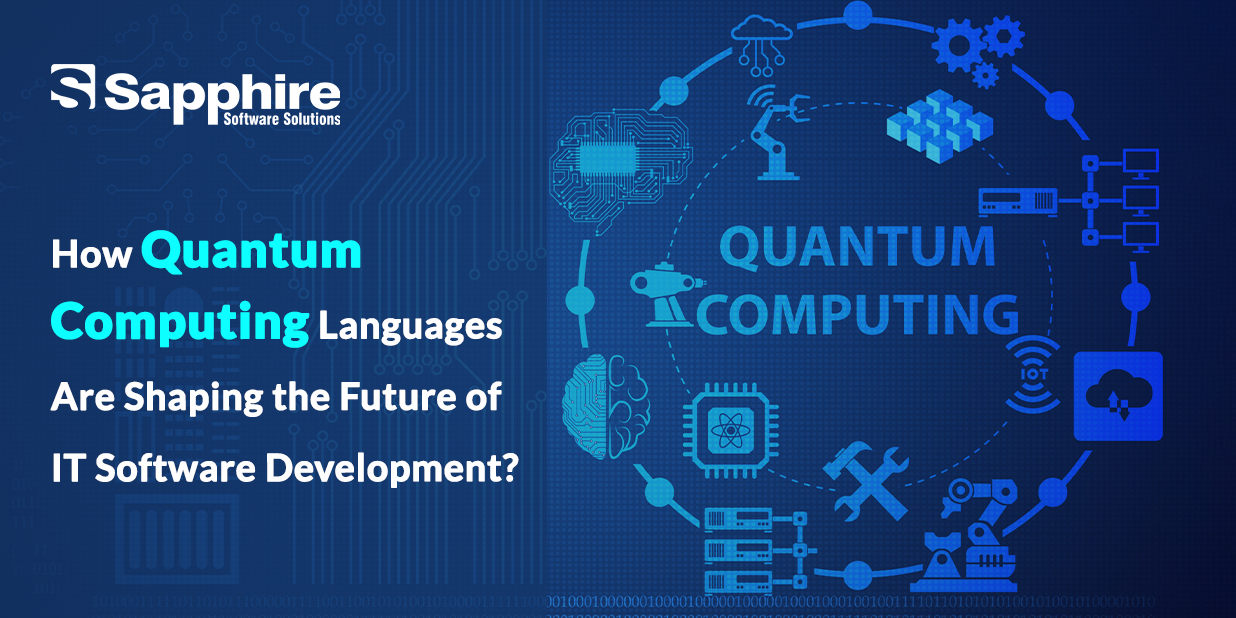
With quantum computers picking up steam, standard programming languages are found wanting in response to the special needs of quantum logic. Step into Quantum Computing Languages like Q#, Qiskit, Cirq, and Quipper—each to support quantum algorithm development and execution.
In contrast to traditional languages, which handle data sequentially, quantum languages are required to operate with qubits that are in more than one state at the same time (superposition). Quantum languages enable programmers to utilize quantum effects of entanglement and interference, essential for creating complicated quantum algorithms. For example, Microsoft's Q# offers complete integration with Visual Studio, making it easy to simulate quantum behavior on classical computers.
For software development in IT, this transformation requires developers to align their skill sets to leverage hybrid architectures that combine classical and quantum processors. It also redefines optimization, machine learning, and problem-solving capabilities, paving the way for new insights in areas such as logistics, pharmaceuticals, and financial modeling.
In short, Quantum Computing Languages are more than a new addition to the developer's toolbox—they're setting the stage for an entire paradigm shift in software conception, design, and implementation.
Quantum Computing Encryption: A Game-Changer for IT Security Solutions
- Easily one of the most revolutionary applications of quantum computers is in the field of cybersecurity. Traditional encryption algorithms like RSA and ECC depend on the difficulty of mathematical problems like discrete logarithms or prime factorization—problems that are nearly impossible to break with traditional computers within a finite time. Quantum computers, on the other hand, exploiting their superposition and entanglement capabilities to process exponential amounts of data in parallel, can break these problems exponentially quicker.
- This ability has fueled a critical drive towards Quantum Computing Encryption, or better still, post-quantum cryptography (PQC). These are future-proof cryptographic approaches designed to be immune to both classical and quantum attacks. Methods like lattice-based cryptography, code-based algorithms, and multivariate polynomial cryptosystems are emerging as top contenders.
- One of the more revolutionary uses is Quantum Key Distribution (QKD). In contrast to classical methods, QKD employs quantum particles such as photons to send keys in an information-theoretically provably secure manner under physics. Any interception attempt disturbs the quantum state of the particle and alerts the parties to a possible compromise. It completely redefines the handling of secure communications to make data interception essentially out of the question.
- For sectors such as defense, banking, and healthcare, where a breach of data can have disastrous consequences, adopting Quantum Computing Encryption provides a forward-thinking layer of security far beyond the reach of existing capabilities. Companies are now investing in hybrid systems that blend classical and quantum-safe algorithms for the purpose of easy transition and compatibility.
- With the nature of cyber threats ever-changing, Quantum Computing Encryption is not a hypothetical phenomenon—it's becoming increasingly a requirement for businesses seeking to protect proprietary data in the post-quantum future. The earlier companies start to transition their IT infrastructure to implement quantum-resilient solutions, the better equipped they will be to weather the next generation of cyber threats.
Role of a Quantum Computing Engineer in Driving IT Innovation and Growth:-
With the growing need for quantum applications, the work of a Quantum Computing Engineer has become pivotal in closing the gap between theory and actual IT applications. These engineers have a unique mix of expertise in quantum physics, algorithm design, software development, and system integration.
One of the main duties of a Quantum Computing Engineer is to design useful applications for sectors like finance, healthcare, logistics, and cybersecurity. For example, in finance, they design quantum algorithms that significantly enhance risk analysis and portfolio optimization. In pharmaceuticals, they design simulations to hasten drug discovery by simulating molecular interactions at a quantum level—something classical computers can hardly do with precision and speed.
Additionally, these engineers lead quantum-cloud fusion. As the big tech firms of IBM, Google, and Microsoft provide quantum computing via the cloud, engineers need to create hybrid solutions that can seamlessly execute on both conventional infrastructure and quantum hardware.
Their work also involves team mentoring and training, open-source quantum contribution, and influencing the organizational quantum adoption strategic roadmap. With quantum computing transitioning from research environments to enterprises, the need for professional engineers will only increase.
Exploring Quantum Computing Multiverse Concepts to Unlock New IT Business Models:-
The idea of the Quantum Computing Multiverse can seem like science fiction, but it has a basis in actual quantum phenomena like superposition and entanglement. A quantum multiverse model simply means that a quantum computer has the power to search for a lot of possible solutions to a problem simultaneously. Contrary to linear computational logic in classical computers, quantum systems compare a large set of parallel possibilities, resulting in more efficient, broader decision-making.
From a business IT perspective, this presents completely new possibilities. Consider logistics and supply chain management. Conventional systems could take hours to optimize and route scenarios. Multiverse simulations in a quantum-based model could accomplish the same thing in seconds by considering all possible paths simultaneously. This is not only about speed; it's about being competitive through real-time data-driven decisions.
A second compelling application is financial modeling. Banks or investment companies might utilize quantum multiverse simulations to analyze multiple market scenarios simultaneously. This provides richer risk assessment and better-informed strategy formulation, cutting uncertainty dramatically. Likewise, in medicine, quantum simulation might assist in modeling the effectiveness of different drug combinations on different genetic profiles, driving breakthroughs in personalized medicine.
To the tech entrepreneurs and IT executives, accepting the Quantum Computing Multiverse means having the capability to design prescriptive systems that can anticipate and prepare for multiple possible futures, rather than react to them. This model of anticipatory computing lays the groundwork for a transition from reactive analytics to forward-thinking business intelligence.
Though wholesale implementation remains in the future, the underlying theories and initial prototypes portend a future where IT solutions will be exponentially more dynamic, adaptive, and personalized—albeit due to quantum multiverse thinking.
How Sapphire is Positioning Itself as a Leading Quantum Computing Company for IT Solutions?
With quantum computing as a game-changing technology, Sapphire Software Solutions is strategically innovating to be at the forefront of Quantum Computing Company players. From its core competencies in cloud, cybersecurity, and R&D, Sapphire is actively incorporating quantum capabilities into its core services to enable its clients to tackle the impending quantum disruption.
Another central aspect of Sapphire's strategy is its smart operations approach. Sapphire's business process services now incorporate cutting-edge technologies—AI, distributed ledgers, and core quantum computing practices—into their cloud-first architecture. This allows the company to provide hybrid solutions that merge classical IT systems flawlessly with quantum-augmented modules, paving the way for future-proof, scalable IT transformation.
Sapphire is another highlight that led to cybersecurity. With its collaboration with Check Point, Sapphire unifies enterprise-class solutions, such as quantum-ready defenses that are designed to protect IoT and operational technology environments collaboration stands out as Sapphire's proactive strategy for dealing with quantum attacks and its ability to design security architectures that are both resilient against classical and quantum attacks.
Furthermore, Sapphire is also playing a crucial role in cloud modernization. Their "Cloud First" strategy puts innovation, speed, and security first, preparing the foundation for quantum-capable services presented through cloud platforms by developing quantum-ready cloud frameworks. Sapphire is preparing customers for workloads that can be accelerated by quantum.
In essence, Sapphire is not merely a Quantum Computing Company by name—it creates the architecture, talent, and partnerships that will position it to dominate quantum-powered IT solutions. Their comprehensive vision is putting them at the vanguard of industry change, providing clients with a paved road into quantum-led innovation.
Conclusion:
The effect of quantum computing on software development and IT solutions is not some far-off dream—it's a nascent reality that's already starting to transform the tech scene. Companies that do not evolve will soon be left in the dust. Quantum computers will surpass classical systems when it comes to processing issues involving enormous data sets, intricate simulations, and predictive modeling. This has severe ramifications for industries such as finance, logistics, pharmaceuticals, cybersecurity, and many others.
Firms like Sapphire Software Solutions, which are already investing in quantum R&D, collaborations, and hybrid infrastructures, are setting themselves up as leaders in the industry. Moving forward on quantum computing now, they're outfitting clients with the solutions and expertise they need to succeed tomorrow.
In short, quantum computing is not so much a technology leap—it's a paradigm shift. The time to acquire knowledge, prepare, and innovate is now. Because in the quantum age, the early birds won't only survive—they'll be leading.